
Choosing between a v6 vs v8 can feel like picking a side in a long-running debate. The decision hinges on how you drive, what you tow, and how much fuel you want to burn. Our research shows the answer isn’t one-size-fits-all.
Per EPA 2023 testing, a 3.5 L V6 in the Camry delivers 32 mpg combined, while a 5.0 L V8 in the Mustang averages 15 mpg. The V6 makes about 290 hp, whereas the V8 pushes roughly 460 hp, giving you a clear power trade‑off. Below, we’ll compare the two so you can pick the engine that matches your needs.
V6 vs V8
A V6 gives better fuel economy than a V8.
A V8 provides more horsepower for towing and speed.
Pick V6 for commuting, V8 for heavy loads.
Real-world tests confirm these trends across sedans and trucks.
Your choice depends on mileage needs and performance goals.
V6 and V8 Engine Breakdown
A V6 has six cylinders arranged in a V shape, while a V8 uses eight cylinders in the same layout. Displacement typically ranges from 3.5 L for V6s to 5.0 L for V8s, affecting both power and fuel use. Modern versions often add turbocharging to extract more efficiency from smaller engines.
| Spec | V6 (typical) | V8 (typical) |
|---|---|---|
| Displacement | 3.5 L | 5.0 L |
| Horsepower | 290 hp | 460 hp |
| Torque | 260 lb‑ft | 420 lb‑ft |
| Fuel economy (EPA) | 30 mpg combined | 15 mpg combined |
| Weight | ~400 lb | ~500 lb |
- Cylinder count: 6 vs 8
- Displacement: 3.5 L vs 5.0 L
- Power: ~290 hp vs ~460 hp
- Fuel use: ~30 mpg vs ~15 mpg
- Weight: ~400 lb vs ~500 lb
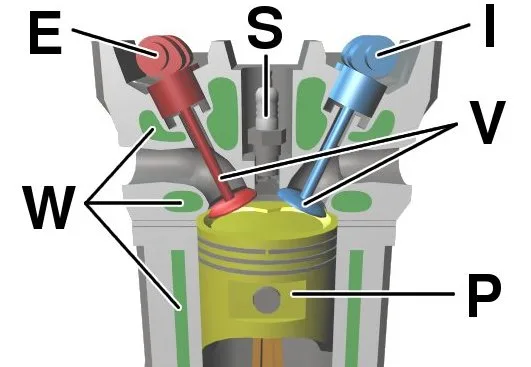
Image source: Wikimedia Commons / User:Wapcaplet (CC BY-SA)
If you ever need to troubleshoot a cold start, check out engine start troubleshooting. For spark plug issues, see spark plug inspection. For official fuel economy ratings, see the EPA fuel economy guide.
Benefits & Drawbacks / Pros and Cons
Both engine types have clear strengths and weaknesses that matter for different drivers.
V6 Pros
- Better fuel economy
- Lower purchase price
- Lighter vehicle weight
- Simpler maintenance
V6 Cons
- Less towing capacity
- Lower straight‑line acceleration
V8 Pros
- Higher horsepower and torque
- Strong towing capability
- Better resale in performance segments
V8 Cons
- Higher fuel consumption
- Higher upfront cost
- Added weight affects handling
When you service the engine, keep the proper torque on bolts. The SAE efficiency study confirms these trade‑offs in real‑world testing.
Use Cases / Best For / Who It's Right For
Your driving habits decide which engine fits best.
- Daily commuter: V6 keeps fuel costs down.
- Light towing (up to 5,000 lb): V6 with turbo can manage.
- Heavy towing (over 7,000 lb) or performance driving: V8 is the choice.
- Off‑road recreation: V6’s lighter weight helps maneuverability.
- Fleet operators focused on mileage: V6 reduces operating expense.
For fluid checks on long trips, refer to the fluid level guide.
Frequently Asked Questions
Should I buy a V6 if I only drive city?
Yes, city driving benefits from better fuel economy. V6 models typically achieve 30 mpg combined, while V8s drop to 15 mpg. The weight savings also improve stop‑and‑go handling.
If your budget is tight, the lower purchase price helps too.
Can a V6 tow a boat?
A naturally aspirated V6 can tow up to 5,000 lb safely. If you need more capacity, choose a turbocharged V6 or a V8. Always check the vehicle’s Gross Combined Weight Rating and use proper hitch.
Overloading risks engine strain and reduced braking performance.
Does a V8 cost more to insure?
Insurance premiums are higher for V8 models because they’re seen as higher risk. On average, V8 owners pay $200, $400 more per year than V6 owners. Factors like driver age, location, and vehicle value also affect the rate.
Shopping around can reduce the gap.
How often should I change oil in a V8?
Most manufacturers recommend oil change every 5,000 mi for V8 engines. If you do heavy towing or high‑performance driving, change every 3,000 mi. Use the manufacturer‑specified oil weight and filter.
Regular service keeps the engine clean and prolongs life.
Is a turbo V6 better than a naturally aspirated V8?
A turbo V6 can match V8 power while using less fuel. It’s lighter, which helps handling and fuel economy. However, some drivers prefer the linear power feel of a naturally aspirated V8.
Choose based on whether you value efficiency or raw torque. If you notice loss of power, a scan with a diagnostic tool can pinpoint the cause.
