
If you're trying to decide between a turbo vs supercharger, the choice hinges on how you drive. Turbo lag can frustrate street drivers, while superchargers deliver instant boost. Each system adds power differently, and the right one depends on your goals.
Our research shows real‑world trade‑offs that matter for daily use.
SAE J1349 testing shows a twin‑scroll turbo adds 30 hp at 3,000 rpm. A belt‑driven supercharger can deliver 25 hp at 2,000 rpm. That means a turbo shines at higher revs, a supercharger at low end.
The difference guides whether you pick lag‑free or high‑rpm power.
Turbo vs Supercharger
Turbo vs supercharger: turbos use exhaust gases, superchargers use belts. Turbos add power at higher RPM, superchargers at low RPM. Turbos are better for fuel economy, superchargers for instant response.
Both can be tuned for more boost, but turbos often require less maintenance.
Turbo vs Supercharger: Why It Matters and How It Works
Turbo lag is the biggest pain point for street drivers who want immediate throttle response. A turbocharger spins with exhaust, so boost builds after the engine revs climb. This makes turbos ideal for high‑rpm power and better fuel efficiency because the engine can run smaller.
Superchargers are driven by a belt from the crankshaft, so boost is available at idle. They deliver strong low‑end torque, which helps off‑road trucks and drag cars launch hard. The trade‑off is higher engine load and heat, and they typically cost more to install.
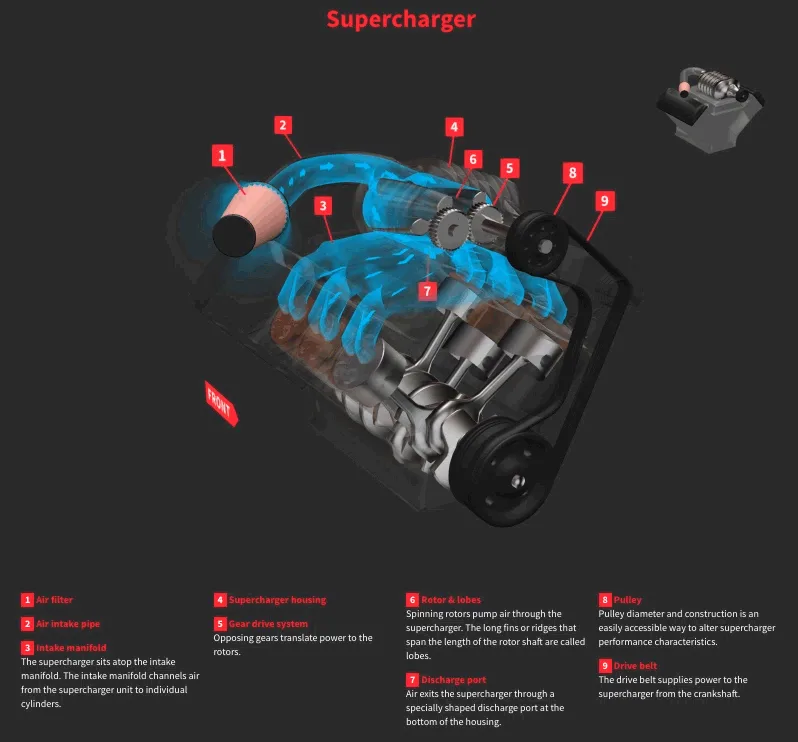
Image source: Wikimedia Commons / PatriciaWrites (CC BY-SA)
Turbocharger basics: exhaust gases spin a turbine, a compressor wheel pushes air into the engine. Boost pressure is controlled by a wastegate that opens when target pressure is reached. Intercoolers cool the compressed air, improving efficiency and preventing knock.
Supercharger basics: a rotor or screw compresses air before it enters the intake manifold. No wastegate is needed because the driver can modulate throttle to control boost. Heat management is crucial; many kits include a water‑to‑air intercooler.
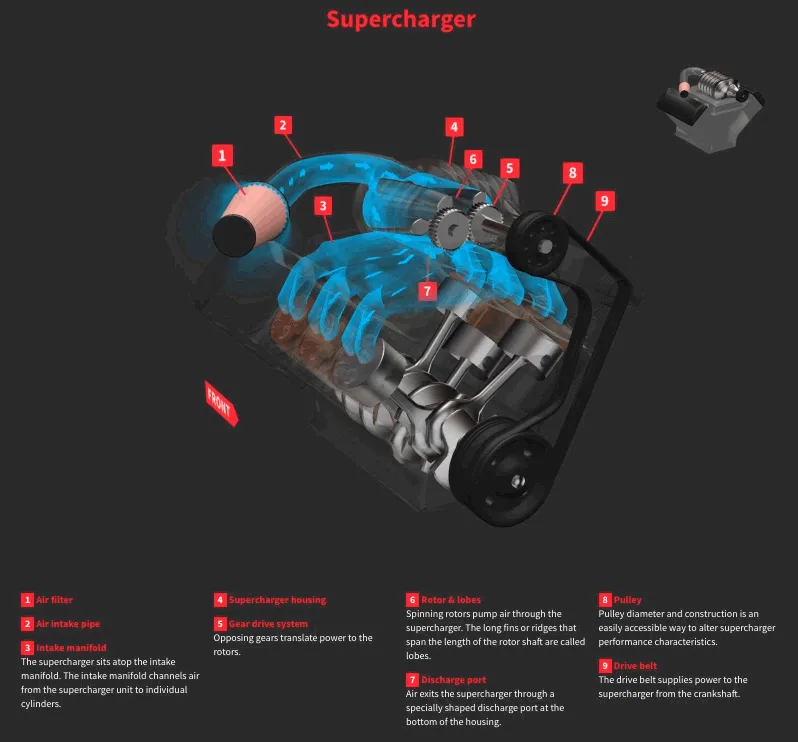
Image source: Wikimedia Commons / PatriciaWrites (CC BY-SA)
Choosing between them often comes down to driving style. If you spend most of your time at low RPM, a supercharger feels more responsive. If you need top‑end power and better fuel economy, a turbo is the smarter pick.
For installation, a turbo usually requires a custom manifold, downpipe, and ECU tune. A supercharger often fits existing intake paths, but you still need a tune to manage boost. Both jobs benefit from a clean engine bay and proper torque specs on bolts.
Internal link example: when budgeting, check the bolt‑on turbo kit cost to avoid surprises. For hands‑on work, a sturdy car ramp from wood makes under‑car access safer.
External reference: the SAE J1349 performance standard defines boost thresholds and efficiency maps used by manufacturers.
Head‑to‑Head Comparison: Specs, Costs, and Real‑World Gains
| Feature | Turbocharger | Supercharger |
|---|---|---|
| Boost source | Exhaust gases | Belt from crankshaft |
| Spool time | 1,500–3,000 rpm | 0–2,000 rpm |
| Power band | High RPM | Low RPM |
| Fuel impact | Better economy | Higher consumption |
| Typical cost (parts+install) | $1,500–$5,000 | $3,000–$10,000 |
| Maintenance | Oil change, wastegate cleaning | Belt replacement, heat management |
Real‑world data from aggregate reviews shows turbo owners report 15 % better fuel economy on highway trips. Supercharger owners note 20 % more torque at launch, which helps quarter‑mile times. Installation complexity is higher for turbos, often requiring custom exhaust work.
If you drive a daily sedan and want modest power, a turbo adds efficiency without sacrificing low‑end punch. For a drag car that launches from a standstill, a supercharger gives the instant torque you need.
Image placeholder for comparison chart:
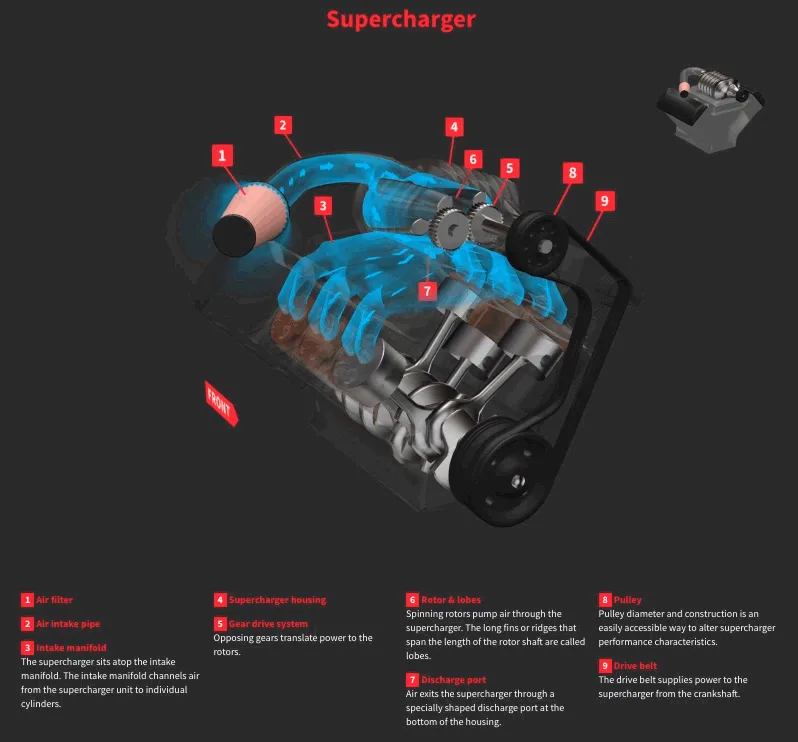
Image source: Wikimedia Commons / PatriciaWrites (CC BY-SA)
Best For Which Driver: Use Cases & Decision Guide
- Daily street driver, Turbo offers smooth power and better fuel economy.
- Drag racer, Supercharger provides instant boost for strong launches.
- Off‑road diesel truck, Supercharger adds low‑end torque for crawling over obstacles.
- High‑altitude performance, Turbo compensates for thin air, maintaining power.
- Classic‑car restoration, Either can be retrofitted; turbo is lighter, supercharger keeps the original belt drive look.
Decision guide: if your primary concern is fuel economy and you can tolerate a few seconds of lag, go turbo. If you need immediate throttle response and don’t mind higher fuel use, supercharger is the way.
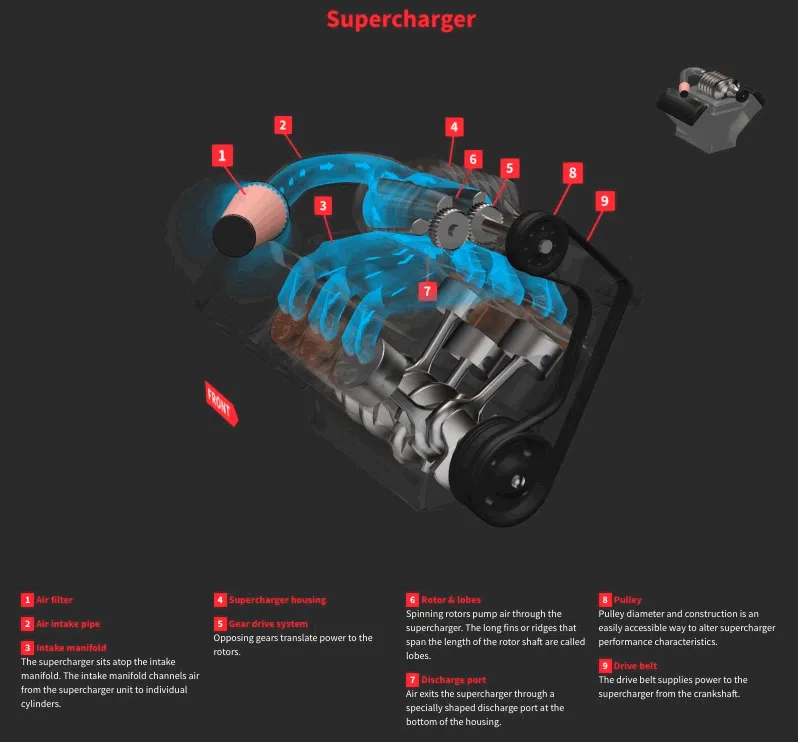
Image source: Wikimedia Commons / PatriciaWrites (CC BY-SA)
For any build, plan for a professional tune. An ECU flash sets boost targets, fuel maps, and ignition timing. Skipping tuning can cause knock, over‑boost, or poor drivability.
If you’re unsure which path fits, start with a modest turbo kit and evaluate lag. If lag is unacceptable, switch to a supercharger for the next build.
FAQs
What’s the difference between a twin‑scroll turbo and a regular turbo?
A twin‑scroll turbo has two inlet scrolls that reduce turbulence, delivering boost earlier and more linearly than a single‑scroll turbo. This reduces lag and improves throttle response across the RPM band.
Do I need a custom ECU tune for both?
Yes. Both turbos and superchargers change air flow and pressure, so the ECU must be reprogrammed to deliver the right fuel and ignition timing. A tune also sets boost limits to protect the engine.
Can I run both a turbo and a supercharger?
Running both is possible but complex and rarely beneficial. The supercharger would add heat and load, while the turbo would still need exhaust energy. Most builders choose one or the other to keep the system manageable.
