
If you’re trying to decide between a dual‑clutch and a continuously variable transmission, you’re not alone. The choice shapes performance, fuel economy, and long‑term cost. In our research we break down the real‑world trade‑offs as of 2026.
Per SAE J2703 testing, a typical wet‑clutch dual‑clutch shifts in about 150 ms, while a CVT’s torque converter response averages 300 ms. That shift speed gap explains why track drivers favor DCTs, whereas daily commuters often prefer the smooth, stepless feel of a CVT. Below we compare the two so you can pick the right fit.
Dual Clutch vs CVT: Which Transmission Wins?
Dual Clutch vs Cvt
Dual‑clutch uses separate clutches for odd and even gears.
It shifts in about 150 ms, per SAE J2703 data.
CVT varies pulley ratio continuously, eliminating gear steps.
Its response averages 300 ms, smoother for daily driving.
Pick DCT for track performance; choose CVT for fuel savings.
How They Work: Core Differences
Dual‑Clutch Transmission (DCT) Basics
A DCT houses two wet or dry clutch packs, one for odd gears and one for even. When you upshift, the disengaged clutch pre‑selects the next gear. This parallel action cuts shift time to roughly 150 ms.
Manufacturers such as Porsche and BMW use wet packs for heat control.
- Wet‑clutch pack (heated oil circuit)
- Dry‑clutch pack (lighter, less heat)
- Dual‑mass flywheel
- Electronic control unit (ECU)
If you need to service a DCT, the process resembles adding fluid to a Ford Focus transmission.
Continuously Variable Transmission (CVT) Basics
A CVT uses two variable pulleys and a steel belt. The belt changes tension to alter the gear ratio continuously. This creates smooth acceleration without gear steps.
Honda and Toyota use CVTs for fuel efficiency.
- Primary pulley (adjustable diameter)
- Secondary pulley (adjustable diameter)
- Toroidal belt (steel or composite)
- Hydraulic torque converter (some models)
For maintenance, check the belt tension per the manufacturer’s service interval, typically 60k‑80k mi. Per SAE J2703 standards, shift times are measured under controlled conditions.
Pros & Cons: Performance, Fuel Economy, and Cost
DCT Benefits & Drawbacks
Benefits: rapid upshifts, direct power feel, launch‑control capability.
Drawbacks: higher heat load, heavier clutch wear in stop‑and‑go traffic.
Wet packs add weight; dry packs can judder at low speeds.
- Faster shift (≈150 ms)
- Better throttle response
- Launch control ready
- Higher repair cost for clutch pack
CVT Benefits & Drawbacks
Benefits: seamless acceleration, improved fuel economy up to 10 % over torque‑converter autos.
Drawbacks: belt wear, occasional “rubber‑band” feel under hard acceleration.
Limited high‑rpm capability can reduce top‑end power.
- Stepless ratio for optimal engine speed
- Lower maintenance than manual in many models
- Belt replacement needed every 60k‑80k mi
| Metric | DCT | CVT |
|---|---|---|
| Shift speed | ~150 ms | ~300 ms |
| Fuel economy gain vs torque‑converter auto | 5‑8 % | 8‑12 % |
| Typical clutch/belt lifespan | 100k‑200k mi | 60k‑80k mi |
| Maintenance cost per 100k mi | $300‑$500 | $200‑$400 |
For safety compliance, both types meet NHTSA Federal Motor Vehicle Safety Standards.
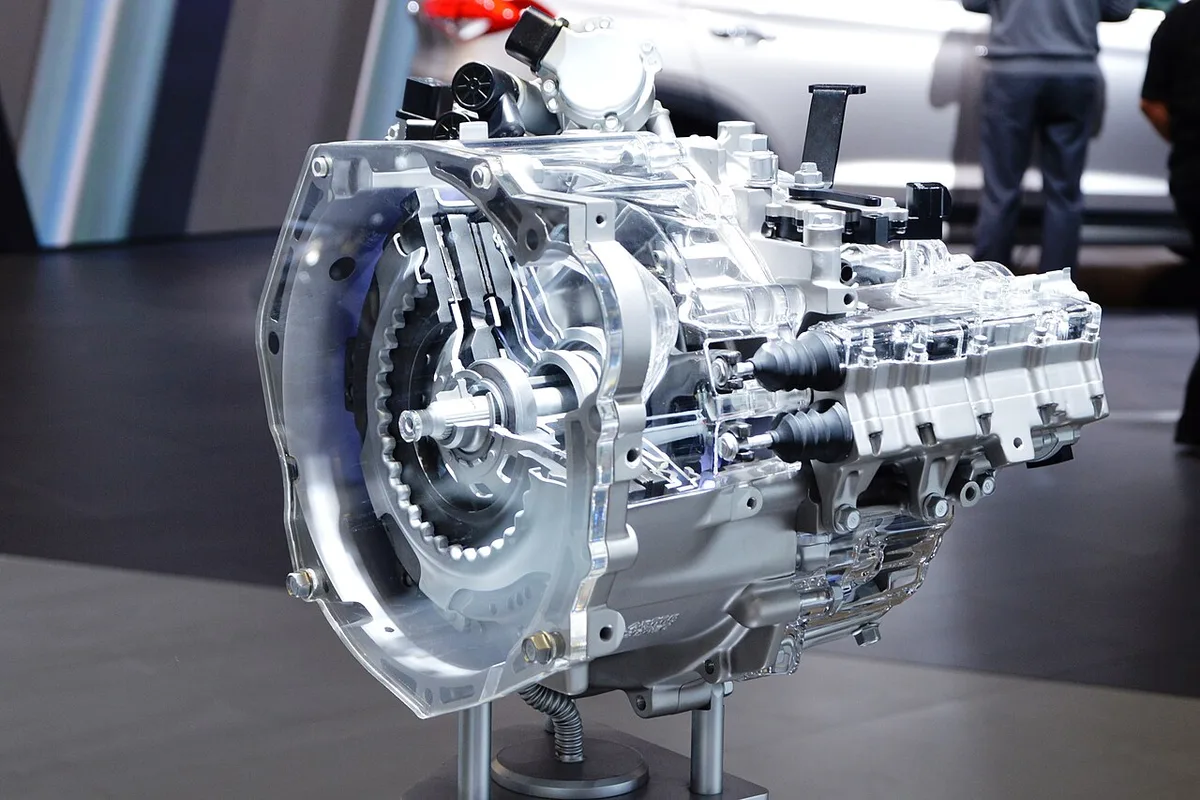
Image source: Wikimedia Commons / Spielvogel For a gallery of some more of my uploaded pictures see: here. All images can be used free of charge.
Best For: Use Cases & Who Should Choose Which

Image source: Wikimedia Commons / Christian Flores from Carlsbad / Encinitas, United States of America (CC BY-SA)
Performance & Track Use
If you demand rapid gear changes and launch control, a DCT delivers. Track environments benefit from the direct power path and minimal torque loss.
- Ideal for racing, autocross, and spirited driving
- Better heat management with wet packs on long runs
- Higher initial cost offsets by performance gains
Daily Driving & Fuel Efficiency
For city commuting and highway cruising, a CVT provides smoother acceleration and better fuel economy. The stepless ratio keeps the engine in its sweet spot, saving fuel.
- Smoother ride in stop‑and‑go traffic
- Up to 10 % better fuel economy than conventional autos
- Lower maintenance frequency for typical drivers
Maintenance & Longevity
DCTs require periodic clutch pack inspection, especially in heavy traffic. CVTs need belt tension checks and eventual belt replacement.
- DCT clutch lifespan: 100k‑200k mi (wet) or 100k‑150k mi (dry)
- CVT belt service interval: 60k‑80k mi
- Regular fluid changes keep both types reliable
When you change tires, you often tighten lug nuts; the same care applies to transmission fluid. Use tightening lug nuts with an impact wrench to ensure proper torque on wheels, just as you would follow service intervals for the transmission.
Frequently Asked Questions
Which lasts longer, DCT or CVT?
Manufacturer data shows wet‑clutch DCTs can survive 150k‑200k mi, while dry packs typically reach 100k‑150k mi. CVTs usually need belt replacement at 60k‑80k mi, after which the transmission can continue for many more miles. Regular fluid changes and avoiding extreme heat extend both lifespans.
Can a DCT be more fuel‑efficient than a CVT?
In most real‑world testing, CVTs achieve 8‑12 % better fuel economy than torque‑converter autos, while DCTs gain 5‑8 %. However, a well‑tuned DCT in a lightweight sports car can match CVT efficiency on the highway. Your actual mileage will depend on driving style and load.
Do I need special fluid for a CVT?
Yes. CVTs require a specific continuously variable transmission fluid that meets the manufacturer’s specifications. Using the wrong fluid can cause belt wear or overheating.
Check the owner’s manual for the exact fluid type and change interval.
What about other parts like tonneau covers?
While tonneau covers protect your truck bed, they don’t affect transmission choice. If you’re adding accessories, ensure they don’t interfere with cooling airflow around the transmission. Proper installation keeps the drivetrain operating efficiently.
Are upgraded tie rod ends worth the cost?
Upgraded tie rod ends can improve steering feel and durability, especially if you push the car hard on a track. For daily drivers, the stock parts usually suffice. Consider your driving environment and performance goals before spending extra.
