
If you've ever asked how does a common rail diesel system work, start with stored pressure, not the computer. Most people hear "common rail" and picture one fat pipe. The rail is a reservoir.
The ECU only chooses when each injector opens, and for how long.
Manufacturer specifications for late passenger and light-truck systems, as of 2026, put peak rail pressure near 1,800 to 2,500 bar. That is about 26,000 to 36,000 psi. Old mechanical pumps never held pressure like that between shots.
Once you can see that split, the fuel path is much easier to follow.
How Does a Common Rail Diesel System Work
How does a common rail diesel system work on a running engine? A high-pressure fuel pump fills one shared steel rail. Every injector on the engine draws from it.
The ECU opens each injector for a set time. That open time sets the fuel for each shot.
The Fuel Path You Have to Picture First
A useful diagram reads left to right. You should see the tank, the lift pump, the filter, and the high-pressure fuel pump. Next comes the rail, then one short steel line per injector.
A return bundle runs back to the tank.
The ECU sits off to the side, wired to the rail pressure sensor and each injector. The low-pressure side only has to keep the pump inlet full. Think a few bar, not thousands.
The high-pressure fuel pump does the hard work. It is usually a cam-driven radial piston pump. The rail's job is storage.
Fuel is already at pressure, so the next shot does not wait on a pump stroke.
Cylinder one and the last cylinder see the same supply. Two valves keep that pressure honest. A pressure control valve can bleed fuel off the rail.
An inlet metering valve limits what enters the pump.
In our research of late light-duty calibrations, inlet metering does most of the control. It sends less hot fuel back to the tank. Notes from Bosch mobility documentation still describe the layout as a pump, a rail, and electronic injectors.
Spotting the Lift Pump, HPFP, Rail, Sensors, and Injectors
On the engine, ignore the plastic covers first. You want the steel. Use the view below to separate rigid high-pressure hardware from soft hose.
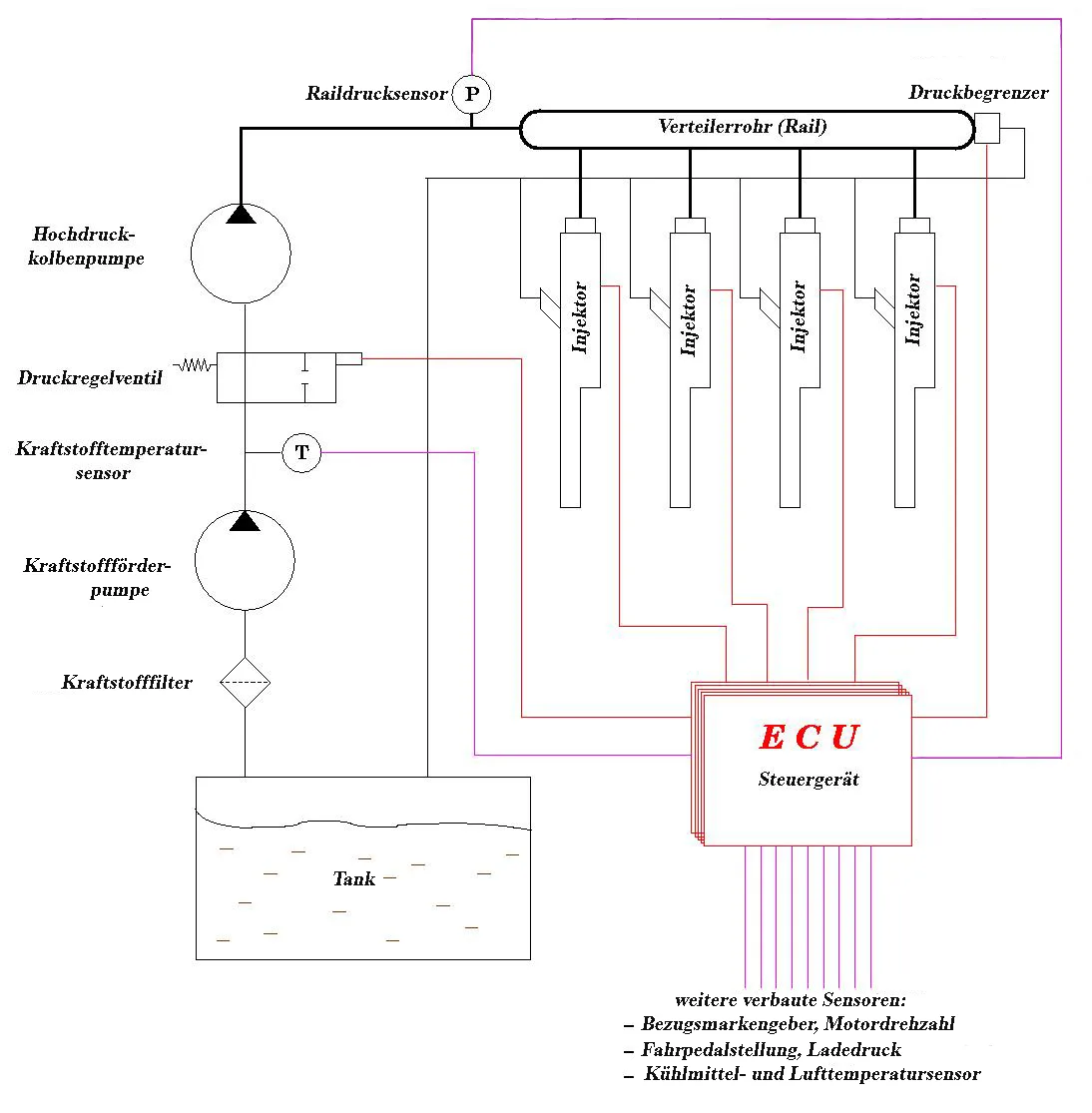
Image source: Wikimedia Commons / AndiF
The shared log is the rail. It is a machined bar with a threaded port for each injector line. A rail pressure sensor usually sits at one end.
The other end often carries the control valve or a relief.
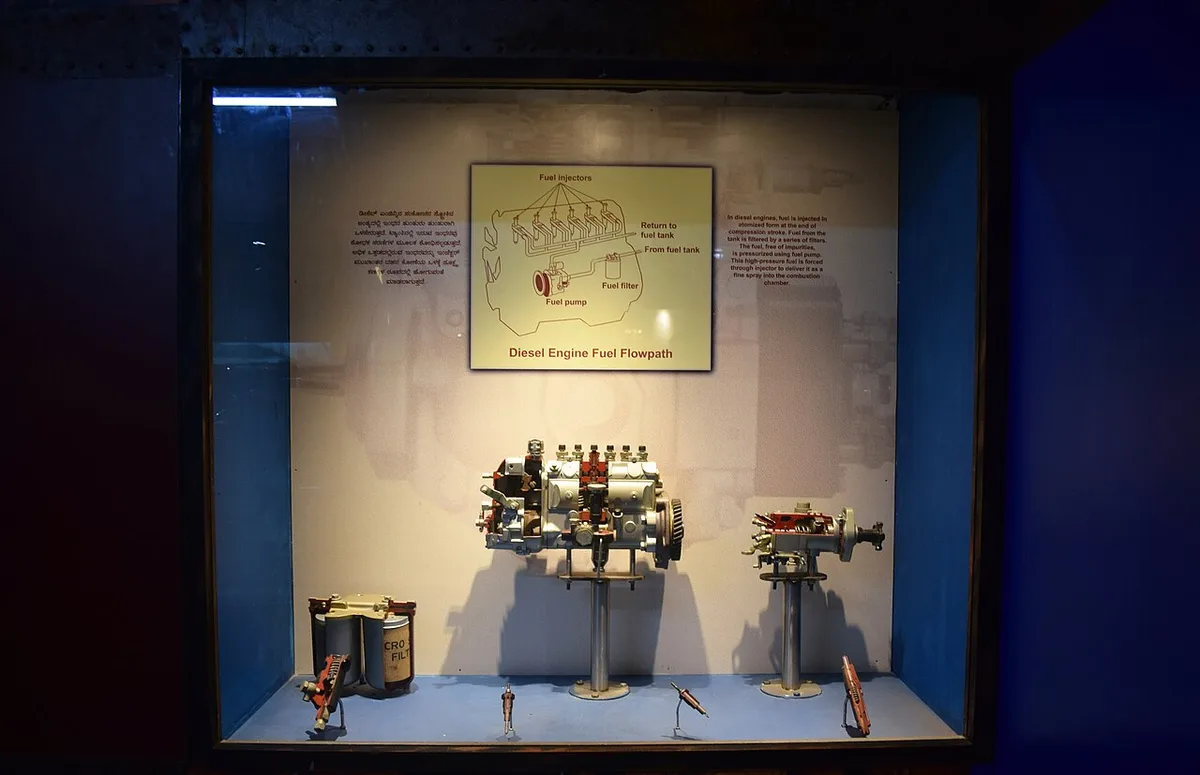
Image source: Wikimedia Commons / Anup Sadi (CC BY-SA)
The high-pressure fuel pump is compact. It is not the long inline pump from older diesels. One thick outlet tube leaves the pump and enters the rail.
That tube is the giveaway.
| Part | What you should see | What it does |
|---|---|---|
| Lift pump and filter | Soft hose, usually near the tank | Feeds the high-pressure pump |
| High-pressure pump | Small pump on the engine | Builds rail pressure |
| Fuel rail | Rigid steel log on the head | Holds pressure for every injector |
| Rail pressure sensor | Small sender on the rail | Reports pressure to the ECU |
| Injectors | One per cylinder, with a plug | Delivers each shot |
Solenoid injectors show a coil housing on top. Piezoelectric injectors are often slimmer, and they switch faster. Early common rail pickups, including many LB7 trucks, used solenoid bodies.
Those pickup injector options still matter when the nozzles coke up.
Low-pressure hose versus steel tube is the other visual test. If it flexes, it is supply or return. If it is a hard line off the rail, treat it as high pressure.
How One Cycle Builds Rail Pressure and Fires Pilot, Main, and Post
Here is one combustion cycle, the way a pressure trace would read.
- The lift pump fills the high-pressure pump inlet.
- The cam drives the pump pistons. Each stroke adds fuel to the rail.
- Rail pressure rises. The sensor tells the ECU the real number.
- The ECU compares that number with the map for rpm and load.
- It trims the metering valve, the control valve, or both.
- Near the top of the compression stroke, it commands a small pilot shot.
- The main shot follows and makes the torque.
- A post shot may follow to support aftertreatment.
Image source: Wikimedia Commons / Ben Brooksbank (CC BY-SA)
Picture the trace next to that hardware. Small pulses, then a taller main pulse, then a late blip. Those are not three injectors.
They are separate openings of the same nozzle.
Pilot injection softens the pressure rise in the cylinder. That is why these engines run quieter than old mechanical diesels. The main shot carries the load.
Post injection raises exhaust temperature so the particulate filter can burn soot.
Federal emissions rules are a big reason the post shot exists. The pump still makes the pressure. The ECU only times the openings.
Most of these engines are turbocharged. Extra air from added boost hardware still has to match fuel the rail can meter cleanly.
Visual Mix-Ups That Hide Real Common Rail Faults
A liquid leak and black smoke are not the same fault. A rail or line leak throws a fine mist and a raw fuel smell. Black smoke means the cylinder got too much fuel or not enough air.
A low rail pressure code, often P0087, is not an automatic pump replacement. Plugged filters, a weak lift pump, air on the inlet, and high injector leak-off show up just as often. Live data from a decent code reader tells you whether pressure follows the target.
A stored light does not.
Do not crack a high-pressure fitting on an engine that just shut down. Pressure can stay high enough to drive fuel through skin. That needs urgent medical care.
Follow the bleed-down in the service procedure, and wear eye protection.
Unit injectors fool people on a drawing. Each one has its own pumping element, and there is no shared log. If you cannot find the rail, you are not looking at this system.
A diesel no-start is another trap. Spark-plug starting tricks do not fill a rail. You need fuel pressure, not a flame in a plug hole.
Tracing the steel lines is easier from simple wooden ramps than from flat on the ground.
Common Rail Diesel FAQs
What pressure does a common rail diesel run?
Idle rail pressure often sits in the low hundreds of bar. Under load, late systems commonly reach about 1,800 to 2,500 bar. Some heavy-duty pumps are rated higher.
The ECU holds a target that changes with rpm and load. It is not one fixed number.
Why is the rail more than a pipe?
The rail stores fuel that is already at injection pressure. Injectors do not wait for a new pump stroke before they open. That keeps the last cylinder on the same supply as the first.
A thin pipe with almost no volume would sag at every shot.
How does a piezo injector differ from a solenoid?
A solenoid injector moves a valve with a coil. A piezoelectric injector moves a crystal stack when voltage is applied. The stack reacts faster, so more shots fit in one combustion event.
Both types still spray fuel stored in the rail.
Is it safe to open a rail fitting after shutdown?
No, pressure can stay high after the key is off. Fuel at that pressure can penetrate skin and needs emergency care. Use the bleed-down steps in the service procedure, with eye protection on.
Keep your face and hands out of the fitting's path.
