
If you've ever typed "how much does a car paint job cost" into a search bar, you've seen the answers disagree. One source says $300. Another says $15,000.
Both can be right, because "paint job" covers everything from a scuffed bumper to a bare-metal respray with the door jambs done.
The numbers here come from shop labor rates, refinish material pricing, and published collision repair cost data. Labor alone is roughly 60 to 80 percent of a typical bill, which is why prep hours move the price more than the paint itself. Once you know which branch of the decision tree you're standing on, the range narrows fast.
How Much Does a Car Paint Job Cost
Most drivers pay $2,000 to $5,000 for a full respray. A single panel runs $300 to $1,000 at a body shop. Budget chains advertise full-car jobs from about $500.
Show-quality work starts near $10,000. The final price tracks scope, finish, condition, and who sprays it.
What You're Actually Paying For: Prep, Labor, and Materials
Paint is the cheap part. A gallon of quality base coat and clear won't wreck your budget on its own. What wrecks it is the forty hours of sanding, masking, and blocking that happen before the gun ever comes out.
In our research across shop invoices and published estimating guides, labor consistently lands between 60 and 80 percent of the total. Materials for a full car usually run $1,000 to $3,500. That gap is the whole story of why two quotes for the "same" job can differ by thousands.
| Cost component | Rough share of a full respray | What drives it |
|---|---|---|
| Teardown and masking | 15 to 20% | How much trim, glass, and hardware comes off |
| Body and rust repair | 0 to 40% | Condition hiding under the old finish |
| Sanding and primer blocking | 20 to 25% | Whether the old paint is scuffed or stripped |
| Paint materials | 15 to 25% | Color type, coverage, and brand system |
| Booth time and bake cycle | 5 to 10% | Local booth rates and cure schedule |
| Cut, buff, and reassembly | 10 to 15% | The finish standard you asked for |
Where the hours actually go
Teardown is the first invisible cost. Removing lights, badges, moldings, mirrors, and door handles takes time, and so does putting it all back without scratching the fresh paint. Trim and step-pad removal on trucks and SUVs alone can add a full day of billed labor.
Masking is the shortcut version of the same job. It's faster and cheaper, but it's also why budget jobs end up with paint edges on the window rubber and overspray on the tires. If a quote is suspiciously low, ask whether they're removing parts or taping around them.
Sanding and primer work is where quality is really decided. A scuff-and-shoot job might take four hours of prep. A proper strip, prime, block, and re-prime can eat thirty.
Same car, same color, wildly different bill.
Small parts add up too. Clips, fasteners, and retainers get replaced constantly, and small hardware pricing follows the same pattern you'd see on any consumable. If you've ever wondered why a $900 bumper repair turns into $1,300, it's usually a box of $4 pieces.
Materials and the regulatory side
Modern refinish systems are layered: epoxy primer, urethane primer surfacer, sealer, base coat, then clear. Each layer has its own reducer, its own pot life, and its own price. Waterborne basecoats have largely replaced solvent bases in many regions because of VOC limits enforced under EPA automotive refinishing rules.
That regulation isn't trivia. It shapes what products a shop can legally spray, which shapes both material cost and how the job gets done. California and several Northeast states run tighter limits than the rest of the country, and shops pass compliance costs through.
Health rules matter just as much. Two-part urethane clears contain isocyanates, a respiratory sensitizer, and OSHA spray-finishing standards require supplied-air respiratory protection for anyone spraying them. That equipment isn't free, and it's part of why a real booth costs more per hour than a garage.
Labor rates by market
As of 2026, independent body shop rates commonly sit between $60 and $120 per hour. Dealer collision centers and high-end restoration shops push $120 to $200 or more. Rural shops undercut metro rates by 30 to 50 percent, and coastal cities sit at the top of every range.
A quality full respray consumes 80 to 150 billed hours. Do the math on those two numbers and the seemingly huge spread in quotes starts to look reasonable.
The Four Factors That Set Your Price
Every estimate you collect is a function of four variables. Change any one of them and the number moves. Change two and it can double.
1. Scope: how much of the car needs paint
If one panel is damaged, you're buying a panel job with a blend into the neighbors. Expect $300 to $1,500 depending on size and whether blending is needed.
If the whole car is chalked, faded, or peeling, you're buying a full respray. That's $2,000 to $5,000 at a competent independent shop, and it goes up from there.
If you want a different color entirely, the price jumps because door jambs, underhood edges, and trunk gutters all need coverage. Add $2,000 to $5,000 for the extra disassembly and material.
2. Condition: what's under the paint
If the panels are straight and rust-free, prep stays predictable. If there's bubbling at the wheel arches, a rust hole in a rocker panel, or filler from an old repair, the scope changes mid-job.
Rust repair is the single biggest quote-killer. Cutting out metal, welding in a patch, and finishing it properly runs $500 to $5,000 or more depending on how far it spread.
Old paint that's cracked, crazed, or lifting has to come off rather than get scuffed. Stripping to bare metal can add 20 to 40 hours of labor on a full car.
3. Finish tier: how good you want it
If you want the car to look tidy from ten feet, a single-stage enamel job gets you there cheaply. If you want depth, gloss, and metallic pop that survives a decade of sun, you need base coat and clear.
If you want show quality, with block-sanded panels and a finish that reads flat under a striping light, the hours triple. That's where $10,000 to $25,000 quotes live.
Matte, satin, pearl, and candy finishes sit at the top because they're unforgiving. Any flaw in the bodywork shows, and any uneven coat is permanent.
4. Who does the work: the shop tier
If you go to a high-volume chain, you're buying speed and a production line. Prep is minimal, materials are value-tier, and the warranty usually covers workmanship only.
If you go to an independent body shop, you're buying judgment. They'll tell you what the car actually needs, and they'll charge accordingly.
If you go to a dealer body shop, you're buying OEM procedures and factory-matched color, at the highest hourly rate in town. If you do it yourself, you're trading cash for risk and weekends.
Cost by Scope: Bumpers, Doors, Hoods, and Full Resprays
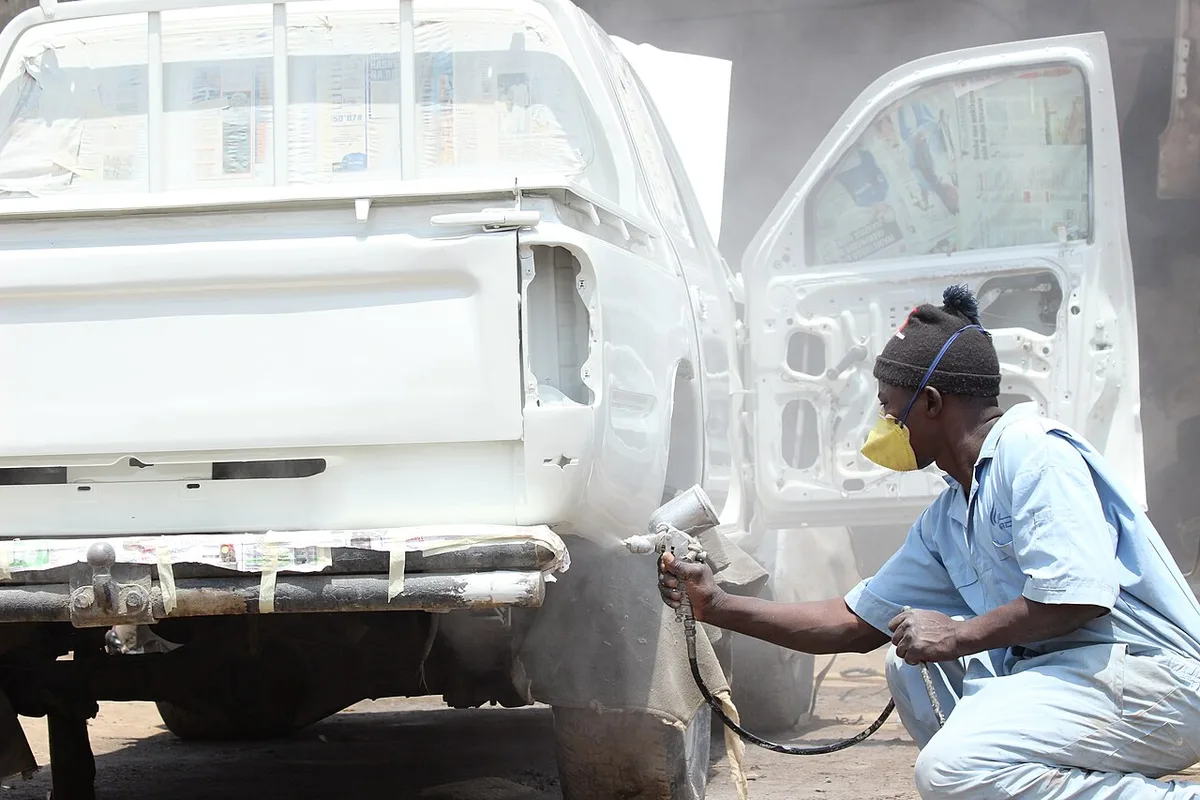
Image source: Wikimedia Commons / KelvinJM (CC BY-SA)
Panel pricing doesn't scale down from full-car pricing. It scales up, because every panel job carries a fixed cost: setup, masking, mixing, booth time, and cleanup.
| Job | Typical price range | What's usually included |
|---|---|---|
| Bumper cover respray | $300 to $900 | Remove, prep, paint, reinstall |
| Door respray | $400 to $1,000 | Handle and trim off, blend into adjacent panel |
| Hood respray | $500 to $1,500 | Underside edges, blend into fenders |
| Roof respray | $600 to $1,500 | Often includes clearing the windshield trim |
| Quarter panel with blend | $600 to $1,500 | Blend into door and rear panel |
| Front clip (hood, fenders, bumper) | $1,500 to $3,500 | Multiple panels, shared prep |
| Full respray, same color | $2,000 to $5,000 | Exterior panels, minimal jamb work |
| Full respray, color change | $4,000 to $10,000 | Jambs, underhood edges, trunk gutters |
| Show-quality full respray | $10,000 to $25,000+ | Bare-metal prep, block sanding, cut and buff |
Why blending costs more than you expect
A proper panel repair never stops at the panel. Paint fades and metallic flake lays down differently across a car, so a shop has to fade color into the door or fender next to the repair.
That means mixing extra color, clearing beyond the repair area, and sometimes clearing an entire adjacent panel. A "small" fender fix often bills as two panels of material and three panels of labor.
Trucks, SUVs, and vans cost more
More square footage means more material and more time. A full-size pickup or three-row SUV typically runs 20 to 40 percent above a sedan for the same finish tier. Roof height also adds ladder work and masking time.
Truck owners often weigh the spend against accessories instead. If the paint is passable and the bed is open, many put the money into bed covers for pickups and skip the respray entirely.
The small stuff around the repair
Paint rarely travels alone. A bumper job usually means new clips, a grille refresh, and sometimes a light housing. Parts-counter bulb prices and trim pieces can add $100 to $400 to a job that was quoted as paint only.
Ask for the parts list separately from the labor line. It's the easiest way to spot a quote that's padded or one that's suspiciously thin.
Cost by Finish: Single-Stage, Base/Clear, and Show-Quality
The finish system is the second-biggest price lever after scope. It changes material cost, labor hours, and how long the result lasts.
| Finish system | Materials, full car | Installed price | Realistic lifespan |
|---|---|---|---|
| Single-stage acrylic enamel | $300 to $700 | $800 to $2,500 | 3 to 6 years |
| Base coat / clear, solid color | $800 to $1,800 | $2,500 to $6,000 | 8 to 12 years |
| Base coat / clear, metallic or pearl | $1,200 to $2,500 | $3,500 to $8,000 | 8 to 12 years |
| Tri-coat, candy, or matte | $2,000 to $3,500 | $8,000 to $20,000 | 10+ years with careful care |
Single-stage enamel
Single-stage paint carries its gloss in the color coat. There's no clear on top, which means fewer coats, fewer hours, and a lower bill.
The tradeoff is durability. Single-stage jobs chalk and fade faster under UV, especially on horizontal surfaces like hoods and roofs. In hot, sunny climates, a cheap single-stage respray can look tired in two summers.
Base coat and clear coat
Two-stage is the modern default, and it's what most factory finishes use. The base lays down color. The clear provides gloss, UV protection, and depth.
Clear coat is what fails first on older cars, which is why you see peeling and white haze on 2000s-era hoods. A quality clear with proper UV blockers is the difference between a five-year job and a fifteen-year job.
Tri-coat, pearl, candy, and matte
These finishes use extra layers or specialty pigments, and they cost accordingly. A pearl or tri-coat needs a tinted mid-coat between base and clear. Candy uses a translucent color over a metallic ground coat.
Matte and satin are their own headache. They can't be sanded or buffed to fix a flaw, so any defect means repainting the panel. Touch-up is essentially impossible.
At these prices, the honest question is whether the car deserves it. If you're spending $15,000 on paint, it's worth asking whether that money belongs in a respray or in big-ticket performance upgrades that change how the car actually drives.
Same-Color Respray vs. Color-Change Costs
A same-color respray paints what people see. A color change paints what they find.
Door jambs, underhood edges, trunk gutters, and the area behind the weatherstripping all need coverage. On some cars, the engine bay and the underside of the hood do too. That's where the extra $2,000 to $5,000 goes.
A partial color change, where the jambs stay the original color, is cheaper but obvious the moment someone opens a door. Buyers notice, and it reads as a shortcut.
The same logic applies to any premium tier: spending more only pays off if the extra money buys something you'll actually feel. It's the identical question you'd ask about pricier suspension parts, and the answer depends on how long you plan to keep the car.
Cost by Shop: Budget Chains, Independent Shops, Dealers, and Mobile Services
Same car, same color, four very different invoices. Shop tier changes the hourly rate, how deep the prep goes, which paint system gets mixed, and what happens if the finish fails in year three. It's the branch people get wrong most often, usually because they compare the headline number and nothing else.
| Shop type | Full respray range | Typical hourly rate | Best fit |
|---|---|---|---|
| Budget chain or production shop | $500 to $2,000 | $40 to $70 | Daily drivers that need to look decent, not perfect |
| Independent body shop | $2,000 to $6,000 | $60 to $120 | Long-term owners who want it done once |
| Dealer collision center | $4,000 to $10,000+ | $120 to $200 | Lease returns, warranty-sensitive cars, exact OEM color |
| Restoration or custom shop | $10,000 to $50,000+ | $100 to $200+ | Classics, show cars, full color changes |
| Mobile paint repair | $150 to $600 per panel | $75 to $150 | One scuffed bumper, lease turn-in, quick flips |
Budget chains: honest about what they are
Production shops run on volume. Cars move through in two or three days, prep is scuff-and-shoot, and trim gets masked rather than removed. The paint is usually a value-tier single-stage or an economy base/clear.
That's not a scam. It's a different product. If your goal is a ten-foot car that looks presentable for three or four years, a chain job delivers exactly that for under $2,000.
The trap is the upsell phone call. You drop the car at the advertised $599, then get a call saying the old clear is failing and the price is now $1,400. Ask upfront what's included and what triggers an add-on.
Independent body shops: where judgment lives
An independent shop inspects the car in person before quoting. They'll flag the rust bubble you didn't notice and tell you whether the hood needs stripping or just sanding. You pay for that judgment, and it's usually worth it.
Expect a written estimate with labor, materials, and parts broken out separately. Reputable shops blend into adjacent panels as standard practice, not as an optional extra.
Warranty terms vary wildly. Some independents offer lifetime workmanship coverage on their own paint work, others give one to three years. Get it in writing before you leave a deposit.
Dealer collision centers and restoration shops
Dealers charge the highest hourly rate because you're buying OEM procedures, factory-matched paint codes, and documentation. On a leased car or one still under corrosion warranty, that paper trail has real value.
Restoration shops are a different animal entirely. They strip to bare metal, block sand every panel, and measure film build. That's how a $10,000 quote becomes $30,000, and on a genuine collector car it's the only route that holds value.
Mobile paint repair: the small-area option
Mobile services handle SMART repairs, which stands for small to medium area repair technique. They'll refinish a bumper cover, a mirror cap, or a door edge in your driveway for $150 to $600.
They work well on solid colors and minor damage. They struggle with metallic blends in poor light, cold weather, or wind, and they can't fix anything that needs panel beating. For a lease return or a quick sale, it's often the smartest money you'll spend.
Questions that separate a real quote from a padded one
- Are you removing trim, lights, and handles, or masking around them?
- Is the price for a same-color respray or a full color change with jambs?
- What paint system are you spraying, and what's the warranty period?
- Does the estimate include blending into adjacent panels?
- What happens if you find rust or old filler once the panels come off?
- Is there a separate line for parts, or is hardware bundled into labor?
Rust and Body Damage: The Hidden Costs That Blow Up Quotes
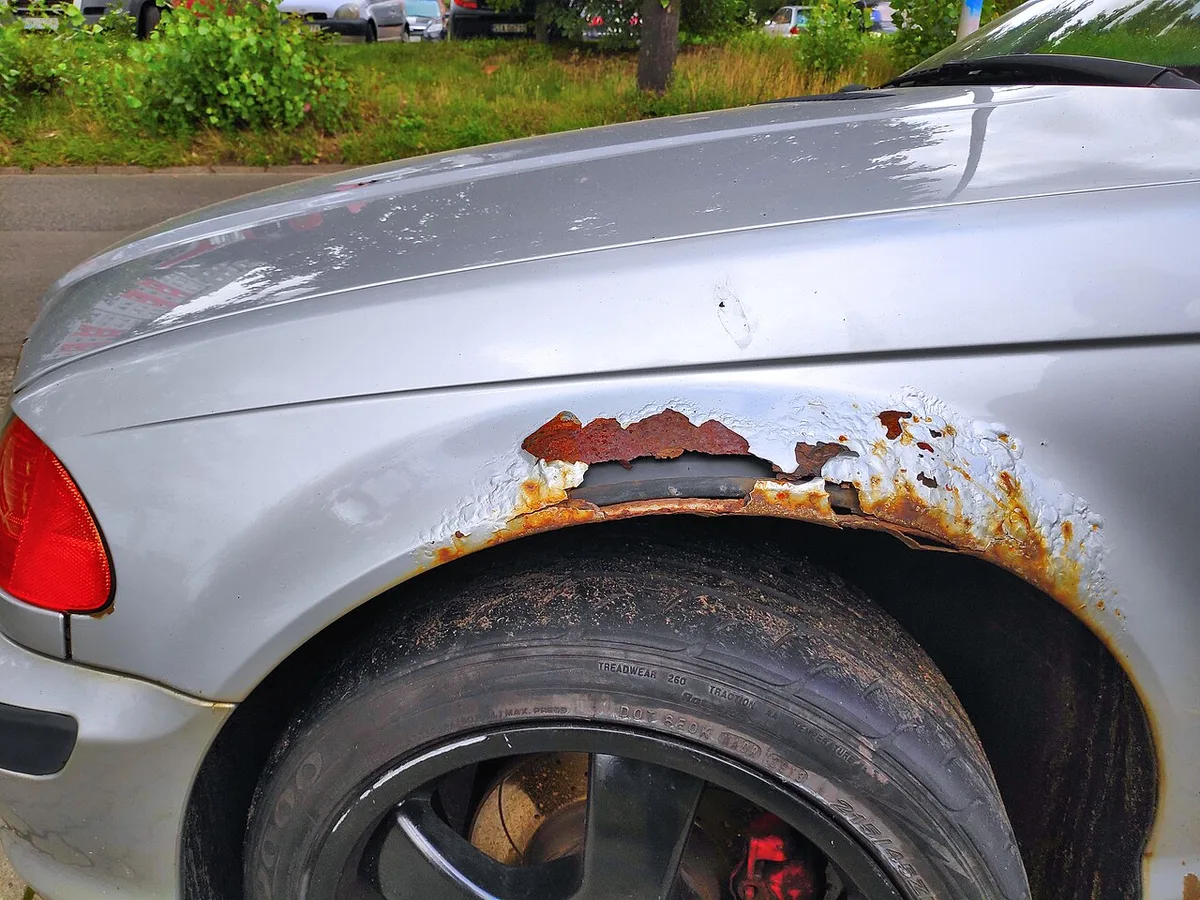
Image source: Wikimedia Commons / Marek Ślusarczyk (Tupungato) Photo portfolio (CC BY)
Rust is the line item that turns a $2,500 quote into a $6,000 invoice. It rarely shows as much as it hides. What looks like a small bubble at a wheel arch is usually a hole on the back side of the panel, and the visible blister is just the last stage.
| Damage type | Typical repair cost | What it involves |
|---|---|---|
| Surface rust, light scale | $150 to $400 | Sand back, treat, prime, refinish |
| Bubbling under paint | $500 to $1,500 per panel | Cut out, weld patch, filler, prime, paint |
| Perforation or rot-through | $1,000 to $3,000 per panel | Full section replacement or fabricated patch |
| Rocker panel replacement | $800 to $2,500 per side | Cut, weld, seam seal, refinish |
| Cab corners on a pickup | $600 to $2,000 per side | Common on older trucks, labor-heavy |
| Rear hatch or tailgate rot | $700 to $2,500 | Often cheaper to source a used panel |
Why the estimate changes after teardown
Shops quote what they can see. Once bumpers come off and trim gets pulled, the real condition shows up. That's when you get the call about a rust hole behind the wheel arch or three inches of old filler in a door.
This isn't dishonesty in most cases. It's physics. You can't assess a panel until you can see both sides of it.
The honest shops photograph what they find and send it to you before proceeding. The ones that just add $900 to the bill without explanation are the ones to walk away from.
Previous repairs make it worse
Old collision work is a wildcard. A dent that was pulled and filled instead of replaced can look fine for a decade, then crack when new paint goes over it. Filler also telegraphs, meaning the repair shows as a faint outline under a glossy finish.
If a shop says they need to strip a panel to bare metal, believe them. Scuffing over failing bodywork is how you get a paint job that looks worse in eighteen months than the one you started with.
When Insurance Covers the Repaint
Insurance pays for damage, not for age. If the paint failed because the clear coat oxidized, that's wear and tear and no policy covers it. If a parking lot scrape, hail storm, or collision caused the damage, a claim usually applies.
Comprehensive coverage typically handles vandalism, hail, and animal strikes. Collision coverage handles the scrape you caused yourself. Either way you're paying the deductible, so run the math before filing.
A $700 bumper repair with a $500 deductible isn't worth a claim. A $4,000 multi-panel job usually is. And a claim will follow the car on its history report, which matters at resale.
One more thing worth knowing. If wheels come off for jamb work on a color change, that's the moment to replace stretched or rusty fasteners rather than reuse them, and it helps to know what a set of lug nuts should cost before you approve the parts line.
DIY Painting: Spray Cans, Rollers, and Garage HVLP Setups
DIY is a real option, and the math can work. It's also the fastest way to spend $600 and end up with a car that looks worse than when you started. The difference is honest self-assessment about prep, patience, and space.
| Method | Material cost, full car | Tool cost | Realistic result |
|---|---|---|---|
| Rattle cans | $100 to $400 | $0 | Uneven coverage, visible overlap, poor UV life |
| Roller and brush enamel | $150 to $250 | $40 to $80 | Acceptable from 20 feet, needs heavy wet sanding |
| HVLP gun with rented booth | $600 to $1,500 | $200 to $600 | Near-professional if prep is right |
| HVLP gun in a garage | $600 to $1,500 | $400 to $1,500 | Dust nibs and orange peel, decent from 10 feet |
Rattle cans and rollers: what they actually deliver
Aerosol cans work for small repairs and nothing larger. Coverage is thin, the propellant limits solids, and the finish won't hold up to UV the way a two-part clear does. On a whole car, expect visible stripes and a lifespan measured in months, not years.
The roller method has a small cult following for good reason. It's cheap, it's low-risk, and with enough wet sanding and polishing you can get a passable result on a beater. It will never match a sprayed finish, and the labor is brutal.
If you go either route, budget for primer, sandpaper, masking tape, and a proper respirator. Those consumables often cost more than the paint itself.
The HVLP route and the compressor problem
High-volume low-pressure guns need air, and most garage compressors can't supply enough of it. A gun that wants 13 CFM at 30 PSI will starve on a 20-gallon, 5 CFM unit, and starving means dry spray and uneven coats.
You're looking at a 60-gallon compressor with a real CFM rating, plus filters, dryers, and hoses. That's $600 to $1,500 before you buy a drop of paint. Factor in a gun, a spare for primer, mixing cups, and strainers and the tool bill climbs fast.
Prep space is the other blocker. If you can't get the car up and stable to work around it, or you're crawling on concrete for hours, the job gets miserable quickly. Doing it safely, with proper stands rather than stacked bricks, is worth sorting out before you start sanding.
The Safety Reality of Spraying at Home
Two-part urethane clears contain isocyanates. These are respiratory sensitizers, meaning repeated exposure can trigger asthma that never goes away. A paper dust mask does nothing against them.
You need at minimum a fitted organic vapor respirator with supplied air being the professional standard.
Fire risk is real too. Solvent vapors in a closed garage plus a water heater pilot light is a genuine explosion scenario. Ventilation isn't optional, and neither is keeping ignition sources out of the space.
Then there's overspray. It travels. It lands on neighbor's cars, on windows, on siding, and on anything within about 50 feet.
If the wind shifts, you own that damage.
Old cars carry one more hazard. Vehicles built before the early 1980s can have lead in factory paint and primer, and sanding it releases dust. Wet sanding and proper respiratory protection are the minimum, and a blood lead test is worth considering if you're doing serious stripping work.
Where DIY actually makes sense
If you have a garage, a decent compressor, weeks of spare time, and a car whose value doesn't hinge on the finish, DIY can save $1,500 or more. If any of those are missing, the pro job is cheaper in the long run.
The worst outcome isn't a bad paint job. It's a bad paint job that has to be stripped off before a shop will touch it, which adds $1,000 to $2,000 to the professional quote you end up paying anyway.
Paint Job vs. Vinyl Wrap vs. PPF: When Something Else Wins
Paint isn't the only way to change or protect a car's appearance, and for a lot of drivers it isn't the best value either. The three main options do genuinely different jobs.
| Option | Typical cost | Lifespan | Reversible | Changes color |
|---|---|---|---|---|
| Full respray, base and clear | $2,000 to $6,000 | 8 to 12 years | No | Yes |
| Vinyl wrap, full car | $2,000 to $6,000 | 5 to 7 years | Yes | Yes |
| Paint protection film | $1,500 to $8,000 | 7 to 10 years | Yes | No |
| Ceramic coating over good paint | $500 to $2,000 | 2 to 5 years | Wears off | No |
Wrap wins when the paint underneath is sound
Vinyl is the better call for a leased car, a color you'll tire of, or a factory finish you want to protect while changing the look. It peels off clean, so resale isn't hurt by a bold color choice.
The catch is the surface underneath. Wrap hides nothing. Dents, peeling clear, and rust all show through as texture, and wrapping over failing paint traps moisture and speeds up the damage.
A wrap quote on a car with bad paint is money thrown away.
PPF protects, it doesn't transform
Paint protection film is a clear urethane layer aimed at rock chips and road rash. On a new car with expensive paint, especially a low nose that eats gravel, it's the smart spend. It won't fix a faded finish or change a color.
When paint is the only answer
If the clear coat is failing, if panels are chalked beyond polishing, or if the body needs rust repair, neither wrap nor film helps. Those are surface products. Paint is structural to the car's appearance, and everything else sits on top of it.
For a car with good paint that's merely dull, a professional cut and polish followed by a coating runs $400 to $900 and buys a few more years. That's the cheapest branch on the whole tree.
Is a Repaint Worth It Before Selling Your Car?
Sometimes a repaint pays for itself. Often it doesn't, and in a few cases it actively costs you money. The deciding factor is what the car is worth and what buyers will assume when they see fresh paint.
The value math that actually matters
Spending $4,000 on paint for a car worth $7,000 is almost never recoverable. You'd need a buyer who values the finish above the car's book value, and those buyers are rare outside the collector market.
Spending $500 to refinish a scuffed bumper on a $12,000 car often is recoverable. Buyers walk away from visible damage because they assume hidden damage behind it.
The general rule our research keeps landing on: fix damage, not age. Damage reads as a problem. Age reads as normal wear, and buyers price that in already.
Fresh paint triggers suspicion
A full respray on an ordinary used car makes buyers wonder what happened. They check panel gaps, they run the history report, and increasingly they bring a paint depth gauge.
Factory film build is typically 4 to 8 mils. Readings of 12 to 20 mils on a single panel suggest bodywork or a previous respray. Uniform high readings across the whole car suggest a full repaint, and that starts a conversation you don't want.
A color change is worse. It narrows your buyer pool, and any unpainted jamb becomes a permanent red flag.
What to fix before you list
- Refinish a scuffed bumper or mirror cap. It's the cheapest visible improvement.
- Polish and coat faded but intact paint. This restores gloss that buyers read as care.
- Address a rust bubble early. It's a negotiation chip in someone else's hands.
- Replace a cracked light lens or a tired headlight bulb. Bright, clear lenses make the whole front end look newer.
- Skip the full respray unless the paint is genuinely failing and the car holds real value.
The collector exception
Original paint is a premium on older and collectible cars. A documented original finish, even with patina and stone chips, is worth more than a mediocre respray. If you're selling into that market, don't touch it.
For everything else, the question is simple. If the paint is failing badly enough that buyers can't see past it, a repair-level respray in the factory color is worth considering. If it's just tired, polish it and price the car honestly.
How to Get Honest Estimates: A Step-by-Step Shop Workflow
The estimate is where the price actually gets set. Everything after that is bookkeeping. Get three written quotes built on the same scope, and the spread tells you more about the shops than any review ever will.
Step 1: Photograph the car in flat daylight
Shops quote better when they can see the problem. Shoot each damaged panel straight on, then at an angle so the light rakes across it. Include the roof, the rockers, and the wheel arches, since those are where rust starts.
Add one wide shot of each side and one of the rear. Photos won't replace an in-person look, but they stop the conversation from starting at zero.
Step 2: Pull the paint code before you call
Every car carries a paint code. It's usually on a sticker in the door jamb, under the hood, or in the trunk, and most manufacturers can decode it from the VIN too.
Give that code to every shop you talk to. It keeps the quotes comparable, and it reveals fast whether a shop plans to mix to your factory color or match it by eye.
Step 3: Shortlist three shops across at least two tiers
Price shopping inside one tier tells you nothing. Two independent shops quoting $3,400 and $3,600 is a coin flip. An independent at $3,600 next to a chain at $900 is an actual decision.
Our research across buyer reports keeps showing the same pattern. Three quotes spanning two tiers is the sweet spot. More than that and you're just collecting paperwork.
Step 4: Make them look at the car
A phone quote is a guess. Rust, old filler, and failing clear only show up under a light with the trim pulled back. Reputable shops will walk the car with you and point at what they see.
Ask one direct question during that walk. "What would change this number?" The answer tells you whether they inspected the car or just glanced at it.
Step 5: Compare line items, not totals
A $2,800 quote and a $3,200 quote aren't comparable until you break them apart. One may include blending and trim removal. The other may be scuff-and-shoot with the bumpers taped in place.
| Line item | What a fair quote shows | Warning sign |
|---|---|---|
| Labor | Hourly count with a stated rate | One lump sum, no hours listed |
| Prep scope | Strip, prime, block sand spelled out | "Prep included" with no detail |
| Blending | Adjacent panels named | No mention of blending at all |
| Materials | Paint system named, brand and line | "Factory match" with no product named |
| Parts | Clips, fasteners, and trim itemized | Everything bundled into labor |
| Warranty | Workmanship term in writing | A verbal promise and nothing else |
What a deposit should and shouldn't buy
Deposits are normal on large jobs and custom work. Ten to thirty percent upfront is common, and it covers materials and booth time.
Get that deposit tied to a written scope. If the shop won't put the scope in writing, the deposit is a one-way door. Pay by card so you have a paper trail if the price moves.
Timeline expectations
Budget chains turn cars around in two to three days. Independent shops usually want one to three weeks. Color changes and rust repair push past a month, and restoration work runs into months.
Ask what happens if parts arrive late. A shop that builds buffer into the schedule won't rush your clear coat to make a Friday pickup.
Mistakes That Turn Cheap Paint Jobs Into Expensive Ones
Most expensive paint jobs start as cheap ones. The money doesn't vanish on day one. It shows up eighteen months later as peeling clear, tape lines, or a finish that has to be stripped before anyone will touch it.
Here's what those mistakes actually cost to undo.
| Mistake | What it costs later |
|---|---|
| Choosing a shop on price alone | $1,000 to $3,000 to redo it properly |
| Masking instead of disassembly | Overspray damage, replacement trim and rubber |
| Skipping the blend | Visible mismatch, respray of adjacent panels |
| Painting over failing clear | Peeling within 12 to 24 months |
| No photos before teardown | Disputes over damage you can't prove wasn't yours |
| Cheap single-stage in a high-UV climate | Chalking within two or three summers |
| Washing too soon | Water spots locked under soft clear |
| Matte finish with no care plan | Unfixable smudges, full panel respray |
Choosing a shop on price alone
The lowest quote is usually lowest for a reason. Fewer prep hours, a cheaper paint line, or masking where disassembly was needed. None of that shows up in the number you compare.
If two quotes differ by more than 40 percent for the same stated scope, one of them is lying about the scope. Ask both shops to explain the gap in writing.
Masking instead of taking the car apart
Taping around trim saves hours. It also leaves paint edges on window rubber, buildup in panel gaps, and overspray on anything the tape didn't quite cover.
Mirrors are a common casualty. Taped mirror caps often come back with lifted glass or cracked housings, and refitting mirror glass is a fiddly job you never budgeted for.
Painting over a failing clear coat
Scuffing and spraying over peeling clear is the single most common shortcut. The new paint adheres to a layer that's already letting go, so it releases with it.
A shop that says your clear is fine to paint over may be right. A shop that says it without sanding a test spot is guessing. Ask them to show you a sanded patch.
Skipping the blend to save money
A panel sprayed edge to edge without blending looks fine in the booth and wrong in sunlight. Metallics flake differently, and a two-year-old finish next to fresh paint reads as two different colors.
Blending adds material and an extra panel of labor. It also isn't optional if you care what the car looks like from ten feet.
Ignoring small rust until it becomes structural
A wheel-arch bubble is a $500 repair. The same rust two years later, once it reaches a rocker or a subframe mount, is a $2,500 repair plus paint.
Rust doesn't stop at the surface you can see. It travels along the back of the panel, which is why cutting back to clean metal is the only fix that holds.
Not documenting the car before it goes in
Walk the car with the shop writer and photograph every panel, the odometer, and any existing damage. It takes four minutes and settles arguments later.
The same logic applies to mechanical work you're bundling in. If the car needs a code pulled before you commit to a big paint bill, an inexpensive code reader tells you whether the check engine light is hiding something worse.
Picking a finish you can't maintain
Matte and satin look incredible on day one. They can't be buffed, polished, or spot-repaired, and most car washes will leave permanent streaks. One scratch means repainting a whole panel.
Before you choose a specialty finish, price the care routine. If you're not prepared to hand wash it yourself forever, pick gloss.
The DIY mistake that costs the most
The expensive DIY failure isn't a bad spray pattern. It's a job that has to be stripped before a pro will fix it, which adds $1,000 to $2,000 to a bill you were trying to avoid.
If the car isn't stable and high enough to work around safely, sorting that out comes first. Building safe wooden ramps takes an afternoon and saves your back, your patience, and a possible hospital visit.
Aftercare: Cure Times, Washing Rules, and Warranty Fine Print
Fresh paint is soft paint. It looks cured because it's dry to the touch, but the solvents are still leaving and the film is still hardening. Treat the first month like the finish is fragile, because it is.
| Timeline | What's safe to do |
|---|---|
| Day of pickup | Drive gently, avoid rain if you can, no wax |
| First 7 days | Hand wash only with a pH-neutral soap if needed |
| 2 weeks | Keep pressure washers away from edges and seams |
| 30 days | First wax or sealant on most base/clear systems |
| 30 to 90 days | Full cure, normal care routine resumes |
| Long term | Hand wash, periodic decontamination, seasonal protection |
Washing rules for the first month
Skip the automatic car wash entirely for the first couple of months. Brush tunnels drag grit, and the strips slap panel edges where the film is thinnest.
Hand wash with two buckets, a soft mitt, and a pH-neutral soap. Dry with a microfiber towel, not a chamois, and don't scrub at bugs or tar.
What actually damages fresh paint
Bird droppings are the worst offender. They're acidic enough to etch clear coat in a day, especially in the sun. Remove them with a soaked cloth, never a dry wipe.
Fuel spills, brake fluid, and bug remover all attack soft clear. So does tree sap, which bonds hard and pulls paint when you pick at it. Park away from trees for the first month.
Old wiper blades belong in this conversation too. Worn rubber drags grit across the glass and can catch the edge of a fresh hood blend, so a set of hybrid blades is cheap insurance while the car is still settling.
Reading the warranty fine print
Most paint warranties cover workmanship, not the finish. That means peeling, lifting, and adhesion failures caused by bad application. It rarely means chips, scratches, accidents, or rust.
Watch for the exclusions that void coverage. Automatic car washes, pressure washing seams, failing to fix chips, and neglected bird droppings all appear in real policy language. So do non-transferable terms, which mean the warranty dies when you sell.
Get the term, the exclusions, and the claim process in writing. If a shop promises lifetime coverage verbally, ask which document it lives in.
Keeping it looking new for years
Salt is the quiet killer in cold states. Wash the underside and the wheel arches monthly through winter, and fix stone chips before they bloom into rust.
In high-UV regions, the enemy is sun on horizontal panels. A quality sealant twice a year slows oxidation on the hood and roof, which are always the first surfaces to fail.
Frequently Asked Questions
Do I need a full respray if only one panel is damaged?
No. A single damaged panel is a panel job with a blend into the panels next to it. That runs $300 to $1,500 at most shops.
A full respray only makes sense when the finish is failing across the whole car or you want a color change.
How long does a car paint job take?
Budget chains finish in two to three days. Independent shops usually need one to three weeks, since prep and booth time can't be rushed. Color changes and rust repair run longer.
Restoration work takes months, and paint keeps curing for another 30 to 90 days.
How much more does it cost to paint a truck or SUV?
Expect 20 to 40 percent more than a sedan for the same finish tier. Trucks and three-row SUVs carry more square footage, more material, and more masking time. Roof height adds ladder work.
A full-size pickup with a color change can land between $5,000 and $12,000.
Can a shop paint over my old clear coat?
Only if the old finish is sound. Clear coat that's peeling, cracked, or lifting has to come off, or the new paint fails with it. Healthy paint gets scuffed and sealed.
Failing clear means stripping to bare metal, which adds 20 to 40 hours on a full car.
Will a repaint show up on my vehicle history report?
Sometimes. An insurance claim creates a record, and those reports are what buyers check. A private job paid in cash usually leaves no entry.
A paint depth gauge still gives it away, since factory film build runs 4 to 8 mils and a respray reads much higher.
What does a lifetime paint warranty actually cover?
Usually workmanship only, not the finish itself. Most policies cover peeling or lifting from poor application and exclude chips, scratches, accidents, rust, and neglect. Many are non-transferable, so coverage ends when you sell.
Get the exclusions in writing before you sign.
The Decision Guide: Finding Your Real Number
By now the pattern should be obvious. Your price isn't set by the car. It's set by which branch you're standing on, and the branches are scope, condition, finish, and shop tier.
Here's the short version.
| If this is you | Best branch | Typical spend |
|---|---|---|
| Car looks tired, worth under $5,000 | Polish and coat, or a chain single-stage | $400 to $1,500 |
| Straight body, keeping it five years or more | Independent base/clear respray | $2,500 to $6,000 |
| Collision or rust damage | Insurance claim or panel job with repair | $500 to $5,000, or your deductible |
| Want a new color, lease or short-term hold | Full vinyl wrap | $2,000 to $6,000 |
| One panel, minor damage | Mobile SMART repair | $150 to $600 |
If You Just Need the Daily Driver to Look Decent
If the car is worth less than the paint job, spend less than the paint job. A $900 to $1,500 single-stage job from a production shop gets a tired daily looking presentable for three or four years.
If the clear is intact and just dull, don't paint at all. A cut and polish with a sealant runs $400 to $900 and buys you a few more years of gloss.
And if you drive a pickup with an open bed, keeping the bed dry might matter more than a glossier tailgate. A set of bed covers costs less than a respray and holds value better.
If You're Keeping the Car for Years
If you're keeping it, pay for prep. The difference between a $2,500 job and a $4,500 job is almost entirely labor hours, and labor hours are what stop rust and keep clear coat adhered.
Choose base coat and clear over single-stage every time here. The extra $1,000 buys roughly double the lifespan, which is the best return on the whole decision tree.
Put the rest into mechanics. Money not spent on show-quality paint goes further on upgraded suspension parts or on adding forced induction, because those change how the car drives instead of how it photographs.
If You're Fixing Collision or Rust Damage
If there's damage, run the deductible math before you call anyone. A $700 bumper repair against a $500 deductible isn't worth a claim, especially since the claim follows the car.
If the damage is rust rather than impact, insurance won't help. Budget for repair plus paint, and get the repair quoted separately so you can see what the metalwork really costs.
Fix it early. Every season you wait moves the number up, and rust under fresh paint comes back through the finish.
If You Want a Color Change
If the paint underneath is sound, wrap first. It's reversible, it protects the factory finish, and it costs roughly the same as a mid-tier respray.
If the clear is failing or the body needs work, wrap is wasted money. Those problems show through vinyl and get worse underneath it, so paint has to come first.
And if you do respray a new color, pay for the jambs. A cheap color change that stops at the door edge is the one upgrade buyers spot instantly, and it costs you more at resale than the jambs would have cost at the shop.
