
Learning how to check if a car is stolen takes about twenty minutes and costs almost nothing. It is also the only thing standing between you and a five-figure loss. A stolen car never arrives with a warning label.
It arrives with a clean advert, a plausible story, and plates that match the paperwork.
Every car carries a 17-character Vehicle Identification Number built to ISO 3779, and that number is the thread you pull. In our research, the mistake that costs buyers the most is treating a clean history report as proof of ownership. It isn't.
So here is the order the checks actually work in.
How to Check If a Car Is Stolen
To check if a car is stolen, verify the VIN rather than the plates. Find the 17-character number in all four locations. Run a free NICB or DVLA check for theft flags.
Pull a paid report for title, finance, and write-off data. Then inspect the rivets, stickers, and paperwork in person.
Why "It Looked Clean" Is the Most Expensive Sentence in Used-Car Buying
A clean history report tells you one thing. Nobody has reported a problem to the databases that feed it. That's the whole promise.
It is not a guarantee of ownership, and it is not proof the car is legal to sell.
Vehicle history providers buy their data from insurers, state titling agencies, salvage auctions, and police feeds. Each source updates on its own schedule. A car stolen three weeks ago may simply not have reached the file yet.
Reporting lag is a feature of the system, not a bug you can argue your way around.
Then there's the harder problem. A cloned car isn't flagged at all. The thief takes a legitimate VIN from a similar vehicle, stamps it onto a stolen shell, and buys plates to match.
Every database on earth will read that VIN as clean, because the VIN belongs to a real car sitting in a driveway two towns over.
The legal exposure is the part buyers underestimate. In the UK, handling stolen goods falls under section 22 of the Theft Act 1968. In the US, every state runs its own receiving-stolen-property statute.
"I didn't know" is a defence you have to prove, and proving it starts with showing what you checked and when.
Here's how the same three lines get read by someone who's done this before:
| Report line | What buyers assume | What it really means |
|---|---|---|
| No theft record | The car isn't stolen | No agency has logged this VIN as stolen, as of the date the feed was pulled |
| Clean title | Clear ownership | No salvage or junk brand in the states that actually responded |
| No outstanding finance | Free of debt | No lien recorded with the data suppliers that answered the query |
Notice what all three have in common. They're statements about records, not about the car in front of you. A fraudster's entire job is producing plausible records.
The rule that saves people is simple. Verify the car, not the paperwork. Paperwork is the one thing a thief practises.
The 60-Second Version: Five Checks in the Order That Actually Matters
Five checks, ranked by what they catch per minute spent. Do them in this sequence, because each one changes what the next one means.
| Order | Check | What it catches | Cost and time |
|---|---|---|---|
| 1 | Compare all four VIN points | Cloned identity, re-VINning, plate swaps | Free, 5 minutes |
| 2 | Free official database check | Reported theft, insurer total loss, export flags | Free, 2 minutes |
| 3 | Paid history report | Title brands, liens, write-offs, mileage gaps | $2 to $45 / £10 to £30, 5 minutes |
| 4 | Paperwork and seller ID match | Curbstoning, title jumping, forgeries | Free, 10 minutes |
| 5 | Physical inspection or pre-purchase inspection | Cut-and-shut repairs, tampering, lock damage | $100 to $300 / £100 to £250, 1 to 3 hours |
Run the first four before you ever agree to a viewing. If a seller resists giving you the VIN in a message, that's your answer, and you've saved yourself a drive.
Then apply the if/then logic:
- If the windscreen plate and the door jamb label disagree, stop. Nothing further down the list matters.
- If a free check returns a theft or total-loss hit, walk away and report it to the police non-emergency line.
- If the paid report shows a lien or a brand the seller never mentioned, treat everything else they've told you as unreliable.
- If all four come back clean, you're still only half done. Clean data on a badly repaired car is the most common failure mode we see.
As of 2026, the National Insurance Crime Bureau VINCheck service is still free, still needs nothing but a VIN, and still only reports theft and total-loss records submitted by its member insurers. It's a real check, not a marketing page. It just isn't the whole picture.
Step five is where most of the value sits, and it's the step people skip to save £150. A proper inspection puts the car on a lift, and an inspector will flag worn steering and suspension parts while the car is in the air. You're paying for someone to look underneath, which is the one place you can't.
How Stolen Cars Get Laundered: Cloning, Ringing, Cut-and-Shut, and Title Washing
Most stolen cars that reach a private buyer go through one of four processes. Knowing the shape of each one tells you which clues to hunt for at the viewing.
Cloning: A Real VIN on a Stolen Shell
Cloning is the cleanest method and the hardest to spot. The thief sources a VIN from a legitimate car of the same make, model, colour, and rough age. Then they replicate the plates and stamp the number onto the stolen vehicle.
Everything matches. The VIN decodes correctly. The history report is spotless, because it's describing a different car.
What breaks the illusion is detail. The trim level on the VIN won't match the seats. The service history will be from the wrong part of the country.
The panel stickers won't be there.
The classic giveaway is that the cloned VIN belongs to a car built for a different market. An American-spec VIN on a UK-registered car with no import paperwork is a red flag every time.
Ringing and Re-VINning
Ringing takes the identity of a written-off or scrapped car and transfers it to a stolen one. The dead car's VIN plates, logbook, and sometimes its whole interior get married to the stolen shell.
Look for a VIN plate that's been re-riveted. Factory rivets are a specific rosette shape, drilled out cleanly by a machine. Hand-set pop rivets look different under a torch, and the drill marks around them rarely get disguised properly.
Grinding marks near a stamping say the same thing louder.
Cut-and-Shut Rebuilds
Two damaged cars welded into one is the oldest trick in the book and still one of the most dangerous. The weld usually sits under the rear seat, under the carpets, or behind the dashboard.
Check the factory spot welds along the sills and the floor pan. They should be evenly spaced and identical on both sides. A line of MIG weld with fresh seam sealer over it means someone built this car in a shed.
Title Washing Across State Lines
Title washing moves a salvage-branded car through a state with looser branding rules until the brand disappears. Title jumping is the cousin of it, where a seller never registers the car in their own name and passes the paperwork straight on.
Both show up as the same thing. The name on the title doesn't match the person standing in front of you. "I'm selling it for my cousin" is not an explanation, it's a warning.
The Two Modern Theft Methods That Feed All Four
Relay attacks and OBD key programming supply most of the stolen stock in circulation right now. Most cars taken this way use remote unlocking fobs that broadcast constantly, even when the key is on the hall table inside the house.
The second method is quieter. Plug into the diagnostic port and a thief with a cheap code reader and programming software can marry a new key to the immobiliser in minutes. That's why a car with two keys and a clean OBD history is worth more than one with a single key and a story.
Locating All Four VIN Points and Why the Hidden Stamping Matters Most
Checking one VIN is a formality. Checking four is a test. A thief can swap a windscreen plate in ten minutes, but matching the typeface, the rivets, and the panel stickers across all four points is work most won't do.
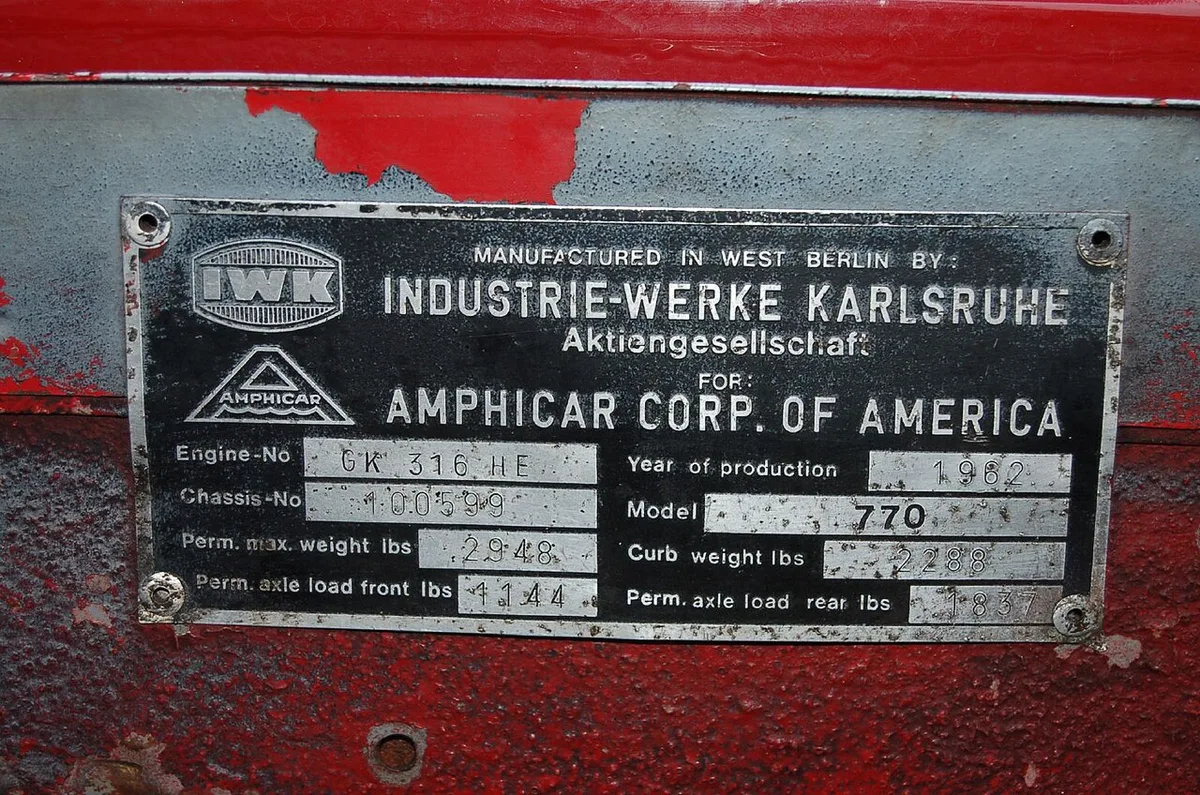
Image source: Wikimedia Commons / Joe Ross from Lansing, Michigan (CC BY-SA)
| Point | Where to look | What it tells you |
|---|---|---|
| Windscreen plate | Lower driver-side corner, readable from outside | The number a buyer sees, and the easiest one to fake |
| Certification label | Driver door jamb in the US, V5C and under-bonnet plate in the UK | Market spec, build date, paint and trim codes |
| Engine bay stamping | Firewall or strut tower, stamped into bare metal | Whether the shell matches the plates |
| Chassis stamping | Front chassis rail or floor pan, sometimes under a flap | The hardest one to alter without leaving a trace |
Some models add a fifth point under the rear seat or on the boot floor. If you can find it, check it. Thieves rarely bother with the ones buyers don't know about.
What a Factory VIN Plate Looks Like
Factory plates are printed, not typed, and the characters sit in a consistent font with even spacing. They don't have air bubbles under them. They don't peel at one corner.
They don't sit crooked by two degrees.
On a US car, the certification label carries the month and year of manufacture, the gross vehicle weight rating, and a bar code. On a UK car, the V5C carries a watermark, a hologram, and a serial number, and the document itself has a specific texture that photocopies can't reproduce. Our research suggests most fake logbooks fall apart at the serial number, not the printing.
Rivets, Grinding Marks, and Repainting
Get close. Factory rivets have a distinctive rosette pattern and sit flush. Replacement ones are usually round-headed pop rivets, and the drill swarf around them is hard to hide entirely.
Then look at the metal around the plate. Fresh paint over old paint shows as a raised edge. A stamping that's been ground back and re-stamped loses the crispness of the original die.
Run a fingertip across it. Machined edges feel sharp and even. Hand-worked ones feel rounded.
The Stamping That Settles Arguments
The chassis stamping is the one a seller can't talk their way around. It's part of the structure, and altering it means grinding and re-stamping, which always leaves evidence.
If it sits low, get the car raised properly. A set of solid wooden ramps does the job safely for a front-end check. Never crawl under a car held up by a scissor jack.
While you're leaning over the engine bay for the firewall stamping, take two extra minutes for spotting a fluid weep on the bell housing and sump. It's not a theft check, but a car that's been thrashed and hastily repaired usually leaks somewhere.
Decoding the VIN: Check Digit, Model-Year Code, and the Mismatches That Scream Trouble
A VIN isn't a random string. It's a structured record, and every character means something specific.
| Positions | Section | What it encodes |
|---|---|---|
| 1 to 3 | World Manufacturer Identifier | Who built it and where |
| 4 to 8 | Vehicle Descriptor Section | Model, body style, engine, restraint system |
| 9 | Check digit | A math validation of the other 16 characters |
| 10 | Model year | The build year, in North American VINs |
| 11 | Plant code | Which factory assembled it |
| 12 to 17 | Sequential serial | The individual unit number |
The structure is defined by ISO 3779, and in the US it's enforced through 49 CFR Part 565, which requires 17 characters for road vehicles. Our research shows that most buyers never decode past position three. That's where the useful stuff starts.
How the Check Digit Actually Works
Each letter converts to a number: A is 1, B is 2, and so on, with I, O, and Q skipped entirely because they're too easy to confuse with 1 and 0. Then each of the 17 positions gets multiplied by a fixed weight running 8, 7, 6, 5, 4, 3, 2, 10, 0, 9, 8, 7, 6, 5, 4, 3, 2.
Add the results. Divide by 11. The remainder is your check digit, and a remainder of 10 shows up as the letter X.
It takes about a minute with a calculator, and it's the fastest way to catch a hand-stamped number.
Does a Failed Check Digit Mean the Car Is Stolen?
No. A failed check digit means the number is internally inconsistent, which is suspicious but not conclusive. Plenty of legitimate vehicles fail because a plate was replaced after an accident, or because the car was never built for the North American market.
Use it as a trigger, not a verdict. If the math fails on a US-market VIN, ask the seller to explain the plate, then verify the chassis stamping. That's where you'll get the real answer.
Reading the Model Year in Position 10
The year code cycles through letters and digits, skipping I, O, Q, U, Z, and 0. Here's the current stretch.
| Code | Model year |
|---|---|
| N | 2022 |
| P | 2023 |
| R | 2024 |
| S | 2025 |
| T | 2026 |
A mismatch here is one of the loudest signals you'll get. If position 10 says 2024 but the car was first registered in 2021, someone has done something they shouldn't have. European VINs often don't encode model year in position 10 at all, so don't panic on a UK or German car that seems to fail the logic.
Where to Decode for Free
NHTSA's vehicle specification data is the authoritative source for US-market VINs, and it's free. It returns the original make, model, trim, engine, plant, and restraint system as the manufacturer reported them.
Decode the VIN, then compare the output to the car in front of you. Wrong engine, wrong trim, wrong body style, or a build date that doesn't fit the seller's story all point the same direction.
Frequently Asked Questions
Can I check if a car is stolen for free?
Yes, in most countries. The US has NICB VINCheck, the UK has the DVLA vehicle enquiry service plus the police non-emergency line, and Australia runs state registration checks alongside PPSR. These confirm reported theft and registration status, but they don't cover liens or accident history.
Does a clean history report prove the car isn't stolen?
No. Reports only reflect what insurers, titling agencies, and salvage auctions have submitted. An unreported theft or a cloned VIN will read as completely clean.
Treat any report as one data point, and always verify the physical VIN points on the car itself.
What's the single biggest red flag at a viewing?
A VIN that doesn't match across all four points. Plates, door jamb labels, engine bay stampings, and chassis stampings should all agree. Any discrepancy means the car's identity has been altered, and you should walk away without further discussion.
Is it illegal to buy a stolen car if I didn't know?
In most jurisdictions, yes, possession of stolen property is an offence regardless of knowledge. Your defence depends on proving you took reasonable steps, such as running checks, meeting the registered keeper, and keeping records. That's the practical reason to document every check you make.
How do I check a car before buying it privately?
Get the VIN first, run the free official check and a paid history report, then compare the seller's ID against the name on the title or V5C. Meet at the registered address, pay by traceable method, and complete the transfer in your name immediately after the sale.
What should I do if I discover the car is stolen after paying?
Contact the police immediately and do not confront the seller. Preserve every message, receipt, and advert. Then report it to Action Fraud in the UK or the FTC and IC3 in the US, and notify your insurer.
Recovery of funds is slow and often partial, which is exactly why the checks happen first.
Free Official Checks: NICB VINCheck, NMVTIS, DVLA Enquiry, askMID, PPSR, and CPIC
Free checks come from the agencies that actually hold the data. That's why they carry more weight than a polished report with a padlock icon on it.
The catch is coverage. Each free service looks at one narrow slice of the record, and none of them talk to each other. Here's the map.
United States: Insurer Data and Federal Title Data
NICB VINCheck is free, needs nothing but a VIN, and returns two facts. It tells you whether the vehicle shows as stolen in insurer-submitted records, and whether it has been reported as a salvage or total loss.
The limit sits in the phrase "insurer-submitted." Member companies cover a big share of the US auto insurance market, not all of it. A theft logged only with a local police department may never surface here.
NMVTIS is the federal counterpart, established under 49 U.S.C. § 30502. You can't query it directly. You go through an approved provider, and most charge between $2 and $5 for a single report.
What NMVTIS adds is breadth. It pulls from state titling agencies, junk and salvage yards, and insurers, which makes it the cheapest reliable source for title brands and total-loss history.
Then run the DMV check for the state printed on the title. Some states publish title status free online. Others want a form and a small fee.
If the car is being sold in a different state from the one that titled it, slow down. That mismatch is exactly what title washing depends on.
- If NICB returns a theft hit, call the police non-emergency line and stop there.
- If NMVTIS shows a brand the seller never mentioned, ask for an explanation in writing before you drive anywhere.
- If the title state differs from the sale state, budget for a title search in both jurisdictions.
United Kingdom: DVLA, MOT History, and the Insurance Database
The DVLA vehicle enquiry service is free and gives up more than most buyers realise. You get tax status, MOT expiry, first registration date, engine size, colour, and the date the last V5C was issued.
That last field is quietly useful. A V5C issued three weeks ago on a car the seller claims to have owned for six years doesn't add up.
The MOT history service is the other free heavyweight. It lists every test with the mileage recorded at the time, plus advisories and failures.
A mileage figure that drops between tests is one of the cheapest clocking detectors available anywhere. So is a cluster of sudden failures after years of clean passes.
The DVLA enquiry does not confirm stolen status. That data lives on the Police National Computer, and the PNC isn't public.
What you can do is call 101 and ask. Plenty of forces will confirm whether a registration is flagged, and it costs nothing but a few minutes on hold.
The insurance side runs through askMID, the Motor Insurance Database lookup. Its terms are aimed at confirming cover on a vehicle you own or are named on, so treat it as a sanity check rather than a title search.
MIAFTR, the insurer-run register of thefts and total losses, is not publicly searchable. You reach it through a commercial provider, which is why the paid reports in the next section still earn their money.
One more free trick worth knowing. The DVLA's tax check asks for the V5C reference number. If the reference on the document in the seller's hand returns an error, the document is not what it claims to be.
Australia, Canada, and the EU: PPSR, CPIC, and Eucaris
Australia's PPSR (Personal Property Securities Register) is the gold standard here. For a couple of dollars it returns finance encumbrances, written-off status, stolen-vehicle flags from police data, and registration details in one hit.
State registration checks are free and worth pairing with it. Service NSW, VicRoads, and the Queensland equivalent all publish rego status and write-off indicators.
Canada splits the job. The Canadian Police Information Centre holds stolen-vehicle data and is accessed through police. Provincial registries such as ICBC in British Columbia and ServiceOntario handle title and lien records.
Europe links national registers through Eucaris, which is how a car exported from one member state gets flagged in another. Belgium's Car-Pass goes further and gives buyers a documented mileage history, free at the point of sale.
| Region | Free official check | What it confirms | What it misses |
|---|---|---|---|
| US | NICB VINCheck | Insurer-reported theft and total loss | Unreported theft, liens, dealer damage |
| US | State DMV title lookup | Title status and brands in that state | Other states, finance, theft |
| UK | DVLA enquiry plus MOT history | Tax, MOT, keeper changes, mileage trail | Stolen status, finance, write-offs |
| UK | Police 101 line | Whether the registration is flagged | Finance, title brands |
| Australia | State rego check plus PPSR | Write-off, stolen, finance, rego | Import history from overseas |
| Canada | Provincial registry plus CPIC | Title, liens, stolen status | Cross-border history |
| EU | National register plus Eucaris | Registration, export flags | Unreported theft in the country of origin |
Paid History Reports: What $20 to $45 Genuinely Buys You, and What It Misses
A paid report is not a better version of a free check. It's a different product, assembled from sources you can't reach directly.
In our research, the reports that hold up share a common trait. They name their data sources and give you a date stamp on every record.
What Comes Back in a Full Report
- Title brands across every state or jurisdiction the car has lived in
- Outstanding finance and lien notation, which is the check most buyers care about
- Write-off and total-loss categories, including salvage, flood, fire, and theft recovery
- Mileage history with the date and source of every reading
- Keeper or owner count and how often the car changed hands
- Plate changes and registration transfers
- Import and export markers, which is where cloned cars usually break cover
- Salvage auction photographs, on the better reports
Those auction photos are the single most underrated feature. A car listed as light front damage that arrives with a caved-in roof tells you the description was fiction.
What It Cannot Tell You
Here's the part the adverts bury. A history report is a records search, not an inspection and not a police check.
- Unreported theft. If nobody filed, there's nothing to find.
- A cloned VIN. The report is describing a different car entirely, and it will look perfect.
- Damage repaired privately. Cash repairs never touch an insurer feed.
- Reporting lag. Insurers and agencies submit on their own schedules, and some are slow.
- Grey imports and cars new to the country. A vehicle with no domestic history returns a clean, empty report.
- Anything after the report date. Pull the report the day you view, not three weeks earlier.
That last point matters more than people think. A report is a snapshot, and a snapshot taken last month says nothing about last week.
Free Check vs Paid Report: Who Each One Suits
| Buyer situation | Best value option | Why |
|---|---|---|
| Car under $3,000, local seller you know | Free NICB or DVLA check plus eyes on the VIN | The report costs a chunk of the purchase price |
| Car over $8,000 from a stranger | Free check plus full paid report plus inspection | The report is under 1% of the money at risk |
| Classic or imported vehicle | Paid report plus a marque specialist | Standard reports often return thin data |
| Trade or auction purchase | Multi-provider report plus PPI every time | You're buying at speed with no comeback |
Some providers attach a guarantee to their data. Read the small print before you rely on it. Most cap the payout, require you to have bought the car in good faith, and demand the report be pulled within a set window before purchase.
Paperwork Under a Torch: Title Brands, V5C Security Marks, Liens, and Keeper vs. Owner
Documents are where a careful fraudster puts the effort. Which is exactly why they deserve fifteen minutes under a bright light rather than a glance on a kitchen table.
Title Brands and What Each One Costs You
A brand is a permanent note on the title. It follows the car, and it never washes out cleanly no matter how many times the car changes hands.
| Brand | What it means | Practical impact |
|---|---|---|
| Salvage | Insurer wrote it off as uneconomic to repair | Value drops hard, insurance gets expensive |
| Rebuilt or prior salvage | Repaired and re-titled after a write-off | Sellable, but expect a 20 to 40% hit |
| Flood | Water damage recorded | Electrical faults for years, corrosion in hidden places |
| Hail | Cosmetic total loss | Usually fine mechanically, poor resale |
| Lemon or manufacturer buyback | Returned under consumer law | Warranty history worth checking closely |
| Junk | Not roadworthy, parts only | Cannot be titled for the road in most states |
| Theft recovery | Stolen then found | Condition depends entirely on what happened in between |
| Odometer rollback | Mileage discrepancy recorded | Assume every service record is unreliable |
A branded car isn't automatically a bad buy. An unbranded car that should have been branded is the one to worry about.
Keeper Versus Owner, and Why the Difference Is the Whole Game
In the UK, the V5C names the registered keeper. The keeper is the person responsible for taxing and insuring the car. The keeper is not necessarily the legal owner.
Ownership can sit with a finance company, a leasing firm, or a relative who paid for the car. That distinction is why an outstanding finance check matters more than a logbook in someone's hand.
The US equivalent is title holding. The name on the certificate of title is the owner, and any lienholder is usually printed on the face of the document.
If a seller hands you a title with a bank listed as lienholder and says the loan is settled, ask for the lien release. Verbal assurances don't release anything.
V5C Security Marks and Title Authenticity
A genuine V5C has a watermark, a hologram, and a serial number, and the paper has a texture that photocopies flatten. Our research suggests most forgeries fail on the serial number rather than the printing.
Check that the serial is present, that it hasn't been overprinted, and that the document number works in the DVLA's online tax check. A logbook that fails a government lookup isn't a logbook.
US titles vary by state, which is the loophole. Some are notarised, some are electronic, and some are printed on plain security paper. If the title looks like it came off a home printer, it probably did.
Watch for an "open" title, where the seller never registered the car in their own name. That's title jumping, and it means the chain of ownership has a hole in it you'll inherit.
The Paperwork That Should Exist Before Money Moves
- Title or V5C in the seller's name, matching their ID
- Lien release if any finance was ever recorded
- Bill of sale with VIN, date, price, and both signatures
- Odometer disclosure where required under 49 CFR Part 580
- Import documents for anything that crossed a border, including customs entry and duty payment
- Service records with dates and mileages that fit the story
Missing paperwork isn't always fraud. But every missing document shifts risk from the seller onto you.
Physical Red Flags at the Viewing
Fifteen minutes with a torch tells you more than three hours of conversation. Bring the right kit and work through the car in the same order every time.
| Tool | What it's for | Cost |
|---|---|---|
| Bright LED torch | Rivets, stampings, weld lines, paint edges | $15 to $30 / £10 to £25 |
| Rag and gloves | Cleaning a stamping before you read it | Nothing |
| Phone camera | Photographing every VIN point and document | You already have one |
| Paint thickness gauge | Spotting filler and fresh panels | $25 to $60 / £20 to £50 |
| OBD2 reader | Checking stored fault codes and readiness monitors | $30 to $150 / £25 to £120 |
That code reader earns its place for a reason separate from theft. A car with every monitor reset and a freshly cleared memory has usually had something hidden, which is why choosing the right diagnostic tool before you view is worth the effort.
VIN Plates, Rivets, and Grinding Marks
Start at the windscreen. Read the plate from outside, then photograph it. The characters should be crisp, evenly spaced, and printed rather than hand-punched.
Now open the driver's door and compare the jamb label. Then find the engine bay stamping and the chassis number. All four should read identically, character for character.
Get within inches of the plate and look at the rivets. Factory rivets are a rosette pattern and sit flush in a recessed pocket. Hand-set pop rivets bulge, and the drill marks around them are almost impossible to fully disguise.
Run a fingertip over the stamping. Original die work feels sharp and consistent. A ground-and-restamped panel feels rounded, and the surrounding paint rarely matches the texture.
If the plate is held on with pop rivets and the seller says the windscreen was replaced, ask which shop did the work and get it in writing. Windscreen replacement doesn't require removing the VIN plate on most cars.
Panel Stickers, Paint Lines, and Spot Welds
Most manufacturers fit VIN stickers to the bonnet, both front wings, all four doors, and the boot or tailgate. Missing stickers on one side only is a pattern worth questioning.
A paint thickness gauge is the fastest way to find filler. Factory paint reads roughly 90 to 140 microns. Readings north of 300 mean bodywork, and readings over 1,000 mean filler deep enough to hide a welded seam.
Then look for overspray. Check the rubber window seals, the door shuts, the arch liners, and the underside of the bonnet. Fresh paint where it shouldn't be tells you a panel was refinished outside a proper booth.
Check the factory spot welds along both sills and the floor pan. They should be evenly spaced and mirrored on each side of the car. A continuous MIG bead with fresh seam sealer over the top is a rebuild, not a repair.
Panel gaps are the low-tech version of the same test. Run a finger along each gap. Uneven widths around one corner suggest the structure moved and was pulled back.
If it's a pickup, lift the bed cover and check the bed floor for fresh undercoat and welded seams. That area hides structural repairs better than anywhere else on the vehicle.
Locks, Keys, Immobilisers, and the Odometer Trail
A stolen car often carries the scars of how it was taken. Look closely at the ignition barrel and the steering column shroud for gouges, fresh screws, or a trim panel that doesn't sit flush.
Count the keys. Two keys with fobs and a valet key is normal. One key and a story about the spare being lost is common enough to be meaningless on its own, but it does make the car cheaper to steal a second time.
Check that the remote locks and unlocks every door, and that the immobiliser light behaves normally when you turn the key. A car that starts with a jump pack and an overridden immobiliser is a problem you inherit.
Then test the mileage against the physical evidence:
- Pedal rubbers worn smooth at 40,000 miles on the clock
- Gear knob and steering wheel polished where the owner's hands sat
- Driver's seat bolster collapsed on a "low mileage" car
- MOT or service records that show the number going backwards
- Mismatched tyre brands on a car described as meticulously maintained
One worn item proves nothing. Three together tell a story the seller can't talk around.
While you're crouched at the wheels, check the locking wheel nut key is present and that all four nuts match. Missing or mismatched hardware is a small thing that points at a bigger one, and it's worth knowing what replacements actually run before you agree a price.
Finally, glance at the glass and mirrors. A freshly bonded mirror glass or a mismatched window on one corner suggests impact damage that never made it onto any report.
Vetting the Seller: ID Matching, Meeting Rules, and Payment Traps
The car can be clean and the seller can still be the problem. This is the part where most buyers relax, and it's the part that costs them.
Matching the Person to the Paperwork
Ask for photo ID and hold it next to the title or V5C. The name should match, and so should the address. If the seller is named on the document but the address differs, ask why and write the answer down.
The most common dodge is the third-party sale. "It's my cousin's car, he's working abroad, I'm just helping." That's not an explanation, it's a gap in the chain of ownership you'll inherit the moment you pay.
Watch for curbstoning too, where a trader poses as a private seller to dodge consumer law obligations. The tells are consistent: the car is parked on a street or in a retail car park, the seller has no paperwork at home, and the phone number turns up on a dozen other adverts.
Search the number. Search the photos with a reverse image lookup. Ten listings from one number is a dealer, and a dealer who lies about being a dealer has told you what kind of dealer they are.
If the seller won't meet at the registered address, treat the whole sale as high risk. There is no legitimate reason to view a car you're about to buy in a supermarket car park.
Meeting Rules That Keep You Safe
- Meet in daylight at the address on the paperwork
- Bring someone with you and tell a third person where you are
- Never view a car at a remote location or a storage yard you can't verify
- Take your own photos of the car, the VIN points, and the documents
- Don't hand over a deposit to "hold" a car you haven't inspected
- Never confront someone you suspect of selling a stolen vehicle
That last rule is not politeness. If the car is stolen, the person in front of you may be involved in something more serious than a dodgy sale. Walk away, then call the police from somewhere else.
Payment Traps and How Each One Works
Payment is where fraudsters make their money, and the methods are well worn.
| Trap | How it works | What to do instead |
|---|---|---|
| Cash only, no receipt | Nothing ties the payment to the car or the seller | Bank transfer with the VIN in the reference |
| Deposit before viewing | Money leaves before you've seen the car or the VIN | Pay nothing until you've inspected it |
| Third-party bank account | The account name doesn't match the seller's ID | Refuse, and treat it as a red flag on the sale |
| Fake escrow site | A convincing clone site "holds" funds that never existed | Use a provider you found yourself, never a link they sent |
| Overpayment scam | A "buyer" or "seller" sends too much and asks for a refund | Never refund a payment you haven't fully cleared |
| Payment screenshot | A phone shows a transfer that was never made | Confirm cleared funds in your own banking app |
The overpayment version usually targets sellers, but it appears in buyer-side scams too. Sometimes it arrives as a "shipping agent" fee for a car you're supposedly buying sight unseen.
If a seller insists on cash, that's not automatically fraud. But insist on a written receipt with the VIN, the date, the amount, both names, and both signatures. Photograph the seller's ID next to it.
Once money has moved, complete the transfer immediately. Register the car in your name the same day and insure it before you drive it home. A gap of a few days is where a lienholder or a previous keeper can complicate everything.
If the seller asks you to put the car in someone else's name, refuse. That request has no innocent explanation, and it puts your name on a document chain you don't control.
Getting an Authoritative Answer: Police Enquiry Lines, Franchised Dealers, and Import Paperwork
No consumer database is the source of truth on theft. The source of truth is a police record. Everything else, NICB included, is a copy of a copy that may be weeks out of date.
That's not a reason to skip the databases. It's a reason to know which question each channel can actually answer.
Calling the Police Without Wasting Anyone's Time
In the UK, dial 101 and ask for the force covering the seller's address. Say you're a buyer, give the registration and the VIN, and ask whether the vehicle is recorded as stolen.
Some call handlers will confirm or deny on the spot. Others will say they can't release third-party vehicle data. That's a data protection answer, not a brush-off.
If you get that answer, change the question. Ask whether the seller can bring the car and the V5C to a station for a check. Many forces will accommodate that.
A seller who agrees is probably genuine. A seller who goes quiet has told you something useful.
US buyers have a similar route. Call the non-emergency line for the seller's town, or the state police. Give the VIN rather than the plate, and explain you're a prospective buyer.
Some departments will run it there and then. Some will point you toward the National Insurance Crime Bureau, which runs a tip line on 1-800-TEL-NICB. Either way, get a name and a reference number if you can.
When the Police Won't Tell You
Plenty of agencies won't discuss a vehicle with a stranger on the phone. That's normal, and it doesn't mean the car is dirty.
What you do next decides whether you learn anything. Ask the seller to attend a station with you. Offer to book it, offer to pay any fee, and offer a time that suits them.
Three outcomes follow. They agree and turn up, which is a strong signal. They agree and cancel twice, which is a weaker one.
They refuse outright and get defensive, which is the answer you were looking for.
Don't accept "I'll get my mate who's a copper to run it" either. That's a story, not a check.
Franchised Dealers and the Spec Mismatch Test
A main dealer for that marque can do something no database can. They can pull the manufacturer's build record for the VIN and compare it to the car in front of them.
That catches clones better than anything else. If the VIN decodes to a 1.6 petrol SE in silver with cloth seats, and the car on the drive is a 2.0 diesel in black leather, the identity has been borrowed.
Dealers can also see whether the car was serviced in the network, and roughly where. A car with six years of stamps from one city suddenly appearing 400 miles away deserves a question.
Most charge nothing for a quick spec pull, especially if you're polite and it's quiet. Some charge a small fee for a written verification. Either way, it's cheap insurance on an expensive car.
Import Paperwork and the Cross-Border Traps
Cross-border cars are where paperwork checks earn their keep. A stolen vehicle exported to another continent is rarely recovered, and the buyer at the far end usually has no idea.
In the US, ask for the customs entry summary (CBP Form 7501), the EPA declaration (Form 3520-1), and the DOT declaration (Form HS-7). A car that entered legally will have all three.
In the UK, look for the NOVA notification confirming duty and VAT were paid, plus the IVA certificate if the car needed one. A V5C issued shortly after import is normal. A V5C with no import trail behind it is not.
In the EU, the certificate of conformity plus the national registration document should match the VIN plate exactly. Eucaris links member state registers, which is how an exported car gets flagged on re-registration in another country.
| Channel | What it confirms | How to access it | Typical wait |
|---|---|---|---|
| Police non-emergency line | Whether the VIN or plate is flagged stolen | Phone call, or seller attends a station | 10 to 30 minutes |
| NICB VINCheck | Insurer-reported theft and total loss | Online, VIN only | 2 minutes |
| Franchised dealer | Build spec, trim, engine, service network history | Phone or visit | Same day |
| Your own insurer | Whether they'll cover it, and at what premium | Phone quote using the VIN | 10 minutes |
| Customs and import records | Legal entry, duty paid, correct declarations | Documents from the seller | Same day |
What Each Check Costs and How Long It Takes
Most buyers overestimate the cost of a full verification and underestimate the cost of skipping it. Here's the honest price list.
| Check | US cost | UK cost | Time |
|---|---|---|---|
| NICB VINCheck | Free | n/a | 2 minutes |
| DVLA vehicle enquiry plus MOT history | n/a | Free | 3 minutes |
| NMVTIS via approved provider | $2 to $5 | n/a | 5 minutes |
| Full vehicle history report | $20 to $45 | £10 to £30 | 5 minutes |
| PPSR (Australia) | A$2 to A$10 | n/a | 5 minutes |
| Police non-emergency enquiry | Free | Free | 10 to 30 minutes |
| Insurance quote against the VIN | Free | Free | 10 minutes |
| Independent pre-purchase inspection | $100 to $300 | £100 to £250 | 1 to 3 hours |
| Dealer VIN and spec verification | Free to $150 | Free to £100 | Same day |
Add it up for a mid-range private purchase. A £7,500 car with a free DVLA check, a £25 history report, and a £180 inspection costs you £205 to verify. That's 2.7% of the purchase price.
Compare that to the downside. Buy a cloned car and you lose the car, the money, and possibly your standing with your insurer in the same week.
The Subscription Trap in Free VIN Check Sites
A lot of "free VIN check" pages aren't free. They ask for a card to "verify identity," then bill a monthly subscription that runs until you cancel it.
The pattern is consistent. You get a partial report, a big upsell, and a recurring charge buried in the terms. Our research suggests the renewal terms are often the smallest text on the page.
Use the official services first. NICB, DVLA, state DMV portals, and PPSR are genuinely free or near-free. Then pay a named provider once, on a one-off basis, with a card you can dispute if it goes wrong.
Why the Inspection Is the Line Item People Cut
The inspection is the only check that looks at the actual metal. It's also the one buyers drop when the budget gets tight, usually on cars under £5,000.
That's backwards. Cheap cars are where cut-and-shut rebuilds live, because the margin on a £3,000 car is thin enough that a shed-built weld job is the only way to make money.
An inspector puts the car on a lift, checks the structural welds, measures paint depth, reads the fault memory, and looks at the state of the tie rod ends and bushings while it's in the air. That's two hours of looking at the half of the car you can't see.
The Time Budget Nobody Plans For
Verification takes two visits, not one. The remote checks take twenty minutes and should happen before you drive anywhere. The viewing takes an hour.
The inspection needs a separate appointment.
If a seller pushes you to decide in one afternoon, that's the pressure tactic, not a coincidence. A genuine seller with a genuine car will hold it for a deposit-free 48 hours while your inspector gets a slot.
Mistakes That Cost Buyers the Entire Purchase Price
These are the errors that show up again and again in fraud cases. Each one is cheap to avoid and expensive to survive.
| Mistake | What it costs | The fix |
|---|---|---|
| Checking the plate instead of the VIN | Everything, if the plates are cloned | Verify the VIN at all four points |
| Pulling the report weeks early | Misses theft or finance recorded since | Pull it the day you view |
| Treating "HPI clear" as a guarantee | False confidence | Read what the report actually covered |
| Meeting in a car park or lay-by | No address to trace, no comeback | Insist on the registered address |
| Paying a deposit before viewing | The deposit, and often the sale | Pay nothing until you've inspected |
| Ignoring a finance marker | The car can be repossessed from you | Get a written lien release |
| Skipping the ID match | Title jumping, curbstoning, fraud | Hold ID next to the title |
| Buying at night or in heavy rain | Hides paint, welds, and plate tampering | View in daylight, dry weather |
| Skipping the inspection on a cheap car | The whole purchase price | Inspect anything over scrap value |
| Accepting a photocopied title | Nothing, because you own nothing | Original documents only |
| Delaying the transfer | Previous keeper or lender complications | Register it the same day |
| Handing cash with no receipt | No proof the payment happened | Bank transfer plus a signed receipt |
The One That Catches the Most People
Buying on emotion is the root of most of the list. You've driven an hour, the car looks great, the seller is friendly, and the price is right. That's exactly when judgment goes soft.
Build a rule before you leave the house. No money moves until the VIN matches at four points, the report is under 24 hours old, and the name on the paperwork matches the face in front of you.
If any one of those fails, you walk. Not negotiate. Walk.
If the Seller Pushes Back on Any Check
Pushback is data. A legitimate seller might be mildly annoyed, but they'll usually comply because they want the sale.
If they refuse to give the VIN in a message, stop. There is no version of that refusal that helps you.
If they refuse an inspection, ask why in writing. "I don't want strangers poking around" is an answer, and it tells you the car hasn't been looked at closely in years.
If they refuse to meet at the registered address, treat the sale as high risk regardless of how good the car looks.
The Mistake That Isn't About the Car at All
Plenty of buyers do every check correctly and then hand over cash in a car park because the seller was charming. The car was clean. The transaction wasn't.
Fraud doesn't need a stolen vehicle. It just needs a buyer who did the vehicle checks and forgot the seller checks.
If the Car Turns Out Stolen: The First 24 Hours, Your Legal Exposure, and Recovery Options
This is the scenario nobody plans for, and the one where the wrong first move makes everything worse.
The First Hour: Stop, Park, Call
Stop driving. Park somewhere legal and public, take the keys, and lock it. Do not drive it home and do not drive it to the seller's address.
Then call the police. Use the non-emergency line if nothing is happening right now, or the emergency line if you feel unsafe or the seller is nearby and aggressive.
Don't confront anyone. Not the seller, not their family, not the person who "helped" with the sale. Confrontation turns a financial problem into a safety problem, and it can compromise the investigation.
What to Say, and What to Keep
Tell the police what you know and how you know it. You bought a vehicle, you've since found reason to believe it's stolen, and here's the VIN, the registration, and the seller's details.
Then preserve everything:
- The original advert, including screenshots with the URL and date
- Every message, text, and email, unedited
- Photos of the seller's ID and the documents they showed you
- Your bank record or receipt, with the VIN in the reference
- The bill of sale, signed and dated
- Photos of all four VIN points, taken before you paid
Get a crime reference number. Without one, insurers, banks, and fraud agencies will struggle to act.
Your Legal Position, Stated Plainly
A thief cannot pass good title. That principle runs through common law systems, and it means the car was never legally yours, however honestly you bought it.
In the UK, section 22 of the Theft Act 1968 covers handling stolen goods. The offence turns on knowledge or belief, so genuine ignorance is a defence. But you have to evidence it, and that's where your check records become the most valuable documents you own.
US state statutes vary. Some require knowledge, some accept recklessness, and a few are stricter still. In every version, the practical question is the same.
What did you do to satisfy yourself before you paid?
Your insurer is the second problem. Many policies exclude or void cover where the vehicle isn't lawfully owned. Call them early and tell them what happened, before they find out from someone else.
Getting the Car Back if Police Seize It
If officers take the vehicle, ask for a property receipt and the name of the recovery operator. Note how it gets recovered and where it's being stored, because storage fees can start accruing immediately.
You'll usually be treated as a witness or an innocent purchaser, not a suspect. That's a better position than it sounds, but it doesn't get your money back. It just keeps you out of the dock.
If the car is later released back to the true owner or the insurer, expect nothing from it. Your claim is against the seller, not the vehicle.
Chasing the Money
Recovery is slow, partial, and depends entirely on whether you can find and serve the seller.
| Route | Who it suits | What it can achieve |
|---|---|---|
| Police report and crime reference | Everyone | Establishes the record and supports every other claim |
| Bank or card dispute | Card payments, recent transactions | Possible chargeback if the payment was misrepresented |
| Section 75 claim (UK credit card) | Purchases over £100 on a credit card | Joint liability with the card issuer |
| Small claims court | Sellers you can name and locate | A judgment, though enforcement is another matter |
| Action Fraud (UK) | Any UK victim | Intelligence gathering, not individual recovery |
| FTC and IC3 (US) | Any US victim | Federal reporting and pattern tracking |
| Civil claim against an identified party | Cases with clear documentation | The best realistic chance of getting funds back |
Keep every message. A seller who wrote "clean title, no finance, owned it three years" has given you a written misrepresentation, and that's worth more than a verbal promise you can't prove.
The Verified Decision Guide: When to Walk, When to Negotiate, When to Buy
Everything above collapses into a small number of decisions. Here's how to make them at the roadside.
| What you found | Verdict | Why |
|---|---|---|
| VIN mismatch across any two points | Walk away | The identity has been altered |
| Theft or salvage hit on a free official check | Walk away and report it | The record is authoritative enough to act on |
| Outstanding finance with no lien release | Walk away | The lender's claim outranks yours |
| Seller won't give the VIN before a viewing | Walk away | No legitimate reason exists for that refusal |
| Seller isn't the registered keeper or title holder | Negotiate only if they produce written authority | Third-party sales hide the chain of ownership |
| Clean data but a branded history in another state | Negotiate hard, or walk | Price should reflect a rebuilt car |
| Cosmetic issues, clean VIN, clean paperwork | Negotiate on price | Normal used-car condition, normal leverage |
| All checks clean, inspection clean, seller verified | Buy | This is what a good purchase looks like |
The Green, Amber, and Red Test
Green, buy with confidence. Four VIN points match, the free official check is clear, the paid report is under 24 hours old and shows no liens, the seller's ID matches the title or V5C, and an independent inspection found nothing structural.
Amber, proceed only with written answers. One minor discrepancy, a recent keeper change, a short ownership period, or a report with gaps in the mileage trail. Get explanations in writing, get the inspection done, and adjust your offer.
Red, walk and don't look back. A VIN that doesn't match, a refusal to meet at the registered address, a request for a deposit before viewing, or a seller who can't explain who legally owns the car.
What "Good Enough" Actually Looks Like
Perfect used cars don't exist, and chasing one costs you good vehicles. A 2016 hatchback with 90,000 miles, a couple of owners, a full MOT or service trail, one small advisory on a tyre, and a clean VIN is a normal, healthy car.
What you're screening for isn't perfection. It's whether the identity is genuine and whether the money is safe. Everything else is negotiation.
Run the checks in order, keep the paperwork, meet the person at their own address, and pay in a way you can trace. Do that and the odds of ending up with someone else's car are close to zero.
