
You spot a truck listed at half of what it should cost, and the ad says one thing you don't recognize: what is a salvage title, anyway? Short version, it's the paperwork an insurance company leaves behind after deciding the car costs more to fix than it's worth. The seller acts like that's a minor detail.
It isn't.
One number sets the whole story in motion. Insurers typically total a vehicle once the repair estimate reaches roughly 70% to 80% of its pre-crash value, depending on state rules and carrier guidelines. That brand then lands in NMVTIS, the national title database run by the U.S.
Department of Justice, and it stays attached to the VIN for life. Understanding how that record gets created is the difference between a genuine bargain and a four-figure mistake.
What Is a Salvage Title
A salvage title is a brand placed on a totaled vehicle. The insurer paid the claim and took ownership of the car. The state then marks the VIN as salvage.
Most states bar that car from public roads until a rebuilt inspection passes. Clean-title cars carry no such brand.
How a Car Gets a Salvage Title: The Total-Loss Process Explained
A salvage brand is a math outcome, not a visual one. Plenty of branded cars look fine in photos and still get totaled, because the repair estimate crossed a line the insurer wasn't willing to pay.
Here's the sequence, start to finish:
- The car takes damage from a collision, flood, fire, hail, or theft recovery.
- You file a claim and the carrier sends an adjuster to inspect it.
- The adjuster writes a repair estimate using parts and labor pricing for your market.
- That estimate gets compared against your car's actual cash value (ACV), which is what a comparable car sells for locally right now.
- If the numbers cross the state threshold, the insurer declares a total loss.
- The carrier pays you ACV minus your deductible, then takes the car or sells it back to you.
- The state titling agency issues a salvage certificate, and the brand follows the VIN from then on.
Notice what's missing from that list: any test of whether the car is safe to drive. Nobody at the insurance company is judging structural integrity. They're judging cost.
The accident, the claim, and the adjuster's total-loss call
The adjuster's estimate is the single most consequential document in this whole story. It's built from a parts and labor database, and it includes hidden damage once the shop tears the car down.
That's why a car with a bent frame and a car with a smashed bumper can end up with the same brand. Age and value matter as much as damage. A 2010 sedan with a $4,800 repair bill and a $5,000 ACV gets totaled.
A 2023 truck with the same bill gets fixed.
Aggregate industry data also shows how often the call is close. Repair costs have climbed faster than used values in recent years, so more cars cross the threshold than most shoppers expect.
How the brand gets attached to the VIN
The insurer reports the total loss to the state, and the state updates the title record against the VIN, not the license plate and not the owner. That's the detail people miss. The brand is welded to the car itself.
Federal law requires insurers and salvage yards to report total-loss and salvage events to NMVTIS. That means a branded car should surface in a national title check even if it moved three states away.
When the paperwork is handled correctly, a buyer anywhere in the country can see the brand with one lookup. When it isn't, you get title washing, which we'll get to later.
Owner retention: buying back your own totaled car
If your own car gets totaled, you usually have the option to buy it back instead of handing over the keys. This is called owner retention, and the insurer simply subtracts the salvage value from your payout.
Say your car is worth $12,000 and a salvage buyer would pay $2,100 for it. You keep the car, and you get $9,400 minus your deductible instead of the full amount.
This makes sense when you know the car's history and the damage is mostly cosmetic. It makes far less sense when the frame is bent or water got into the wiring. Either way, the car still ends up with a salvage brand, so you'll be the one handling the rebuilt inspection later.
One practical note people forget: a totaled car usually isn't safe to drive home, and a flatbed needs a solid mounting point. Knowing how to find a proper recovery point matters before anyone hooks a strap to your bumper.
Salvage vs. Rebuilt vs. Clean vs. Non-Repairable Titles
These four labels get used interchangeably in marketplace listings, and that's where buyers get hurt. They mean very different things.
| Title status | What it means | Can it be driven on public roads? |
|---|---|---|
| Clean | No total-loss brand on record | Yes |
| Salvage | Insurer declared a total loss, not yet rebuilt and inspected | Usually no |
| Rebuilt / reconstructed | Repaired and passed the state inspection | Yes, in most states |
| Non-repairable / junk | Declared unfit to ever return to the road | No, permanently |
Salvage title: totaled and off the road
A salvage title means the car was declared a total loss and hasn't been through the rebuild process. In most states it's not legal to drive it on public roads in this condition.
You can still buy and sell these cars. You can repair them. You just can't plate and insure them normally until the brand changes.
Rebuilt (reconstructed) title: repaired, inspected, street-legal
A rebuilt title means someone repaired the car and a state authority inspected it. The exact name varies, so you'll see "rebuilt," "reconstructed," "restored salvage," and "prior salvage" depending on where you live.
Here's the part that trips people up: a rebuilt title is still a branded title. It is not a clean title, no matter what a seller tells you. The car is legal to drive, but the discount and the insurance complications follow it forever.
Non-repairable (junk or parts-only) title: never drivable again
This is the end of the line. A non-repairable title, sometimes called a junk title, parts-only title, or certificate of destruction, means the state has permanently barred the vehicle from returning to the road.
These cars get sold for parts or scrap. If someone offers you a "great deal" on a car with a certificate of destruction and promises you can fix it up, walk away. No inspection will undo that brand in most states.
Clean title: the default, and why it's not a safety guarantee
A clean title means no total-loss brand is on record. It does not mean the car was never wrecked, never flooded, or never repaired badly.
Plenty of cars get damaged, fixed out of pocket, and never reported to an insurer. No claim means no brand. That's why a pre-purchase scan with a decent diagnostic tool and a mechanical inspection still matter on a clean-title car.
The title tells you about insurance history, not about the last ten years of the car's life.
You can also check open safety recalls directly through NHTSA using the VIN, which takes about a minute and occasionally turns up an unfixed airbag or fuel-system recall.
The Numbers: Total-Loss Thresholds, Payout Math, and the Resale Value Hit
This is where the topic stops being abstract. Salvage status is a financial event, and the numbers are predictable enough to plan around.
State rules drive everything. Some states use a flat percentage of value. Others use the total-loss formula, which adds the repair cost to the salvage value and compares that sum to the ACV.
A few leave it to insurer judgment.
| State | How the brand typically gets triggered |
|---|---|
| Texas | Repair cost plus salvage value meets or exceeds ACV |
| Florida | Repair cost reaches 80% of value |
| Iowa | Repair cost reaches 70% of value |
| Colorado | No fixed percentage, insurer determination |
| California | Total-loss formula set by regulation |
Treat that table as a starting point, not gospel. Thresholds change, and your state DMV is the only authority that counts. Verify before you sign anything.
The payout math is simple once you see it laid out:
| Line item | Example |
|---|---|
| Pre-crash actual cash value | $12,000 |
| Deductible | $500 |
| Salvage value | $2,100 |
| Check to the owner | $9,400 |
Now the part buyers care about most. What does the brand do to resale?
| Title status | Typical discount against clean-title comps |
|---|---|
| Rebuilt title | 20% to 40% |
| Unrepaired salvage | 50% or more below retail |
| Non-repairable | Parts value only |
Those discounts are the market correcting for risk, and they're sticky. A rebuilt car doesn't slowly earn its value back. It sells at a discount the day you buy it and at a discount the day you sell it.
Rebuild costs add up faster than people budget for, too. Small parts bills stack quickly, and even basic hardware prices can add real money to a full tear-down. If you're doing the work yourself and need to get under the car, homemade ramps are a cheaper route than a lift, provided you build them to handle the load.
The honest summary as of 2026: a salvage car can be a genuinely good deal, but the savings have to exceed the repair bill plus the resale hit plus the insurance friction. Most buyers only count the first number.
Can You Insure a Salvage or Rebuilt Title Car?
This question sinks more salvage deals than any mechanical problem. The car can be perfect and still be hard to insure.
An unrepaired salvage car usually can't be insured for road use at all, because it isn't legally drivable. Once it's rebuilt and inspected, coverage becomes possible, but the terms change.
| Coverage type | Unrepaired salvage | Rebuilt title |
|---|---|---|
| Liability only | Generally unavailable | Usually available |
| Collision and comprehensive | No | Sometimes, with conditions |
| Full coverage required by a lender | No | Rarely |
| Gap insurance | No | Typically excluded |
| Stated value or agreed value | No | Occasionally, with an appraisal |
In our research, the pattern across carriers is consistent. Many major insurers will write liability coverage on a rebuilt car and decline physical damage coverage entirely. Others will offer collision and comprehensive but cap the payout at a percentage of what a clean-title version would be worth.
That cap matters more than the premium. If you total your rebuilt car, the check reflects the branded value, not what you paid for it.
A few practical rules that save people a headache:
- Call your insurer with the VIN before you buy, not after.
- Get the coverage answer in writing, including the payout basis.
- Ask specifically whether the policy pays ACV or a stated amount.
- Confirm your lender's rules if the car needs financing.
- Re-shop coverage every renewal, because carrier appetite shifts.
One more thing worth knowing. Some states require a rebuilt-title inspection before the car can be registered, and that inspection is a safety check, not a quality check. It confirms the car has the right parts and isn't a stolen-parts build.
It does not certify that the frame is straight or that the airbags actually work.
That gap is exactly why so many rebuilt cars end up back in the shop. Suspension and steering components take the worst of it after a hard hit, and cheap replacements are everywhere. Our breakdown of whether upgraded tie rod ends are worth the money applies double on a rebuilt front end.
If you're shopping for coverage and the carrier says no, don't assume every carrier will. Specialty insurers exist for rebuilt vehicles, and state insurance departments publish complaint data that helps you judge them before you commit.
Financing a Salvage Vehicle: Why Most Lenders Say No
Because the car is the collateral, and a branded title makes that collateral hard to sell. A lender who has to repossess a salvage or rebuilt vehicle is holding an asset that might fetch half of book value at auction. That risk gets priced in, or the application gets declined outright.
Most banks and credit unions write their loan policy around clean-title collateral. It's not a legal ban. It's an internal guideline buried in the underwriting manual, and no amount of good credit changes it.
Here's how the routes actually shake out in our research:
| Financing route | Works on a branded title? | What to expect |
|---|---|---|
| Major bank auto loan | Rarely | Policy exclusion, not a credit issue |
| Credit union | Sometimes | Lower loan-to-value cap, higher APR |
| Buy-here-pay-here lot | Often | In-house financing, steep rates |
| Personal loan | Usually | Unsecured, so the title doesn't matter |
| Credit card | Technically | Never do this on a vehicle purchase |
| Dealer financing on a trade-in | Depends | Many dealers won't take the trade at all |
Loan-to-value is the second wall. Even a lender willing to touch a rebuilt car will often cap the loan at 50% to 80% of its branded value. On a $14,000 rebuilt truck, that could mean an $8,000 loan and a $6,000 cash gap.
Now the trap that kills deals late in the process. Most auto loans require the borrower to carry collision and comprehensive coverage. Many insurers won't write physical damage coverage on a rebuilt vehicle.
So the lender approves you, the insurer declines, and the financing falls apart at the signing table.
Check both answers before you negotiate. Call the insurer with the VIN first, then take the coverage confirmation to the lender. That order saves you a wasted week.
If cash is the only realistic path, treat the purchase price as the full budget. A branded car tends to need money after the sale, and a repair fund matters more than a warranty you probably won't get.
The Safety Risks: Frame Damage, Airbags, and Flood-Car Red Flags
The state inspection is not a safety certification. It confirms the car has the right parts and isn't a stolen-parts build. It does not tell you the frame is straight or that the airbags will fire.
That leaves the real risk assessment to you. Here's where the danger actually hides.
| Damage type | Typical risk level | Why |
|---|---|---|
| Hail | Low | Cosmetic panels, glass, no structure |
| Theft recovery | Low to moderate | Ignition and lock damage, sometimes stripped interior |
| Rear or front collision, cosmetic | Moderate | Bumper, lights, and cooling parts |
| Side impact | High | Unibody deformation, B-pillar integrity |
| Frame or unibody damage | Very high | Crumple zones can't be restored by pulling |
| Flood | Highest | Hidden corrosion and electrical failure years later |
Structural vs. cosmetic damage
Cosmetic damage is bolts and panels. Replace a fender, a hood, a headlight assembly, and the car's crash structure is untouched.
Structural damage is different. Modern vehicles are built with crumple zones designed to fold in a specific pattern at a specific load. Pulling a bent rail straight on a frame machine doesn't restore that engineered behavior.
Sectioning is the other red flag. That's when a shop cuts out damaged rail or apron metal and welds in a replacement section. Done to manufacturer procedure with the right welds, it can hold up.
Done quickly in a driveway, it's the reason some rebuilt cars fold up in a second crash.
Ask a simple question before you buy. Which panels were replaced, and was any structural metal cut or welded?
If the seller can't answer, an independent body shop can. A post-repair inspection on a lift runs a couple hundred dollars and finds things a title check never will.
Missing and counterfeit airbags
This is the part that genuinely endangers lives, and it gets skipped constantly. A deployed airbag is expensive to replace. A set of front airbags, a module, and pretensioners can run well past $3,000 on some models.
That cost pressure creates two problems. Some rebuilt cars get sold with dead airbags still installed and the warning bulb pulled. Others get cheap counterfeit inflators from overseas.
NHTSA has issued repeated warnings about counterfeit airbags, which may not deploy at all or may rupture and send shrapnel into the cabin. A scan tool can tell you a lot here. Stored SRS codes, a mismatch between the module and the VIN, or a module reporting a crash event are all flags.
Check the seatbelt pretensioners too. They fire with the airbags and are often overlooked during a cheap rebuild.
Flood-car red flags
Flood damage is the worst category for a used-car buyer, and it's the hardest to spot in a photo. Water doesn't just ruin carpets. It gets into connectors, fuse boxes, seat motors, and the transmission.
Here's what our research turns up as the strongest physical tells:
- Mud or silt in the spare tire well, door jambs, and under the seats
- Fogging or waterline staining inside headlight and taillight housings
- Rust on bolts under the dash that shouldn't see moisture
- A musty smell that air freshener can't hide
- Stained or wrinkled seat rails and carpet backing
- Corroded wiring harness pins behind the kick panels
- A milky or burnt-smelling transmission dipstick
That last one is worth checking yourself. Water in the gearbox shows up as a strawberry-milkshake color on the dipstick, and it's a fast way to confirm a flood story. Our guide to servicing the gearbox afterward covers what fresh fluid should look like.
Electrical gremlins show up months later. Modules corrode slowly, and the failures look random. That's why flood cars are the one category where even a steep discount rarely makes sense.
Title Washing and Hidden Brands: How Salvage Cars Get Disguised
Title washing is the practice of moving a branded vehicle through a state with weak brand-transfer rules to produce a clean-looking title. It's fraud, it's illegal, and it still happens.
The mechanics are boringly simple. A rebuilt title from one state gets surrendered for a new title in a state that doesn't carry the brand forward the same way. Repeat it once more and the paper trail looks clean.
Export and re-import schemes do the same thing on a bigger scale. So does VIN cloning, where a stolen car gets the identity of a wrecked one from a salvage yard. Both are why a VIN check that only looks at one state proves almost nothing.
The federal government pushed back on this with NMVTIS. Insurers, salvage yards, and junkyards must report total-loss and salvage events, which means brands should follow the VIN nationally. The system works, but reporting lags and some records have gaps.
Watch for these patterns on any listing:
- A title issued in a different state within the last year or two
- The seller's name not matching the name on the title
- A "lien release" story that doesn't match the dates
- Photos that carefully avoid the door jamb stickers
- A price well below market with a vague damage explanation
Stolen-and-recovered cars deserve their own caution. A recovery after a theft often means ignition and lock damage, and sometimes a stripped interior. The push-button versus keyed setups fail in different ways, which is why the two ignition styles behave so differently after a theft recovery.
Penalties for title fraud are real, and they land on the seller who signed the paperwork. That's cold comfort if you've already paid cash for a car you can't register.
How to Verify a Car's Title History: VIN Checks and NMVTIS
Start with the VIN, and start before you talk money. The windshield plate is the easy one. Then check that it matches the door jamb sticker and the title itself.
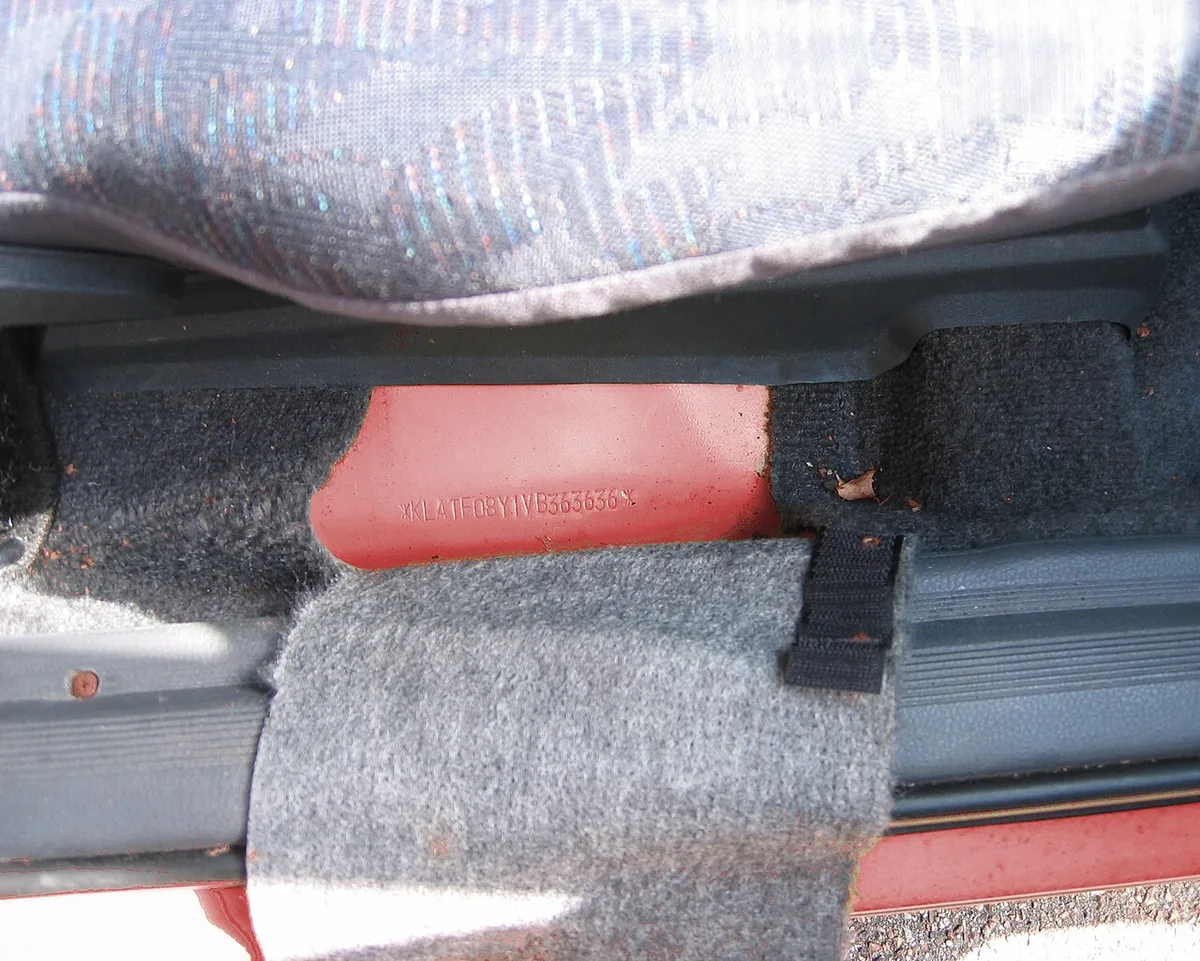
Image source: Wikimedia Commons / Hans Haase (CC BY-SA)
Three matching VINs is a good start. A missing or re-riveted plate is a stop sign.
Next, run the VIN through NMVTIS. The U.S. Department of Justice runs the program, and approved providers pull reports for a few dollars each.
You can find the provider list through vehiclehistory.gov. This is the check that catches brands from other states.
Here's the verification stack we'd run on any branded or suspicious car:
| Check | What it reveals | Rough cost |
|---|---|---|
| NMVTIS report | Total-loss, salvage, and junk brands nationwide | $2 to $10 |
| State DMV title request | Current title status in your state | Free to small fee |
| NICB VIN check | Theft and salvage records | Free |
| VIN plate and sticker inspection | Cloning and tampering signs | Free |
| Independent pre-purchase inspection | Frame, rust, prior repair quality | $150 to $300 |
| Scan tool codes | Stored SRS and crash data | Free to small fee |
Two more habits separate careful buyers from unlucky ones. First, ask for a photo of the actual title, not the listing description. Look at the issue date, the state, and whose name is on it.
Second, treat the vehicle history report as evidence, not proof. Those reports only reflect what was reported. A car fixed out of pocket with no insurance claim can look spotless for a decade.
If the seller resists any of this, that's your answer. A legitimate seller with a clean car has no reason to block a ten-dollar lookup.
From Salvage to Street-Legal: Earning a Rebuilt Title
The path from salvage to rebuilt runs through your state DMV, and the order matters. You repair, you document, you inspect, then you apply. Skip a step and you start over.
Budget time before money. Three to eight weeks is common in states with appointment backlogs, and parts delays push it further.
Repairs and the paper trail you'll need
Save everything. Receipts for major parts, photos of the damage before you touched it, photos during the repair, and photos of the finished work. Inspectors want to see the sequence.
Most states care most about provenance. Receipts for airbags, seatbelts, and major body sections prove the parts weren't stolen. A junked airbag module bought from a stranger with no paperwork is a problem you can't talk your way out of.
Photograph the VIN plates and door stickers before disassembly too. Some states want them visible in the finished photos, and a painted-over sticker fails inspection.
Label the small stuff as well. It's easy to lose track of which bolts and clips came from where on a long rebuild, and a mixed bag of fasteners slows everything down. Simple jobs like reseating a mirror housing are good practice runs before you get to the front clip.
Do the mechanical work to a standard you'd accept on a car you planned to keep. Cheap suspension parts are the classic shortcut on a rebuild, and a rebuilt front end punishes that choice fast. It's worth knowing whether a mid-priced suspension brand holds up before you save forty dollars on a tie rod.
The state safety inspection
This is the gate, and it's run by the state, not by a friendly shop. Depending on where you live, it's handled by state police, the highway patrol, or a DMV-licensed inspection station.
What they check varies more than people expect. Common items include:
- Brakes, lights, horn, and wipers
- Frame and unibody condition, sometimes on a lift
- Airbag and SRS function
- VIN verification against the title
- Receipts for major components
- Emissions compliance in states with testing programs
The inspection is a compliance check. It isn't a quality audit, and passing it doesn't mean the car is well built. Some states also require the car to be insured or registered before the appointment, so read your state's checklist twice.
Bring the paperwork you were told to bring. Missing a receipt is the most common reason people get sent home and rebooked three weeks out.
Applying for the rebuilt title: fees, photos, and paperwork
Once the inspection passes, you submit the application with the signed-off inspection form, your salvage title or certificate, fees, and any required photos. Fees generally run $50 to $200 depending on the state, and a new title document arrives by mail.
The brand changes, but it doesn't disappear. The new title will read rebuilt, reconstructed, or prior salvage depending on your state's vocabulary. That word follows the car for the rest of its life.
Register it, insure it, and disclose it if you ever sell. Most states require written disclosure of a branded title at sale, and buyers who find out later have legal ground to come back at you.
One last piece of advice for the seller side. Price the car against other branded vehicles, not against clean-title comps. Asking clean-title money for a rebuilt car is the fastest way to sit on it for six months.
When a Salvage Car Is a Smart Buy, and When It's a Money Pit
The brand tells you one thing: an insurer once ran the numbers and decided not to pay. It says nothing about whether the car in front of you is a good deal. That call comes down to four variables.
Damage type, your own skill level, how long you plan to keep the car, and how you're paying for it.
Get all four pointing the same direction and a branded car can save you real money. Get two of them wrong and you're the person who buys someone else's problem.
If the damage was hail or theft, the odds tilt your way
Hail damage is cosmetic. Panels, glass, and trim get replaced, and the structure never moves. If a hail-totaled car passes a mechanical inspection, the brand is paperwork and nothing more.
Theft recovery is the second-best category. A stolen car often comes back with a punched ignition, broken glass, and a missing stereo. Sometimes the interior is stripped.
That's repair work you can see and price.
Ask two questions before you commit. Was the wiring harness cut, and did anyone swap the ECU? Both turn a simple recovery into a long, expensive hunt for electrical ghosts.
If the frame was straightened, slow down
Pulling a bent rail back to spec doesn't restore how it absorbs a hit. The metal has already done its job once. It won't fold the same way a second time.
That doesn't make every structural rebuild worthless. It makes the documentation matter more than the car. Manufacturer sectioning procedures, weld-through primer, correct high-strength steel, and photos of every stage are what separate a proper repair from a driveway guess.
If the seller has receipts and photos, proceed with an independent inspection. If they have a story and a fresh coat of undercoating, walk.
If it's a flood car, the answer is usually no
Flood damage is the one category where a steep discount rarely compensates you. Water sits in connectors, fuse boxes, and module housings long after the carpets dry. The failures show up in month eight, not week one.
Corrosion moves slowly through pins and grounds. You end up chasing random no-starts, dead gauges, and transmission faults that no shop can pin down. Labor alone can exceed the car's value.
The exceptions are narrow. A flood car bought strictly as a parts donor is fine. A flood car with documented water levels below the floor pan, bought by someone who plans to replace every harness, is a project, not a daily driver.
If you're paying cash and keeping it, the math works differently
The resale hit only hurts when you sell. Drive a rebuilt car for eight years and the 20% to 40% discount gets spread across a lot of miles.
Compare two paths on a $15,000 budget:
| Path | What you get | Cash left for repairs |
|---|---|---|
| Clean-title sedan, 90,000 miles | No brand, full coverage available | $0 |
| Rebuilt pickup, 70,000 miles | Branded, liability only | $3,000 |
The second path wins if the truck is sound and you can cover the repairs yourself. It loses badly if the rebuild was sloppy and you're paying shop rates.
If you need financing, a warranty, or full coverage, the answer is no
Three things a branded car usually can't give you: a normal auto loan, a factory warranty, and full physical damage coverage. If any of those are must-haves, stop shopping branded cars.
That's not a knock on salvage vehicles. It's a fit question. The category rewards cash buyers with mechanical skills who keep cars a long time.
Salvage Title Mistakes That Cost Buyers Thousands
Most bad salvage purchases follow the same handful of patterns. Here are the ones that show up again and again in buyer complaints and state enforcement actions.
Trusting the listing photos
Photos hide everything that matters. They hide frame rails, weld quality, waterlines, and the corrosion behind a wheel arch.
Always see the car in daylight, on a lift if possible. Bring a flashlight and look under the dash, inside the wheel wells, and at the bottom of the spare tire well.
Skipping the five-dollar VIN check
An NMVTIS report costs less than a coffee. Skipping it is the single most expensive shortcut in this whole process.
That report is how you catch a car branded in another state. It's also how you catch a junk title that got cosmetically cleaned up in a resale listing.
Believing the state inspection means safe
The inspection checks compliance, not craftsmanship. It confirms the car has the right parts and a verified VIN. It does not confirm the frame is straight or that the airbags will deploy.
Budget a separate post-repair inspection with a body shop. Two hundred dollars here routinely saves four figures later.
Forgetting ADAS recalibration
This one catches people on modern cars. A camera behind the windshield, radar in the bumper, or sensors in the mirrors all need recalibration after replacement or a geometry change.
Recalibration runs a few hundred dollars per system on many models, and sometimes requires a dealer visit. On a car with three or four systems, that's real money missing from your repair budget.
A car with a crooked lane-keeping camera isn't just annoying. It can steer when it shouldn't.
Buying out of state without checking your own DMV
Some states won't accept certain out-of-state brands, or require extra paperwork before they'll issue a title. Buy a rebuilt car in a lenient state and you may not be able to register it at home.
Call your state's title division before you travel. Ask two things: will you title this brand, and what documents do you need.
Paying clean-title money for a branded car
Sellers anchor high and hope you don't check comps. Price the car against other rebuilt listings, not against clean-title trucks of the same year and mileage.
If the discount isn't at least 20%, there's no reason to accept the insurance friction and resale hit.
Handing over cash before the title is in hand
Never pay in full for a title you haven't seen. An "open" title that skips the seller's name is a red flag, and title skipping is illegal in most states.
Verify the name on the title matches the seller's ID. Check for liens and get a lien release if one exists. A branded car with an unresolved lien is a paperwork fight you can't win.
Ignoring the airbag light or the "just a sensor" story
An SRS light on a rebuilt car is not a minor annoyance. It often means a deployed airbag was never replaced, or the module was never reset.
Scan the car and read the stored codes yourself. Crash data stored in the module and a VIN mismatch are both hard stops.
When to Walk Away or Call in a Pro
Some situations need a professional, and some need you to leave. Knowing which is which saves you from the worst version of this purchase.
Walk away immediately if any of these appear
- The seller won't send a photo of the title or the VIN plate
- The title isn't in the seller's name
- A certificate of destruction is offered as "fixable"
- The car has fresh undercoating over the frame rails and rockers
- The seller discourages an inspection or a VIN check
- The price sits at clean-title level with no explanation
- The VIN on the dash doesn't match the door jamb sticker
Any one of those is enough. You don't need a second reason.
Bring in a body shop when structure is involved
If the car took a hit near the frame rails, aprons, or B-pillar, get a post-repair inspection. A shop puts it on a lift, measures the structure, and checks weld quality and panel gaps.
Expect $150 to $300 in most markets. Ask for photos and a written summary you can take to a seller when you negotiate.
Bring in a mechanic when the car runs but feels wrong
Pulling, vibration, uneven tire wear, or a steering wheel that sits off-center after a rebuild all point to geometry problems. A alignment check and a suspension inspection will tell you whether it's a cheap fix or a bent structure.
Worn steering and suspension parts are the classic corner cut on a budget rebuild. Our look at whether premium tie rod ends earn their price is worth a read before you accept a shop's cheapest option.
Bring in the state when the paperwork feels off
Title fraud is a criminal matter, not a civil dispute. If you suspect a washed brand or a cloned VIN, contact your state DMV's investigations unit and the NICB.
Your state attorney general's consumer protection office handles dealer-side disclosure failures. Keep every message, listing screenshot, and receipt. Documentation is the whole case.
Bring in your insurer before money changes hands
One phone call with the VIN settles the coverage question. Ask what they'll write, what the payout basis is, and whether they'll cover physical damage at all.
Get the answer in writing. A verbal "should be fine" from an agent isn't a policy.
Salvage Title FAQs
Can you legally drive a car with a salvage title?
Usually not on public roads, though the rules vary by state. An unrepaired salvage vehicle is generally treated as off-road until it passes a rebuilt inspection and gets a new title. Some states allow limited driving permits for repair or inspection trips.
Check your state DMV before you drive it anywhere.
Can a salvage title ever go back to clean?
No, in practical terms. Once a total-loss brand attaches to a VIN, the record stays in NMVTIS permanently. A successful rebuild earns a rebuilt or reconstructed title, which is still a brand.
A few states use different wording, but no legitimate process erases the history.
Is a rebuilt title the same as a salvage title?
No. A salvage title means the car was totaled and hasn't been repaired and inspected. A rebuilt title means the repairs are done and a state authority signed off.
Both are branded titles, and both carry a resale discount, but only the rebuilt version is normally legal to drive.
How much does a salvage title hurt resale value?
Expect roughly 20% to 40% below clean-title comparables for a rebuilt car. Unrepaired salvage sells for far less, often half of retail or below. The discount is permanent and follows the VIN, so plan for it on the day you sell, not just the day you buy.
Can you get full coverage on a rebuilt title car?
Sometimes, but it's not guaranteed. Many major carriers write liability only on branded vehicles. Others offer collision and comprehensive with payout caps tied to branded value.
Call with the VIN before you buy and get the coverage answer in writing.
What's the difference between a salvage certificate and a salvage title?
A salvage certificate is the ownership document issued after a total loss, and it's what you present to prove you own the wreck. A salvage title is the branded title record tied to the VIN. Terminology varies by state, and some use the two terms interchangeably.
Your DMV defines which document you need for a rebuild.
The Verdict: Should You Buy a Salvage Title Car?
Sometimes. The brand isn't the deciding factor. The damage type, the documentation, and your own situation are.
Here's the test we'd run before signing anything:
- If the damage was hail or a clean theft recovery, and a mechanic signs off, buy it.
- If the damage was structural but the repair has photos and receipts, buy it only after an independent inspection.
- If the damage was flood, assume electrical problems and price accordingly, or walk.
- If you need a loan, full coverage, or a warranty, buy a clean-title car instead.
- If you can't inspect it in person, don't buy it.
Run the break-even math honestly. Take the clean-title price, subtract the branded price, and you have your total savings. Now subtract the repair bill, the inspection fees, the recalibration costs, and the resale hit you'll take later.
If that number is still comfortably positive, you've found a deal. If it's thin, you're absorbing all the risk for almost no reward.
One last thing. A salvage title is a record of an insurance decision, not a verdict on the car. Some branded vehicles are genuinely good machines with a paperwork penalty attached.
Others are rolling repair bills with fresh paint. The VIN check, the lift, and the receipts are what tell you which one you're standing in front of.
