
How to jump start a car with another car is a practical skill every driver should know. You pair a running donor car with jumper cables to charge the dead battery. This avoids calling for roadside assistance in many cases.
The process starts with checking safety and matching components carefully. Manufacturer specifications indicate cables should be at least 4-gauge for standard cars. We'll break down the full workflow from start to finish.
Is This Battery Safe to Jump From Another Car?
Is this battery safe to jump from another car? Many drivers ask this question right before grabbing the cables. If the battery is swollen, leaking, cracked, or frozen, stop immediately.
Jumping a damaged battery risks an explosion or severe acid burns.
Manufacturer specs confirm you should only attempt a jump on a healthy lead-acid battery. A resting voltage below 12.4 volts means the battery is too discharged to jump safely. You can test it with a multimeter if available, but visual damage is the real red flag.
As of 2026, most passenger cars still use basic 12-volt flooded lead-acid batteries. Start-stop and hybrid vehicles often have special requirements. Always check your owner's manual first.
If the battery fails these checks, replace it or call for help instead of risking the jump.
Match the Donor, Cables, and Terminals First
You must match the donor car, cables, and terminals before any clamp touches a battery. The donor vehicle needs to run at a modest idle, and its battery should be fully charged. Cables need the right gauge to carry the current without overheating.
Cables too thin or too short create more problems than they solve. You want at least 12 feet of length for tight parking spaces. Copper or copper-clad clamps grip better than cheap aluminum ones.
The image below shows typical jumper cables with red positive and black negative clamps.
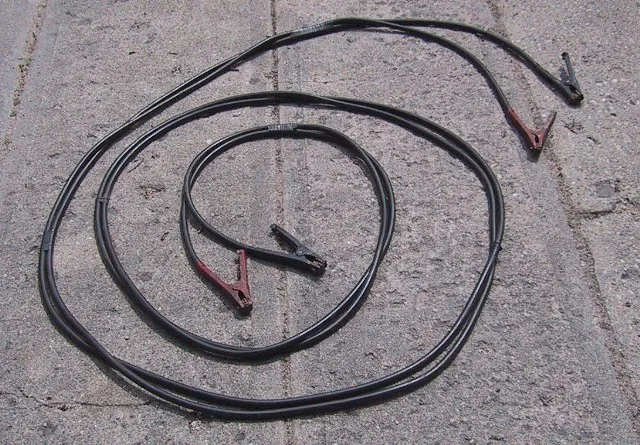
Image source: Wikimedia Commons / Wtshymanski at English Wikipedia
The second image shows a typical jump setup with the donor car nearby and the dead battery in view.
Image source: Wikimedia Commons / D-Kuru (CC BY-SA)
Remote jump posts on the engine bay or underhood area work best on many modern cars. Trunk batteries require extra cable length. Older vehicles often have direct battery posts that are easier to reach.
Always confirm the donor car is close enough but not touching the dead vehicle. This matching step prevents most early mistakes.
The Cable Order for a Normal 12-Volt Jump
Follow this exact cable order every time to avoid reversed polarity. Start with the dead positive terminal. Connect the red clamp to the dead car's positive post or remote post.
Next, attach the red clamp to the donor car's positive terminal. Then connect the black clamp to the donor car's negative terminal. Finally, touch the black clamp to bare metal on the dead car away from the battery.
This last ground point completes the circuit safely.
Keep vehicles from touching each other to prevent sparks flying between them. Set the parking brake on both cars and turn off all accessories. The donor engine should idle at about 2,000 RPM for a few minutes before you crank the dead vehicle.
Short crank bursts of 5 to 10 seconds work best. Let the starter cool between attempts.
After the dead car starts, drive both vehicles for 15 to 30 minutes to recharge the battery. This method works for most 12-volt cars. Hybrids and electric vehicles use different procedures and should not be jumped from another car.
Always refer to your specific owner's manual for confirmation.
Sparks, Reversed Clamps, and Cars You Should Not Jump
Reversed clamps create dangerous sparks and can damage the alternator or electronics. Red and black must stay matched exactly to positive and negative. Swapping them reverses the current flow and risks fire.
You should never jump a frozen battery. It can crack and leak acid when current flows. Cracked or leaking batteries pose the same danger.
Some modern cars with buried batteries or start-stop systems use special remote terminals only.
Hybrids and plug-in hybrids require the manual's exact procedure. Improvising on a 12-volt point in these vehicles can damage the high-voltage system. Donors with small batteries may stall if the dead car draws too much power.
Keep the donor idle time short and manage accessories on both vehicles.
The National Highway Traffic Safety Administration stresses these safety rules in their vehicle guidance. If the battery shows any swelling or corrosion, replace it instead of jumping. These mistakes happen more often than people admit.
Following the order and checking conditions first prevents 90 percent of problems.
Jump Start Questions Drivers Actually Ask
How long should I run the donor car? Run it for 3 to 5 minutes at idle before cranking the dead vehicle. This gives the donor battery time to supply the charge.
How long does the jump take? The whole process usually takes 10 to 15 minutes from first connection to driving away. The real work is the short cranks and final drive.
Can I use the same cables next time? Clean the clamps after every use. Store them dry and check for corrosion before the next jump.
Thick cables last longer and perform better.
What if the car still won't start? The jump fixed the battery but the charging system may need attention. Test the alternator after the jump to rule out other issues.
Should I replace the battery after jumping? Many batteries recover after a jump but others are already failing. A deep discharge often means the battery needs replacement soon.
Check the voltage after driving to confirm it holds charge.
