
Your car won't crank, and every forum thread says the same thing: replace the starter. Before you spend $200 on a part you might not need, it's worth learning how to test a starter properly. Most no-crank situations aren't the motor at all.
They're a tired battery, a corroded ground, or a switch that never sent the signal.
Manufacturer specs put cranking draw at roughly 150 to 250 amps on a gasoline engine, and that number is where the diagnosis lives. A battery can sit at a healthy 12.6 volts and still fold under that load. So we test the circuit under stress first, then work our way toward the motor.
How to Test a Starter
Testing a starter means checking the battery, cables, and grounds first. Then confirm the start signal reaches the solenoid. Measure voltage drop while the engine is cranking, not at rest.
Next, check current draw and cranking speed. If all of that passes, bench test the motor itself.
The Symptom-First Way to Find the Real Fault
Diagnosis starts with your ears, not your wallet. The noise you hear (or don't) tells you which branch of the circuit to attack first.
| Symptom | Likely cause | Test to run first |
|---|---|---|
| Silence, no click | Open circuit: battery, cable, switch, safety switch | Cranking voltage at the starter B+ stud |
| One loud click, then nothing | Solenoid contacts or a weak battery | Voltage drop, both paths |
| Rapid chatter | Battery voltage collapsing under load | Battery load or conductance test |
| Slow, labored crank | Cable resistance or a worn motor | Amp clamp reading |
Start With What You're Hearing
A single click means the solenoid is getting power but the contacts aren't closing. Total silence points upstream, toward the ignition switch or a safety switch. A slow grind usually means the motor is fighting too much resistance to spin.
Each one sends you somewhere different.
Why No Crank and Cranks But Won't Start Are Two Different Jobs
If the engine spins normally and refuses to fire, the starter is fine. Stop testing it. That's a fuel or ignition problem, and chasing the starter wastes an afternoon.
Rough running plus fouled plugs is a separate trail entirely, one that often ends at oil-soaked electrodes rather than the motor.
Rule Out the Cheap Stuff Before You Touch the Starter
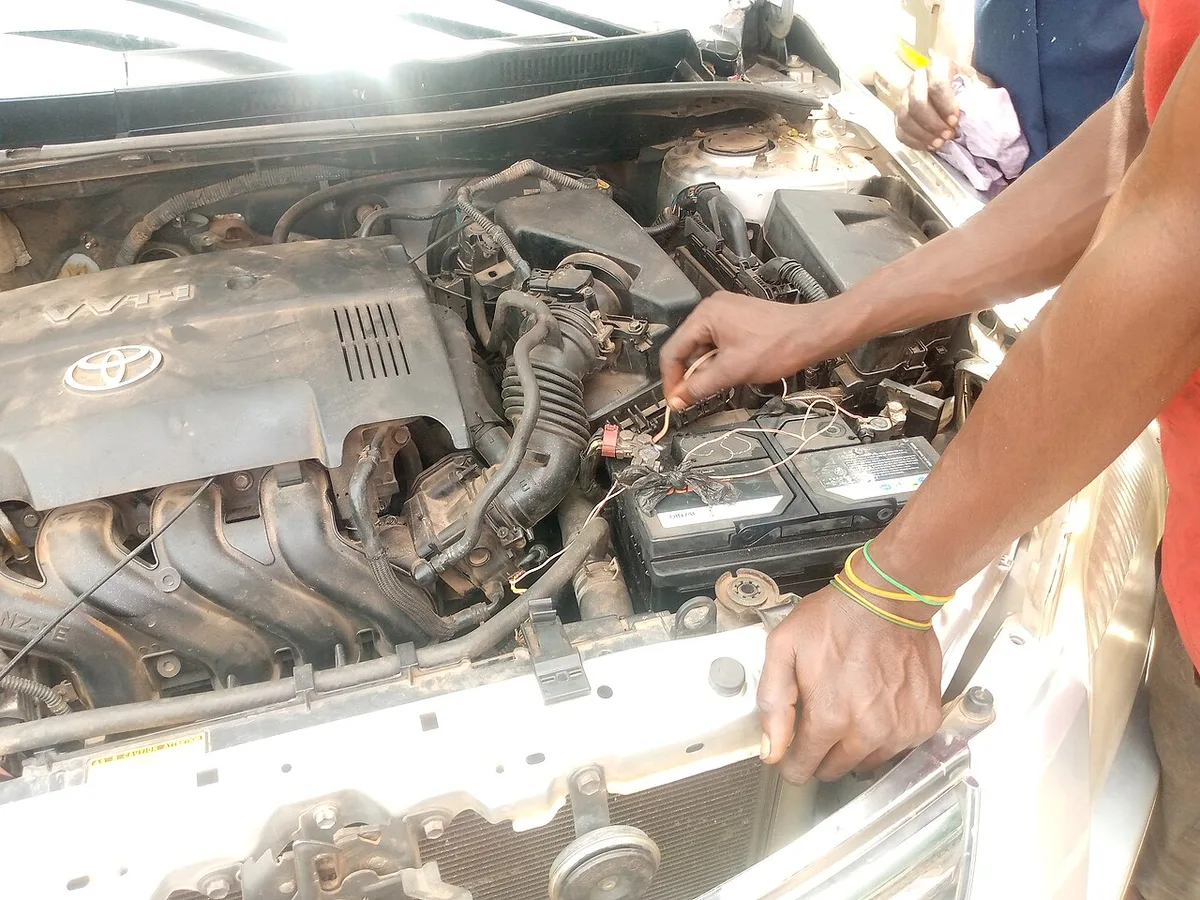
Image source: Wikimedia Commons / Azorbli (CC BY-SA)
Battery State of Charge vs. Cranking Voltage
12.6 volts at rest means a fully charged battery. It says nothing about behavior under a 200 amp pull. Per SAE J537 testing conventions, cranking voltage at the posts should hold at or above 9.6 volts at around 70°F.
Drop below that and the battery or cabling is your culprit.
Cables, Lugs, and the Ground Strap Everyone Forgets
Resistance testing a battery cable is close to useless. One strand of copper passes a continuity check and still chokes at 200 amps. Load the circuit and measure the drop instead.
The engine-to-body ground strap rots from the inside out in road-salt country, and it's the part nobody inspects.
Battery work is also a burn and acid risk, so shop safety basics deserve a read before you lean over a post with a wrench. Comparing a $12 strap to a $200 starter as of 2026 makes the point. And if you need height to reach the solenoid, sturdy wooden ramps beat a bare jack every time.
The Signal Chain: Switch, Safety Switch, Relay, Solenoid
The start circuit is a relay chain. Key to ignition switch, switch to safety switch, safety switch to relay, relay to the S terminal on the solenoid. A break anywhere in that chain looks exactly like a dead starter from the driver's seat.
Where the Start Signal Goes Missing
Automatics won't crank in gear. Manuals need the clutch pedal floored. A tired clutch interlock or a misadjusted neutral switch kills the start signal while everything else tests fine.
Push-button cars add another gate, and a fob with a weak battery can mimic a starter failure. Knowing how keyless entry behaves keeps you from bench testing a healthy motor.
Testing the S Terminal Without Guessing
Pull the small wire off the S terminal and connect a remote starter switch. Key off, transmission in park or neutral, parking brake set. Press the button.
If the motor cranks, the starter is healthy and the fault is upstream. If nothing happens, the solenoid or motor is the suspect.
The Voltage Drop Test That Actually Finds Hidden Corrosion
This test separates guessers from diagnosticians. Set your meter to DC volts and put one lead on each end of the cable you're judging. Then crank.
The meter shows how much voltage gets lost in that cable instead of reaching the starter.
Positive Path and Ground Path, Measured Under Load
Keep the positive side under half a volt and the ground side under 0.3 volts. A tenth of a volt per connection is the working rule of thumb. Anything higher means clean it, re-crimp it, or replace it.
Reading the Numbers: What's Passing, What's Failing
- Under 0.5V across the positive run: healthy.
- Over 0.5V: resistance in that cable, so retest each end separately.
- Ground path over 0.3V: the strap or engine ground is the fault.
- Under 9.6V at the posts while cranking: battery or charging system, not the motor.
Current Draw and Cranking Speed: Judging the Motor Itself
Using an Amp Clamp Safely
Clamp around the main positive cable, never the small signal wire. Expect roughly 150 to 250 amps on a gasoline engine and 250 to 500 on a diesel. A seized starter can spike well past those figures, so watch the clamp while a helper turns the key.
When High Draw Means Seized, Not Stuck
A motor that gulps current and never turns may be fighting a locked engine. Pull the plugs and bar the crank over by hand. If it won't budge, the starter was never the problem.
Hydrolock and a snapped timing belt both imitate a dead starter, and both will wreck a new one. A scanner that shows live data can confirm cranking rpm without pulling anything apart.
Bench Testing a Starter Out of the Vehicle
Bench testing confirms what the in-car numbers hinted at. It also lets you verify a replacement before you bolt it in and fight for a refund later.
The Battery, Jumper Cables, and Remote Switch Setup
Clamp the starter nose in a vise so it can't jump. Run a negative jumper from the battery to the starter housing. Run the positive jumper to the large B+ stud.
Then bridge B+ to the small S terminal with a remote starter switch, and keep your fingers clear of the bendix.
What Bendix Extension and Draw Tell You
A healthy unit snaps the drive out and spins hard. If the gear kicks out but the motor stays still, the solenoid contacts are burnt. If the motor spins and the gear never moves, the drive or shift fork is broken.
Clamp an amp meter on the positive lead and compare the reading to the spec sheet.
Checking Brushes, Commutator, and Ring Gear Wear
Open the housing and measure brush length against the OEM wear limit. Look for scored bars or burnt segments on the commutator. Check the bendix teeth and the flywheel ring gear too, because a chewed gear will grind no matter how strong the motor is.
Mistakes That Cost Money, Skin, or Both
- Replacing the starter first. The parts cannon is expensive and usually wrong. Prove the fault before you buy.
- Testing cables with an ohmmeter. Continuity passes on a single strand of copper. Load the circuit instead.
- Jumping the solenoid with a screwdriver. One slip welds the tool to the block and can take a battery terminal with it.
- Bypassing the neutral safety switch. A car that starts in gear can lurch and hurt someone.
- Cranking past 15 seconds. The motor overheats and the solenoid contacts pit.
- Leaving the negative cable connected. Disconnect it first, reconnect it last, every time.
- Wearing rings or a metal watch band. A short across the posts burns skin fast.
Reaching for an aerosol can isn't diagnosis either. If the engine cranks normally and won't fire, aerosol starting aids hide a fuel or spark fault instead of finding it.
Starter Testing by Vehicle Type: Gas, Diesel, Marine, Small Engine, Hybrid
| System | Typical draw | What changes |
|---|---|---|
| 12V gasoline | 150 to 250 A | Baseline procedure above |
| 24V diesel | 250 to 500 A | Two batteries, test each one separately |
| 6V classic | Lower cranking rpm | Grounds and cable gauge matter more |
| Marine inboard gas | Similar to automotive | Ignition-protected (SAE J1171) parts only |
| Small engine | 30 to 100 A | Same logic, smaller numbers |
| Hybrid or EV | No conventional starter | Stop here, high voltage is a different job |
On 24V trucks, one weak battery in the pair drags the whole system down, so load test them individually. Marine setups corrode every connection, and testing at the battery instead of the starter stud will fool you. Small engines still follow the symptom tree, just with a smaller amp clamp.
Costs, Replacement Decisions, and When to Stop Diagnosing
| Item | Typical US cost (2026) |
|---|---|
| Remanufactured starter | $80 to $250 |
| New starter | $150 to $400 |
| Shop labor | $100 to $200 per hour |
| Tow | $75 to $150 |
| Multimeter | $25 to $60 |
| Amp clamp | $40 to $150 |
The math is blunt. A ground strap and terminal cleanup costs less than a tow, and it fixes a large share of no-crank complaints.
Stop diagnosing when the numbers line up. Voltage drop under load within spec, normal draw, and a free-turning engine means the motor is fine and the fault is upstream. Replace when draw is high and the engine bars over by hand, or when the bendix grinds a ring gear you've already inspected.
Paying more for a quality reman is a judgment call, much like premium versus budget chassis parts, and the cheap units earn their reputation.
Frequently Asked Questions
Can I test a starter without removing it?
Yes. Check battery voltage while cranking, measure voltage drop on both paths, and read current draw with a clamp. A remote starter switch on the S terminal isolates the motor from the rest of the circuit.
Only pull the unit if those tests point at it.
How many amps should a starter draw?
Gasoline engines usually pull 150 to 250 amps, and diesels run 250 to 500. Exact figures live in the OEM service manual. A reading far above spec on a free engine points to a failing motor or a bad ground forcing it to work harder.
Why does my starter just click once?
A single click means the solenoid gets power but the contacts don't close. It can also be a battery that collapses under load. Measure voltage at the B+ stud while a helper turns the key to separate the two.
How long can I crank before the starter overheats?
Keep each attempt to 10 or 15 seconds, then let it cool for a couple of minutes. Repeated long cranks melt solenoid contacts and cook the windings. If it won't fire in three tries, stop and diagnose.
Can a bad starter be repaired instead of replaced?
Often, yes. Brushes, solenoids, and drive assemblies are serviceable on many units. The catch is labor and parts availability.
Once a commutator is badly scored or the field coils are burnt, a remanufactured unit is usually the cheaper path.
Quick Decision Guide: Match Your Symptom to Your Next Move
Work down this list until one line matches what your car is doing. Then run that single test and stop.
- Silence, no click. Test cranking voltage at the B+ stud. If it's low, the fault sits upstream in the switch or safety switch chain.
- One loud click. Measure voltage drop on both paths. If both pass, the solenoid contacts are burnt.
- Rapid chatter. Load test the battery. It's collapsing under the pull.
- Slow grind, hot engine only. Check the ground strap and cable ends for heat damage.
- Cranks fine, never fires. Walk away from the starter. That's a fuel or spark problem.
- Huge draw, engine won't bar over. Stop. You have a seized or hydrolocked engine, not a starter.
If every test passes and the motor still won't spin, bench test it before you buy anything. That order saves money every time.
