
The real answer to how much does it cost to lift a truck starts around $250 and climbs past $11,000. That spread isn't marketing noise. A leveling spacer and a long-arm coilover conversion both get sold as "a lift," and they don't belong in the same conversation.
Per manufacturer install manuals and published shop book times, a 4-inch bracket lift eats 6 to 8 hours of labor before anyone touches a wrench. At $100 to $200 an hour, that's $600 to $1,600 in labor alone, before parts, tires, or alignment. So the first thing worth understanding is what that sticker price actually covers.
How Much Does It Cost to Lift a Truck
A leveling or spacer kit installed typically costs $250 to $1,400. Entry-level 4-inch bracket lifts land between $1,200 and $2,700 installed. Mid-tier 4 to 6-inch systems run $2,400 to $4,800.
Premium long-arm or coilover builds reach $4,500 to $11,000 or more. Those figures cover parts and labor only.
What Lifting a Truck Really Costs and Why the Advertised Kit Price Lies
Every lift kit listing quotes a single number: the box price. That number is honest as far as it goes. It just doesn't go very far.
The box price covers brackets, spacers, and hardware. It rarely covers the parts that make the truck driveable afterward. Our research across manufacturer install manuals and real shop quotes shows the out-the-door figure typically runs 1.6 to 2.5 times the advertised kit price.
Here's what the ad price quietly skips.
- Kit completeness. "Complete" is the loosest word in the aftermarket. Some 4-inch kits ship with new front struts and rear shocks. Others reuse your stock shocks with a spacer bolted on top, which works for a while and then stops working.
- Brake lines and ABS wiring. A 6-inch lift stretches the stock front brake lines close to their limit. Extended stainless lines and wheel speed sensor extensions are cheap parts that show up as separate line items.
- Track bar, bump stops, and sway bar links. Necessary on most trucks above 3 inches. Frequently sold as add-ons rather than included.
- Alignment and calibration. A four-wheel alignment runs $100 to $250. Speedometer correction adds $150 to $400. Forward camera recalibration adds $150 to $500 on newer trucks.
- Tires and wheels. The lift exists to clear bigger rubber. A set of four 33 to 37-inch tires runs $1,200 to $2,800, and aftermarket wheels add $800 to $2,000.
- Labor. The single biggest omission. Nobody advertises the install.
Even the small stuff adds up, and replacement fasteners aren't free once you start snapping twenty-year-old bolts.
There's a warranty layer too. Under the Magnuson-Moss Warranty Act, a dealer can't void your entire factory warranty just because you installed a lift. They can deny a specific claim if they can show the lift caused the failure.
That distinction matters when a $3,000 transmission claim gets denied because of a driveline angle nobody corrected.
As of 2026, the gap between advertised and actual cost has widened. Kit prices have climbed with steel and freight, and shop labor rates in metro areas have pushed past $200 an hour. Budget from the total, not the listing.
The Four Variables That Decide Your Bill Before You Buy Anything
Four things move your number more than anything else. Nail these down first and the quote stops surprising you.
| Variable | How much it moves the bill |
|---|---|
| What you drive | $0 to $3,000 swing based on drivetrain, axle type, and rust |
| Lift height and tire goal | $0 to $2,500 swing once you pass 35-inch tires |
| Kit tier | $300 to $9,000+ in parts alone |
| Who installs it | $0 (DIY) to $2,000+ in labor |
Variable one: what you drive. A 2WD half-ton with a coil-spring front end is the cheapest truck on earth to lift. A 4WD heavy-duty diesel with a solid front axle and 200,000 miles of road salt is the most expensive. The diesel weighs more, the driveline is longer, and the front differential has to come down to fit the brackets.
Variable two: your lift height and tire goal. Work backward from the tire, not forward from the height. A 2-inch lift clears 33s on most half-tons. Four inches clears 35s.
Six inches clears 37s. Each step up adds parts, labor hours, and a regear conversation.
Variable three: kit tier. A $300 spacer kit and a $4,500 long-arm system are both "lift kits." We'll break down what each tier buys in the next section.
Variable four: who installs it. DIY saves the labor but costs you a weekend, a torque wrench, and the risk of a mistake you can't see until the truck wanders at 70 mph. A specialty 4×4 shop charges more per hour than a general mechanic but usually books fewer hours, because they've done your exact platform before.
Here's the if/then logic in plain terms. If you drive a 2WD half-ton and want 33s, you're in the $400 to $1,200 range. If you drive a 4WD half-ton and want 35s with a quality ride, you're at $3,000 to $6,000 all in.
If you drive a diesel HD truck and want 37s with corrected geometry, plan on $8,000 to $14,000.
Lift Kit Tiers: What $300, $1,500, $4,000, and $9,000 Actually Buy
Tiers are the fastest way to understand lift pricing. Each step up buys geometry correction, better damping, and more completeness.
| Tier | Parts cost | Installed | What you actually get |
|---|---|---|---|
| Leveling or spacer kit | $100 to $500 | $250 to $1,400 | Spacers, maybe shocks, stock geometry |
| Body lift | $200 to $600 | $600 to $1,700 | Pucks between body and frame, zero suspension change |
| Entry 4-inch bracket lift | $700 to $1,600 | $1,200 to $2,700 | Drop brackets, blocks, basic shocks |
| Mid-tier 4 to 6-inch system | $1,600 to $3,200 | $2,400 to $4,800 | Corrected knuckles or brackets, quality shocks, brake lines |
| Long-arm or coilover conversion | $3,000 to $8,000+ | $4,500 to $11,000+ | New control arms, coilovers, corrected geometry throughout |
Spacer and leveling kits
A leveling kit is a spacer that sits on top of your strut or coil spring. It raises the front 1.5 to 2.5 inches to remove the factory rake. Cost is low because nothing about the suspension geometry changes much.
These are genuinely good value for a daily driver that sees dirt roads and snow. They're a poor fit for anyone planning 35s or serious trail use. Above 2.5 inches, spacer lifts start binding CV axles and eating ball joints.
Entry-level bracket lifts
Bracket kits drop the front differential, control arms, and steering components to keep angles closer to stock. That's the right idea. Cheap execution is where they fall apart.
A $900 bracket kit often ships with stock-length shocks and no bump stop extensions. The ride gets harsh, the front end tops out, and the ball joints take the beating. These kits work fine for a budget street truck on 33s.
They struggle with towing, washboard roads, and anything past 4 inches.
Mid-tier 4 to 6-inch systems
This is where the value curve peaks for most buyers. Mid-tier systems from established suspension manufacturers include corrected steering knuckles or drop brackets, extended brake lines, bump stop extensions, and properly valved shocks.
You're paying for engineering, not just steel. Caster stays in spec, the steering doesn't wander, and the truck still tows. For a truck that does double duty as a daily and a weekend toy, this tier is usually the sweet spot.
Long-arm and coilover conversions
Long-arm kits replace the stock control arms with longer units and relocated mounting points. Coilover conversions swap the factory strut for a rebuildable coilover with adjustable damping.
The payoff is real articulation, better ride quality on rough terrain, and geometry that stays correct at 6 inches and beyond. The cost is real too. Expect $4,500 to $11,000 installed, plus rebuild intervals on the shocks every 30,000 to 50,000 miles.
If you're going this route, upgraded steering linkage stops being optional. Big tires and big travel punish stock tie rods fast.
Branch One: Leveling Kit, Spacer Lift, or Body Lift?
Three cheap options, three different jobs. Pick by what you actually want the truck to do.
| Option | Best for | Installed cost | Max lift |
|---|---|---|---|
| Leveling kit | Removing rake, fitting 33s | $250 to $900 | 1.5 to 2.5 inches |
| Spacer lift | Budget clearance on a 2WD or light 4WD | $500 to $1,400 | 2 to 3 inches |
| Body lift | Tire clearance without touching suspension | $600 to $1,700 | 1 to 3 inches |
If you just hate the factory rake, get a leveling kit. The front sits lower than the rear from the factory so the truck looks level when loaded. A 2-inch front spacer fixes the look for a few hundred dollars installed.
If you want 33s on a budget 4WD, a 2 to 2.5-inch spacer lift works. Keep it at or under 2.5 inches and the CV angles stay reasonable. Go past that and you're into bracket-kit territory whether you like it or not.
If you want tire clearance with zero suspension change, a body lift is the answer. It raises the cab and bed off the frame with polyurethane pucks. Suspension geometry, ride quality, and alignment all stay factory.
Body lifts have trade-offs. The gap between body and frame shows unless you fit gap guards. The shifters and steering column need extension brackets.
And on a truck with rusty body mounts, those bolts can fight you for hours.
If you're handling the install yourself, safely getting the front end in the air is step one. A proper set of stands beats a scissor jack every time.
If you want the truck to sit level and still tow well, skip the tall lift entirely. A leveling kit plus rear airbag helper springs keeps the payload manners intact. That's often the smarter money for a work truck.
Branch Two: Bracket Kit, Knuckle Kit, or Long-Arm, and Which One Fits Your Truck
Once you pass 3 inches, the real decision starts. All three approaches raise the truck. They solve geometry in completely different ways.
| Approach | How it works | Best for | Typical installed cost |
|---|---|---|---|
| Bracket kit | Drops diff, control arms, and steering | Budget 4-inch builds on IFS trucks | $1,200 to $2,700 |
| Knuckle kit | Taller steering knuckle, keeps arms closer to stock | 4 to 6-inch builds wanting stock-ish angles | $2,000 to $4,500 |
| Long-arm kit | Longer arms with relocated pivots | 6-inch-plus builds and serious off-road use | $3,500 to $9,000+ |
If your truck has independent front suspension and you want 4 inches, a bracket kit is the entry point. The drop brackets restore most of the stock angles. Watch the CV axle angle, which starts binding somewhere around 25 to 30 degrees on most IFS platforms.
If you want 4 to 6 inches without dropping the differential, a knuckle kit does the work differently. A taller knuckle lifts the truck while the control arms stay closer to their factory plane. Caster and camber stay easier to manage, and you keep more ground clearance under the diff.
If you have a solid front axle, none of that applies. Solid-axle trucks use coil springs or leaf springs with radius arms or four-links. Cost depends on whether you're adding coils, long arms, or a full coilover conversion, not on bracket geometry.
If you want 6 inches or more with real articulation, go long-arm. Short arms at extreme angles bind, ride harshly, and tear through bushings. Long arms fix the geometry properly instead of compensating for it.
One more consideration: center of gravity. Raising a truck moves weight upward, and NHTSA has documented the rollover sensitivity of high-center-of-gravity vehicles for decades. A tall lift with narrow stock tires is the worst combination.
Wide, properly rated tires and corrected sway bar links are not cosmetic upgrades.
If you're building a trail rig, breaking loose stubborn hardware is half the battle on a high-mileage truck. Adding auxiliary lighting afterward is the easy part.
How Much Lift You Actually Need, Mapped to Tire Size
Tire size drives the budget, not lift height. Decide the rubber first, then let the lift follow. Buyers who start with "I want 6 inches" usually end up spending more than they needed to.
Here's the mapping our research keeps landing on, based on manufacturer fitment notes and published install guides.
| Tire size | Minimum lift on most trucks | Extra work usually needed | Typical all-in range |
|---|---|---|---|
| 33-inch | 2 to 2.5 inches | Minor trimming on some platforms | $400 to $1,800 |
| 35-inch | 3.5 to 4 inches | Alignment, brake lines on some, regear optional | $2,500 to $6,000 |
| 37-inch | 6 inches | Regear, driveline correction, brake check | $6,000 to $12,000 |
| 38 to 40-inch | 8 inches or long-arm | Regear, steering and brake upgrades | $10,000 to $20,000+ |
The old rule of thumb still holds: 2 inches clears 33s, 4 inches clears 35s, 6 inches clears 37s. Treat it as a starting point, not gospel. It assumes a half-ton truck with near-stock wheel offset and a tire that isn't unusually wide.
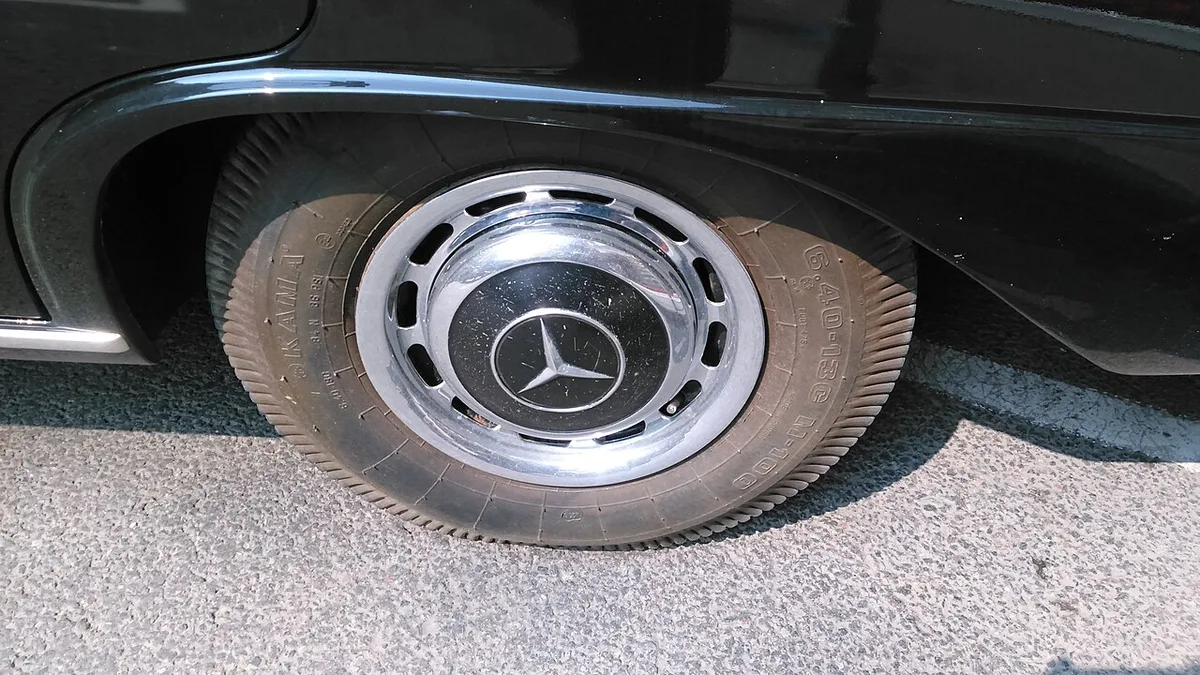
Image source: Wikimedia Commons / DL24
If you want 33s on a half-ton, a 2 to 2.5-inch leveling kit usually does it. On a 2015-or-newer F-150, the front crash bars may need spreading or trimming. On a Tacoma, the cab mount chop shows up around 33s at full stuff.
Both are labor items, not parts items, and both add a few hundred dollars.
If you want 35s, plan on 3.5 to 4 inches and a proper bracket or knuckle kit. This is the point where brake lines, bump stops, and alignment correction stop being optional. It's also where most buyers start thinking about gears.
If you want 37s, you're into 6-inch territory and a regear conversation. A 37-inch tire on a stock 3.55 axle ratio turns a truck into a slug. The transmission hunts for gears, fuel economy drops 1 to 3 mpg, and the brakes work harder than they were designed to.
If you want 38s or bigger, long-arm or coilover territory. Steering linkage, brakes, and often axle shafts need attention. This is where builds cross from "modified truck" into "project vehicle."
Wheel offset changes the math. Stock backspacing on most half-tons sits around 5.5 inches. Aftermarket wheels at 4.5 inches push the tire outward, which clears the upper control arm but loads the fender and liner at full compression.
Wide tires on stock wheels do the opposite and rub the control arm at full lock.
Gear ratio pairing for bigger tires
Regearing is the most commonly skipped line item on a lift quote. It's also the one that decides whether the truck feels right afterward.
| Tire size | Workable ratio | Ideal ratio |
|---|---|---|
| 32 to 33-inch (stock) | 3.31, 3.55 | 3.55 |
| 33 to 35-inch | 3.73 | 4.10 |
| 35 to 37-inch | 4.10 | 4.56 |
| 37 to 38-inch | 4.56 | 4.88 |
| 39-inch and up | 4.88 | 5.13 |
Regearing runs $1,200 to $2,500 per axle. Two axles lands between $2,000 and $4,500 with labor. That number alone can double a budget that looked comfortable a week ago.
Labor: Book Hours, Shop Rates, and Why a Rust-Belt Truck Costs More
Labor is the line item nobody advertises. It's also the one that varies most from quote to quote.
Published book times give you a baseline to sanity-check any estimate you get.
| Job | Book hours | Labor at $150 per hour |
|---|---|---|
| Leveling kit | 2 to 4 | $300 to $600 |
| Body lift | 6 to 10 | $900 to $1,500 |
| 4-inch bracket lift | 6 to 8 | $900 to $1,200 |
| 6-inch lift | 8 to 12 | $1,200 to $1,800 |
| Long-arm or coilover conversion | 12 to 16+ | $1,800 to $2,400+ |
Shop rates vary by region and by who's holding the wrench. Independent 4×4 specialty shops commonly run $100 to $200 an hour. Dealership service departments run $150 to $250 an hour.
General repair shops sit somewhere in between but often book more hours because your truck isn't a platform they see weekly.
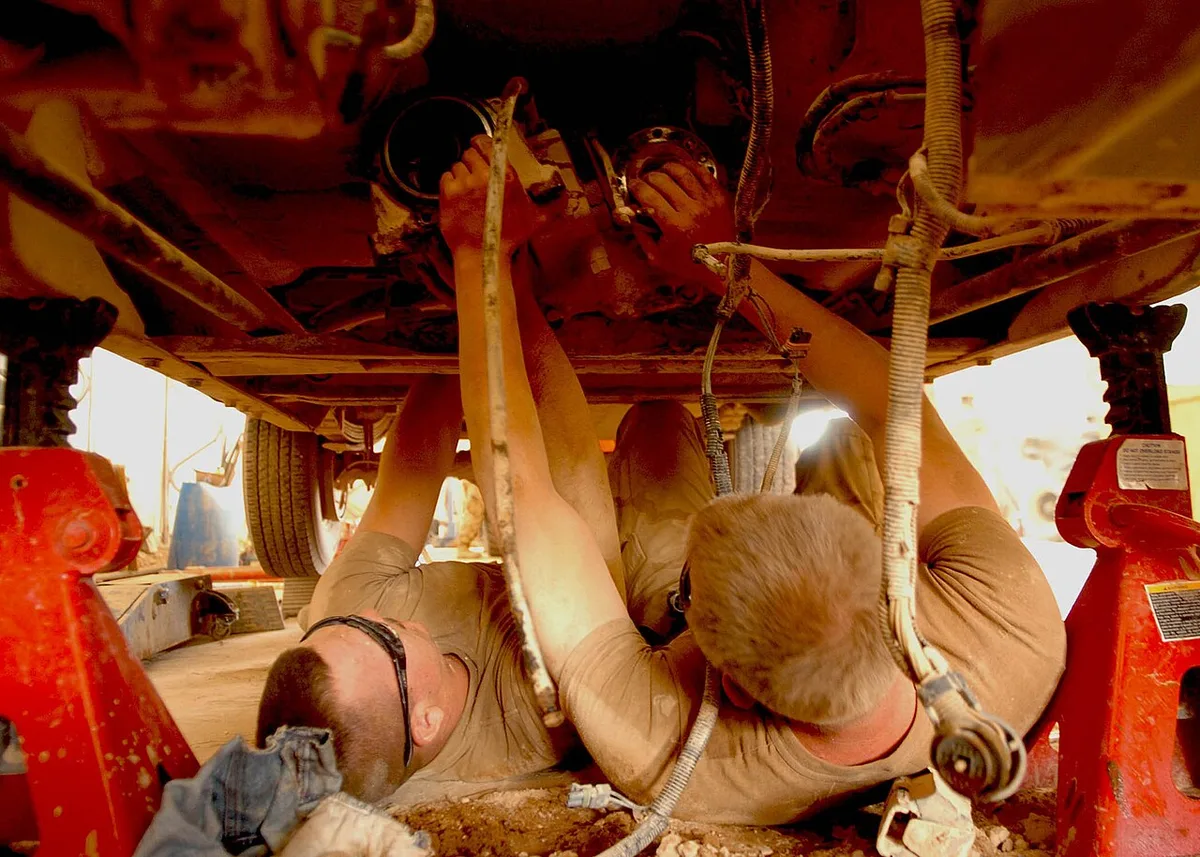
Image source: Wikimedia Commons / U.S. Navy photo by Mass Communication Specialist 2nd Class Michael Lindsey
Book time assumes a clean truck that comes apart the way the manual says. Real trucks don't always cooperate.
If the truck has spent ten winters in a salt state, add 2 to 6 hours to the estimate. Body mount bolts seize and snap. Torsion bar adjusters weld themselves to the keys.
Rear shock bolts shear off and need to be drilled out.
If the shop has to drop the fuel tank, the bill climbs again. Some rear block installs need tank clearance, and a tank half full of fuel is heavy, awkward work.
If the front differential has to come down, that's another chunk of time. Bracket kits for IFS trucks often require it, and the diff is not light.
If the truck is a crew-cab long-bed diesel, expect the upper end of every book time range. More weight, more length, more hardware.
Ask any shop two questions before you book. How many of your exact platform have they lifted this year, and does their quote include alignment. A shop that answers "a few" is learning on your truck at your hourly rate.
What the hourly rate doesn't cover
Most quotes leave out shop supplies, disposal fees, and diagnostic time. Those add $50 to $200 in practice.
Alignment is almost always a separate line. So is any fabrication, including trimming, spreading crash bars, or welding. Ask for those as separate line items in writing.
The Hidden Line Items Nobody Quotes Upfront
The kit price is the visible part of the iceberg. Everything below the waterline is where budgets break.
| Add-on | Typical cost | When you need it |
|---|---|---|
| Four-wheel alignment | $100 to $250 | Always, after any suspension change |
| Extended brake lines | $80 to $250 | Lifts past 4 inches |
| Driveshaft spacer or slip yoke eliminator | $150 to $800 | When driveline angle goes out of spec |
| Carrier bearing drop kit | $60 to $150 | Two-piece driveshafts after lifting |
| Bump stop extensions | $50 to $200 | Anything past 3 inches |
| Speedometer recalibration | $150 to $400 | Any tire size change |
| ADAS camera recalibration | $150 to $500 | Trucks with forward collision or lane keeping |
| New tires, set of four | $1,200 to $2,800 | If you're going bigger |
| Aftermarket wheels, set of four | $800 to $2,000 | If offset requires it |
| Regear, both axles | $2,000 to $4,500 | 35s and up on tall gears |
| Steering stabilizer | $100 to $400 | Big tires, solid axles |
| Traction bars | $400 to $900 | Lifted trucks that tow or launch hard |
Alignment isn't a formality. Caster goes out of spec the moment you change ride height, and low caster is what makes a lifted truck wander at highway speed. A proper four-wheel alignment on a lifted truck runs $100 to $250 at a shop that knows the platform.
Driveline correction is the one buyers skip and regret. Lifting the truck changes the pinion angle. If it goes too far out, you get a vibration that starts around 40 mph and gets worse.
A carrier bearing drop kit is cheap. A rebuilt driveshaft and a new U-joint isn't.
Speedometer error is a legal and practical issue. Bigger tires make the truck travel farther per revolution than the computer thinks. Your speedometer reads low, your odometer undercounts, and your shift points feel off.
A tuner or inline calibrator fixes it in minutes. A basic scan tool of your own can confirm what the truck is reporting before you pay someone to chase it.
Headlights need attention too. A lifted truck aims its beam higher, and unadjusted headlights blind oncoming traffic. That's a safety problem and, in some states, an inspection failure.
Even a simple bulb swap deserves a re-aim afterward.
The costs that show up six months later
Some line items don't appear on any quote because they haven't happened yet.
- Ball joints and tie rod ends wear faster with bigger tires and corrected angles that are still not stock.
- CV axle boots tear when angles stay past the design limit.
- U-joints fail earlier when pinion angle is off.
- Brake pads and rotors wear faster with heavier wheel and tire packages.
- Shocks on cheap kits blow out inside 30,000 miles.
Budget $500 to $1,500 over the first two years for wear items accelerated by the lift. That's not pessimism. It's the pattern aggregate owner reports show again and again.
DIY vs. Independent 4×4 Shop vs. Dealership: Cost, Time, and Risk
Three paths, three very different trade-offs. None of them is wrong. They just suit different people.
| Path | Labor cost | Time | Main risk |
|---|---|---|---|
| DIY in a home garage | $0 | One weekend, sometimes two | Torque errors, missed steps, no alignment |
| Independent 4×4 shop | $100 to $200 per hour | One to three days | Quality varies by shop |
| Dealership service department | $150 to $250 per hour | Two to five days | Higher rate, sometimes less lift experience |
If you have a level garage floor, decent tools, and patience, DIY is genuinely viable for a leveling kit or a body lift. A 4-inch bracket kit is a longer job but still doable. Long-arm and coilover conversions are where DIY gets risky.
If you're paying for someone else's time anyway, pick a specialty shop over a dealership for suspension work. They've done your platform before, they know the shortcuts that are safe and the ones that aren't, and they usually book fewer hours.
If the truck is under factory warranty, the dealership path has one real advantage. They can't blame the lift for a failure they installed. That's worth something when a claim gets contested.
The tool list that decides whether DIY is realistic
- Torque wrench rated to at least 250 ft-lb
- Impact gun for the stubborn stuff, with a proper socket set
- Jack stands rated well above the truck's curb weight
- Floor jack with enough lift height
- Spring compressor for coil-based kits
- Penetrating oil, applied days ahead, not minutes
- Breaker bar, metric and standard sockets, hex and Torx bits
- Brake bleeder if lines get opened
Missing any of these turns a one-day job into a three-day job with a parts run in the middle. Getting the front end safely in the air is the first hurdle, and ramps you can build yourself handle a lot of the lighter work without lifting a wrench to a jack.
An impact gun on the wheel nuts saves real time on the teardown. Just finish every critical fastener by hand with a torque wrench. Steering and suspension bolts do not respond well to guesswork.
What DIY actually saves and actually costs
A $1,200 labor quote is real money. So is a mistake.
DIY saves the hourly rate and costs you a weekend. It also costs you the alignment, because you'll still pay a shop for that. And it costs you the risk of a fastener torqued to feel instead of spec.
Our read of owner reports: DIY works well for confident wrenchers on simpler kits. It goes badly for first-timers on 6-inch systems with driveline correction and brake line work.
Why the Same Lift Costs Different Money on an IFS Half-Ton vs. a Solid-Axle Diesel
Two trucks, same lift height, wildly different bills. The suspension architecture explains most of it.
| Factor | IFS half-ton | Solid-axle heavy-duty |
|---|---|---|
| Front lift method | Spacers, drop brackets, or taller knuckles | Coil springs, coilovers, or leaf packs |
| Parts count | High, many brackets and drops | Lower, but heavier components |
| CV axles | Angle limits around 25 to 30 degrees | None to worry about |
| Steering | Bump steer and tie rod angle issues | Drag link and track bar geometry |
| Weight | Lighter, easier on springs | Diesel engine adds 600 to 1,000 lb over the front axle |
| Typical installed cost | $1,200 to $4,800 | $4,000 to $14,000 |
If you drive an IFS half-ton, the cost is driven by bracket count and CV angle. Every inch past 3 pushes the axles further toward binding. Bracket and knuckle kits exist specifically to keep those angles sane, and they cost more than a spacer.
If you drive a solid-axle diesel, the cost is driven by weight and driveline length. A heavy front end needs a spring rate matched to it. Cheap spacer kits on a diesel sag within a year and ride like a brick.
Solid-axle trucks have their own geometry demons. Track bar angle, drag link angle, and caster all move together. Get them wrong and you get death wobble, a violent shimmy that shows up over bumps at highway speed.
It's the single most common complaint on lifted solid-axle trucks, and fixing it properly means adjustable track bars, corrected caster, and often a new steering stabilizer.
Steering linkage takes a beating either way. Big tires and wide offset multiply the load on every joint in the system, which is why spending up on steering joints is usually cheaper than replacing cheap ones twice.
Diesel trucks also carry extra complexity underneath. Exhaust and emissions hardware sits close to the frame. Fuel tanks are larger and heavier.
Driveshafts are longer and more sensitive to pinion angle. Every one of those turns into labor hours.
Model year matters as much as architecture. Ford revised the F-150 front end more than once. GM changed the Silverado and Sierra suspension across generations.
Ram's 1500 and 2500 share a badge and almost nothing else underneath. A kit built for one year may not fit the next, and fitment notes are where that shows up.
Mistakes That Turn a $2,000 Lift Into a $6,000 Repair Bill
Most blown budgets trace back to the same short list of errors. None of them are exotic. They're just easy to skip when you're excited and the kit is sitting in the garage.
Here's what the expensive ones cost to fix.
| Mistake | Typical repair bill | What goes wrong |
|---|---|---|
| Stacked lift blocks | $300 to $1,200 | Axle wrap, cracked blocks, failed inspection |
| Skipping the alignment | $600 to $1,500 | Cupped tires, wandering steering, worn ball joints |
| Spacer on top of stock shocks | $400 to $1,200 | Topped-out front end, blown shocks, cracked mounts |
| No bump stop extensions | $200 to $900 | Shocks bottom out and destroy themselves |
| Wrong wheel offset | $400 to $1,200 | Tire rub at full lock, torn liners, damaged fenders |
| Ignoring driveline vibration | $400 to $1,500 | Worn U-joints, failed carrier bearing, rebuilt shaft |
| Torquing by feel | $200 to $2,000 | Sheared studs, stretched bolts, loose steering hardware |
| No re-torque at 500 miles | $150 to $800 | Fasteners back out, alignment shifts |
| Skipping the regear | $2,000 to $4,500 | Transmission hunting, clutch and converter wear |
| Used kit with missing hardware | $200 to $600 | Brackets that don't fit, trips to the parts counter |
If you're buying a used kit off marketplace listings, assume hardware is missing. Bolts, spacers, and bracket-specific fasteners rarely survive a teardown. A $600 used kit that needs $400 in replacement hardware isn't a bargain, and a kit for a different cab or engine configuration won't fit at all.
If the seller can't tell you the part number, walk away. Fitment notes exist for a reason. A kit built for a crew cab short bed may not clear a long bed's fuel tank or driveshaft loop.
If the price is half of retail and the photos look staged, check the welds in person. Cheap powder coat hides ugly work, and a bracket that cracks at 70 mph is not a savings.
Stacked blocks deserve their own warning. Piling a lift block on top of a factory block is banned outright in a long list of states. It also multiplies axle wrap, which is the spring wind-up that snaps pinions and U-joints.
One properly sized block is fine. Two stacked blocks is a failure waiting for a load.
Brake lines and steering hardware are the other category that isn't about money. A stretched front brake line can fail under full droop, and that happens exactly when you need brakes most. Steering bolts that weren't torqued to spec can back out over a few thousand miles.
Neither failure announces itself first.
The cheap fix list is short. Buy the complete kit. Extend the brake lines.
Add bump stops. Torque everything to factory spec with a real wrench. Get the alignment the same week.
Re-torque at 100 to 500 miles.
How to inspect a lifted truck before you buy it
A used lifted truck is a stack of somebody else's decisions. Look at the cheap parts first.
- Check for stacked blocks at the rear axle. Two blocks means walk away.
- Look at the front brake lines for stretched or zip-tied routing.
- Check tire wear across the tread. Cupping means the alignment was never corrected.
- Grab the front driveshaft and check for play at the U-joints.
- Look at the CV boots for cracks, grease streaks, or torn ribs.
- Ask for the alignment sheet and the kit part number.
- Look at the pitman arm and track bar bracket for cracks or weld repairs.
- Check that the speedometer matches a GPS reading.
Tire wear tells you more than any service record. A truck on 37s with feathered front tires and a clean stack of receipts still has a geometry problem. Receipts prove parts were bought, not that the install was finished.
Lift Laws, Bumper Height, Insurance, and Warranty: The Compliance Branch
Every state writes its own rules, and they don't agree. A lift that passes inspection in one state can fail 200 miles away. That's a cost driver people forget until the truck is built.
Here's what compliance actually costs when it goes wrong.
| Compliance item | Typical cost | Why it bites |
|---|---|---|
| Failed inspection and rework | $100 to $400 | Height, lighting, or mud flap violations |
| Bumper or frame height correction | $150 to $800 | Dropping the bumper back into legal range |
| Headlight re-aim | $50 to $150 | Beam height and glare rules |
| ADAS camera recalibration | $150 to $500 | Forward collision and lane keeping |
| Insurance premium change | 5 to 15 percent | Disclosed modifications raise rates |
| Diminished value after a claim | 5 to 15 percent of resale | Modified trucks appraise lower |
State statutes generally cap bumper and frame height, and the numbers vary widely. Several states also restrict stacked blocks, set minimum block width, and require mud flaps behind lifted trucks. Headlight mounting height is commonly capped somewhere near 54 inches in a number of state codes, though you'll want to read your own.
Federal rules sit on top of that. FMVSS 108 governs lighting performance, and NHTSA publishes guidance on aftermarket modifications that affect compliance. Lighting isn't a cosmetic issue once you've changed ride height.
A raised housing pushes the cutoff line up, and swapping in fresh bulbs won't fix aim by itself.
If your state runs safety inspections, budget for rework before you buy. Fixing height or lighting after the fact usually costs more than planning for it.
If you plan to tow, check bumper and hitch height rules too. A bumper that sits too high changes trailer geometry, and some states treat that as a violation on its own.
Insurance is the quieter cost. Modifications that aren't disclosed can complicate a claim, and a lifted truck with bigger tires often carries a higher premium once the insurer knows. Report the lift.
Get the agreed value documented. A denied claim on a $40,000 truck costs more than a decade of premium increases.
Warranty is a separate track. Under the Magnuson-Moss Warranty Act, a dealer can't void your whole factory warranty because of a lift. They can deny a specific claim if the modification caused the failure.
Keep receipts, keep the alignment sheet, and keep the calibration records. Documentation is what wins those arguments.
Newer trucks add one more line item. Forward collision cameras, radar units, and lane keeping systems are calibrated to a specific ride height. Lift the truck and the calibration drifts.
Manufacturer service information treats recalibration as required after suspension changes, not optional.
Three Builds Priced Out: Budget Leveling Kit, Mid-Tier 4-Inch, Turnkey 6-Inch
Ranges are useful. Itemized quotes are better. Here are three realistic builds, priced line by line, using 2026 shop rates.
Build one: 2.5-inch leveling kit on a 2016 Silverado 1500 4WD
The cheapest sensible path to 33s on a half-ton.
| Line item | Cost |
|---|---|
| Front leveling spacers with rear block | $180 |
| Install labor, 3 hours at $150 | $450 |
| Four-wheel alignment | $150 |
| Four 33-inch tires | $1,400 |
| Mount, balance, TPMS reset | $120 |
| Headlight aim | $75 |
| Total | $2,375 |
Skip the wheels and this build stays under $2,400. Keep the stock 18s, keep the stock shocks, and accept that the ride is firmer than factory. That's a fair trade at this price.
Build two: 4-inch mid-tier system on a 2020 F-150 XLT 4WD
The build most buyers actually want, with geometry correction and 35s.
| Line item | Cost |
|---|---|
| Mid-tier 4-inch kit with knuckles, brake lines, bump stops, shocks | $2,600 |
| Install labor, 8 hours at $150 | $1,200 |
| Four-wheel alignment | $200 |
| Four 35-inch tires | $1,900 |
| Aftermarket wheels with correct backspacing | $1,100 |
| Speedometer calibration | $250 |
| ADAS recalibration | $300 |
| Total | $7,550 |
Crash bar work on this generation adds $150 to $400 if the shop has to spread or trim them. Regearing pushes the total past $9,500, which is why a lot of 35-inch builds live with the stock 3.55 gears and accept the shift-hunting.
Build three: 6-inch system on a 2019 Ram 2500 Cummins 4WD
Heavy truck, heavy bill. The diesel front end and the driveline length both add cost.
| Line item | Cost |
|---|---|
| 6-inch kit with replacement coils and quality shocks | $3,900 |
| Install labor, 12 hours at $175 | $2,100 |
| Four-wheel alignment | $250 |
| Carrier bearing drop and driveshaft spacer | $400 |
| Regear both axles to 4.10 | $3,000 |
| Four 37-inch tires | $2,400 |
| Aftermarket wheels | $1,200 |
| Speedometer calibration | $300 |
| ADAS recalibration | $300 |
| Dual steering stabilizer | $450 |
| Total | $14,300 |
That number lands at the top of the heavy-duty range, and it's honest. Skipping the regear drops it by $3,000 and makes the truck miserable to drive. Skipping the driveline correction saves $400 and buys a vibration that never goes away.
One way to trim labor on any of these builds is handling the wheel work yourself. Spinning the nuts off with power tools saves an hour, and finishing them by hand with a torque wrench keeps it safe.
Living With a Lifted Truck: Re-Torque, Maintenance, and the Ongoing Costs
The build cost is a one-time hit. The ownership cost is a slow drip that most buyers never price in.
| Ongoing cost | Typical amount | Frequency |
|---|---|---|
| Re-torque and inspection | $0 to $150 | 100 to 500 miles after install |
| Alignment check | $100 to $250 | Annually or after any impact |
| Tire rotation | $0 to $80 | Every 5,000 to 7,500 miles |
| Shock rebuild, coilover systems | $150 to $400 per shock | 30,000 to 50,000 miles |
| CV boots and U-joints | $200 to $700 | As needed, sooner with big angles |
| Brake pads and rotors | $300 to $900 | Faster wear with heavy wheel packages |
| Fuel cost increase | 1 to 3 mpg loss | Every tank |
| Insurance adjustment | 5 to 15 percent | Ongoing |
That mpg loss is real money. Dropping from 17 to 14 mpg over 15,000 miles a year costs roughly $500 at $3.50 a gallon. Over five years, it's a set of tires you didn't plan to buy.
Re-torque is the one task nobody should skip. Suspension fasteners settle after the first few hundred miles, and a track bar bolt that backs off half a turn changes how the truck steers. Do it at 100 miles, then again at 500.
Then check the torque on the steering and suspension hardware at every oil change.
Grease fittings are your early warning system. Coilover systems and aftermarket control arms often ship with zerk fittings, and dry joints wear fast. Two minutes with a grease gun beats a $600 control arm.
Alignment deserves an annual look even if nothing feels wrong. Curb strikes and potholes move things, and lifted trucks have less margin before caster drifts out of spec. A $150 check is cheaper than a $900 set of cupped tires.
Brakes wear faster than most owners expect. Bigger tires and heavier wheels add rotating mass, and the stock system has to manage more inertia. If the pedal feels soft or the truck takes longer to stop loaded, that's the system telling you it's out of its comfort zone.
Off pavement, the maintenance list grows. U-joints take more load, CV boots see bigger angles, and anything you drag across a rock gets inspected afterward. Having something solid to hook a strap to matters more than another inch of lift, and so does checking the hardware after every trail day.
Simple jobs get harder too. An oil change on a lifted truck may not clear a standard set of ramps, and a floor jack that worked at stock height won't reach the frame. A set of wooden ramps built to your own dimensions solves the first problem for the price of lumber.
What a lifted truck is worth at resale
Modified trucks sell to a smaller pool. That cuts both ways.
A well-built truck with documentation sells fast in an off-road-heavy market. A cheaply lifted truck with mystery parts sells slowly and appraises lower. Dealers discount hard for suspension work they can't verify, and private buyers who know trucks can spot a bad install in five minutes.
Keep the kit part number, the alignment sheets, the calibration records, and the install invoice. That paper trail is worth real money at resale, and it's the difference between a buyer trusting the build and walking away.
Frequently Asked Questions
How much does it cost to lift a truck 2 inches?
A 2-inch leveling kit installed runs $250 to $900. Add tires and you're at $1,400 to $2,400. That covers parts, labor, and an alignment.
It doesn't cover wheels, and it doesn't cover the tire size jump if you go past 33 inches.
Is it cheaper to install a lift kit yourself?
Yes, by roughly $450 to $2,400 in labor depending on kit complexity. DIY also costs you a weekend, a torque wrench, and a professional alignment afterward. It makes sense on leveling and body lifts.
It's a poor bet on long-arm or coilover systems.
Does lifting a truck void the warranty?
Not the whole warranty. Under the Magnuson-Moss Warranty Act, a dealer can only deny claims for failures the lift caused. A lifted truck with a denied transmission claim usually comes down to uncorrected driveline angle and no documentation.
How much does it cost to lift a truck and fit 35-inch tires?
Plan on $2,500 to $6,000 for a half-ton. That covers a 3.5 to 4-inch kit, install labor, alignment, tires, and speedometer correction. Wheels, regearing, and ADAS recalibration push it toward the top of that range or beyond.
Do I need to regear after lifting my truck?
Only if you go bigger on tires. A 35-inch tire on a 3.55 axle ratio is workable. A 37-inch tire on the same gears isn't.
Regearing runs $1,200 to $2,500 per axle, and it's the line item that decides whether the truck feels right afterward.
How much does a shop charge to install a lift kit?
Independent 4×4 shops run $100 to $200 per hour, dealerships $150 to $250. Book time ranges from 2 to 4 hours for a leveling kit up to 12 to 16 hours for a coilover conversion. Rust, cab configuration, and diesel hardware all add hours on top.
