
Your car won't crank, you've cycled the key a dozen times, and someone online just told you how to bypass a starter relay with a screwdriver. That advice can absolutely get you off a shoulder and back home. It can also weld a screwdriver to a live terminal, melt a harness, or send the car lurching into whatever is in front of it.
Here's the part the quick answers skip. Every automatic-transmission car sold in the US has had to meet FMVSS 102, the federal starter interlock rule, for decades. Anything that jumps around that interlock is a diagnostic test, not a repair.
Hold that distinction in your head and the rest of this guide will make sense.
How to Bypass a Starter Relay
To bypass a starter relay, test the battery first. Confirm the relay is actually the fault. Build a fused jumper wire with insulated clips.
Touch terminal 30 to terminal 87 for two seconds. The starter should crank. Pull the jumper off right away.
Why "Just Jump Pins 30 and 87" Is the Worst Advice on This Topic
Jumping the two main pins with a screwdriver is the version of this job that gets shared the most. It's also the version that skips every check that matters.
What a bypass can and can't prove
A bypass proves one thing: whether the starter motor spins when it gets battery power. It tells you nothing about why the relay didn't close. It won't reveal a dead ignition switch contact, a corroded ground, or a body control module that never sent the start request.
Treat it as a split-half test, not a fix.
If the engine cranks on a jumper, the fault sits on the control side. If nothing happens, the problem is downstream: the starter, the main cable, or a ground.
The real risks: lurching cars, welded screwdrivers, melted harnesses
- An unfused jumper can pull 200 amps or more, and it will weld itself to the terminals.
- A car that starts in gear moves the instant it catches.
- Backfeeding the wrong pin can damage a module that costs more than the starter.
Federal rules back this up. FMVSS 102, enforced by NHTSA, has required a starter interlock on automatic cars since the 1990s. Bypassing it in a parking lot is a diagnostic step.
Making it permanent is a different decision, and one your insurer will ask about. Keep a tow number handy and know the vehicle's rated recovery points before you need them.
What a Starter Relay Actually Does in the Start Circuit
A starter relay is a small electromagnetic switch. A thin wire from the ignition switch energizes its coil, and the coil pulls a set of contacts closed. Those contacts then send current to the starter solenoid or the starter's trigger terminal.
That two-stage design earns its keep. The ignition switch and the wiring behind the dash can't handle 150 to 250 amps of cranking current. The relay lets a low-current signal control a high-current load without running thick cable through the cabin.
Control side vs. high-current side
The control side is everything upstream of the relay coil: ignition switch, neutral safety switch, clutch switch, immobilizer, and the module that decides a start is allowed. The high-current side starts at the relay contacts and runs to the starter. Most no-crank failures live on the control side, and that's the half a screwdriver jump skips.
Coil, contacts, and the difference between a relay and a solenoid
A relay moves current between terminals. A solenoid moves current and mechanical parts, which is why a Ford-style fender-mounted solenoid does both jobs in one can. On plenty of modern cars the relay lives inside the fuse box or power module and isn't serviceable on its own.
Manufacturer service data says to test those at the connector, not swap them.
Diagnose Before You Bypass: Click, Chatter, Silence, or Slow Crank
The sound your car makes when you turn the key is free diagnostic data. Read it before you open the fuse box.
- One loud click, no crank: the relay or solenoid closed, but the starter didn't turn. Suspect the starter, the main cable, or a bad ground.
- Rapid chatter: voltage is collapsing under load. Charge or replace the battery first.
- Total silence: the control circuit never fired. Check the neutral safety switch, the ignition switch, and the relay coil.
- Slow, dragging crank: battery or cable resistance, not the relay.
Battery voltage, cable corrosion, and ground straps
Start with numbers. A healthy battery rests around 12.6 volts and shouldn't drop below roughly 9.6 volts while cranking. Corroded terminals and a frayed engine ground strap mimic a dead relay, and they're far more common.
The click test, the swap test, and the voltage drop test
Have someone hold the relay while you crank. A faint click means the coil is getting power. Then swap in an identical relay from the same box, ideally from a non-critical circuit like the horn or fog lamps.
If the fault moves with the relay, you've found it.
A voltage drop test settles arguments. Measure from the battery positive post to the starter stud while cranking, then repeat from the battery negative post to the engine block. Anything over about 0.5 volts per connection means resistance, not a failed part.
A scan tool won't show this, which is why choosing a scan tool only covers half your toolkit.
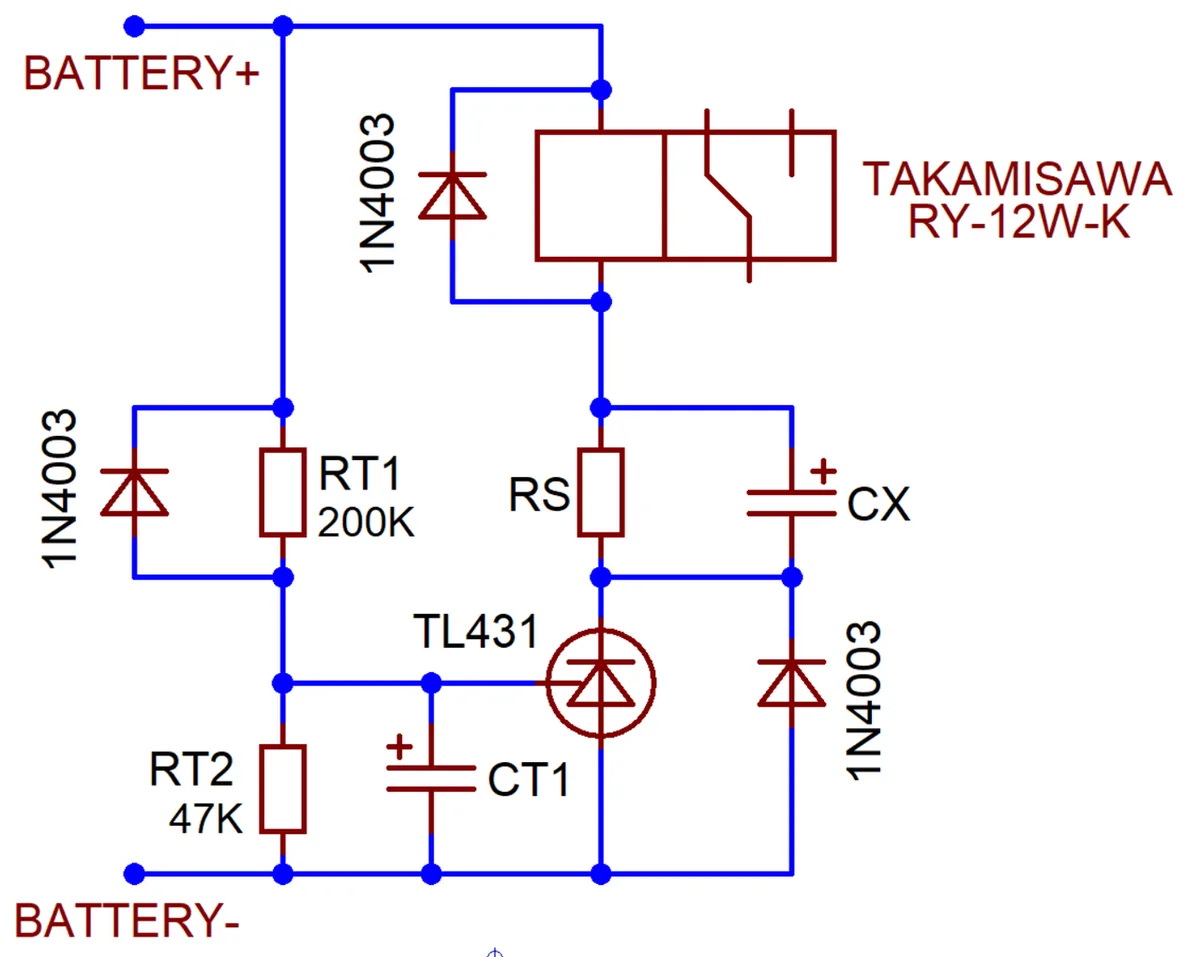
Image source: Wikimedia Commons / Retired electrician
Reading the Relay Pinout and Building a Fused Jumper
Don't guess which pin is which. Read the numbers molded into the relay body and cross-check them against the fuse box lid or the wiring diagram. The DIN 72552 numbering system is standard across most of the industry.
| Terminal | Function | What it means for you |
|---|---|---|
| 30 | Constant battery positive | The live feed you jump from |
| 85 | Coil ground | Control side, leave it alone |
| 86 | Coil positive | Control side, leave it alone |
| 87 | Load output to the starter | The pin you jump to |
| 87a | Rest contact, closed at rest | Unused on most start relays |
On a four-pin relay, the coil is the pair that reads 50 to 120 ohms across it. Confirm that with a meter before you assume anything.
Jumper wire gauge, inline fuse rating, and the remote starter switch option
Build the jumper properly. Use 10 or 12 AWG wire, crimp on insulated alligator clips, and put a 20 to 30 amp inline fuse in the middle. That fuse protects the wire, not the starter, so don't size it by feel.
A remote starter switch does the same job with a trigger button and no live terminals near your hand. It costs more than a homemade jumper and earns it if you'll do this more than once. Wire sizing follows SAE J1128 for the control side and SAE J1127 for battery cable.
How to Bypass a Starter Relay, Step by Step
Do these in order. Skipping steps is how people get hurt.
Pre-checks: park, chock, key off, neutral safety switch verified
- Park on level ground, set the parking brake, and chock a wheel.
- Put the transmission in Park or Neutral and keep your foot off the throttle.
- Turn the key off and pocket it. With push-button start, keep the fob well clear of the cabin, because keyless systems can wake a circuit you thought was dead.
- Locate the relay and confirm the pin numbers against the diagram.
Making the brief crank and pulling the jumper immediately
With the key in the run position, touch the jumper between terminal 30 and terminal 87. Two seconds is plenty. The starter should spin, and the engine may catch.
Pull the jumper off the moment it does, and keep your hands, sleeves, and any jewelry clear of the fan and belts.
What each result tells you about the next repair
If it cranks and runs, the control side is your fault, so test the coil and the trigger wire next. If it cranks but won't fire, you had two problems all along. If nothing happens, the starter circuit is the issue, and a starter fluid trick won't rescue a starter that never turns.
Either way, remove the jumper before you drive anywhere. It's a test lead, not a repair.
Bypass vs. Solenoid Jump, Roll Start, and Calling a Tow
Not every no-crank deserves a jumper wire. Sometimes the smarter tool is a different method, and sometimes it's a phone call.
Side-by-side on effort, risk, and what each one actually fixes
| Method | Best when | What it risks |
|---|---|---|
| Relay bypass | Control side suspected, starter untested | Welded jumper, arcing, lurching car |
| Solenoid jump (30 to the S stud) | Fender-mounted solenoid with open access | Same arc risk, hands closer to the starter |
| Roll start | Manual gearbox, slope, helper available | Clutch and drivetrain wear, no help if fuel or spark is dead |
| Jump pack | Battery clearly weak or drained | Solves nothing when the battery is healthy |
| Tow truck | No tools, no safe access, or crank-no-fire | Money and waiting |
Which method fits your transmission, tools, and roadside situation
If you drive a manual and you've got a slope plus a friend, a roll start is the least violent option. No live terminals, no sparks. Some push-button cars won't energize the ignition circuit during a roll, so confirm yours fires before you start pushing.
On an automatic, the relay jump and the solenoid jump do the same job. Both feed the starter directly. Your real choice is access and tooling, not technique.
The money side is lopsided. A tow hook runs roughly $75 to $150 plus per mile, and a mobile diagnostic runs $100 to $200. A fused jumper costs under $10.
That math only favors the jumper when you can reach the terminals safely with daylight to spare.
Where People Get Hurt: Mistakes, Interlocks, and When to Stop
Most injuries here come from three mistakes, and all three are avoidable.
- Defeating the neutral safety switch so the car cranks in gear. It will move.
- Jumping with a bare screwdriver or unfused wire. At cranking current, metal becomes a fuse and a torch.
- Feeding power into terminal 85 or 86. That backfeeds the coil and can reach the body control module.
Backfeeding the BCM, defeating the neutral safety switch, unfused jumps
Those modules aren't cheap. A replacement BCM often needs programming at a dealer, which turns a $20 relay into a four-figure bill.
On the interlock side, FMVSS 102 exists for a reason. The rule requires automatic cars to be unable to crank in gear, and a permanent workaround puts that failure mode back into the vehicle. Your insurer will care if it shows up in a claim.
Immobilizers, warranty and insurance fallout, and the tow-or-not call
An aftermarket starter kill or factory immobilizer can block cranking no matter what you jump. If the security light is flashing, stop. The relay isn't your problem.
Call the tow when any of these is true: you're on a live traffic lane, you can't reach the terminals without lying under the car, you smell hot plastic, or nothing happens on a good jumper. A scissor jack on gravel isn't worth the risk either. If you need height, solid wooden ramps beat a jack every time.
Frequently Asked Questions
Can you bypass a starter relay with a screwdriver?
Yes, technically, and you shouldn't unless it's an emergency. A screwdriver has no fuse and no insulation at the tip. Cranking current can weld it to the contacts, throw sparks, and burn your hand.
Build a fused jumper with insulated clips instead. It costs a few dollars and does the same job far more safely.
Does bypassing a starter relay damage anything?
A brief, correctly aimed jump usually leaves no damage. Trouble starts when you bridge the wrong pins, hold the jumper too long, or run without a fuse. Backfeeding the coil circuit can damage modules, and long cranking overheats the starter.
Keep it to two seconds and remove the jumper straight away.
Can you bypass a starter relay on a push-button car?
Sometimes, but often not. On many keyless vehicles the start request travels over a data bus, and the module won't release the circuit without a valid key nearby. Jumping the relay may spin the starter while the engine stays dead.
Verify the pinout and the security light first, then decide.
What does it mean if the starter cranks on a jumper but the car won't run?
It means the starter circuit is healthy and something else is stopping combustion. Common culprits are fuel delivery, spark, or a crank signal. That's a separate diagnosis, and continuing to crank on a jumper just drains the battery and heats the starter.
Is it safe to drive with a jumper still in place?
No. A jumper is a test lead, not a repair. It bypasses the relay's switching and leaves live metal where the factory put a sealed contact.
Remove it, then replace the relay or trace the control circuit properly before you drive anywhere.
