
You can learn how to change differential fluid in an afternoon with two jack stands, a hand pump, and about two quarts of gear oil. The job itself is simple. The hard part is figuring out which version of the job you're doing, because the correct procedure changes with the axle in front of you.
Manufacturer service data puts most passenger-car and light-truck axle capacities between 1.2 and 2.5 quarts, and the real fill spec is usually "level with the bottom of the fill hole" rather than a quoted number. As of 2026, plenty of new vehicles still ship with "lifetime fill" language in the manual, which is a service interval, not a promise. Here's how to work out which branch you're on before you crack a plug loose.
The Real Reason Diff Fluid Matters More Than the Interval Sticker Says
Gear oil lives a harder life than most people assume. A differential is the geared housing at each axle that lets the wheels spin at different speeds, and its fluid gets squeezed between gear teeth under extreme pressure every time you accelerate. Every heat cycle cooks it a little more.
Add a trailer, a muddy trail, or a hot summer, and the fluid oxidizes faster than the mileage suggests.
The interval sticker is a starting point, not a rule. Most owner's manuals list 30,000 to 50,000 miles for severe duty and leave light use open-ended. "Lifetime fill" is the phrase that does the most damage.
It usually means the fluid is expected to outlast the warranty, not the axle.
Here's what happens when it wears out. The additive package depletes, the oil thins, and the gears start running metal on metal. A faint whine on deceleration is the early warning.
A howl you can hear over the radio means the damage is already done.
The money math is blunt. Two quarts of quality synthetic gear oil and a fresh crush washer run maybe $40 to $60. A ring and pinion rebuild with new bearings typically lands between $1,500 and $3,000 at a shop.
That's the whole argument for spending a Saturday morning under the truck.
One more thing. The drain plug magnet is the cheapest diagnostic tool on the vehicle. Fine grey fuzz is normal.
A fuzzy paste is worth watching. Chunks or glitter mean you stop and investigate before refilling anything.
How to Change Differential Fluid
Learning how to change differential fluid comes down to four moves. Loosen the fill plug first, then pull the drain plug. Let it drain fully and check the magnet.
Refill until oil drips from the fill hole, then torque both plugs. Use the fluid spec in your owner's manual, not a guess.
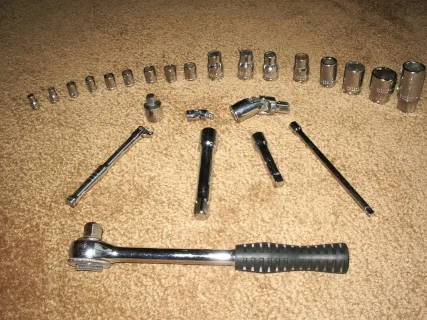
Image source: Wikimedia Commons / Blaine Maber at en.wikipedia
Four Things to Check Before You Buy a Single Quart
The procedure forks hard based on four answers. Get these right and the rest is mechanical. Get them wrong and you're walking to the parts store.
Is there a fill plug, and will it come out?
Always break the fill plug loose before you touch the drain plug. If the fill plug is seized and the axle is already empty, you've turned a fluid change into a tow. Soak it with penetrant, use a six-point socket or the correct hex bit, and stop before you round it off.
Open diff, clutch-type limited-slip, or sealed unit?
An open differential takes standard gear oil. A clutch-type limited-slip needs friction modifier, usually one 4 oz bottle, or it will chatter in parking-lot turns. A sealed unit with no drain plug has no serviceable fluid unless you pull the cover.
What does the OEM actually call for?
Viscosity matters. A truck rated for 75W-140 should not get 75W-90 just because that's what's on the shelf. Look up the spec in your owner's manual or a factory service manual, and match the service category from the American Petroleum Institute, which is GL-5 for nearly all hypoid axles.
Ignore bottles that claim to be universal.
Do you have room to fill it?
A rear diff under a low car may leave no space for a quart bottle. A hand pump with a flex hose solves most of it. If clearance is tight, building your own ramps can buy you the height you need.
Sort that out before the axle is empty. You'll also need jack stands, a drain pan, and gloves. None of it is pricey, and even small hardware costs stay trivial next to a rebuild.
Which Unit Are You Working On? Front Diff, Rear Diff, or Something Else
Not every gear oil job is a rear axle. Modern AWD vehicles can carry three or four separate fluid compartments, and mixing them up gets expensive fast.
- Rear-wheel-drive pickup or body-on-frame SUV: one rear differential, plus a front diff if it's 4WD.
- Front-wheel-drive based AWD crossover: a rear drive unit, often a clutch pack, plus a power transfer unit bolted to the transaxle.
- Full-time 4WD: front diff, rear diff, and a transfer case, each with its own spec and fill plug.
- Sports car with a limited-slip: clutch-type LSD in the rear, sometimes with a cooler and pump.
If your vehicle has a transverse engine and an AWD badge, the power transfer unit is the part everyone ignores. It holds less than a quart and cooks itself sitting next to the exhaust.
If you crawl under a car and see two plugs close together, identify both before loosening anything. Draining an automatic transmission by mistake is a common and messy error. If you're also planning a transmission filter job, run it as a separate session so the pans don't get confused.
Refilling one is its own skill, and the fill level on a sealed automatic follows a specific sequence.
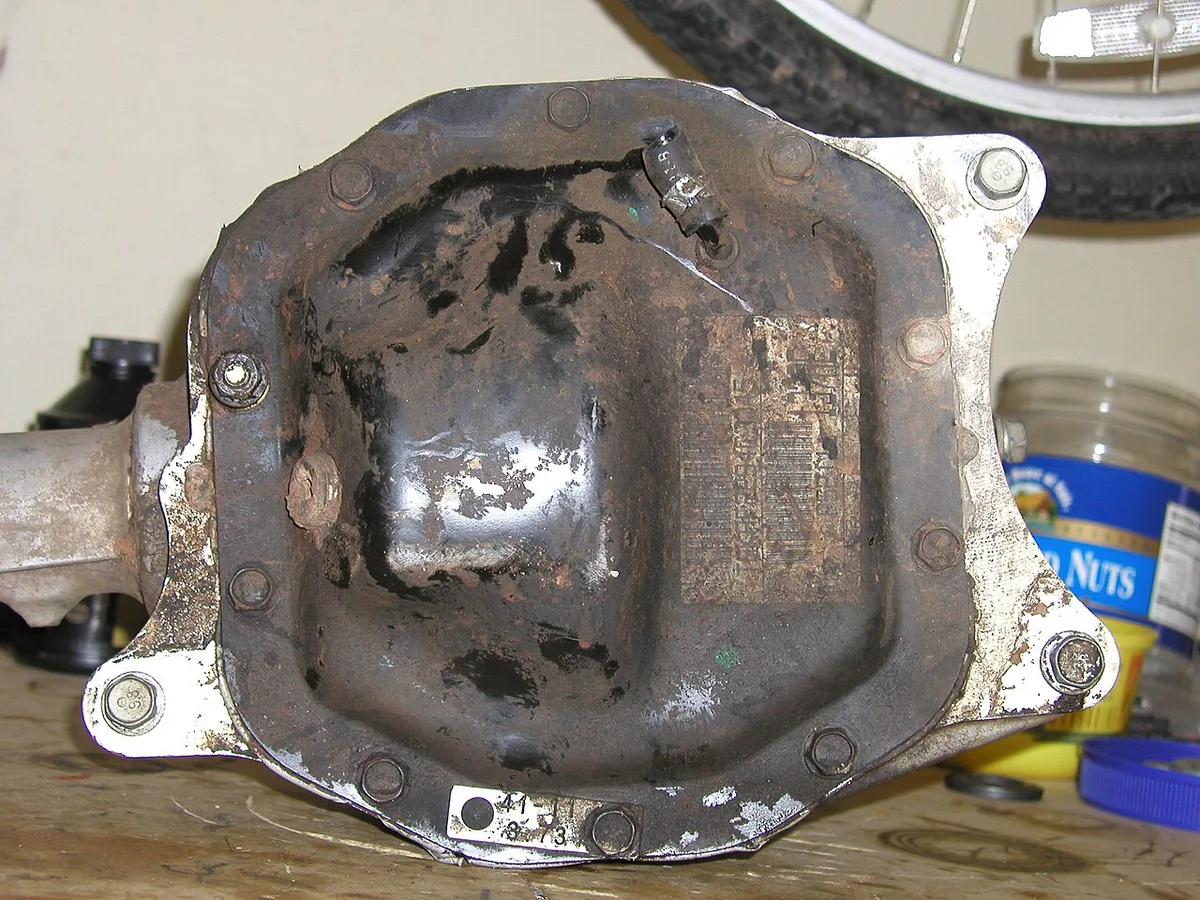
Image source: Wikimedia Commons / Michael Robinson (unixxx) (CC BY-SA)
Step-by-Step: Drain, Read the Magnet, Fill to the Hole, Torque
Warm the fluid first. A five-minute drive makes it drain faster and carries more debris out with it. Warm, not hot.
Gear oil at operating temperature will burn you.
- Chock the wheels and lift the vehicle on jack stands. It has to sit level, because the fill level is measured at the fill hole.
- Clean around both plugs with a rag and brake cleaner.
- Crack the fill plug loose. Loose, not out.
- Set the drain pan, pull the drain plug, and let it run until it stops dripping.
- Wipe the magnet and look at what's stuck to it.
- Reinstall the drain plug with a new crush washer and torque it to spec.
- Pump fluid in until it just starts to drip from the fill hole.
- Reinstall the fill plug, torque it, and clean up the spill.
Torque values are axle-specific, usually somewhere between 15 and 35 ft-lb for the plugs. Don't guess, and don't go leaning on an impact gun. Aluminum covers and tapered pipe plugs strip easily.
Hand-tight plus a torque wrench is the whole game.
If the diff is a clutch-type limited-slip, add the friction modifier before the gear oil. Then drive slow figure-eights in an empty parking lot for a few minutes and recheck the level.
Mistakes That Turn a $60 Fluid Change Into a $2,000 Rebuild
Most failures in this job aren't mechanical. They're small judgment calls made fast, and they cost real money.
The friction-modifier mistake that makes an LSD chatter
If a clutch-type limited-slip shudders in tight turns a week after the change, the additive is the first suspect. Those clutch packs need a friction modifier to slip smoothly. Skip it and they grab and release instead.
One 4 oz bottle is the usual dose for a single axle. A second bottle rarely fixes chatter caused by the wrong base fluid, so match the spec first. Use an LS-rated gear oil, add the modifier before the oil, then drive slow figure-eights to work it into the packs.
Overfilling, underfilling, and the "lifetime fill" myth
Overfill an axle and the gears whip the oil into foam. Foam doesn't lubricate, and the extra pressure finds its way past the pinion seal. Underfill it and the outer bearings starve on long sweeping turns.
Either way, the fill hole is the gauge, measured with the vehicle sitting level. Manufacturer service data confirms that quoted capacities are a guide for buying, not for filling.
The other expensive mistake is trusting the "lifetime fill" line in the manual. Across owner's manuals and published dealer maintenance schedules, that phrase usually means the fluid is expected to outlast the warranty. Nothing more.
A few more that show up constantly:
- Draining the transmission by mistake on vehicles with closely spaced plugs. Identify both before you loosen either. The transmission filter service runs as its own job for exactly this reason.
- Slathering RTV on a cover gasket. Too much sealant squeezes inward and can block an oil passage.
- Reusing a crushed drain plug washer, then chasing a slow drip for a month.
- Attacking a rusty plug with power tools. Using impact tools on small fasteners rounds heads faster than any hand tool.
Safety, Used-Oil Disposal, and When to Walk Away
The stakes here are lower than brake work. They still aren't zero. A truck held up by a jack alone is a truck that can fall on you.
- Jack stands under the frame or the axle tubes, wheels chocked, every single time.
- Gloves and safety glasses. Hot gear oil and hot exhaust both burn.
- Open the garage door. Gear oil fumes are heavy, sulfurous, and not something to breathe for an hour.
Used gear oil is hazardous waste. It carries sulfur and heavy-metal additives that don't belong in soil or storm drains. Per US EPA guidance, pour it back into the container it came in and drop it at an auto parts store or municipal collection site.
While you're underneath, look at more than the axle. Torn CV boots, leaking seals, and worn steering parts are cheaper to catch now than after the next alignment.
When should you skip the DIY job?
Skip it when the housing is corroded badly enough that a plug is likely to strip, or when the axle is already howling. A howl means bearing or gear damage, and fresh fluid won't fix it.
Walk away from a rust-belt rear cover with rounded bolts, a unit with no drain or fill plug at all, or a dealer-only fluid you can't source. Paying a shop $150 to $250 beats a tow bill plus a thread repair.
Frequently Asked Questions
How often should you change differential fluid?
Follow the severe-duty number in your owner's manual, typically every 30,000 to 50,000 miles. Trucks that tow, plow, or wade through water should sit at the low end. Light-use vehicles can stretch further, but a first change by 60,000 miles is cheap insurance on any axle.
Do you have to remove the diff cover to change the fluid?
No, not if the housing has a drain plug. A drain-and-fill gets roughly most of the old oil out and takes 45 minutes. Pulling the cover adds a visual inspection and lets you wipe the magnet clean, which is worth doing on a high-mileage axle or after a rebuild.
Does low differential fluid throw a warning light?
Not directly. Differentials have no fluid level sensor, so no code tells you the axle is low. A basic scan tool can flag a wheel-speed sensor fault, which is a different problem.
Your ears are the real diagnostic tool here: whine on acceleration means check the level now.
Can you use the same fluid in the transmission?
No. Axle gear oil and transmission fluid are different products with different additive packages, and GL-5 gear oil can attack yellow-metal parts in some gearboxes. A sealed automatic also needs its own fill procedure and level check, which is a different sequence entirely.
What does a chattering limited-slip feel like?
It feels like a shudder or binding through the floor and steering wheel during slow, tight turns in a parking lot. The rear end grabs and releases in a rhythm. Nine times out of ten it's a missing friction modifier or the wrong gear oil, not a worn-out diff.
