
Most trailer accidents don't start on the highway. They start in the driveway, ten minutes before you leave, when the weight goes onto the deck in the wrong place. Learning how to load a trailer properly comes down to a few numbers and one habit: heavy stuff forward, then check the result.
Get it wrong and the trailer will tell you at 60 mph, usually with a wag that turns into a spin. Per SAE J2807, the standard most automakers now publish towing ratings against, a rig has to hold its lane through a set test course. Weight placement is the biggest variable you control.
Here's how to get it right, from the door-jamb sticker to the last ratchet strap.
How to Load a Trailer Properly
Load about 60 percent of the cargo weight ahead of the trailer axle. Keep 10 to 15 percent of total trailer weight on the tongue. Put dense items low and centered left to right.
Secure everything with rated straps to rated anchor points. Then weigh the rig and test for sway.
Why Loading a Trailer Wrong Is Genuinely Dangerous
Trailer sway doesn't announce itself. It starts as a small wiggle at the hitch, and the natural reaction is to steer against it. That correction is usually what turns a wiggle into a spin.
A trailer is a pendulum on wheels. The axle is the pivot, and the coupler is the weight on the end of the arm. When the tongue is too light, nothing holds the front of the trailer down, so any sideways nudge sends it wandering.
The energy involved explains the stakes. A 5,000 lb trailer at 65 mph carries roughly the same kinetic energy as a 2,500 lb car at 92 mph. Stop that load with a trailer brake controller set too low and the trailer will try to pass you.
Here's the failure chain that ends most of these crashes:
- Tongue weight drops below about 10 percent of trailer weight.
- The trailer starts yawing at the coupler instead of tracking.
- The driver corrects, and the correction arrives half a beat late.
- Each cycle adds amplitude instead of damping it out.
- The trailer shoves the tow vehicle's rear axle sideways and the rear tires lose grip.
By step five there's not much left to do but hold the wheel straight and bleed speed gently. Hard braking mid-sway is how single-vehicle rollovers happen, because it shifts weight forward and unloads the tires that are supposed to be saving you.
The financial side is just as unforgiving. Exceeding GVWR or an axle rating can give an insurer solid grounds to walk away from a claim after a crash. So can a load that wasn't secured to the federal standard, even if you never planned to tow commercially.
Worn parts make all of this worse. A tired rear shock, a sagging spring, or sloppy steering linkage lets a small wag grow faster than the driver can react. NHTSA's public safety resources at nhtsa.gov are worth a look for tire recalls and defect notices before you blame your loading technique for a handling problem.
None of this is mysterious. It comes down to three numbers you can measure in your driveway before you ever hit the road.
The Numbers That Keep a Trailer Stable: 60/40 Loading, 10-15% Tongue Weight, and a Low Center of Gravity
Tongue weight is the downward force the loaded coupler puts on the ball. In the UK and Ireland you'll see the same measurement called noseweight. Either way, you measure it with the trailer sitting level, loaded, and disconnected from the truck.

Image source: Wikimedia Commons / The Bushranger (CC BY-SA)
The 60/40 rule is the practical version of the physics. Put roughly 60 percent of your cargo weight ahead of the axle group and 40 percent behind it. That biases the load forward without making the rig nose-heavy.
Three placement rules cover most of it:
- Heaviest items directly over or just ahead of the axle. Not at the very front, where they eat payload and lift the truck's steering.
- Second-heaviest behind the axle, but close to it. Distance matters more than mass here.
- Nothing heavy at the rear. A 500 lb machine sitting behind the rear ramp door acts like a lever and unloads the tongue faster than almost anything else you can do.
Why Even Loading Causes Sway
Even weight distribution front to back is the single most repeated piece of trailer advice on the internet, and it's wrong. Balance the load perfectly over the axle and your tongue weight drops toward zero. A trailer with no tongue weight has nothing pinning its coupler to the ball, so it steers itself.
Think of the trailer axle as a fulcrum. Every pound you place behind it levers a pound off the ball. That's why moving one heavy item two feet backward can change how the whole rig behaves at highway speed.
Here's what the targets look like across common setups:
| Rig type | Target tongue weight | Why it works |
|---|---|---|
| Bumper-pull utility or cargo trailer | 10-15% of loaded trailer weight | Keeps the coupler loaded so the trailer tracks behind the truck |
| Gooseneck | 15-25% of loaded trailer weight | The hitch sits over the rear axle, which can carry more downward load |
| Fifth wheel | 15-25% of loaded trailer weight | Same geometry as a gooseneck, same weight bias |
| Boat trailer with surge brakes | 10-15%, never under 5% | Too light and the coupler slams on every stop |
| UK caravan noseweight | 5-7% of trailer weight, capped by the tow bar | European guidance is lower, and tow bars are often rated to 50-100 kg |
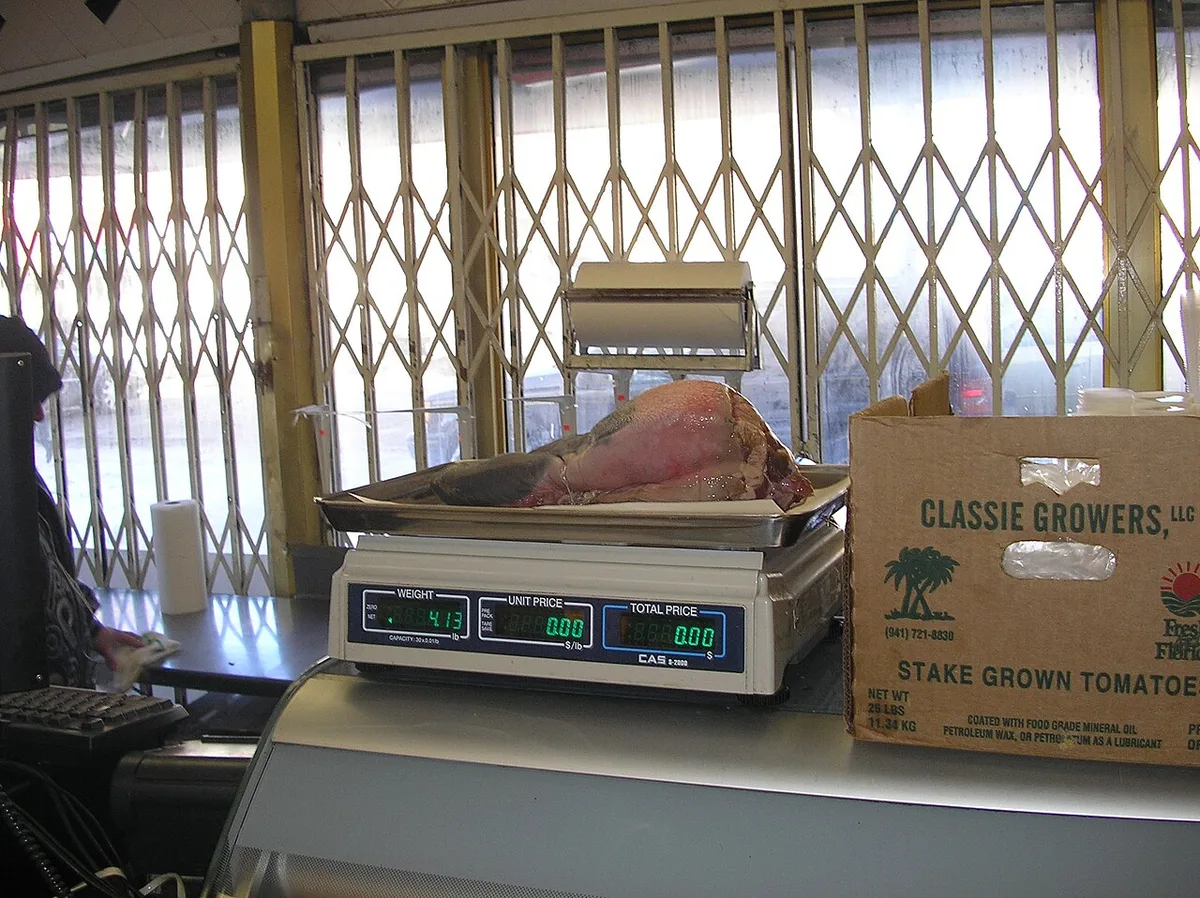
Image source: Wikimedia Commons / Marecheth Ho'eElohuth (CC BY-SA)
Keeping the Center of Gravity Low
Height is the other half of the stability equation. A tall stack of light stuff looks tidy and ruins your day, because a high center of gravity gives the trailer leverage to lean in a corner or a crosswind.
- Heavy, dense items go on the deck. Light, bulky items go on top.
- Keep the load below the top of the trailer sides where you can. Anything above the deck rails catches wind like a sail.
- Match weight left to right too. An off-center load preloads one tire and one spring, and it makes the trailer pull to one side under braking.
- Stack flat and tight. Gaps let cargo shift, and a load that shifts mid-trip becomes a different, worse load.
Ride height at the ball matters as much as where the weight sits. If the ball mount leaves the trailer frame nose-high, you unload the front axle of a tandem trailer and overload the rear one. Nose-down does the opposite and puts extra load on the truck's rear axle.
Ramps are part of the loading plan, not an afterthought. A steep, short ramp changes the angle of the machine as it climbs, and that changes where the weight lands. Plenty of owners end up building your own ramps once they realize a longer, gentler pair solves the problem for good.
How Tongue Weight Actually Prevents Trailer Sway
Sway is a yaw oscillation. The trailer rotates around its axle, alternating left and right, and the coupler traces an arc that pushes the back of your truck with it. Tongue weight is the damping force that stops that oscillation from growing.
Load the ball properly and the coupler has to lift the front of the trailer before it can swing sideways. That takes energy, and it bleeds off the wiggle instead of amplifying it. With too little weight on the ball, the front of the trailer is free to wander and the wiggle gets fed instead of damped.
Every rig has a critical speed. Below it, a disturbance fades on its own. Above it, the same disturbance grows.
More tongue weight raises that critical speed, which is why a well-loaded trailer feels planted at 70 mph and a badly loaded one feels loose at 55.
The push comes through the tow vehicle's rear axle. As the trailer yaws, it applies a sideways force at the hitch, and the hitch is behind the rear axle on a bumper-pull setup. That geometry levers the front tires and makes the truck feel vague right when you need precision.
Too much tongue weight is a real problem too, just a different one:
- It eats into the truck's payload, sometimes hundreds of pounds of it.
- It unloads the front axle, which lightens steering and lengthens stopping distance.
- It can push the rear axle past its GAWR even when total weight looks fine.
- It makes the truck squat, which points the headlights at the sky and changes the trailer's attitude.
Aim for the target range rather than piling weight forward until it "feels stable." On a 6,000 lb trailer, 10-15 percent is 600 to 900 lb on the ball. That's a wide enough window to tune with real measurements instead of guesswork.
Short trailers deserve extra respect here. A 10-foot utility trailer has a shorter distance between the coupler and the axle, so it reacts faster and with less warning than a 20-foot car hauler. The percentage rule still applies.
The margin for error doesn't.
Know Your Ratings First: Payload, GVWR, GCWR, and Hitch Class
You can't load a trailer correctly until you know what the tow vehicle and trailer are each rated to carry. There are six numbers involved, and they're routinely confused with each other.
| Rating | What it actually covers |
|---|---|
| GVWR | The most the vehicle or trailer can weigh fully loaded, set by the manufacturer |
| GAWR | The most weight a single axle is rated to carry, listed separately for front, rear, and trailer axles |
| GCWR | The combined weight of the tow vehicle, the trailer, and everything in both |
| Payload | GVWR minus curb weight, printed on the yellow sticker in the driver's door jamb |
| Curb weight | The vehicle with fluids and a full tank, no people and no cargo |
| Hitch rating | Maximum tongue weight and trailer weight for your specific hitch, in both weight-carrying and weight-distributing modes |
Payload Is the Number That Bites You
As of 2026, a typical half-ton crew-cab 4×4 might advertise a tow rating north of 10,000 lb while its door sticker lists 1,400 to 1,800 lb of payload. Those two numbers describe very different trucks, and the sticker is the one that governs.
Run the math on a realistic family trip:
- Payload available: 1,500 lb
- Two adults and two kids: 480 lb
- Cooler, tools, luggage: 180 lb
- Tongue weight of a 5,500 lb trailer at 12 percent: 660 lb
- Remaining payload: 180 lb
That's before anyone throws a firewood bundle or a hard folding cover in the bed. A tonneau or other bed storage option adds real weight you have to count, and it's easy to forget because it's bolted on rather than loaded.
Airbags and helper springs won't fix this. They level the truck, which helps the headlights and the ride, but they don't change a single rating on that sticker. The rear axle is still rated for what it's rated for.
Hitch Class and What the Label Actually Says
Hitch class sets the ceiling on tongue weight and trailer weight. These are the typical ranges you'll see, though the label on your specific hitch is always the authority.
| Class | Typical max trailer weight | Typical max tongue weight | Typical use |
|---|---|---|---|
| I | 2,000 lb | 200 lb | Small utility trailers, bike racks |
| II | 3,500 lb | 300-350 lb | Light boats, pop-up campers |
| III | 5,000-6,000 lb | 500-600 lb | Utility trailers, small cargo trailers |
| IV | 10,000 lb | 1,000 lb | Enclosed cargo, car haulers, mid-size travel trailers |
| V | 12,000-17,000 lb | 1,200-1,700 lb | Large equipment trailers, gooseneck and fifth wheel adapters |
Read the label closely, because most hitches list two sets of numbers. The weight-carrying figure applies to a plain ball mount. The weight-distributing figure is higher and only applies once spring bars are installed and adjusted.
Towing a 9,000 lb trailer on a Class IV hitch without bars because the label says 10,000 lb is a misread that shows up in crash reports.
Cargo securement has its own federal baseline. The rules in 49 CFR Part 393, published by FMCSA, are written for commercial vehicles, but they're the clearest published standard for how much holding capacity a load actually needs. The working load limit of all your tie-downs combined should reach at least half the weight of the cargo they hold.
Beyond Tongue Weight: The Other Causes of Trailer Sway
Tongue weight is the big one, but it isn't the only one. Plenty of rigs sway with the weight placed perfectly, and diagnosing those takes a different set of checks.
- Ball mount height. A trailer sitting nose-high or nose-down changes how weight sits on its axles. Level the frame with the right drop or rise.
- Tire pressure. Underinflation lets the sidewall flex, and flexing sidewalls steer the trailer for you. Set pressures cold, per the placard.
- Mismatched tires. Different sizes, load ranges, or wear levels on a tandem axle mean the tires fight each other.
- Crosswinds and passing semis. A semi's bow wave gives a lightly loaded trailer a shove. It shouldn't turn into a sway event, and it will if the tongue is light.
- Short tow vehicle wheelbase. An SUV towing near its limit has less leverage to resist the trailer's push than a long-bed pickup.
- Worn suspension and steering. Loose linkage lets a small correction become a large one, and front-end wear shows up first as vague steering under load.
- Dry or missing sway control. A friction sway bar that's been run dry, or a dual-cam setup that was never adjusted, adds nothing.
- Load shifting mid-trip. A load that settles or slides changes your carefully planned weight distribution. Recheck after the first 10 to 20 miles.
| Symptom | Likely cause | First thing to check |
|---|---|---|
| Sway that starts around 55-60 mph | Tongue weight too low | Measure actual tongue weight |
| Truck feels vague and steers light | Front axle unloaded by too much tongue weight | Recheck payload and ball mount height |
| Trailer wanders without a trigger | Worn steering or suspension parts | Inspect tie rods, ball joints, rear shocks |
| Sway only in crosswinds | Light trailer, tall profile, no sway control | Add sway control, recheck tongue weight |
| Pulls to one side under braking | Uneven left-right loading or a dragging brake | Reweigh side to side, check brake adjustment |
| Constant small corrections needed | Trailer nose-high or nose-down | Fix ball mount drop or rise |
When Sway Isn't a Weight Problem
If a gentle lane change at 45-55 mph on an empty road produces more than one mild wag, treat it as a warning. If the wag continues after you center the wheel and ease off the throttle, stop and reload before you go faster.
If the rig is stable solo but goes loose when loaded, it's almost always distribution. If it's loose even empty, look at tires, alignment, and hitch height. And if the correction itself feels difficult, check your steering grip: relaxed hands at nine and three make a small, precise input possible, and a death grip makes overcorrection almost automatic.
One more variable that catches people out: water tanks. Travel trailers with fresh water carried in tanks behind the axle behave very differently full than empty. Fill up before you leave and recheck the tongue weight rather than discovering the difference on a mountain grade.
How to Load a Trailer Properly, Step by Step
Everything up to now has been the physics and the paperwork. This section is the driveway sequence, in the order that keeps you out of trouble. Work through it top to bottom, and don't skip a step when you're in a hurry, because the skipped step is always the one that mattered.
Read the Stickers and Plan the Load Before You Lift Anything
Every number you need is printed somewhere on the rig. The trick is knowing where to look.
| Where to look | What it tells you |
|---|---|
| Driver's door jamb sticker | Payload, axle ratings, tire size and pressure for the truck |
| Label on the receiver hitch | Max tongue weight and trailer weight, weight-carrying and weight-distributing |
| Trailer VIN plate on the tongue | Trailer GVWR, GAWR per axle, and sometimes empty weight |
| Tire sidewall or trailer placard | Load range, max load, and cold pressure |
Run the payload math backward before you load. Start with the door sticker number, then subtract people, pets, tools, and whatever already lives in the bed. What's left is the tongue weight you have to spend.
At a 12 percent target, 700 lb of leftover payload supports roughly a 5,800 lb loaded trailer, so a family half-ton fills up faster than most people expect.
Then sketch the load before you touch it. A note on your phone with item weights beats guessing in the driveway. Spec sheets, shipping labels, and mulch bag counts all give you real numbers.
Heavy items get their positions decided on the sketch first, and light filler fills the gaps around them.
Loading on paper has one more payoff. When the scale or the sway test tells you the tongue is light, you'll know exactly which item to slide forward instead of guessing.
Prep the Trailer: Tires, Lights, Deck, and Brakes
Do this walk-around before the first pallet touches the deck.
- Set tire pressure cold, per the trailer placard, on every tire. Matched pressures on a tandem matter more than people think.
- Check the DOT date code on each sidewall. Trailer tires usually age out before they wear out, and the accepted guidance is replacement at five to six years regardless of tread.
- Confirm the lug nuts are torqued to spec. An impact gun makes wheel work fast, but careless impact wrench technique leaves hardware loose, and a departing trailer wheel does serious damage at speed.
- Walk the lights with a helper: running, brake, turn, and clearance.
- Inspect the deck for soft spots, missing screws, and nails working their way up.
- Test the breakaway battery and pull the pin to confirm the brakes lock.
- Verify the brake controller connection and the manual override lever.
- Chock the trailer wheels on both sides before anyone sets foot on a ramp.
The tow vehicle deserves a quick look too. A truck with a nagging dash light is a bad bet on a mountain grade, and a good code reader costs less than one tow bill on a rural highway.
Place Heavy Cargo Over or Just Ahead of the Axle
On a 3,000 lb load, the 60/40 split means about 1,800 lb ahead of the axle group and 1,200 lb behind it. The heaviest single item goes over the axle itself or slightly forward of it. The second heaviest sits just behind, close in.
Light filler goes last.
The common overcorrection is cramming everything against the front wall. That spikes tongue weight past your target, eats payload, and unloads the truck's front axle. The front wall isn't the goal.
The goal is the window: nose-heavy enough to plant the coupler, not so heavy the truck squats and steers vague.
Ground slope matters more than it looks. Loading on a slope shifts the rig's effective balance as items roll or slide uphill, so level ground first if you have the choice. If you don't, plan the placement as if the trailer were level and recheck once you're parked flat.
Balance Side-to-Side and Keep the Center of Gravity Low
Left-right balance gets skipped constantly, and it shows up as a pull under braking and uneven tire wear. Aim for the big weights centered on the trailer's centerline. A quick sanity check is the gap between each wheel arch and the ground: if one side sits lower, move weight across.
Vertical placement follows the same logic as the 60/40 rule. Dense, heavy items ride on the deck. Light, bulky items stack on top.
A trailer loaded like a pyramid handles like a pyramid, and a crosswind is all it takes to test that.
Tall items that can't be split, like an armoire or a stack of cabinets, go forward of the axle and get strapped at two heights. Low anchor at the base, high anchor at the top, opposing angles. That stops the topple instead of just stopping the slide.
Hitch Up Level: Ball Size, Coupler Latch, and Safety Chains
- Match the ball to the coupler exactly: 1-7/8", 2", or 2-5/16" is stamped on both parts. Never eyeball it.
- Back under, lower the coupler fully onto the ball, close the latch, and install the pin or lock. A latched coupler without a pin can pop open on a pothole.
- Cross the safety chains under the tongue so they form a cradle. Attach them to frame-mounted points, never to the ball mount.
- Clip the breakaway cable to its own frame point, short enough to activate in a separation but with enough slack to turn.
- Plug in the connector and run the full light test again now that everything's connected.
- Level the rig: measure the trailer frame height front and rear, then select the ball mount drop or rise that brings the frame level with the truck loaded.
- Fully retract and stow the jack, pull the chocks, and confirm the ramps are latched or secured in the tow vehicle.
That level check is worth thirty seconds of measuring. A nose-high tandem unloads its front axle and overloads the rear one, which is the textbook recipe for a blowout on a hot day.
Securing the Load: Tie-Downs, Working Load Limits, and Anchor Points
A perfectly placed load that slides two feet in a panic stop is no longer perfectly placed. Securement is part of loading, not a chore that happens afterward.
The working load limit, or WLL, is the maximum force a strap, chain, or anchor is rated to hold in normal use. It's roughly one third of breaking strength, so a strap with a 10,000 lb break strength is rated to hold about 3,333 lb working. The tag on the hardware is the authority, not the box it came in.
| Securement | Typical working load limit | Best use |
|---|---|---|
| 1-inch cam buckle strap | 200-300 lb | Light, soft cargo that crushing would ruin |
| 2-inch ratchet strap | About 3,333 lb | The utility trailer workhorse |
| 4-inch ratchet strap | About 5,400 lb | Enclosed trailers, heavy freight |
| 5/16-inch Grade 70 chain with binder | About 4,700 lb | Machines, vehicles, equipment |
| Axle straps with soft loops | 2,300-3,300 lb | Vehicle axles and wheels |
The 50 percent rule from the ratings section is the baseline, and the regulation behind it has a detail most people miss. Under 49 CFR 393.106, a tie-down that runs from an anchor, over or around the cargo, and back to another anchor counts at its full WLL. A strap that runs directly from the truck to a hard point on the cargo counts at only half.
Looped straps do double the work of direct ones, which is why the four-corner method is so effective.
The commercial rules also set a tie-down count floor, and it's a sound one for private haulers: two minimum for anything over 1,100 lb, with additional tie-downs for each additional 10 feet of cargo length. Four corners plus opposition beats one strap per side every time.
Anchor Points and Where Not to Hook
Good straps on bad anchors is still a bad system. Recessed D-rings with backing plates, stake pockets, and rated E-track fittings are the real anchors. Inspect them for rust and cracked welds before each trip, because a corroded backing plate is a failure waiting for a bumpy road.
Never hook to sheet metal, bumpers, brake lines, wiring, or the coupler itself. On cars and trucks, factory recovery points have their own ratings and rules, and they're designed for pulling a stuck vehicle, not restraining cargo down a highway. Confusing the two is how bumpers get bent and strap anchors rip out at 65 mph.
Technique tips:
- Run four straps at opposing angles, roughly 45 degrees to the load where the anchor layout allows.
- Chock the wheels of anything that rolls, in addition to strapping it.
- Add edge protection at every sharp corner: purpose-made protectors, rubber, or folded cardboard. Webbing chafed against a steel edge can part in a few miles.
- Ratchet until the strap is tight and the load can't shift, then stop. Over-cranking crushes panels, bends light tie rails, and stretches webbing.
- Retire any strap that's cut, frayed, or sun-bleached. UV kills webbing quietly, and damaged straps fail without warning.
Then recheck. Straps settle and loads shift in the first miles, so stop at 10 to 20 miles and re-tighten everything. A quick strap check at every fuel stop after that costs you two minutes.
Verifying the Load: Tongue Weight Scales, the CAT Scale Three-Pass, and the Sway Test
Loading by feel is guessing with confidence. Measuring takes twenty minutes and settles the argument with numbers.
| Method | Ballpark accuracy | Cost |
|---|---|---|
| Bathroom scale and pipe setup | Decent, setup-dependent | Free |
| Dedicated tongue weight scale | Within about 2 percent | $100-350 |
| Certified public scale | Certified legal weight | Per weighing, usually around $15 |
The bathroom scale method works for lighter tongue weights. Park the trailer level on flat ground, set the scale on a block so the jack foot sits at ball height, and lower the jack onto the scale. For heavier tongues, use the lever arrangement with a pipe and a jack stand, or skip straight to a certified scale.
Never guess on a heavy trailer.
The CAT Scale Three-Pass
A certified truck stop scale gives you every axle weight in one printout, and the three-pass method isolates the numbers that matter.
- Pass one, truck only. Weigh the tow vehicle loaded exactly as it will be driven, passengers included. Note the steer and drive axle weights.
- Pass two, truck plus loaded trailer. Same setup, trailer hitched. The steer and drive weights will jump, and the trailer axles get their own line. Tongue weight is the difference between the truck axle totals in pass one and pass two.
- Pass three, after adjusting a weight-distribution hitch. This shows the transfer: the steer axle should come back near its solo weight, and every axle stays under its GAWR.

Image source: Wikimedia Commons / Johannes Weiland
Read the printout against every rating from the earlier section: steer axle vs front GAWR, drive axle vs rear GAWR, trailer axles vs trailer GAWR, and the combined total vs GCWR. You can be legal on GVWR and still over on the rear axle, and the printout is where that surfaces.
Reweighs at the same stop cost a couple of dollars, so adjusting the load and rolling back across the platform is cheap. Move cargo forward in one to two foot increments, re-weigh, and repeat until the tongue lands in the target window.
The Sway Test
Numbers verified, do one live check. Find an empty stretch of road and hold 45 to 55 mph. Make one gentle lane change, smooth input, hands relaxed at nine and three.
A healthy rig settles within one cycle. The trailer swings once, comes back, and tracks straight. The truck's steering stays weighted the whole time.
If you feel two or more wags, or the steering goes light as the trailer swings, don't muscle it down the highway. Stop and move weight forward. A weight-distribution hitch or airbags can mask a light tongue, but they don't fix it, and the next crosswind will remind you.
How Loading Differs by Trailer Type
The percentages travel across trailer types, but geometry changes what forward means and how much the hitch can carry. Here's how the big three differ.
Bumper-Pull vs. Gooseneck vs. Fifth Wheel
| Bumper-pull | Gooseneck | Fifth wheel | |
|---|---|---|---|
| Hitch point | Behind the rear axle | Over the rear axle | Over the rear axle |
| Target hitch weight | 10-15% | 15-25% | 15-25% |
| Sway tendency | Highest | Low | Lowest |
| Bed space used | None | Some | Significant |
| Typical loads | Utility, cargo, boats | Equipment, livestock, hotshot | RVs, heavy freight |
A bumper-pull puts the pivot behind the tow vehicle's rear axle. That's a lever, and it's why tongue weight and a good WDH matter so much on this style. A gooseneck or fifth wheel puts the pivot directly over the rear axle, so the pin weight carries on the axle instead of hanging behind it.
The front axle stays loaded and steering stays honest.
Gooseneck pin weights run big. Twenty percent of a 15,000 lb trailer is 3,000 lb riding in the bed, which is more payload than many half-tons have to give. The payload math bites even harder on this style, so check the truck's numbers before you load, not after.
There's a turning trade too. A gooseneck tracks closer to the tow vehicle's path, which makes it easier to place in tight spots than a same-length bumper pull. A long bumper-pull swings wide and cuts corners, which is how fences and tailgates get claimed.
Single Axle vs. Tandem Axle
A single axle trailer is lighter, cheaper, and easier to back. It also has a short wheelbase, so it reacts to disturbances faster and needs its tongue percentage held firmly. One caution during loading: a single axle trailer tips when weight moves behind the axle, so keep the jack down and the wheels chocked until the load is placed.
A tandem carries more and tracks straighter. The critical extra check is level attitude, because a nose-high tandem unloads its front axle and overloads its rear one. Two axles sharing a load evenly is the whole point, and a bad ball mount quietly defeats it.
Triple axle setups take that further. They carry serious weight, but they scrub tires in tight turns and demand a perfectly level deck. If you're running triples, the scale is not optional equipment.
Open Deck vs. Enclosed
An open deck keeps the center of gravity low and gives you rub rails and stake pockets for anchors. The trade is exposure: tall loads catch wind, weather gets at everything, and anything valuable sits on public display.
An enclosed trailer protects cargo and hides it, but the box itself eats payload. Two trailers with the same 7,000 lb GVWR can differ by over a thousand pounds of empty weight, and the enclosed one gives you less to load as a result. It's also a sail and sits taller, so crosswinds and passing trucks affect it more.
The hidden trap inside an enclosed trailer is that you can't see the load lean. Strap interior cargo as seriously as an open-deck load, use the E-track and D-rings, and do the 10-mile recheck even when everything looks closed up and tidy.
Loading Real Cargo: Mowers, ATVs, Cars, Lumber, and Livestock
Theory meets the driveway here, and each cargo type has its own traps. These are the placements that come up constantly in towing forums, service calls, and insurance claims.
Mowers and Zero-Turns
Drive the machine on and position it over or just ahead of the axles. Set the parking brake, chock the wheels, then run four straps to the frame. Never strap to the mower deck, because decks are designed to move, and never to steering or control arms that bend under load.
Zero-turns deserve extra care. They're top-heavy, ramps are steep, and a rollover during loading is common enough to have a name in the repair trade. Low speed, straight up the ramp, and a spotter beats every alternative.
ATVs, UTVs, and Dirt Bikes
Four corner straps with soft loops around the frame or A-arms. Don't crank the suspension all the way down: suspension cycles at road speed loosen straps that were torqued against compressed springs. A light preload is enough, and the 10-mile recheck catches what settled.
UTVs changed this math. A big side-by-side runs 1,500 to 2,500 lb depending on the model, and that weight sits high on tall tires. Put the machine over the axles, strap the frame rather than the cage, and leave the parking brake set as a backup rather than a plan.
Dirt bikes are the easy one. Two straps at the handlebars pulling forward and down, two at the rear, front wheel in a chock. Compress the forks maybe an inch.
More than that and you'll be replacing fork seals.
Cars and Trucks on an Open Hauler
Four straps, crossed, at the four corners. The preferred method is axle straps or wheel nets around the unsprung parts, not the body. Strapping a unibody car by the frame rails or tow hooks sounds smart until you bend something expensive.
Position the vehicle so its weight sits centered over the trailer axles, then check that the front bumper clears the tongue and the rear overhang is legal. Nose-first is the default because it puts the engine mass ahead of the axle. Backing a rear-engine car on can be the better call, and it's worth thinking through before you commit.
Leave the transmission in park or in gear with the parking brake set, and strap the body to the trailer as well if it's a long haul. A car that rocks on its suspension works the straps loose over hundreds of miles.
Tie-down costs add up fast on this setup. A proper four-point kit with axle straps and ratchets runs a couple hundred dollars, which is why a lot of first-time haulers end up pricing hardware online before their first trip, right alongside things like lug nut replacements and the other small parts that quietly add up.
Lumber, Plywood, and Building Materials
Long, flat, and dense describes most building material loads, and it changes the plan. Lumber wants to sit flat on the deck, banded or strapped at multiple points along its length, with the heaviest bundles over the axles.
Plywood sheets are sails. A stack of 3/4-inch sheets weighs about 70 lb each, so ten sheets is 700 lb, and the wind load at highway speed is the real problem. Keep the stack low, strap it at the front, middle, and rear, and don't let sheets overhang the sides where they can flex and crack.
Overhang rules matter here more than anywhere. Most US states allow up to 4 feet of rear overhang before you need flags, and some are stricter. Red flags on the rear corners in daylight, a red light or reflector at night, and a check on your state's specific overhang limit before you pull out.
Long pipe, rebar, and 20-foot boards also need a flag and often a front overhang warning. Strapping them at two points isn't enough. Three points minimum on anything over 15 feet, or the middle sags and the ends whip.
Livestock and Live Loads
Animals move, and a moving load changes its own weight distribution. That's the entire difference between hauling cattle and hauling mulch.
Load livestock so the weight sits forward, with dividers used to keep animals from bunching at the rear. A group of cattle that all drift backward during braking turns a stable trailer into a tail-heavy one in seconds. Dividers and a forward bias are the fix.
Floor condition is a safety item, not a maintenance item. Wet, corroded floors in livestock and horse trailers fail under hooves and hooves punch through. Check the floor before every trip, and use mats for grip.
Ventilation and stopping rules apply too. Long trips need rest stops with water and airflow. In the US, livestock transport welfare expectations are enforced at the state level, and the details vary.
The USDA's animal health resources at usda.gov cover interstate movement requirements if you're crossing state lines.
Horses add one more variable. A horse's sense of balance is decent, but a rough-riding trailer will panic it. Smooth braking, wide turns, and a trailer with good suspension matter more than any strapping technique.
Appliances, Pallets, and Awkward One-Offs
A refrigerator or a washer is tall, heavy at the base, and top-heavy once it's on a dolly. Lay it down if the manufacturer allows it, or stand it upright against the front wall with straps at two heights. Compressors in fridges need to sit upright for hours before you plug them in, so upright is usually the right call.
Pallets are the easiest load on a utility trailer if you can get them on with a forklift. Center the pallet over the axles, run two straps over the top crossing the pallet, and use corner protectors so the webbing doesn't cut into the shrink wrap and the product underneath.
Awkward one-offs, like a single sofa or a stack of doors, need the same discipline as a full load. One heavy item centered over the axle with four opposing straps beats one heavy item shoved against the front wall with two.
Boat Trailers and the Ramp Exception
Boats load differently because the trailer is built around the hull. Bunks and rollers position the boat, and the winch post and bow eye hold it forward. The transom should sit over or just behind the rear axle, and the tongue weight target is still 10 to 15 percent.
The ramp is where this goes wrong. Backing down, the trailer tips as the axle crosses the ramp break. Winch the boat on rather than powering on, because powering on can shift the hull and dunk the tow vehicle's exhaust.
Two straps at the stern, plus the winch strap and a safety chain at the bow, is the minimum. Surge brakes complicate backing up ramps and driveways, and most couplers have a lockout for exactly that. Check yours before you're halfway down a wet ramp with a line of trucks behind you.
A Quick Placement Reference
| Cargo | Best position | Securement |
|---|---|---|
| Zero-turn mower | Over the axles | Four straps to frame, wheels chocked |
| ATV or UTV | Over the axles | Four corner straps, soft loops, light preload |
| Car or truck | Centered over axles, engine forward | Four crossed straps at wheels or axles |
| Lumber and plywood | Flat, heavy bundles over axles | Three or more straps, low stack, flags on overhang |
| Livestock | Forward bias with dividers | Dividers, mats, latched gates |
| Palletized goods | Centered over axles | Two crossing straps plus corner protection |
| Boat | Transom over rear axle | Winch strap, bow safety chain, two stern straps |
The Trailer Loading Mistakes That Cause Accidents
Most of these show up in the same handful of failure patterns. None of them require bad intentions. They require a rushed Sunday morning and a habit nobody corrected.
Loading the Heavy End Last
The rear ramp door is the easiest place to put something. It's also the worst. Anything heavy behind the axle levers weight off the coupler, and a 500 lb item two feet behind the axle can strip most of your tongue weight in one move.
Fix it by loading the heavy end first, while you can still walk the deck. If you've already loaded tail-first, unload and start again. Shuffling cargo around a full deck is how people get hurt.
Trusting "Load It Evenly"
Evenly distributed front to back means near-zero tongue weight. That's the exact condition that produces sway at highway speed. Our earlier sections covered why, and it's worth repeating here because the advice is everywhere and it's still wrong.
Skipping the Payload Math
Tongue weight counts against the truck's payload, and so do passengers, pets, tools, and whatever lives in the bed full time. Plenty of rigs are under on trailer weight and over on payload without anyone noticing until the rear axle hits a scale.
Strapping to Whatever Looks Solid
Sheet metal, bumpers, brake lines, bed rails, and the coupler all fail as anchors. So do rusted D-rings with no backing plate. A strap that rips free at 60 mph turns into a whip.
Ignoring Trailer Attitude
A nose-high trailer looks fine in the mirror and unloads its front axle. If you've never measured frame height at the front and rear of the deck, you don't actually know whether your ball mount is right. Measuring takes a minute.
Over-Tightening and Under-Tightening at the Same Time
Ratchet straps get cranked until the cargo creaks, then left alone for 300 miles while they stretch and settle. Tight enough to stop movement, then rechecked at 10 to 20 miles and at every fuel stop. That's the whole technique.
Forgetting the Wheels
Anything that rolls needs chocks in addition to straps. Trailers get chocked before anyone walks up a ramp too, because a trailer that rolls back with you on the ramp is a genuinely bad afternoon.
Loading on a Slope
A sloped driveway changes where weight settles as items slide. Load on flat ground when you can. When you can't, plan the placement as if the deck were level and recheck once you're parked flat.
| Mistake | What it causes | The fix |
|---|---|---|
| Heavy cargo at the rear | Sway, loss of control | 60/40 split, heavy items over the axle |
| Even front-to-back distribution | Near-zero tongue weight | Load deliberately front-biased |
| Ignoring payload sticker | Overloaded rear axle, voided claim | Run the math before loading |
| Strapping to sheet metal | Strap failure at speed | Rated anchors with backing plates |
| Wrong ball size | Coupler pops off | Match 1-7/8", 2", or 2-5/16" exactly |
| No recheck after 10 miles | Loose straps, shifting load | Stop and retighten early in the trip |
| No wheel chocks | Trailer rolls during loading | Chock both sides every time |
The Legal Side: Weight Limits, Cargo Securement Rules, and Weigh Stations
Weight law doesn't care that you're hauling your own stuff on a Saturday. Personal use gets you out of commercial driver rules in most cases. It doesn't get you out of axle ratings, lighting requirements, or an overweight citation.
The federal cargo securement standard lives in 49 CFR Part 393, Subpart I, and it's written for commercial vehicles. Several states apply similar language to private haulers, and insurers reference it heavily when a load comes loose. Following it voluntarily is the cheapest insurance you'll ever buy.
Brakes, Lights, and State Thresholds
Most states require trailer brakes somewhere around 3,000 lb gross trailer weight. Some set the number lower, in the 1,500 to 2,000 lb range, and a few tie it to the tow vehicle's weight instead. Your state's statute is the one that applies, not a forum post.
Lighting rules are similar. Tail lights, brake lights, turn signals, and clearance lights are baseline. Many states also require a breakaway system that applies the trailer brakes if the coupling fails, and that system needs a charged battery to work.
Dimensions and Overhang
The common US limits are 8 feet 6 inches wide and 13 feet 6 inches tall before you need an oversize permit. Rear overhang past the trailer deck usually needs a red flag in daylight and a light or reflector at night.
Loads wider than the trailer are a separate headache. Mirrors, escorts, and permits come into play, and the rules shift state to state. Check before you leave, not at the first weigh station.
Do You Have to Stop at Weigh Stations?
Private vehicles generally don't have to pull into weigh stations unless the state directs them to or the vehicle crosses into commercial territory. Many stations post "all vehicles over 10,000 lb" or similar language, and an RV or a heavy trailer can fall inside it.
The commercial line usually sits at 26,001 lb GCWR, or a trailer rated over 10,000 lb. Cross that and CDL rules, hours of service, and inspection requirements can start to apply. If your rig is anywhere near those numbers, read your state's rules properly.
Regional Differences Worth Knowing
| Region | Key difference |
|---|---|
| US states | Brake thresholds, towing speed limits, and overhang rules vary widely |
| UK | DVSA towing guidance, B+E licence categories, 50 mph on single carriageways and 60 mph on dual carriageways |
| Europe | Type Approval rules, MTPLM plates, noseweight capped by the tow bar rating |
| Canada | Provincial weight and lighting rules, metric ratings on newer plates |
| Australia | State-based registration and towing limits, different hitch conventions |
Speed limits while towing catch people out. Several US states drop the limit for vehicles with trailers, often to 55 or 60 mph, and enforcement is real. In the UK, trailer limits are lower than the posted limit for cars, and the 85 percent guidance for caravan weight relative to the tow car's kerb weight is still the standard advice for new towers.
Pre-Trip Checks and Trailer Maintenance That Keep You Safe
The best loading job in the world doesn't help if a bearing seizes at mile 200. Trailers sit for weeks, and sitting is hard on them.
Run this list before every trip:
- Tire pressure, cold, all tires, matched across an axle.
- Tire age, read from the DOT date code on the sidewall.
- Lug nut torque, checked with a calibrated wrench rather than an impact gun.
- Lights, every function, with a helper or a wall.
- Coupler latch, safety pin, and ball condition.
- Safety chains, crossed and rated, no cracked links.
- Breakaway cable and battery charge.
- Brake controller gain and manual override.
- Deck condition, especially on wood-deck and livestock trailers.
- Ramp pins, latches, and capacity labels.
- Anchor points, D-rings, and E-track for corrosion.
Torque gets skipped more than anything else. An impact wrench makes wheel work fast, but careless use leaves hardware either loose or stretched, and trailer wheels are unforgiving about it. Our guide to torquing wheel hardware covers the sequence and the finishing pass with a hand wrench.
Maintenance Intervals That Actually Matter
| Interval | Task |
|---|---|
| Every trip | Tire pressure, lights, coupler, chains, breakaway, brake controller |
| Every 10 to 20 miles on the road | Strap recheck, tire and hub temperature by hand |
| Every 3 months or 3,000 miles | Brake adjustment, lug torque, visual inspection of springs and hangers |
| Every 12 months or 12,000 miles | Bearing repack and seal replacement |
| Every 5 to 6 years | Tire replacement regardless of tread depth |
| Annually | Breakaway battery replacement, full wiring inspection |
Hub temperature is a free diagnostic. After 20 miles, put a hand near each hub. A hub noticeably hotter than the others is a bearing or brake dragging, and it's cheaper to fix in a parking lot than on a shoulder.
Bearing repack intervals matter more than most owners realize. A trailer that sits in a driveway for months collects condensation in the hubs, and water in grease ruins bearings quietly. Warm hubs, grease streaks on the wheel, or a wobble when you spin a wheel by hand all mean stop now.
Electrical faults are the other common failure. Corroded grounds cause lights that work in the driveway and quit in the rain. If a tow vehicle throws a lighting or brake code while hitched, the right scan tool will tell you whether it's the truck, the trailer, or the connector.
Wood decks need a look before every heavy load. Soft spots, popped screws, and nails working upward all start small. A deck that flexes under a mower is a deck that will fail under a mower.
When Good Loading Isn't Enough: Weight-Distribution Hitches, Sway Control, and Getting Help
Sometimes the numbers say you're fine and the rig still feels loose. That's when hardware and setup come into play, not more cargo shuffling.
When You Actually Need a Weight-Distribution Hitch
A weight-distribution hitch, or WDH, uses spring bars to lever load off the tow vehicle's rear axle and back onto its front axle and the trailer axles. It's not a sway device, though it helps with sway by keeping the front tires loaded.
The rule of thumb most installers use: if your loaded tongue weight exceeds half the hitch's weight-carrying rating, or the trailer runs over roughly 5,000 lb, you're in WDH territory. Your hitch label settles it. Many hitches list a weight-distributing rating that's meaningfully higher than the weight-carrying one, and that higher number only applies with bars installed and adjusted.
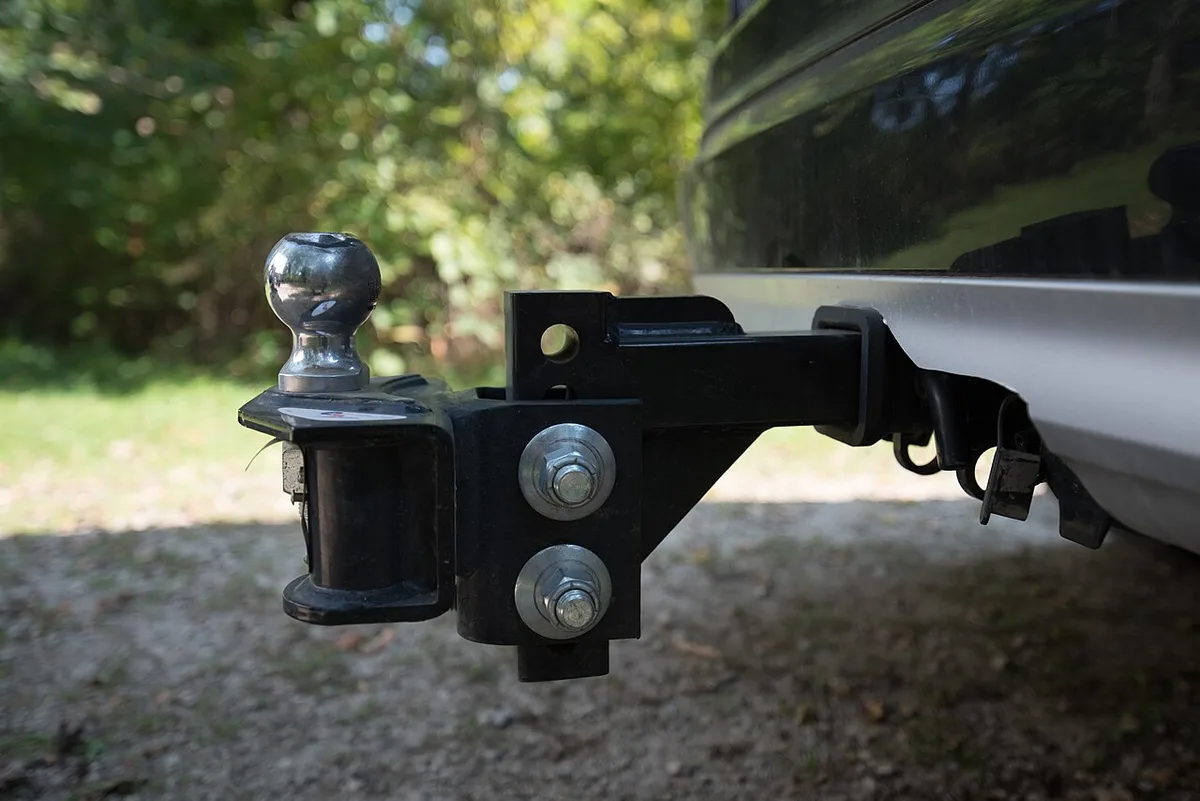
Image source: Wikimedia Commons / Tony Webster from Minneapolis, Minnesota, United States (CC BY)
Setup follows a simple three-measurement routine:
- Measure the front fender height on level ground with the truck loaded but unhitched.
- Hitch up and measure again. The front will rise, often an inch or more.
- Install the bars and adjust the links or washers until the front height comes back to within about half an inch of the solo number.
Get that right and the steering comes back. Get it wrong and you've either under-transferred weight or overloaded the front axle, and both feel worse than no bars at all.
Sway Control Options Compared
| Type | How it works | Best for |
|---|---|---|
| Friction sway bar | Friction pad resists yaw at the ball | Light trailers, budget setups |
| Dual-cam | Cams recenter the trailer after a disturbance | Mid-weight travel trailers |
| Electronic sway control | Truck sensors brake individual wheels | Trucks with factory tow packages |
| Pivot-projection hitch | Projects the pivot point forward, near the rear axle | Long trailers prone to sway |
Friction bars need adjustment and occasional pad replacement. Run one dry and it does nothing. Electronic systems built into newer trucks are genuinely effective, but they're a backstop rather than a license to load badly.
Pivot-projection hitches cost real money, and they work. If you tow a long travel trailer in crosswinds regularly and you've already fixed tongue weight, ball height, and tires, they're the next step.
Airbags, Helper Springs, and What They Don't Do
Airbags level the truck. They improve headlight aim, ride quality, and rear suspension travel. They do not raise GVWR, GAWR, or payload by a single pound.
That distinction matters after a crash. An insurer looking at a sagging rear end and a load over the axle rating isn't going to be impressed by the fact that the truck sat level. Level isn't the same as legal.
When to Get Help
Some situations call for a professional rather than another afternoon of trial and error:
- Your rig scales over a rating even with the load placed correctly.
- Sway persists after tongue weight, ball height, and tire pressure are all verified.
- You're setting up a gooseneck or fifth wheel for the first time.
- You're towing a combination near your licence or CDL threshold.
- The trailer has structural rust, cracked welds, or a failing deck.
A commercial hitch installer, a trailer shop, or your state's commercial vehicle enforcement office can answer questions a forum can't. And if you're ever unsure at the roadside, the safest call is to stop, not to push on and hope the wag settles.
Trailer Loading FAQs
How Much Tongue Weight Should My Trailer Have?
Ten to fifteen percent of the loaded trailer weight for a bumper-pull, and 15 to 25 percent for a gooseneck or fifth wheel. A 6,000 lb trailer wants 600 to 900 lb on the ball. Measure it loaded and level, not empty.
What Happens If I Load a Trailer Tail-Heavy?
Tongue weight drops toward zero and the trailer starts steering itself. You'll feel a wag that grows instead of fading, usually somewhere between 50 and 60 mph. It can end in a spin or a rollover, and hard braking mid-sway usually makes it worse.
Is Even Weight Distribution Really Bad Advice?
Yes, for front-to-back placement. Balancing a load perfectly over the axle leaves nothing pinning the coupler to the ball. You want a deliberate forward bias instead, with roughly 60 percent of cargo weight ahead of the axle group.
How Do I Measure Tongue Weight Without a Scale?
Use a bathroom scale with a lever setup: a pipe under the coupler, a jack stand at a known distance, and the scale at another. Multiply the reading by the lever ratio. It's accurate enough for light trailers.
Heavy trailers deserve a proper tongue scale or a certified weighbridge.
Does Tongue Weight Count Against My Truck's Payload?
It does, and it counts fully. A 700 lb tongue weight is 700 lb off the yellow door-jamb sticker, alongside passengers, tools, and anything else in the truck. That's why payload, not towing capacity, is usually the number that limits a half-ton.
Do I Need a Weight-Distribution Hitch?
You need one when loaded tongue weight exceeds roughly half your hitch's weight-carrying rating, or when the trailer runs over about 5,000 lb. The label on your receiver hitch is the authority. If it lists a separate weight-distributing rating, that number only applies with the bars installed and adjusted.
