
Backing a trailer is the part nobody warns you about. Learning how to back up a trailer isn't really about courage or coordination. It's about a pivot point that answers late and a mirror that shows you the wrong end of the problem.
Get the setup right and the maneuver almost drives itself.
The physics never changes, which is why the skill transfers from a 4×8 utility trailer to a 30-foot travel trailer. Our research keeps landing on the same numbers too. Conventional trailers want 10 to 15 percent of their gross weight on the tongue, and that tongue weight is what keeps the trailer tracking instead of wandering.
Here's how the whole thing works, starting with the three rules that cover most of the job.
How to Back up a Trailer
Backing up a trailer comes down to steering the bottom of the wheel. Point that wheel bottom toward your target. Move at a walking pace, at idle or just above.
Watch the trailer tires in the mirrors, not the box. Straighten the wheel once the trailer points where you want it. Pull forward and reset when the angle goes bad.
The 30-Second Answer: The Three Rules Behind Every Good Back
Three rules do most of the work. Everything else in this guide is detail layered on top of them.
Rule One: Steer the Bottom of the Wheel
Put your hand at six o'clock on the rim and move it toward your target. That single habit solves the direction problem that ruins most first attempts.
Here's why it works. When you reverse, the rear of the tow vehicle swings opposite to where the front wheels point. The bottom of the steering wheel moves opposite to the top.
So the bottom of the wheel travels in the same direction the trailer nose will travel. Your eyes track the wheel bottom, your hand follows, and the trailer goes where you intended.
The old instruction to "turn opposite the direction you want the trailer to go" is technically true. It's also the sentence people misapply at speed. They watch the top of the wheel, turn it the "wrong" way, panic, and saw the wheel back and forth until the rig folds.
Anchor your reference point at the bottom and the confusion disappears.
Rule Two: Watch the Tires, Not the Box
The trailer's body swings through a much wider arc than its axles. Stare at the box and you'll correct against a moving target that isn't telling you where the trailer is actually headed.
Track the trailer tires instead. They show you the path the trailer is committed to, and they show you drift before it becomes damage. On a crowned boat ramp or a gravel lane, the tires are also your only warning that the trailer is walking toward soft ground or off the edge of the concrete.
Rule Three: Walking Pace, and Reset Without Shame
Idle speed is fast enough. Roughly 1 to 3 mph, foot hovering the brake, ready to stop inside a foot. Speed is what turns a small miscalculation into a bent bumper.
When the angle goes bad, pull forward and start over. That's not failure, that's the recovery procedure. The GOAL habit (Get Out And Look) belongs here too.
Stop the truck, walk the path, look at what the mirrors can't show you, then reset. Professionals do this constantly. Beginners grind it out and pay for bodywork.
| Rule | What you actually do | What it prevents |
|---|---|---|
| Bottom of the wheel | Hand at six o'clock, move it toward the target | Losing track of steering direction |
| Tires, not the box | Eyes on the trailer wheels in the mirror | Overcorrecting on the body's wide swing |
| Walking pace plus reset | Idle speed, pull forward when the angle dies | Jackknife, bent hardware, crunched panels |
Why Your Brain Fights the Trailer: Pivot Points and Delayed Reaction
A trailer isn't a car with extra length bolted on. It's a second vehicle attached by a single joint, and that joint changes everything about how inputs translate into movement.
The pivot point is the coupler on a bumper-pull trailer, or the kingpin on a fifth-wheel and gooseneck. Every steering input rotates the tow vehicle around its own rear axle, which pushes or pulls that pivot sideways. The trailer then rotates around its own axles in response.
Two rotations, one joint, and a delay between them.
That delay is what scrambles your instincts. You turn the wheel, nothing happens for a beat, so you turn it more. Then the trailer catches up all at once and you're already past the angle you wanted.
The fix is mechanical: small input, pause, watch the trailer answer, then adjust. Treat every steering correction as a request, not a command.
Inches at the wheel become feet at the axle. A quarter turn of the rim held for two seconds can swing a trailer's tail several feet. That's why the drivers who look calm are the ones making tiny, patient inputs, and why the drivers fighting the wheel are usually the ones causing damage.
The Jackknife Angle and Why It Sneaks Up
Jackknifing means the articulation angle between tow vehicle and trailer has closed too far. On a conventional rig, metal-to-metal contact typically arrives somewhere around 90 degrees of articulation, sometimes less depending on tongue length, bumper depth, and spare tire placement.
The trap is that a jackknife rarely announces itself. You're chasing a target, the angle opens past 45 degrees, the trailer disappears from the mirror, and now every correction makes it worse. Past roughly 60 degrees, most rigs stop being recoverable in reverse.
Stop the truck, pull forward to straighten, and re-approach with a better starting position.
Your Front Corners Are Swinging Too
While you're watching the trailer, the front of your tow vehicle is sweeping a wide arc in the opposite direction. That's what clips mailboxes, fuel pumps, campsite pedestals, and parked cars.
On a long-wheelbase truck with a crew cab, the front overhang swings further than you'd guess. Give yourself two feet of clearance more than feels necessary on the front side, and let a spotter watch that corner if the space is tight.
Your hands stay low on the rim throughout, the same relaxed grip that keeps steering smooth in normal driving. Panic gripping the top of the wheel is how people lose track of which way is which.
Your Rig Decides Your Method: Axles, Wheelbase, and Hitch Type
Two trailers of the same length can behave completely differently. Axle count, axle position, tow vehicle wheelbase, and hitch type all change how fast the trailer reacts and how much forgiveness you get.
| Rig type | Where it pivots | Reaction speed | Forgiveness |
|---|---|---|---|
| Single-axle utility, 4×8 to 6×12 | Coupler at the bumper | Very fast | Low, small inputs only |
| Tandem-axle utility or cargo | Coupler at the bumper | Fast, but scrubs and resists turning | Moderate |
| Bumper-pull travel trailer, 20 to 30 ft | Coupler, long distance to axles | Slow to start, slow to correct | Moderate, more thinking time |
| Fifth-wheel or gooseneck | Over or in front of the rear axle | Predictable, tracks tighter | Highest |
Single-Axle vs. Tandem Trailers: Reaction Speed and Forgiveness
A single-axle trailer pivots on one contact patch per side. It changes direction almost instantly and overruns your correction just as fast. Short single-axle utility trailers are the twitchiest thing most people will ever back up.
Tandem axles behave differently. The tires scrub sideways against the pavement and resist rotating, so the trailer starts turning later and keeps turning after you straighten the wheel. That lag is annoying on a straight back and genuinely helpful on a tight turn, because the trailer won't snap out from under you.
Practical translation: with a single axle, expect to make half the steering input you think you need. With tandem axles, expect to hold the input a beat longer than feels right, then unwind early.
Tow Vehicle Wheelbase and Rear Overhang
Wheelbase is the quiet variable. A short-wheelbase truck rotates its rear end quickly, so the trailer responds almost immediately. A long-wheelbase crew cab moves the same trailer more gradually and gives you a wider window to react.
Rear overhang matters just as much. Distance from the rear axle to the hitch ball acts like a lever. Long overhang amplifies every steering input into a bigger lateral push at the coupler.
That's great for swinging a trailer into a tight spot and terrible for precision at speed.
The rule of thumb: short wheelbase plus long overhang equals a rig that reacts faster than your hands. Slow down further and shrink your inputs to match.
Gooseneck and Fifth-Wheel Backing: A Different Pivot, Different Rules
Fifth-wheel and gooseneck trailers pivot over the rear axle instead of behind the bumper. That single change makes them the easiest rigs to back up, and the reason experienced haulers prefer them for tight campsites and loading docks.
Because the pivot sits inside the wheelbase, the trailer follows the truck's path more closely. The trailer tracks tighter, responds predictably, and stays visible in the mirrors far longer. The classic mistake is oversteering, since inputs translate into more trailer movement than a bumper-pull driver expects.
One more setup detail for these rigs: the bed has to stay clear. If you run a fifth-wheel, the lid has to clear the hitch plate, and clearing the hitch plate is its own puzzle worth solving before you hook up.
Towing ratings themselves follow a published protocol, SAE J2807, maintained by SAE International. That standard covers acceleration, braking, and cooling performance at gross combined weight, and manufacturer towing guides cite it directly. It doesn't measure backing skill, but it tells you what the rig is rated to do once you're hitched.
Sight Side or Blind Side: Choosing Your Approach Before You Move
Most backing failures are decided before the transmission goes into reverse. Where you stop the truck and which side you approach from determine how much of the trailer you can see.
Sight-side backing means the trailer sits on the driver's side, visible in your left mirror. Blind-side backing puts it on the passenger side, where the trailer disappears behind the cab at a much shallower angle.
Driver-Side Backing: The Default for Good Reason
You can see more, from a better angle, with less neck craning. Given any choice at all, swing wide and set up so the target ends up on your left.
On a campsite loop, that might mean driving past the site, turning around, and approaching from the opposite direction. On a job site, it might mean a lap around the block. Ten seconds of repositioning beats twenty minutes of blind-side guesswork.
Blind-Side Backing: When the Trailer Disappears
Sometimes the layout forces it. A one-way alley, a ramp lane with traffic behind you, a driveway with a wall on the left side. You take the blind side because the alternative is worse.
What carries you through is preparation. Set the passenger mirror lower and wider before you move. Use a spotter on that side, or a camera, or both.
Accept that you'll be stopping to look more often.
If the trailer vanishes from the mirror entirely, stop. Don't guess, don't "feel it out." Get out, walk back, confirm the alignment, get back in. Every experienced driver has a version of this habit, and it's the reason their fenders are intact.
Matching the Approach to the Obstacles
Run through this before you commit:
- Obstacles on the driver's side? Approach from the passenger side instead, even though visibility is worse.
- Traffic behind you on a ramp or in an alley? Take the side that needs fewer pull-forward resets, since each reset costs time and goodwill.
- Target on the passenger side with a wall on the driver's side? Back in from the driver's side by swinging wide, so the trailer swings toward the target as the truck straightens.
- No spotter, no camera, tight blind side? Reposition until the target is on your left. That's not a compromise, that's the correct call.
- Heavy crosswind? Take the sight side every time. Wind plus limited visibility is how trailers end up in ditches.
Mirrors, Backup Cameras, or a Spotter: Picking Your Visibility Setup
You need to know where the trailer is at all times. There are three ways to get that information, and the best drivers stack two of them.
Tow Mirror and Convex Spot-Mirror Setup
Stock mirrors on most trucks show you the trailer's front corner and not much else. Tow mirrors extend the arm and add a convex lower section, which widens the view enough to see the trailer's tires.
Set them before you move, not during the maneuver. Angle the main mirror down the side of the truck so you can see the trailer's flank. Angle the convex section lower and wider so the tires and the ground beside them are visible.
A loose or chipped mirror glass wrecks that setup fast, so replacing a loose mirror glass comes before any backing practice. You can't aim a mirror that vibrates.
Backup Cameras and Wireless Trailer Cams
Rear visibility rules changed the baseline here. Under Federal Motor Vehicle Safety Standard 111, backup cameras became standard equipment on new light vehicles under 10,000 pounds as of May 1, 2018, per the National Highway Traffic Safety Administration. As of 2026, most late-model tow vehicles have a screen worth using.
A factory backup camera helps with the first few feet. It shows the hitch area and immediate obstacles, then the trailer leaves the frame. Wireless trailer-mounted cameras solve that by putting the lens on the trailer's rear, which is genuinely useful for long enclosed trailers and boat trailers on a ramp.
What cameras don't fix is depth perception. A wide-angle lens flattens distance, so the gap between your trailer and a pedestal looks bigger than it is. Use the camera for awareness and the mirrors for measurement.
Spotter Briefing: Hand Signals, Radios, and Stop Means Stop
A bad spotter is more dangerous than no spotter, because they create false confidence. Brief yours before the truck moves.
- Agree on signals: come toward me, go away, straighten, stop. Keep it to four.
- Agree that "stop" means stop immediately, no discussion, no finishing the maneuver.
- Agree that the spotter stays visible in the driver's mirror at all times.
- Agree that the spotter never stands between the trailer and the tow vehicle, and never behind the trailer.
- Use two-way radios or a phone call when the site is loud. Hand signals break down at 40 feet in the rain.
If the spotter steps out of view, the truck stops. That rule isn't a suggestion. A spotter pinned between a trailer and a tailgate is the failure mode that kills people, and it happens at idle speed.
When Going Solo Beats a Bad Spotter
Going solo with the GOAL habit is a legitimate strategy. You control the pace, you know what you've checked, and nobody's waving you into a post.
The workflow is simple: back a few feet, stop, get out, look, adjust, repeat. It's slower and completely reliable. If your reverse lamps are dim and you're backing at night, adding auxiliary reverse lighting helps more than squinting does.
| Setup | Cost | Best for | Main limitation |
|---|---|---|---|
| Extended tow mirrors | Low to moderate | Every rig, every back | Blind side still hides the trailer |
| Backup camera | Standard on newer vehicles | Hitch alignment, first few feet | Trailer leaves the frame quickly |
| Wireless trailer camera | Moderate to high | Long trailers, boat ramps, solo work | Poor depth perception, screen glare |
| Spotter with radios | Low | Tight sites, unfamiliar layouts | Only as good as the briefing |
| Solo with GOAL | Free | Any situation, any rig | Slower, requires discipline |
One last mechanical check before you trust any of this. Confirm wheel torque on the truck and the trailer before a long back, and know what fresh lugs cost before one goes missing at a ramp. A wobbly trailer wheel makes precision backing impossible.
Before You Turn a Wheel: The Setup That Decides the Back
By the time you shift into reverse, most of the outcome is already locked in. Mirror position, seat height, where you stopped the truck, and whether the trailer's brakes will fight you all get settled while the truck is still in park.
That's good news. Setup is the part you can perfect without any talent at all.
Walking the Path Before You Commit
Get out and walk the ground the trailer will travel. Do it every time in a new spot, and do it without exception at night or in bad weather.
Look up first. Tree limbs, awning arms, low utility lines, and garage door tracks all sit above the sightline from the driver's seat. A travel trailer with a roof vent open will find every branch on the property.
Then look down. Curbs, drain grates, ramp drop-offs, soft turf, and standing water change what the trailer can do. Gravel and wet grass cut your traction and let the tires wander.
Then look sideways. Bollards, pedestals, fence posts, hose bibs, and the neighbor's mailbox are the things that actually get hit. Walk the width of the trailer plus a foot on each side.
Mirrors and Seat: Getting the View Right
Set mirrors while parked, with the trailer hitched. Adjusting them mid-maneuver is how people lose the trailer entirely.
Start with the seat. Raise it enough to see the trailer's fender line and a stretch of ground beside it. If you're craning your neck before you move, you'll be blind by the second correction.
Angle the main mirror down the flank of the trailer. The lower convex section should show the trailer tires and the pavement next to them. Some drivers set the passenger mirror slightly lower for backing, then reset it for the road.
Clip-on extension mirrors help narrower tow vehicles, but they vibrate. Anything loose in the mirror makes the trailer tires unreadable at distance. Fix the hardware before you fix the aim.
Sway Bar Off, Brake Controller Checked, Surge Brakes Understood
Friction sway-control bars are built to resist exactly the motion you need when reversing. Left engaged, they fight the turn, bind the linkage, and in some designs bend hardware.
Manufacturer instructions for most friction sway bars say to loosen or disconnect before backing. Follow the specific manual for your bar, and remember to reconnect before you hit the highway.
Electric brake controllers need a behavior check too. A proportional controller set high will grab hard at idle speed and stall the truck. Drop the gain a couple of numbers for tight backing, then restore it for the road.
Test the manual override lever while stationary so you know what full trailer brake feels like.
Surge brakes are a different animal. They actuate from the coupler compressing against the tow vehicle, which means a surge-equipped trailer brakes itself whenever you reverse. Most couplers include a reverse lockout solenoid fed by the 7-way connector, or a manual lockout pin on older units.
If the trailer drags or the actuator chatters in reverse, that lockout is the first thing to check.
Planning the Pull-Up Position
This is the highest-leverage decision in the whole maneuver. Where you stop the truck determines how much correction you'll need.
The rule is simple. Stop with the trailer's axles slightly past the target, and the tow vehicle offset to the opposite side of the turn. That position opens the angle you need before reverse ever engages.
Pull too far forward and you can't reach the spot. Stop too short and the trailer is still behind the pivot when you need it turning. Both mistakes cost a full reset.
Try this in an empty lot. Park a couple of cones as a target. Set up three different pull-up positions and back in from each.
You'll feel the difference inside ten minutes, and that feeling sticks.
| Check | What good looks like | Why it matters |
|---|---|---|
| Path walk | Overhead, ground, and both sides cleared | Finds what mirrors can't show |
| Mirrors | Trailer tires and adjacent ground visible | Gives you a real reference point |
| Sway bar | Loosened or disconnected per manual | Prevents binding and bent hardware |
| Brake controller | Gain lowered, override tested | Stops grab-and-stall at idle |
| Surge lockout | Solenoid powered or pin fitted | Lets the trailer roll backward |
| Pull-up position | Axles just past target, truck offset | Sets the angle before you move |
Straight-Line Backing, Step by Step: The Drill That Builds Everything Else
Straight-line backing is the foundation skill, and it's the one worth drilling first. If you can hold a trailer straight for fifty feet in reverse, every other maneuver gets easier.
The sequence matters more than the speed.
- Line up the truck and trailer straight, with the target directly behind.
- Put your hand at six o'clock on the wheel.
- Release the brake and let idle speed move you, foot covering the brake pedal.
- Watch the trailer tires. Note which way the trailer nose drifts.
- Correct with a small input, then pause and let the trailer answer.
- Counter-correct as soon as the trailer comes back to center.
- Stop before you reach the target, get out, look, then finish the last few feet.
Small Inputs, Pause, Watch
The pause is the part people skip. Without it, you correct before the trailer has responded, and then you correct again on top of a correction that was already working.
Physically count it out. One second at idle is roughly 1.5 feet of travel at walking pace. That's enough time for the trailer to start answering your input.
Hold your correction for a beat, then unwind. Most drivers who struggle are not making wrong inputs. They're making too many.
Mirror Sweeps and Where Your Eyes Go
Sweep your vision front to back, not side to side. Check the trailer tire in the driver's mirror, then the front corner of the trailer, then back down.
Don't stare. A fixed gaze on one mirror makes you miss the trailer's front corner approaching the truck's bedside, which is exactly the contact that dents a cab.
If your rig has a rearview mirror worth using, glance at it for the trailer's overall attitude. Then return to the side mirrors for measurement.
How Do You Know When to Straighten the Wheel?
Straighten when the trailer's tires are tracking parallel to your intended path, not when the trailer box looks lined up.
The box lies. It swings wide on the turn and reads crooked long after the axles have settled. Watch the tires, confirm they're parallel, then bring the wheel back to center and let the rig roll straight.
If the trailer's nose is still swinging when you center the wheel, it will keep swinging. Wait for the tires to go parallel, then center.
A Practice Drill Worth Twenty Minutes
Empty parking lot, two cones, no audience. Back straight for thirty feet, stop, get out, check. Repeat until you can do it without a single correction.
Then add a cone on each side as a gate. Back through the gate without touching either one. That drill teaches you the width of your trailer and where your mirrors stop being useful.
Finally, do it on a slight side slope and on gravel. The trailer will behave differently, and learning that difference in a parking lot beats learning it at a ramp.
Backing Around a Corner: Offset Pull-Ups and the S-Curve
Turning while reversing is not straight-line backing plus a wheel input. The geometry changes, and the setup changes with it.
Your job is to create an angle, feed the trailer into it, then chase the trailer around the corner while keeping the articulation angle sane.
Where to Stop and Angle the Truck
Drive past the target with the trailer's axles a few feet beyond it. Then offset the tow vehicle away from the turn direction.
For a target on your left, pull forward past it and swing the truck slightly right before stopping. That leaves the trailer angled so the first reverse input sends it left.
For a target on your right, mirror the move. Pull past and offset left.
How far past? Rough rule for a tandem-axle trailer: one trailer length beyond the target for a 90-degree turn. Longer trailers need more, and fifth-wheels need less because the pivot sits inside the wheelbase.
Steer Into It, Then Chase
The cadence is two-part. First input bends the trailer. After that, you're following it.
Turn the bottom of the wheel toward the target side until the trailer starts to rotate. Then reduce the input and let the trailer continue around. If you keep the wheel turned, the articulation angle keeps closing and you're headed for a jackknife.
Think of it as nudging the trailer into the turn, then steering to stay behind it. The wheel is mostly straightening during the second half of the maneuver.
The S-Curve for Dogleg Driveways and Offset Targets
Offset driveways, curved campground roads, and jobsite gates that don't line up with the street all need an S-curve. You're reversing through two opposing arcs.
Break it into two halves. The first arc gets the trailer past the first obstacle or the mouth of the drive. The second arc straightens the trailer into the final target.
Most people fail here by trying to solve both arcs at once. Do the first half, stop, look, then start the second. A pause at the midpoint is far cheaper than a bent fender.
Resetting the Whole Pull-Up, Not Just the Wheel
When the angle dies, pull forward and reset the entire position. Not a foot, not "just a bit." Pull out far enough to rebuild the angle you lost.
The most common version of this mistake is a driver who pulls forward three feet, wiggles the wheel, and reverses back into the same dead end. That's not a reset, that's a rerun.
Reset the pull-up distance, the lateral offset, and the truck's rotation. Three things, every time.
| Situation | Pull-up move | Common failure |
|---|---|---|
| Target on your left, open space | Past the target, offset right | Stopping too early, no angle |
| Target on your right, wall on left | Past the target, offset left | Swinging the front corner into the wall |
| Dogleg driveway | Two-stage S-curve, stop at midpoint | Trying both arcs in one motion |
| Tight 90-degree into a bay | One trailer length past, wider offset | Steering past the point of articulation |
| Fifth-wheel or gooseneck | Shorter pull-up, smaller inputs | Oversteering the easy pivot |
Backing Down a Boat Ramp: Crowns, Algae, and the Edge of the Concrete
Ramps pack more variables per square foot than any other backing surface. You get grade, crown, algae, drop-offs, an audience, and often a time limit.
The trailer has to go in straight. A crooked trailer on a ramp means a crooked boat, and a crooked boat means two people wrestling it in front of a queue.
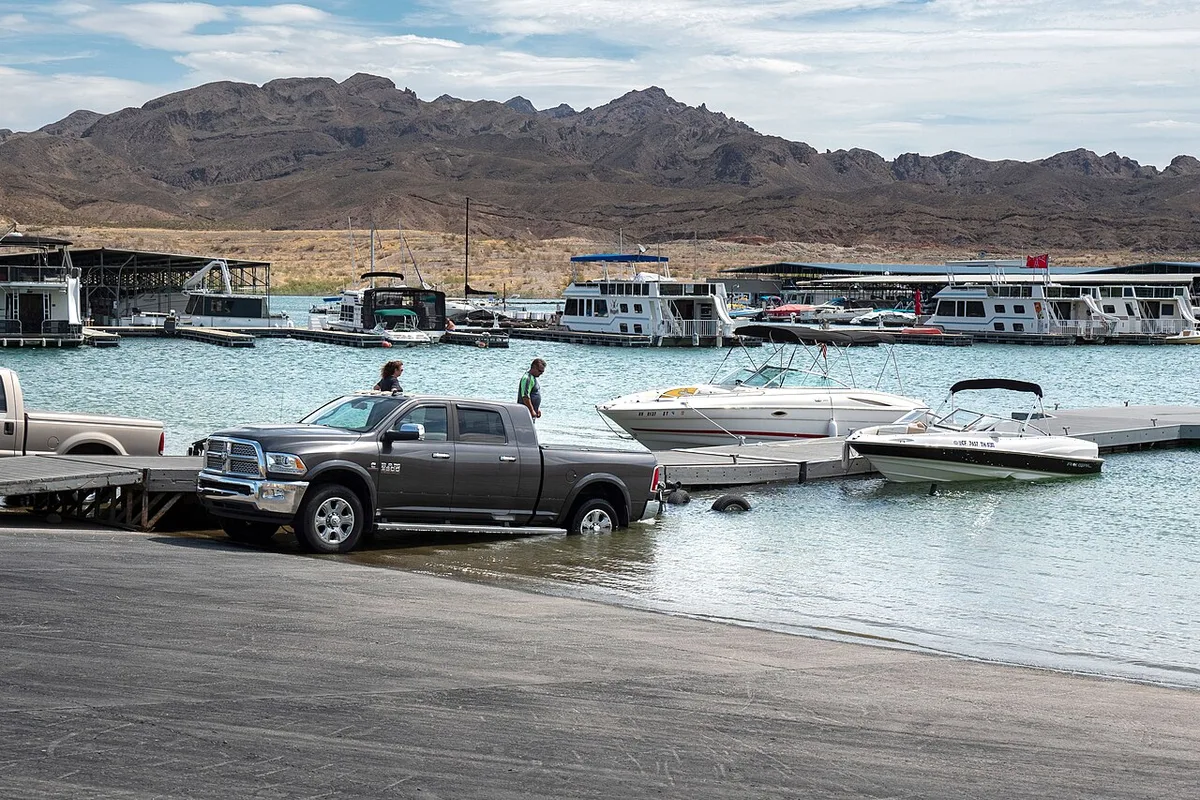
Image source: Wikimedia Commons / Andrew Cattoir (Lake Mead National Recreation Area)
Ramp Grades, Crowned Surfaces, and Slick Lanes
Launch ramps commonly sit in the 12 to 15 percent grade range, which is steep enough that gravity is genuinely working against your brake pedal control. Idle speed becomes faster than you want.
Crown is the sneaky one. Many ramps are built higher in the middle for drainage, so the trailer wants to walk toward one edge as it rolls down. You'll feel it through the hitch before you see it in the mirror.
Algae, moss, and silt make wet concrete genuinely slippery. Traction drops, tires spin, and the trailer can slide sideways under braking. Saltwater ramps in tidal areas add a wet, slimy band right at the waterline.
If the surface looks green or dark, assume it's slick and slow everything down further.
Straighten Early and Stay on the Pad
Straighten the rig on flat ground at the top of the ramp, before the trailer's tires touch the incline. Trying to correct alignment halfway down is where trailers walk off the concrete edge.
Watch the trailer tires against the ramp edge in your mirrors. Pick a reference on the ramp surface, a seam, a drain, or a painted line, and keep both tires on the same side of it.
If a tire drops off the edge, stop. Don't try to climb back up with forward momentum on a grade. Pull forward slowly, re-center, and come back down.
Surge Brakes in Reverse and When to Winch Instead
Boat trailers are usually surge-braked, which means the reverse lockout matters every single launch. Confirm the solenoid is getting power from the 7-way connector before you leave the staging area.
If the trailer drags or the actuator clunks repeatedly, don't force it. Roll forward, check the connector pins for corrosion, and test again. Saltwater exposure eats those pins faster than anything else on the rig.
Some launches call for a winch or a second person. Steep ramps, heavy boats, and shallow water where the trailer has to go deep all qualify. Backing until the truck's rear wheels get wet is a choice, not a requirement.
Ramp Etiquette That Keeps the Line Moving
Do your prep in the staging area, not on the ramp lane. That means loading gear, removing transom straps, installing the drain plug, and rigging lines before you join the queue.
Then back down once, launch, and pull clear. If you need to reposition, pull all the way out and get back in line.
Hand signals work well here because the ramp is loud and the driver can't hear anything over an idling engine. Brief your helper on four signals before the wheels roll. That's the same discipline covered earlier for tight sites, and it matters more with a crowd watching.
One more ramp-specific note on the tow vehicle: a long rear overhang means the back bumper goes underwater sooner than you expect on a steep launch. Know your hitch height and your exhaust location before you commit.
Tight Spots: Campsites, Storage Slots, and Narrow Alleys
Tight backing is mostly a reading problem. Read the site, then pick the approach that needs the fewest corrections.
The good news is that tight spots reward patience more than skill. Every extra pull-forward reset costs ten seconds. Every contact costs a season.
Reading the Pad Before You Commit
Stop the truck at the entrance and walk the site. Note the pedestal, the picnic table, the fire ring, the tree limbs, and the utility box. Those are the four or five things that get hit.
Check the surface too. Gravel pads roll under a loaded trailer. Sand traps a tongue jack.
Sloped pads make a trailer walk once you unhitch.
Then check the exit. It's easy to back into a spot that you can't get out of, especially with a tow vehicle that can't turn around in the aisle.
Using the Whole Approach Road
A campground loop or storage aisle is a tool, not just a path. Use its full width to set your angle.
If the aisle is wide enough, swing out to the far side before turning in. That's the pull-up offset explained earlier, applied at scale. The wider your starting angle, the less articulation you need mid-maneuver.
If the aisle is one-way and narrow, take the sight side even if it means driving around the loop again. One lap is free. A crushed pedestal isn't.
Why Multiple Resets Are Normal, Not Failure
In a tight campsite, three or four pull-forward resets is a normal, professional outcome. Storage units and urban alleys regularly take more.
Each reset should change something. If you pull forward and reverse back to the same position, you've learned nothing and burned a minute.
Change one variable per reset. Move the truck over a foot. Add a bit more angle.
Start the turn a beat later. Small changes, one at a time, and the maneuver converges.
Tight-Spot Approach Table
| Site type | Best approach | Key hazard |
|---|---|---|
| Back-in campsite, left side | Swing wide right, sight side in | Pedestal and picnic table |
| Back-in campsite, right side | Loop around or back in sight side | Fire ring, low limbs |
| Self-storage drive aisle | Wide offset, slow entry | Overhead door tracks, bollards |
| Urban alley, one-way | Blind side in, GOAL often | Dumpsters, utility meters |
| Gravel farm gate | Sight side, dry line chosen first | Soft shoulders, fence posts |
| Narrow residential driveway | Two-stage S-curve, spotter on the blind corner | Parked cars, mailboxes |
Two mechanical habits help in every one of these. Keep the tongue jack fully raised, since a jack that drags catches on seams and lifts the coupler. And check trailer tire pressure before a tight back, because a soft tire changes the trailer's tracking and makes precision worse.
If you ever do get a trailer stuck in soft ground or off a pad edge, knowing where to attach a recovery point matters more than horsepower. Pulling from the wrong spot bends frames and snaps chains.
When It Goes Sideways: Jackknife Recovery and Mid-Back Fixes
Every back that ends badly had a moment where it was still fixable. That window is usually about two seconds wide. What you do inside it decides whether you drive home or call your insurer.
The good news is that recovery is procedure, not talent. Here's the playbook for each failure mode.
The Jackknife: Stop the Moment You Feel It Closing
You know the signs by now. The trailer fills the mirror at an extreme angle, its tires stop rolling while the truck is still moving, and the gap between tailgate and trailer box is visibly dying. Past that point, reverse is the enemy.
The fix is three moves:
- Brake and hold. Don't steer, don't roll another inch.
- Shift into drive, straighten the wheel, and creep forward until the articulation angle opens back up.
- Re-approach from a new pull-up position with more offset.
Pulling forward works because forward motion opens the angle and reverse closes it. It's pure geometry. The drivers who fold rigs are the ones who keep reversing and sawing the wheel, betting the trailer will somehow unwind.
It won't.
When the Trailer Leaves the Mirror
This happens on blind-side turns and long trailers. One mirror sweep, the tires are there. The next, nothing but your own tailgate.
Stop. Set the parking brake if you're on any grade. Get out and look, because guessing from the seat is how fenders meet posts.
When you walk back, pick a fresh reference line to the target, then decide whether to continue or reset the whole approach.
Leaning out the window and "feeling it" is not a technique. It's a coin flip with a deductible.
Spotter Out of Sight: Stop, No Debate
If your spotter's hands leave the mirror, brake immediately. Not gently, not after a beat. Immediately.
The spotter's job is to stay visible. If they keep disappearing, the approach angle is wrong, and the fix is a reset, not a spotter jogging alongside to keep up. A reset costs a minute.
The alternative doesn't bear spelling out.
Trailer Walking Off the Edge or Sinking
Soft ground and ramp edges announce themselves early. You'll feel the trailer tug the truck sideways, or see a tire riding below the pad surface in the mirror.
Stop before anything gets worse. On a ramp, pull forward to solid concrete, re-center on a seam or painted line, and come down again. In mud or wet grass, get off the throttle the second a wheel spins.
Spinning digs, and a buried tire is a recovery job, not a backing job.
If the ground is genuinely soft, change your approach line to firmer ground, or lay traction boards under the tires. If it comes to a pull, use rated recovery points on the truck. Bumpers and hitch balls are not recovery points.
| What's happening | First move | Recovery move | Never do this |
|---|---|---|---|
| Angle past 45 degrees and closing | Brake and hold | Pull forward, re-approach wider | Keep reversing and saw the wheel |
| Trailer gone from the mirror | Stop, set brake, GOAL | Pick a fresh line or full reset | Guess from the driver's seat |
| Spotter out of view | Brake instantly | Wait, then reset the approach | Keep rolling to find them |
| Tire off the ramp edge | Stop before it drops more | Pull forward, re-center on a seam | Power up the edge in reverse |
| Wheel spinning in soft ground | Off the throttle | Traction boards or a new line | Spin faster to dig out |
One pattern runs through all five rows. Stop first, think second, move third. The instinct to keep moving and fix it on the fly is what body shops are built on.
The Mistakes That Crush Tailgates, Fenders, and Trailer Lights
Body damage from backing is rarely a talent problem. It's a discipline problem, and the same handful of failures cause almost all of it.
Sawing the Wheel Instead of Inching It
Overcorrecting is mistake number one by a mile. The trailer drifts a foot, the driver gives it a quarter turn, the trailer overshoots, and now a correction is fighting a correction.
The fix is physical, not mental. Make the input, count one full second out loud, watch the tires respond, then decide. Two degrees of wheel at a time is plenty for most trailers.
Watching the Box Instead of the Tires
This earned a repeat here because it shows up in insurance photos constantly. The box swings wide and lies about the trailer's path. The tires tell the truth.
Nearly every crushed fender started with someone steering against the box's arc.
Starting Crooked and Hoping
A rig that begins the back out of line finishes out of line. No amount of mid-maneuver steering fully recovers a crooked start, because you spend the whole back correcting instead of placing.
Straighten the truck and trailer before reverse engages. Ten seconds of alignment saves the entire maneuver.
Sway Bar Engaged, Tongue Jack Down
Both come straight from the pre-move checklist, and both get skipped when people are in a hurry. A friction sway bar left tight fights the turn, binds the linkage, and can permanently bend its mounting hardware.
A tongue jack left down catches on pavement seams, storage-unit door tracks, and ramp lips. It can lift the coupler mid-back or gouge a campsite pad. Run the same short checklist every single time, even for a fifteen-foot back.
The One More Try Trap
This one separates beginners from people who've paid for bodywork. The angle is dying, the trailer is clearly past saving, and the driver reverses another four feet anyway.
Call the reset at the first sign, not the third. Pulling forward is free. Paint, sensors, and sheet metal are not.
Modern tailgates carry cameras and sensors inside the panel, so even a low-speed crunch often becomes a four-figure body-shop bill. If the crunch takes out a tow vehicle lamp, at least a replacement bulb is the cheap part of a bad day.
One mechanical footnote. Long stretches of low-speed creeping with a loaded trailer build heat in an automatic transmission. If towing is a regular thing for you, keeping up with transmission service keeps that slow-speed work from turning into a rebuild.
| Mistake | What it typically costs | The fix |
|---|---|---|
| Overcorrecting | Jackknife, bent hitch hardware | Small inputs with a counted pause |
| Watching the box | Crushed fenders, clipped posts | Eyes on the trailer tires |
| Crooked start | Whole maneuver spent correcting | Straighten before reverse |
| Sway bar engaged | Bound and bent sway hardware | Checklist before every back |
| Tongue jack down | Coupler damage, gouged pads | Same checklist, no exceptions |
| Refusing the reset | Tailgates, bumpers, trailer lights | Pull forward at the first bad sign |
Trailer-Backing Safety Rules That Aren't Optional
Everything above is technique. This section is the part where being casual changes lives, including yours. None of it is negotiable.
Nobody Between the Truck and the Trailer. Ever.
This is the one that kills people. A truck in reverse at idle can push with more force than any human can resist. A person pinned between the tailgate and the trailer box has seconds, not minutes.
NHTSA's backover data is what drove the rear-visibility camera rule covered earlier. Those crashes kill around two hundred people a year in the US. They happen at walking pace in driveways and lots, not on highways.
With a trailer attached, the rule is simple. The spotter stands to the side, behind the trailer's axle line, where the driver can see their hands.
If You Can't See Their Hands, the Truck Stops
Say it in the briefing and enforce it without discussion. The moment hands leave the mirror, the brake goes down. A spotter you can't see is a spotter you can't protect.
Chock Before You Unhitch, Every Time
An unhitched trailer on even a mild grade can roll, and a dropping tongue does real damage to shins, trucks, and anything else in its path. Chock both sides of a tire before the jack ever leaves the coupler.
Never trust the tongue jack alone to hold a trailer. Never trust chocks alone on soft ground either. Use a wide pad under the jack on gravel, sand, or soft asphalt on a hot day.
The same discipline applies to fifth-wheel landing gear.
Chains, Breakaway Cable, and Working Lights
Cross the safety chains under the tongue so they form a cradle if the coupler ever fails. Attach the breakaway cable to the tow vehicle's frame or a dedicated point, never to a chain, so it can't go slack with the chains.
Check the lights before you back anywhere: running lamps, brake lamps, both turn signals, and hazards. Required lighting falls under FMVSS 108 for consumer rigs. If you tow commercially, the equipment rules in 49 CFR 393 apply instead, and the Federal Motor Carrier Safety Administration publishes the current requirements.
Weight Limits That Change How the Rig Behaves
An unbalanced trailer doesn't just tow badly. It backs badly, wandering and over-responding no matter how good your inputs are.
- Keep tongue weight around 10 to 15 percent of gross trailer weight on a bumper pull.
- Aim for 15 to 25 percent on fifth-wheel and gooseneck rigs.
- Load roughly 60 percent of cargo weight forward of the axle.
- Stay inside the trailer's GVWR and the tow vehicle's GCWR from the manufacturer's towing guide.
People and Pets Stay Clear
Nobody rides the trailer deck, the tongue, or the ramp during a maneuver. Kids and dogs belong inside a vehicle or well clear of the whole area, because they move unpredictably at exactly the wrong moment. A closed tailgate, or an empty one, is the only tailgate.
Decision Guide: Matching Your Method to Your Rig, Your Spot, and Your Crew
You now have the full toolkit. This is the cheat sheet for picking which tools fit your situation on any given day.
| Your rig | Your situation | Best setup | Approach that fits |
|---|---|---|---|
| Single-axle utility, 4×8 to 6×12 | Storage lot, solo | Mirrors plus GOAL | Half-size inputs, sight side, expect resets |
| Tandem-axle utility or equipment | Job site with crew | Spotter with radios | Offset pull-up, one trailer length past target |
| Boat trailer | Busy public ramp | Driver-side spotter plus mirror | Straighten at the top, prep in staging |
| Bumper-pull travel trailer | Back-in campsite | Spotter plus backup camera | Loop around for the sight side |
| Enclosed cargo trailer | Narrow alley at night | Camera plus auxiliary lighting | GOAL at midpoint, slow blind side |
| Fifth-wheel or gooseneck | Any campsite or dock | Mirrors alone are often enough | Short pull-up, small inputs |
Solo With a Camera, or Spotter and Mirrors?
If your backing happens in the same place weekly, like a driveway or a storage unit, go solo with mirrors, the camera, and the GOAL habit. Learn one spot until it's automatic.
If you back somewhere new every trip, which is most RVers, invest in the spotter briefing and your own mirror skills. The camera is a bonus, not the plan. New places are where spotters earn their keep.
If you launch a boat alone, go at off-peak hours and build a routine. Full prep in the staging area, one slow straight back, GOAL at the waterline. Solo ramp work rewards preparation more than any other kind.
If you back trailers daily for work, train your crew and buy radios. A practiced spotter with a radio beats every camera on the market for tight, repetitive spots.
What to Practice First This Season
Skill builds in a specific order, and skipping steps is why some drivers plateau.
- Straight-line backing in an empty lot, thirty to fifty feet, no corrections.
- Sight-side 90-degree backs through a cone gate.
- The GOAL habit until stopping and looking feels automatic.
- The reset habit: pull forward on the first bad sign, not the third.
- Blind-side backs with a briefed spotter.
- Ramp work with a helper, on a quiet weekday morning.
Short, frequent sessions beat one marathon afternoon. A couple of focused hours a weekend, for a month, is how competence actually gets built.
Trailer-Backing FAQs
Which Way Do I Turn the Wheel When the Trailer Needs to Go Left?
Move the bottom of the steering wheel toward the left, with your hand at six o'clock. That's a counterclockwise turn, and it sends the trailer's rear left. Straighten as soon as the trailer starts rotating, then chase it with small corrections.
If it overshoots, pull forward and reset rather than reversing deeper into the angle.
Why Does My Single-Axle Trailer Jackknife So Fast?
One axle pivots on a tiny contact patch, and nothing resists it. Tandem axles scrub sideways against the pavement, which slows the rotation naturally. Your single-axle trailer answers steering in under a second, so a normal-sized input is already too much.
Use roughly half the wheel movement you think you need, and pause longer between corrections.
Is a Backup Camera Enough to Back Up Solo?
For straight backs and open areas, yes, once you've practiced with it. For tight blind-side spots, no camera is enough on its own. Wide-angle lenses flatten distance, so gaps look bigger than they really are.
Stack the camera with your mirrors and the GOAL habit, and treat it as one input, not the whole solution.
Do I Need to Release the Sway-Control Bar Before Reversing?
Yes, if it's a friction bar. Loosen or remove it per the manufacturer's manual, because it's designed to resist exactly the articulation you need in reverse. Left engaged, it fights the turn and can bend its mounting hardware.
Integrated and dual-cam systems usually don't need this. Check your manual, and reconnect before highway speed.
How Slow Should I Actually Be Going?
Walking pace, which is roughly 1 to 3 mph. Idle speed in most automatics gets you there. Keep your foot hovering the brake, and go slower still on ramps, gravel, and wet surfaces.
Speed multiplies every error you make, and slow speed is the only thing that makes small corrections possible.
How Long Does It Take to Get Consistently Good?
Most drivers handle straight-line backing after one focused practice session. Consistent sight-side 90-degree backs usually take a few outings. Comfortable blind-side work and busy ramps take a season of regular towing.
The practical basics arrive fast with deliberate practice, and a couple of weekends in an empty lot covers most of it.
