
Choosing the right drive belt gets confusing fast when you're staring at a serpentine belt vs v belt diagram in a service manual. One belt runs nearly every accessory. The other splits the job across two or three shorter belts.
Pick the wrong style and it simply will not seat on the pulleys.
Most passenger cars built after the mid-1990s use one multi-rib serpentine belt. Manufacturer guidance commonly lists a 60,000 to 100,000 mile service life. Older engines still run classic V-belts with a wedge profile.
As of 2026, you match the belt to the pulleys, not the other way around.
Serpentine Belt vs V Belt
A serpentine belt is one long multi-rib belt. A V-belt is a shorter wedge-shaped belt. Modern cars usually use the serpentine design.
Older cars often use one or more V-belts. You must match the belt to your pulley layout.
How a Serpentine Belt and a V-Belt Actually Differ
A serpentine belt has several small ribs along its length. Shops also call it a multi-rib belt or a poly-V belt. Those ribs lock into grooved pulleys.
One belt usually drives the crankshaft, alternator, power steering pump, A/C compressor, and often the water pump.
A V-belt uses a trapezoid cross-section. The slanted sides wedge into a deep groove. Friction on those sides creates the grip.
Older engines often ran a separate short belt for each accessory.
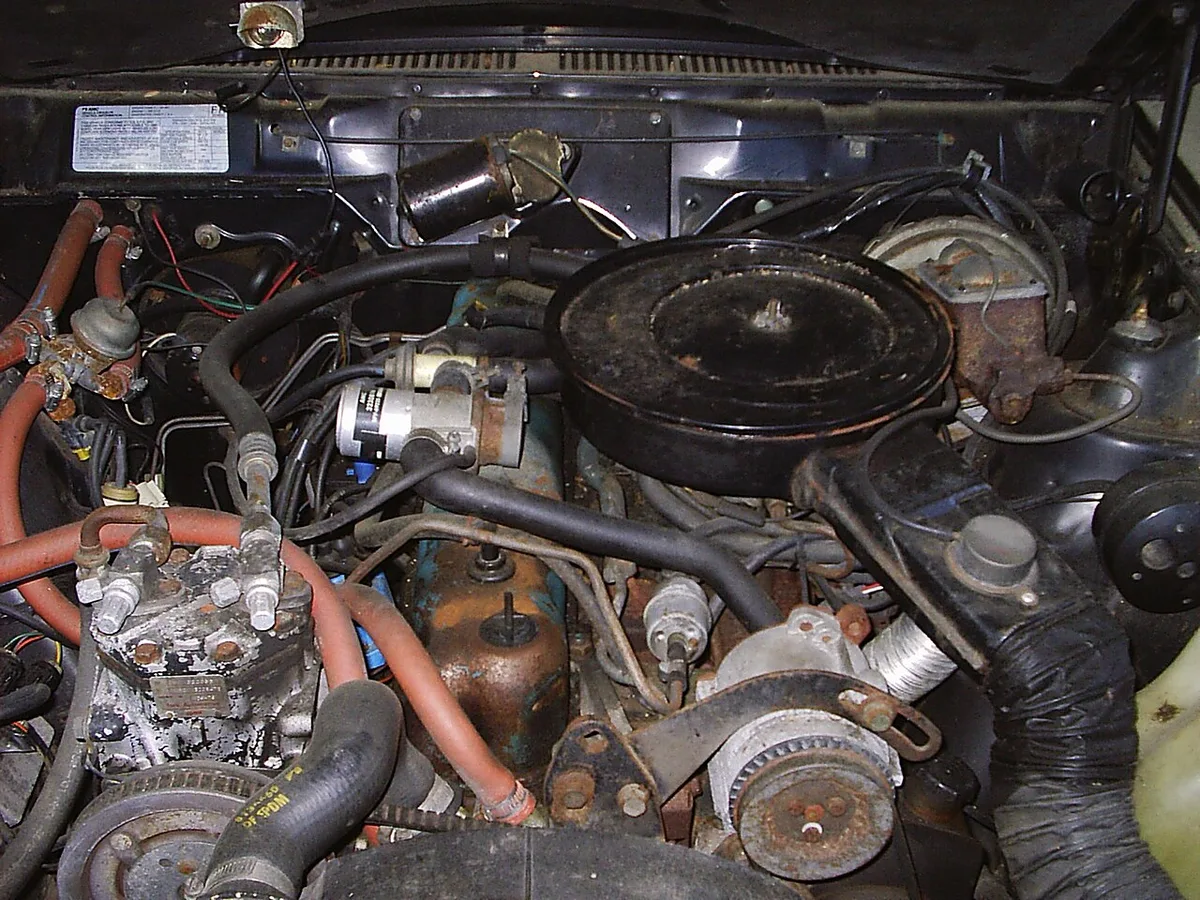
Image source: Wikimedia Commons / CZmarlin, Christopher Ziemnowicz, releases all rights but a photo credit would be appreciated if this image is used anywhere other than Wikipedia. Please leave a note at Wikipedia here. Thank you!
Current serpentine belts are usually EPDM rubber. Manufacturer catalogs from Gates list EPDM because it resists heat and cracking better than older neoprene. Some V-belt lines still use neoprene.
EPDM also stays flexible on a cold start.
Tension is the other split. A serpentine drive uses a spring-loaded tensioner and sometimes an idler. A V-belt drive usually needs a swinging bracket and hand-set tension.
Belt profiles follow SAE automotive standards. The rib pattern and the groove have to agree. If they don't, the belt slips or walks off.
Serpentine Belt vs V-Belt Side by Side
The failure mode is why this comparison still matters. One snapped serpentine belt can drop charging, power steering, and coolant flow together. A broken V-belt often takes out only the accessory on that belt.
You still need a plan either way. The repair just looks different.
| Factor | Serpentine belt | V-belt |
|---|---|---|
| Profile | Multi-rib | Wedge shape |
| Belts on a typical engine | One | Two or three |
| Tension method | Automatic tensioner | Manual bracket |
| Common service life | 60,000 to 100,000 miles | 30,000 to 50,000 miles |
| Typical part cost | $15 to $60 | $8 to $25 each |
| Noise | Quieter when healthy | Squeals sooner if loose |
| If it fails | Most accessories stop | Often one accessory stops |
Serpentine belts fit modern cars that already have a tensioner and a long accessory pack. V-belts fit older engines built with separate wedge pulleys. Forcing a conversion is not a weekend upgrade.
You would need new pulleys, brackets, and alignment time.
A slipping belt can set a charging fault before it snaps. A basic code reader helps you confirm the alternator side. If the belt lets go away from home, the tow strap belongs on the factory tow hook.
Which Belt Fits Your Engine and Driving
If you see one long belt wrapping five or more pulleys, buy a serpentine belt. If you see two or three short belts, buy V-belts in the exact lengths. The under-hood routing sticker is the authority.
Follow that path before you order parts.
Daily drivers from the mid-1990s on are serpentine territory. Replace the tensioner if the arm flutters or a new belt still chirps. Pre-1990 trucks and many classic V8s still want the original V-belt sizes, bought as a set so they wear together.
On those older small-blocks, new exhaust gaskets matter too. An exhaust leak cooks a nearby belt.
Release the tensioner with the proper tool. Don't pry the belt off with a screwdriver. Clean glazed pulley faces, then check alignment with the engine off.
If the crank pulley sits low, basic wooden ramps beat a shaky jack.
When a belt fails in traffic, the wheel can go heavy in a second. Use correct hand placement and coast to the shoulder. A rough idle after the repair is not always the belt.
Oily plug tips point to a different leak.
On an automatic tensioner, ignore the old thumb-press trick. The wear marks on the tensioner show the range. On a V-belt, light deflection at the longest span is only a rough check.
The factory spec still wins.
Frequently Asked Questions
Can I replace a V-belt with a serpentine belt?
No. The pulleys use different shapes. A serpentine belt needs ribbed grooves and usually a tensioner.
A V-belt needs a wedge groove. Changing styles means new pulleys, brackets, and alignment work. Treat that as a custom build, not a normal belt service.
How do I know which belt my car uses?
Check the belt face. Ribs mean a serpentine belt. A smooth wedge means a V-belt.
One long belt is almost always serpentine. Two or three short belts are V-belts. The sticker under the hood shows the factory routing.
Match that path before you buy.
What happens if a serpentine belt breaks while driving?
Most accessories stop at once. You lose power steering, charging, and often coolant flow. The wheel gets heavy.
The temperature can climb fast. Pull over and shut the engine off. A V-belt failure usually kills only the accessory on that one belt.
How often should I replace these belts?
Plan on 60,000 to 100,000 miles for a serpentine belt. V-belts often need service closer to 30,000 to 50,000 miles. Oil leaks, high heat, and a weak tensioner cut those numbers.
Replace the belt if you see deep cracks, glaze, or missing ribs. Don't wait for a roadside snap.
