
That cold-morning tick is easy to shrug off until the cabin smells like a tailpipe. The symptoms of a bad exhaust manifold gasket usually start as noise, then show up as a rough idle and a lean code. You can separate a gasket leak from a cracked manifold or a bad downpipe joint if you check the clues in order.
Per SAE J2012, a system-too-lean fault is stored as P0171 on bank 1 and P0174 on bank 2. Those codes often appear when the leak sits ahead of the upstream oxygen sensor. As of 2026, that code pair plus soot at the flange is still the clearest scan clue.
Use the branches below before you buy parts.
Symptoms of a Bad Exhaust Manifold Gasket
Symptoms of a bad exhaust manifold gasket show up fast. You hear a tick or hiss near the manifold. The noise is often loudest on a cold start.
Exhaust smell can enter the cabin. Soot at the flange and lean codes are common.
Decision Tree: Diagnosing a Bad Exhaust Manifold Gasket Leak
If the tick is loud only on a cold engine, then the gasket is likely lifting off the flange. Heat swells the metal and the noise fades. If the tick stays loud after a full warm-up and you can see a crack, then the manifold is split.
If you smell exhaust inside the car, then stop driving. Carbon monoxide from a leak near the firewall can reach the fresh-air intake. That's not a wait-and-see problem.
In our research, a cold-only tick plus black soot at the flange is the pair that holds up. Use the table before you order parts.
| What you notice | Likely source | Next move |
|---|---|---|
| Cold tick that fades | Loose bolts or a tired gasket | Recheck the flange cold |
| Tick that stays hot, plus a crack | Cracked exhaust manifold | Replace the manifold |
| Hiss low, under the car | Downpipe or donut gasket | Inspect the joint past the manifold |
| Whistle up top, no soot | Intake or vacuum leak | Smoke-test the intake side |
| P0171 or P0174 with flange soot | Leak before the O2 sensor | Confirm, then replace the gasket |
| Cabin exhaust smell | Leak near the cowl | Park it and fix it first |
A basic scan tool shows whether the leak is leaning out the mixture. Wet, oily plugs point to a different fault. Sort out oily plug tips before you blame the flange.
Repair Steps for a Bad Exhaust Manifold Gasket
Work on a fully cold engine only. A hot flange will burn you. Heat also throws off the torque reading.
- Scan and note any lean or misfire codes.
- Get a clear view of a low flange with sturdy shop ramps or a lift.
- Look for soot streaks where the manifold meets the head.
- Remove the heat shield and unbolt the flange.
- Clean both faces until they are bare and flat.
- Fit a new graphite or multi-layer steel gasket.
- Torque the bolts in the order your manual lists.
- Start the engine cold and listen at the flange.
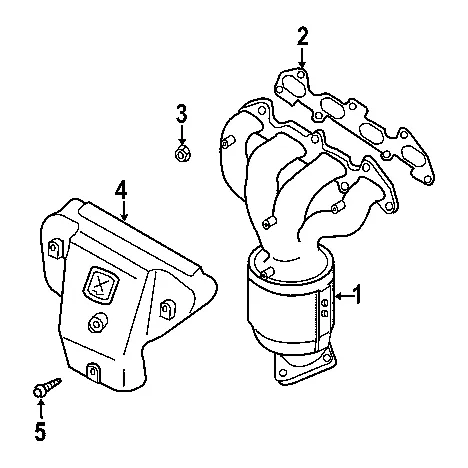
Image source: Wikimedia Commons / Unknown authorUnknown author
Graphite handles repeated heat cycles, so it's the usual seal. Multi-layer steel suits headers and higher exhaust heat. On a small-block Chevy, match the header flange seal to the port shape.
Don't reuse stretched bolts. Pull the torque from your engine manual. Recheck it after a heat cycle if the manual says so.
Common Mistakes When Diagnosing Exhaust Manifold Gasket Issues
The biggest miss is calling every tick a bad gasket. A cracked manifold and a loose downpipe donut sound the same from a few inches away. Change only the gasket and the tick is back on the next cold start.
Skip RTV as your only seal. A thin film is fine only where the manual allows it. A thick bead squeezes out and the leak comes right back.
Don't keep driving once fumes reach the cabin. State inspections and federal emissions rules treat that leak as a failed exhaust. A related misfire can also overheat the catalytic converter.
Planning on adding bolt-on boost later? Fix the flange first. Extra pressure makes a weak seal louder and drives the mixture leaner.
FAQs About Exhaust Manifold Gasket Problems
Can a bad exhaust manifold gasket cause a check engine light?
Yes. A leak ahead of the upstream oxygen sensor adds air the ECU never measured. The sensor reports a lean mix, so the computer stores P0171, P0174, or both.
A cylinder that runs too lean can also set a misfire code.
Does a bad manifold gasket tick only when the engine is cold?
Often, yes. A tired gasket or loose bolt opens a small gap while the iron is cold. Heat closes that gap, so the tick fades or stops.
If it stays just as loud when the engine is fully hot, suspect a crack or a joint farther down the pipe.
Are exhaust fumes in the cabin dangerous?
Yes. Exhaust in the cabin can carry carbon monoxide. You will not always smell it clearly once it mixes with other fumes.
Headache, dizziness, and nausea mean you should get fresh air now. Park the car and fix the leak before anyone rides in it again.
Will a leaking manifold gasket fail an emissions test?
It can. Inspectors look for exhaust leaks, and soot on the flange is easy to spot. Extra air ahead of the catalyst also skews the oxygen readings used in the test.
Leave it for months and you can cook the converter as well.
How can you tell a gasket leak from a cracked manifold?
Soot in a line along the gasket face points to the seal. A crack looks like a thin split in the casting, often by a runner. The crack keeps ticking after a full warm-up.
A gasket leak more often quiets down once the metal expands.
