
A stabilizer bar is one of those parts every car has and almost nobody can explain. So what does a stabilizer bar do? Short version: it's a torsion spring that ties the left and right suspension together and resists body roll when you corner.
That's the answer most people get, and it's only half the story.
Per Federal Motor Vehicle Safety Standard 126, electronic stability control is calibrated around the factory roll stiffness, so changing a bar changes more than how the car leans. In our research, most OEM bars measure roughly 18 mm to 28 mm in diameter, and stepping up a size shifts grip balance at the limit. Here's how the part actually works, and where it does nothing at all.
What Does a Stabilizer Bar Do
A stabilizer bar links the left and right suspension through a torsion spring. It resists body roll when the car corners. The bar twists as one wheel rises and the other drops.
It does nothing when both wheels move together. A thicker bar adds roll stiffness without stiffening the ride.
What a Stabilizer Bar Really Does, and the Times It Does Nothing
Look under any modern car and you'll find a bent steel bar running across the front or rear suspension. It's clamped to the chassis at two points and connected to the suspension at each end. Nothing about it moves until the two sides of the car start disagreeing with each other.
The torsion spring trick: why it only works when two wheels move differently
The bar behaves as a torsion spring. When both wheels rise together, the bar simply pivots in its bushings and contributes nothing. When one wheel rises and the other drops, the two lever arms rotate in opposite directions and the bar twists.
That twist is the spring.
Stiffer steel resists that twist harder. So does a shorter lever arm, a thicker bar, or a solid bar instead of a hollow one.
What it does in a straight line, over a single-wheel bump, and one wheel at a time
On a smooth straight road, the bar is dead weight. Same story over a speed bump where both wheels compress equally. There's no roll happening, so there's nothing for it to resist.
Hit a pothole with one wheel and the bar is very much awake. It takes part of that single-wheel impact and hands it across to the other side. That's why a big front bar can make a car feel jumpy on broken pavement.
Stabilizer bar vs sway bar vs anti-roll bar: the same part under three names
They're all the same component. "Stabilizer bar" is the term in most factory service literature. "Sway bar" is what US enthusiasts say out loud.
"Anti-roll bar," or ARB, is the engineering label you'll see in vehicle dynamics vocabulary and motorsport rulebooks.
Bar Rate, End Links, and Bushings: The Parts That Decide How It Behaves
Two bars of identical diameter can feel completely different on the road. The rate, the mounting points, and the condition of the small hardware decide how much of that twist actually reaches the chassis.
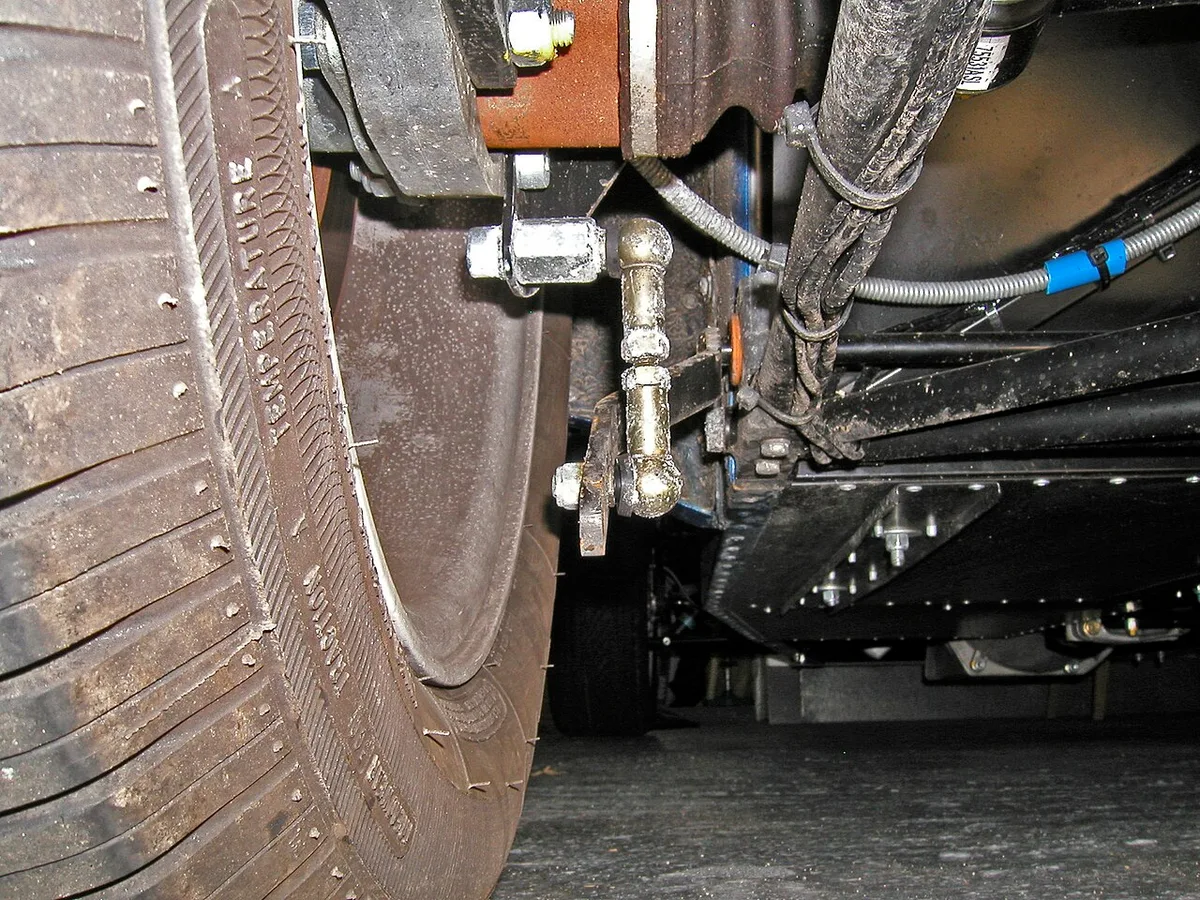
Image source: Wikimedia Commons / Brian Snelson from Hockley, Essex, England (CC BY)
Diameter, wall thickness, and why 10% thicker is about 46% stiffer
Torsional stiffness climbs with the fourth power of diameter. Going from a 24 mm bar to 26.4 mm, a 10% bump, adds roughly 46% more rate. That's why a couple of millimeters sounds harmless and behaves like a different car.
Hollow bars rewrite the math. A hollow 30 mm bar can match a solid 26 mm bar for rate while shedding 30% to 50% of the weight. As of 2026, most aftermarket performance bars land between 28 mm and 35 mm.
End links, D-bushings, and brackets: the cheap parts behind an expensive-sounding clunk
End links are the weak point in the system. They're small ball-and-socket joints, and they wear out. A tired link clunks over bumps and often gets misdiagnosed as a bad strut, CV joint, or ball joint.
Bushings do the quiet work. Rubber is silent and compliant. Polyurethane is firmer and sharper, but it squeaks if you install it dry.
Whether pricier steering ends actually pay off comes down to how long you plan to keep the car.
Adjustable bars, hole positions, and setting preload correctly
A hole-adjustable bar gives you two or three rate settings by moving the end link along the arm. Moving inboard softens it. Moving outboard stiffens it.
Blade-adjustable bars let you tune without crawling underneath twice.
Preload is the step most people skip. If one link ends up longer than the other, the bar sits twisted while the car is level. That pulls the car and skews corner weights.
Set adjustable links on flat ground, and a set of solid wooden ramps makes the job far easier.
Hollow vs solid, rubber vs polyurethane, and what each one costs you in noise
Hollow bars save weight and cost more to make. Solid bars are cheap and heavy. Rubber bushings keep the cabin quiet.
Poly bushings sharpen response and add a squeak you'll hear at low speed. Pick based on whether you want a track tool or a commuter.
Front vs Rear: How the Bar Split Changes Grip
Roll stiffness distribution and lateral load transfer in plain terms
Cornering pushes weight onto the outside tires. The end of the car with more roll stiffness takes a bigger share of that transfer. A tire carrying more load has less grip to give.
So the stiffer axle runs out of grip first.
Big front bar: more understeer, more confidence, slower at the limit
A stiff front bar makes the car feel planted at six tenths. At nine tenths, the nose pushes wide and steering input stops helping. That's understeer, and it's the safer of the two failure modes.
It's also why big front bars are popular with drivers who never touch the limit.
Big rear bar: rotation on demand, snap oversteer in the wet
A stiffer rear bar frees up the back end and sharpens turn-in. Go too far and the rear steps out with no warning on a damp roundabout. Snap oversteer is genuinely dangerous on a street car.
A little rotation is fun, a lot is a spin waiting to happen, and how you hold the wheel matters more once the car starts moving under you.
How bars interact with spring rate, dampers, and alignment
A bar is the cheapest roll-stiffness knob you can turn. Springs set ride height and base rate. Dampers control how fast weight moves.
Alignment sets the contact patch. A bar can't rescue worn dampers or a bad alignment, and it can't add grip that was never there.
Where a Sway Bar Earns Its Keep
Daily driving, crosswinds, and emergency lane changes
This is the everyday win. Less body roll means less camber loss on the outside tire, so the car stays composed in a quick lane change or a gust of crosswind. Passengers notice too, because motion sickness is largely a body-roll problem.
Towing and hauling: load sway versus trailer sway control
A heavy load in the bed or on the hitch raises the center of gravity, and a rear bar helps control the resulting body sway from steering inputs. Trailer sway is a different animal. That's a weight distribution and hitch problem.
Owners who buy a sway bar to fix a badly loaded trailer waste money and stay unsafe.
Track days and autocross: the bar as a balance tool
On track, the bar becomes a tuning device. One hole change can take a car from pushing through a corner to rotating cleanly. That's real lap time, and it costs nothing once the bar is already on the car.
Off-road and rock crawling: disconnecting for articulation
Solid axles need flex to stay planted on uneven ground, and a connected bar fights that. Quick-disconnect links or an electronic disconnect free up travel. Two rules apply.
Reconnect before you drive home, and never run a trail without proper rated recovery points fitted.
EVs, lifted trucks, and rollover-prone platforms
EVs carry a heavy battery low in the floor, which helps, but their curb weight still loads the outside tires hard. Lifted trucks and tall SUVs are the real concern, and rollover resistance ratings show why. A bigger bar doesn't lower a center of gravity.
It only limits how much the body leans on the way to the limit.
Stiffer Isn't Better: Common Mistakes and the Strut Brace Confusion
Sway bar vs strut tower brace vs shocks vs springs: what each one actually fixes
Most handling-upgrade disappointment comes from buying the wrong part for the complaint.
| Part | What it actually fixes | What it won't fix |
|---|---|---|
| Stabilizer bar | Body roll, front/rear balance | Ride height, harshness |
| Strut tower brace | Chassis flex at the strut tops | Roll, grip balance |
| Dampers | How fast weight transfers | Steady-state lean |
| Springs | Ride height, base rate | Balance on their own |
A strut brace is stiffening for the body shell, not a roll control device. It gets confused with a sway bar constantly.
Driving with a broken end link or a bent bar
A snapped link rarely strands you, but the bar starts flopping and the handling changes mid-corner without warning. Fix it before a track day, not after. Same rule for a bar bent after a curb strike or a careless tow.
Lift kits, link geometry, and bars that foul the driveshaft or coil
A three-inch lift moves the axle away from the frame. Stock links end up too short or at a bad angle, and the bar can contact the driveshaft at full droop. Extended links and relocation brackets exist for exactly this reason.
Deleting a rear bar on a street car, and mismatched rates
Pulling the rear bar is an old trick for calming a twitchy chassis. On a stock daily driver it usually just adds understeer and lets the body roll further. Mismatched rates are the bigger sin.
A 30 mm front bar against a stock rear turns a neutral car into a plow, and budget joints fail faster, which is really the question behind whether brand-name ends hold up.
Inspection, Replacement, and Safe Practices
Most stabilizer bar faults show up with the car parked and a pry bar in your hand. Start with a visual pass: cracked bushings, rust at the brackets, boots split on the end links, and any shiny wear marks where the bar has been rubbing something.
The pry-bar test and spotting cracked mounts
Then load the bar by hand. Push and pull each end link with a pry bar and watch for slop at the ball socket. Any free play means a worn link, not a worn shock.
While you're under there, look closely at the mounting brackets and the subframe around them. Elongated holes or a hairline crack in the sheet metal is a structural problem, not a squeak to grease over.
Jacking safely, and the removal sequence
Never work under a car held only by a hydraulic jack. Stands on solid ground, wheels chocked, and the car level before anything comes loose.
- Soak the end link nuts in penetrating oil a day ahead
- Break the link nuts free while the car is still on the ground
- Support the suspension arm so the bar isn't loaded
- Unbolt the links, then the brackets
- Slide the bar out, noting which way the arms face
Torque specs come from the factory service manual, not from memory. Use thread locker on the bracket bolts and recheck them after a week.
If the bar is seized in rusted brackets, or the subframe has to drop, that's the point where a shop with a lift earns its hourly rate.
Post-install test drive, re-torque, and alignment
Drive gently for the first few miles and listen for new noises. Re-torque the hardware after roughly 50 miles. Any suspension work that changes ride height should be followed by an alignment check.
Greasing poly bushings, rust at the brackets, and long-term upkeep
Poly bushings need silicone grease at every oil change or they'll squeak. In road-salt states, rinse the bar and brackets in spring, because that's where rot starts. End links typically last 60,000 to 100,000 miles on a street car.
Warranty, insurance, and inspection questions
Under the Magnuson-Moss Warranty Act, a dealer can't void your whole warranty over a sway bar, but they can decline a claim if the part caused the failure. Declare suspension mods to your insurer, and check state inspection or UK MOT rules before you go much stiffer than stock.
Frequently Asked Questions
Do I need a rear sway bar on a daily driver?
Only if the car didn't come with one and you want less roll. Most modern cars already have a rear bar sized by the factory. Adding a bigger one sharpens turn-in but can make a wet-road car twitchy, so change one end at a time.
Can I drive without a sway bar?
Yes, but carefully. The car won't fall apart, though body roll increases and emergency lane changes feel vague. It's acceptable for a slow trail crawl.
It is not acceptable for highway driving or towing.
Why does my car clunk over bumps?
Worn end links are the usual suspect, especially a light rattle at low speed. Worn bushings, loose bracket bolts, and tired ball joints sound similar. A pry-bar test on the links separates them quickly.
Is a thicker sway bar always an upgrade?
No. Thicker adds roll stiffness at one end, and that end loses grip first. A big front bar on a neutral car creates understeer.
Match the bar to your springs, dampers, and tires, or you'll make it slower and less predictable.
Does a sway bar affect ride comfort?
Barely, in a straight line. That's its appeal. It adds roll control without the harshness of stiffer springs.
The exception is a single-wheel bump, where a stiff bar shares that impact across the axle and you feel it.
