
What happens if you drive on old gas depends on three things: the fuel's age, its ethanol content, and the engine burning it. A six-month-old tank can leave a carbureted mower dead in the driveway. That same fuel might run almost normally through a modern fuel-injected car.
The difference isn't luck. It's chemistry.
Gasoline starts oxidizing the moment it leaves the refinery, and ASTM D4814, the specification that defines automotive spark-ignition fuel, only promises the fuel meets spec at the pump, not in your tank six months later. In our research, the practical window for E10 is roughly three to six months before drivability problems show up. Past that line, the advice splits sharply depending on what's in your tank and what's bolted to it.
What Happens If You Drive on Old Gas
Old gas loses its lighter compounds and some octane. Your engine may idle rough, hesitate, or misfire. Gum and varnish can clog injectors, carburetor jets, and fuel filters.
Most cars survive one tank of stale fuel without lasting damage. Small engines and two-strokes are far less forgiving. Stop driving if the check engine light flashes.
What Actually Happens When Old Gas Sits in Your Tank
Gasoline isn't one chemical. It's a blend of hundreds of hydrocarbons plus a detergent package, all tuned to vaporize and burn at a specific rate. Leave it parked and that blend drifts.
Two processes run at the same time. The light, volatile fractions evaporate off. The heavier fractions react with oxygen and turn sticky.
Both changes chip away at the fuel's only real job.
Oxidation, evaporation, and the light ends that vanish first
The "light ends" are the small, fast-burning molecules, things like butane and pentane. They're what makes a cold engine catch quickly on a winter morning. They're also the first thing to leave, because they boil at low temperatures and your tank vents to the atmosphere.
Lose enough of them and the fuel's volatility drops, which shows up as Reid vapor pressure falling below the seasonal spec. The practical result is a car that cranks longer before it fires, then stumbles for the first thirty seconds. Warm weather hides this.
Cold weather exposes it.
Oxidation is the slower, nastier half. Oxygen attacks the fuel's unsaturated hydrocarbons and creates peroxides, then acids, then gum. Heat drives the reaction hard.
A widely used rule of thumb in fuel chemistry is that reaction rates roughly double for every 10°C (18°F) increase in storage temperature. A tank in a sun-baked driveway in Phoenix ages nothing like a tank in a cool garage in Seattle.
Octane drifts down too. You won't usually lose enough to cause knock in a modern engine with a knock sensor, because the computer pulls timing to compensate. You will lose a little power and a little efficiency, and you'll pay for it at the pump without noticing.
Gum, varnish, and why deposits form in the places fuel sits still
Fresh gasoline carries dissolved gum in tiny amounts. Sealed in a steel can, that's manageable. Exposed to air in a half-empty tank, those gums concentrate as the volatiles leave, and they start plating out on metal.
Where they land depends entirely on where fuel stops moving. A carburetor float bowl holds a small pool of fuel that never circulates. When it evaporates, the residue bakes onto the jet orifices and the float needle seat.
That's why a mower that ran fine in October won't start in May.
Fuel injection behaves differently, but not always better. Injector tips sit at the hot end of the engine with a film of fuel on them. As that film oxidizes, it forms a lacquer that narrows the spray pattern.
A partially clogged injector still sprays, just badly, so the engine runs lean on one cylinder while the oxygen sensor chases the error.
Fuel filters catch what breaks loose. A tank that sat for a year can shed rust and gum flakes once you start driving again, and the filter takes the hit before the pump or injectors do. That's the cheap part of the chain, and it's why a filter swap fixes a surprising number of "bad gas" complaints.
| Time in the tank | What's happening | What you'd notice |
|---|---|---|
| 0 to 8 weeks | Normal oxidation, minor light-end loss | Nothing |
| 2 to 4 months | Volatility drop, gum starting to form | Slightly longer cranking, faint hesitation |
| 4 to 6 months (E10) | Noticeable oxidation, moisture pickup, octane loss | Rough idle when cold, mild misfire, worse economy |
| 6 to 12 months | Heavy gum, possible phase separation in ethanol blends | Hard starts, check engine light, clogged filter |
| 12 months and beyond | Varnish, corrosion, tank debris | No-start, fuel pump strain, injector or carb damage |
One thing worth saying plainly: the fuel doesn't become poisonous to your engine the instant it crosses some magic date. Degradation is a slope. The question is always how far down the slope you already are.
How Long Gas Really Lasts: E10, Ethanol-Free, and Diesel Timelines
Storage life isn't a single number. It's a range set by ethanol content, container type, temperature, and how much air is sitting on top of the fuel. Here's the working version we use.
| Fuel type | Typical usable life in a vented equipment tank | What fails first |
|---|---|---|
| E10 (standard US/UK unleaded) | 3 to 6 months | Volatility loss, then moisture-driven phase separation |
| E5 super unleaded (UK) | 6 to 9 months | Oxidation and gum formation |
| Ethanol-free E0 gasoline | 6 to 12 months | Oxidation, slower than ethanol blends |
| Canned alkylate fuel | 2 to 3 years sealed, about 1 year once opened | Evaporation after opening |
| Two-stroke pre-mix (E10) | Roughly 30 days | Oil separation and octane loss |
| Diesel (B0 to B5) | 6 to 12 months | Water absorption, microbial growth, filter clogging |
The 3-to-6-month window for ethanol blends
Ethanol is the reason modern pump gas has a shorter shelf life than the fuel your grandfather drained out of a tractor. It's hygroscopic, meaning it pulls water out of the air. Every time the tank breathes through its vent on a warm day and cools overnight, a little moisture comes in with the air.
For a while the ethanol holds that water in suspension and the fuel still burns. Once the water content crosses roughly 0.5 percent by volume in E10 at moderate temperatures, phase separation begins. The ethanol and water drop out of solution and sink, leaving a lean, low-octane gasoline layer on top and a corrosive ethanol-water layer underneath.
As of 2026, E10 is the default grade at most US pumps and has been the standard UK unleaded since 2021, so this is the fuel most readers actually have in the tank. If you want the current blend specifications and regional availability, the Alternative Fuels Data Center maintains them by state.
Small engines suffer most here, because their tanks are small, vented, and often metal. A lawnmower with a quarter tank of E10 left in a humid shed for five months is a phase separation case waiting to happen.
Sealed straight gas, canned alkylate fuel, and long-term storage
Take ethanol out of the equation and everything slows down. Ethanol-free gasoline stored in a genuinely sealed metal container, with minimal air space and stable temperatures, can stay usable for a year or more. We've seen reports of two-year-old E0 running fine when the can was full and never opened.
Canned alkylate fuels are the engineered version of that idea. They're ethanol-free, made from a narrow hydrocarbon cut, and sold in sealed cans with a long stated shelf life. For equipment that runs a few times a year, like a generator or a chainsaw, they're the closest thing to a no-drama storage solution.
The catch is cost. Canned fuel runs several times the price per gallon of pump gas, so it makes sense for a two-gallon can feeding a trimmer, not for a truck.
Why a half-empty tank ages faster than a full one
This is the single most useful storage fact in the whole topic. The space above the fuel line, sometimes called ullage, is where the damage happens. More air means more oxygen for oxidation, more room for volatiles to escape into, and more surface for moisture to condense on during temperature swings.
A full tank has almost no air. A quarter tank has three quarters air, and every warm day pushes fuel vapor out of the vent while every cool night pulls fresh humid air back in. That breathing cycle is why an almost-empty tank can go bad in half the time of a full one.
So if you're storing anything for the off-season, fill it. That's the whole trick, and it costs nothing.
Diesel timelines run on a different clock
Diesel doesn't have the volatility problem gasoline does, so it doesn't go flat in the same way. It has different enemies: water, oxygen, and microbes. Stored diesel absorbs moisture, and at the water-fuel interface a film of bacteria and fungus can grow, producing acids and dark sludge that plugs filters fast.
Biodiesel blends are worse. B5 and above are more hygroscopic and oxidize faster than straight diesel, so a B20 sitting for a year is a real risk. We'll cover the full diesel picture, including why you never dilute contaminated diesel, further down.
The 60-Second Decision Guide: Drive It, Dilute It, or Drain It?
If you just want the answer, work through these six conditions in order. The first one that applies to you decides what you do.
- Age under three months, engine running fine. Drive it. Top off with fresh fuel when you can and don't think about it again.
- Three to six months, tank at least half full, no symptoms. Dilute and burn it off. Fill with fresh high-octane, add a cleaner, drive normally.
- Three to six months, tank nearly empty, no symptoms. Top off before you drive anywhere. Running concentrated stale fuel through the system is the risk you're avoiding.
- Any age, but the engine is misfiring, hesitating, or throwing a flashing check engine light. Stop driving. A flashing light means unburned fuel is hitting the catalytic converter, and that's a fire-risk component worth more than the fuel.
- Visible layer, cloudy fuel, or a sour varnish smell. Drain it. Phase-separated fuel can't be fixed by additives.
- Small engine, two-stroke, or boat. Treat anything over two months as suspect, and anything over four months as drain-on-sight.
| Situation | What to do | What it costs you |
|---|---|---|
| Fresh-ish fuel, healthy engine | Top off and drive | A tank of gas |
| Stale but not separated, car | Dilute at 1 part old to 3 or 4 parts fresh, add cleaner | Fuel plus a $10 to $20 additive |
| Stale, small engine | Drain tank, line, and float bowl | An hour plus disposal |
| Phase separated | Full drain and refill, replace the filter | Fuel, filter, disposal trip |
| Misfire with a flashing light | Stop, diagnose, likely tow | Diagnostic fee, possibly a tow |
Those last two rows are where people get burned. A flashing check engine light on the highway is not a "limp it home" situation if you can avoid it. If you do need a recovery, know where to hook a strap before anyone arrives with a winch.
The quick branch table for cars, mowers, and stored vehicles
Same fuel, three totally different outcomes. A car with a sealed EVAP system and a high-pressure injection pump is the most forgiving host for stale gas. A mower with a vented plastic tank and a gravity-fed carburetor is the least.
That's why the same six-month-old fuel that a Honda Civic burns without complaint can destroy a Honda mower's season. Keep the machine in mind, not just the calendar.
Branch One: The Engine Runs Fine and the Tank's Mostly Full
This is the good branch. Your car starts normally, idles smooth, and the check engine light is off. The fuel is old but not broken.
Now the goal is to get rid of it without letting it concentrate.
Topping off with fresh high-octane fuel and the dilution ratio that works
Dilution isn't a vague concept. It's arithmetic. If you have four gallons of stale fuel in a twelve-gallon tank, adding eight gallons of fresh fuel puts you at roughly 33 percent old fuel, which almost any fuel-injected engine will burn without complaint.
A practical target is to keep old fuel at or below a quarter of the total tank volume. Beyond that, you're asking the engine to compensate for octane loss and volatility loss at the same time.
A few rules that make the dilution actually work:
- Use the highest octane available at the pump for the top-off. You're buying back lost knock resistance, not chasing performance.
- Drive it down to a quarter tank, then refill fresh. Repeat once if the tank was really stale. Two cycles clears almost anything short of separated fuel.
- Do the dilution before a longer drive, not before a short one. You want the engine at full temperature for twenty minutes or more, which burns off crankcase moisture and gives the fuel system time to move everything through the filter.
- Don't top off and then park the car for another month. That just resets the clock on a bigger volume of marginal fuel.
One warning worth spelling out: don't pour old gas into a nearly full tank and call it diluted. If the tank is already at 90 percent, adding two stale gallons gives you a 20 percent blend in a volume you'll take weeks to burn. Dilution only works when there's room to add fresh fuel.
Adding a fuel system cleaner and what it can and can't fix
A decent polyetheramine (PEA) based cleaner will dissolve soft gum deposits in injectors and on intake valves. It genuinely helps when the fuel is marginal and the injectors are lightly varnished.
What it won't do is restore fuel that has already separated, raise the octane of a tank that's gone flat, or remove hard baked-on lacquer from a carburetor jet. Those are mechanical problems, not chemical ones.
| Additive type | What it actually does | What it won't fix |
|---|---|---|
| PEA fuel system cleaner | Dissolves soft gum in injectors and combustion chambers | Hard varnish, separated fuel, low octane |
| Fuel stabilizer | Slows oxidation during storage | Fuel that's already degraded |
| Octane booster | Raises knock resistance temporarily | Volatility loss, moisture, deposits |
| "Dry gas" (isopropanol) | Helps pass small amounts of water through the system | A true separated layer |
Pour the cleaner in before the fresh fuel, not after. The splash of fresh gas helps it mix, and you want it circulating on the first drive rather than sitting in the filler neck.
If your engine is direct-injected, understand that an in-tank cleaner never touches the intake valves. Those get cleaned by walnut blasting at a shop, not by a bottle. And if you're already looking at injector replacement because the deposits are old and hard, sourcing replacement injectors is a different conversation from cleaning them.
When burning it off is genuinely the right call
Burning it off is the right call when three things are true at once. The fuel is under about six months old. The engine is fuel injected and running clean.
And you have a drive of at least thirty minutes ahead of you.
That combination means the fuel will move through the system at temperature, the filter will catch what loosens, and the engine management will trim around any minor loss of volatility. You spend a tank of gas and nothing else.
It's the wrong call when the tank is your only fuel and the car has to start reliably tomorrow morning. Stale fuel's biggest practical failure is cold-start volatility, and a January morning is a bad place to discover you were wrong.
Branch Two: Rough Idle, Hard Cold Starts, or a Misfire Code
Now the fuel has started to show. The car cranks longer than it used to. The idle hunts for a few seconds when you pull up to a light.
Maybe the check engine light came on yesterday and went off again.
The first job is to sort symptoms that are survivable from symptoms that mean park it.
Symptoms that mean stop driving versus symptoms that clear once warm
Some rough running is the engine working around bad fuel. Some of it is damage in progress. The smell and the behavior tell you which.
Keep driving, but diagnose soon:
- Rough idle for the first thirty to sixty seconds that smooths out completely
- Slightly longer cranking, especially in the cold
- A steady (not flashing) check engine light with no drivability change
- A faint loss of power and 1 to 2 mpg off your usual economy
Stop and get it looked at:
- A flashing check engine light, which means active misfire and raw fuel in the exhaust
- Strong rotten-egg or raw gasoline smell from the tailpipe
- Visible smoke, especially dark or blue-tinged
- Knocking or pinging under light load that wasn't there before
- Any case where the engine stalls at speed
A flashing light is the one people ignore and shouldn't. Unburned fuel burns inside the catalytic converter, and converters are expensive enough that a $150 tow is the cheap option.
If the engine won't fire at all and you're tempted to reach for a shot of starting spray, read up on where it's safe to spray first. Ether into the wrong place on a modern engine does real damage.
Reading P0300-series misfires and lean fuel trim codes
A P0300 is a random or multiple-cylinder misfire. A P0301 through P0308 points at a specific cylinder. Neither tells you the cause, only that combustion isn't happening cleanly or on time.
Here's where old fuel earns its diagnosis. Stale fuel causes misfires in two distinct ways. Low volatility makes cold starts lean, which triggers misfires on the first few firing cycles.
Clogged injectors deliver less fuel than the computer expects, which shows up as positive long-term fuel trims (typically +10 percent or higher) alongside a P0171 or P0174 lean code.
That combination, misfire plus lean trim plus a tank of old gas, is about as clean a diagnosis as you get without a pressure gauge. Pulling those codes yourself takes five minutes and a reasonably chosen scan tool, and it saves you paying a shop to tell you the same thing.
One caution: don't clear the codes and call it fixed. The codes will come back if the fuel is still the problem, and you'll have thrown away the freeze-frame data that pointed at it.
Why a clogged fuel filter looks exactly like a failing fuel pump
This is the most expensive misdiagnosis in the whole topic. A restricted filter starves the engine at high demand, so the car loses power on hills, hesitates under acceleration, and eventually stalls. A failing pump does exactly the same thing, because a weak pump also can't hold pressure under load.
The difference is roughly $600 to $1,000 in parts and labor.
The diagnostic order that saves money is simple. Check fuel pressure and volume at the rail. If pressure is low, replace the filter first, then re-test.
Only condemn the pump if pressure is still low with a known-good filter and a clean tank.
While you're in there, look at the spark plugs. Old fuel burns dirty, and a plug that's been fed varnish-rich gasoline will show deposits that tell you how long this has been going on. If the plugs come out wet or black rather than tan, oil-fouled plug symptoms are worth ruling out before you blame the fuel entirely.
Finally, replace the filter any time you drain a stale tank. The fuel that comes out of the drain carries every particle that settled over the last year, and the filter is where it stops.
Branch Three: Phase Separation and the Water Layer Under Your Fuel
Phase separation is the moment old fuel stops being merely old and starts being contaminated. It only happens with ethanol blends, and it's the one failure mode you can't drive your way out of.
Here's how it works. Ethanol dissolves into gasoline and carries a small amount of water with it. As long as the water stays dissolved, the fuel burns normally and nothing bad happens.
Push past the saturation point and the ethanol lets go. It bonds with the water instead, turns heavier than gasoline, and sinks to the bottom of the tank. What's left on top is a lean, low-octane gasoline layer that runs hot and knocks.
How ethanol pulls moisture out of the air and drops it to the tank bottom
Ethanol is hygroscopic, which means it absorbs water from the air around it. Your fuel system vents to atmosphere through the EVAP system or the cap on a small engine. That vented air carries humidity.
Every warm day, the tank expands and pushes vapor out. Every cool night, it contracts and pulls fresh moist air in. Repeat that cycle for a few months and the ethanol quietly soaks up water it can't hold.
At roughly 0.5 percent water by volume, E10 at moderate temperatures starts separating. Drop the temperature and the tolerance shrinks further. A fuel that's stable at 85°F in July can separate in a 40°F garage in January.
E85 is far less forgiving, since it carries so much more ethanol. A marine tank in a humid climate is worse again, because salt air and constant temperature swings push moisture in faster than anything on land.
The nasty part is where the water layer sits. Your fuel pickup draws from the bottom of the tank, so the engine drinks the ethanol-water mix first. That layer is corrosive and it does not combust properly.
Spotting cloudiness, a visible line, and the sour smell
Cloudy fuel is the early warning. Clear gasoline looks like ginger ale. Fuel with water in suspension looks like weak tea or skim milk.
A visible line is the confirmed case. Pull a sample from the bottom of the tank with a siphon into a clear glass jar and let it settle for ten minutes. Two distinct layers with a sharp boundary means it has separated.
The smell test comes third. Fresh gas smells sharp and solvent-like. Degraded fuel smells sour, like old paint or varnish.
A tank that smells sweet or moldy is usually a tank with water sitting in it.
On a small engine, tilt the machine and look at what comes out of the fuel line. If the first few ounces are milky or amber while the rest is pale, you've found the layer.
Why dry gas additives can't undo phase separation
Dry gas is isopropanol or methanol, and it works by re-dissolving small amounts of water back into the fuel. That's fine for a splash of condensation in a half tank. It is useless against a real separated layer.
To pull a quart of separated water back into solution you'd need an enormous volume of alcohol, far beyond what a bottle contains. Adding a can of dry gas to a separated tank mostly just adds more alcohol to a mix that's already out of balance.
Worse, some additives can push more water out of suspension rather than locking it in. You spend fifteen dollars and end up with the same tank plus a slightly different smell.
If you've confirmed a layer, drain it. There's no chemical shortcut. Drain the tank, replace the fuel filter, and if the tank is metal, inspect it for corrosion where the water sat.
| What you see | What it means | What to do |
|---|---|---|
| Slightly hazy fuel, no line after settling | Small water in suspension | Dilute with fresh fuel, add a PEA cleaner, drive |
| Sharp line in a settled sample | Phase separation | Full drain, new filter, fresh fuel |
| Rust or dark sediment in the sample | Tank corrosion or breakdown | Drain, inspect tank, expect filter and possibly pump work |
| Milky fuel that stays milky | Free water or microbial contamination | Drain, clean, and on diesel check for bug growth |
One more thing worth knowing. A separated tank doesn't usually announce itself with a check engine light right away. The car may idle fine and only stumble under load, because the ethanol layer gets drawn in small doses before the pump pulls a big gulp on a hard acceleration.
Branch Four: Small Engines, Two-Strokes, and Seasonal Equipment
Small engines are the hardest-hit group in this whole topic, and it's not close. Vented tanks, tiny fuel volumes, gravity-fed carburetors, and months of total inactivity make them a textbook case for stale fuel damage.
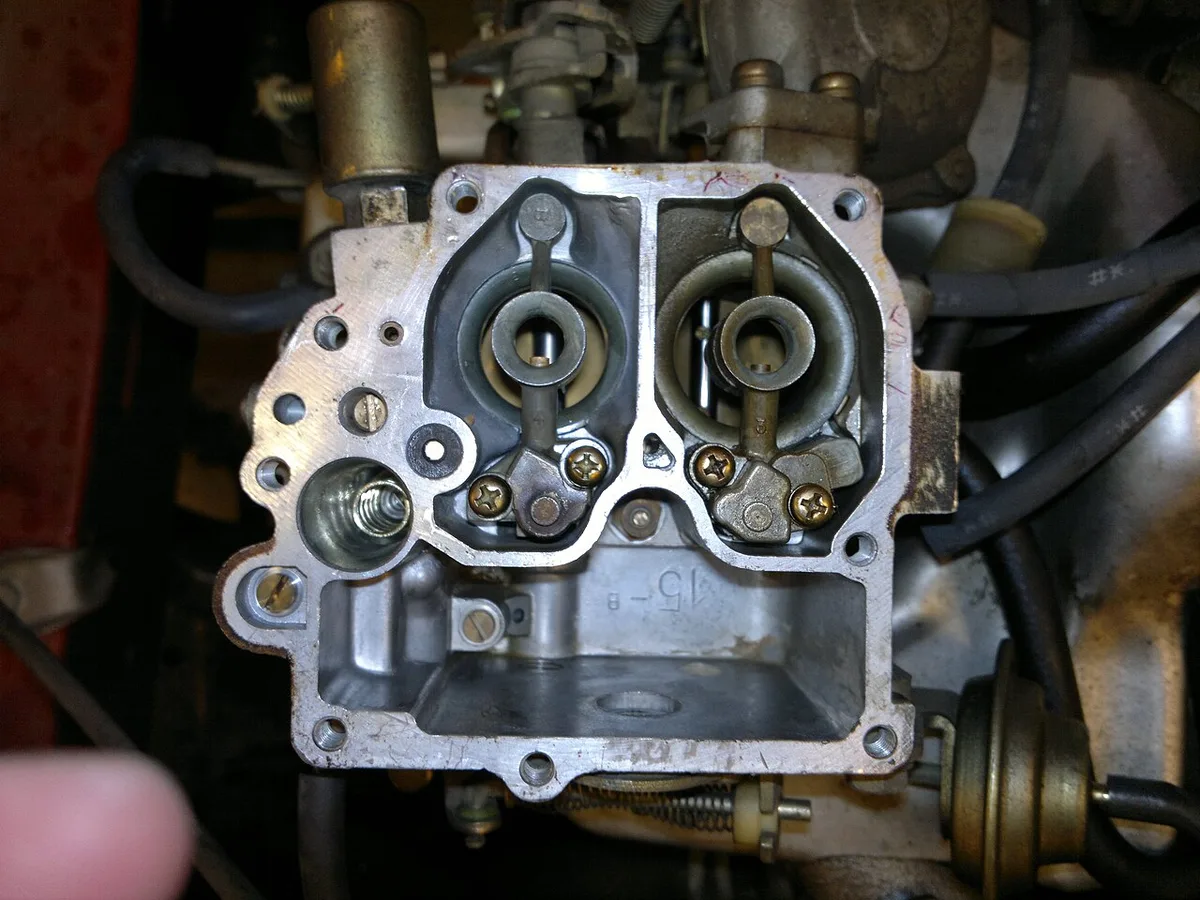
Image source: Wikimedia Commons / Hoikka1 (CC BY-SA)
Manufacturer owner's manuals are blunt about it. Honda, Briggs & Stratton, Kohler, and Stihl all publish storage guidance that comes down to the same few instructions: add stabilizer, run the treated fuel through the system, and shut the fuel off or drain the bowl. Many specify that for storage beyond thirty days, untreated fuel is a bad idea.
Lawnmowers, generators, snowblowers, and chainsaws: the highest-risk group
The pattern repeats every spring. A mower that ran perfectly in October won't fire in May. The fuel has been sitting in a vented plastic tank in a shed through a full winter of temperature swings.
Generators are worse in a quieter way. They sit for a year at a time, get dragged out during a storm, and refuse to start exactly when you need them. A generator that fails during an outage is a hazard, not an inconvenience.
| Equipment | Typical storage length | Most common failure | Likely fix |
|---|---|---|---|
| Lawnmower | 5 to 7 months | Varnished main jet, sticking float needle | Carb clean or rebuild kit |
| Snowblower | 7 to 9 months | Gelled fuel in bowl, hard starting | Drain bowl, fresh fuel |
| Generator | 12+ months | Clogged jet, corroded tank, split fuel line | Full fuel system clean |
| Chainsaw | Variable, often long | Two-stroke mix separation, hard start | Fresh mix, carb adjustment |
| String trimmer | 6 to 8 months | Blocked fuel filter, cracked primer bulb | Filter and bulb swap |
The cheapest fix on that list is the fuel filter, and on most handheld equipment it's a two-dollar part behind the fuel cap. Change it before you rebuild anything.
Varnished carburetor jets and the sticking float needle
A carburetor works by metering fuel through holes measured in fractions of a millimeter. The main jet and pilot jet are the two that matter most, and they're the two that clog first when fuel dries in the bowl.
Fuel left in the float bowl evaporates over weeks. What stays behind is a tacky film that hardens into a yellow-brown varnish. That film narrows the jet, so the engine runs lean, surges at idle, and won't take throttle.
The float needle suffers the same fate. Varnish on the needle seat stops it sealing properly, so fuel either floods the engine or starves it. A flooded crankcase on a mower means diluted oil, and diluted oil means bearing wear.
Cleaning a carb properly means disassembly, a soak in carburetor cleaner, and a blast of compressed air through every passage. Don't ream brass jets with a wire or drill bit. You'll change the metering size and never get the mixture right again.
A rebuild kit with new gaskets, a needle, and a seat costs less than a new carburetor in most cases. On cheap equipment the whole carb is sometimes the same price as the kit, and swapping the unit is the faster job.
Two-stroke pre-mix separation and oil starvation risk
Two-stroke fuel has an extra clock running. The oil you mixed into the gas doesn't stay in suspension forever, and ethanol blends shorten that window.
Roughly thirty days is the working number for E10 pre-mix. After that the oil can drop out, the fuel loses octane, and the mix ratio you carefully measured stops being the mix ratio the engine gets.
Run a two-stroke on separated pre-mix and you're running it on a leaner oil ratio than you think. The result is scored pistons and seized bearings. A seized top end on a chainsaw or trimmer is a repair that often costs more than the tool did.
The rule is simple. Mix small batches, date the can, and dump anything older than a month into your car's tank if it's still clean. Never into a two-stroke.
Canned pre-mixed alkylate fuel solves this entirely for occasional users. It's ethanol-free, oil is already blended, and it has a stated shelf life measured in years rather than weeks.
Canned ethanol-free fuel as the no-drama fix
For equipment that runs a handful of times a year, canned alkylate fuel is the most reliable answer we've found in the research. It's ethanol-free, low in aromatics, and sealed in a metal can with a long shelf life.
The cost is the tradeoff. A quart of canned fuel can run eight to twelve dollars, which is several times pump gasoline per gallon. For a trimmer that burns a quart a season, that's cheap insurance.
For a lawn tractor burning two gallons a week, it's not.
A middle path works well. Run pump E10 during the season, then switch to canned fuel for the last tank before storage. You get the clean fuel sitting in the system all winter without paying premium prices year round.
Whichever route you take, one habit matters more than the fuel itself. Run the carburetor dry before storage. Shut the fuel valve and let the engine idle until it dies, or drain the bowl screw.
An empty bowl can't varnish.
Carburetor vs. Fuel Injection: Why the Same Bad Gas Hits Them Differently
Same stale fuel, two very different repair bills. The reason comes down to pressure, passage size, and how much fuel sits still.
A carburetor meters fuel at atmospheric pressure using gravity or a low-pressure pump. A modern fuel injection system pushes fuel through tiny orifices at 40 to 60 psi on port injection, and 2,000 psi or more on direct injection.
That pressure does two useful things. It keeps fuel moving constantly, so there's less time for it to sit and oxidize. It also blasts through small partial restrictions that would stop a gravity-fed carburetor dead.
| Factor | Carbureted engine | Port fuel injection | Direct injection |
|---|---|---|---|
| Fuel pressure | 2 to 7 psi | 40 to 60 psi | 2,000 to 2,900 psi |
| Where deposits land | Jets, float bowl, needle seat | Injector tips, intake valves | Injector tips, combustion chamber, intake valves from PCV |
| Typical stale-fuel symptom | Won't start, surges, floods | Rough idle, lean misfire, hesitation | Misfire, rough idle, hard cold start |
| Tolerance for old fuel | Very low | Moderate | Moderate to high |
| Typical repair | Carb clean or rebuild | Injector clean or replace | Injector replacement, walnut blasting for valves |
Small passages, float bowls, and where deposits actually stick
The float bowl is the enemy. It's a small reservoir of fuel that sits exposed to air inside the carburetor body. When that fuel evaporates, everything dissolved in it stays behind as a film on the walls, the jets, and the float.
Fuel injection has no equivalent. The rail is a sealed tube under pressure, the injectors are closed when the engine is off, and the fuel that's in there isn't exposed to moving air. That's why a fuel-injected car tolerates six-month-old gas far better than any mower.
Injectors do have their own weak point. The tip sits in a hot zone, and a thin film of fuel on the pintle can bake into lacquer when the engine shuts down hot. Do that a few hundred times on marginal fuel and the spray pattern degrades.
How modern injectors and high-pressure pumps tolerate stale fuel, and where they don't
Modern engine management is remarkably good at covering for bad fuel. Knock sensors pull timing when octane drops. Oxygen sensors and fuel trims adjust the mixture when the fuel leans out.
The car keeps running and you barely notice.
Two things defeat that adaptability. Debris is one. A stale tank sheds rust and gum, and a high-pressure pump hates particles more than anything else.
The clearances inside a common-rail or gasoline direct injection pump are measured in microns.
Heat is the other. Direct injection injectors run hotter than port injectors, so deposits bake on harder and faster. When a GDI injector clogs, the misfire is usually sharp and cylinder-specific rather than a vague roughness.
So the practical takeaway flips depending on what you drive. If your car is port-injected, stale fuel mostly costs you a filter and a bottle of cleaner. If it's direct-injected, keep the tank fresh and don't gamble on year-old fuel.
Diesel Doesn't Go Bad the Same Way, and the Advice Flips
Diesel fails on a completely different set of rules. It doesn't have gasoline's light ends, so it doesn't go flat. It has water, oxygen, and microbes to worry about instead.
Water is the big one. Diesel absorbs less water than ethanol blends but it still picks up moisture, and that water collects at the bottom of the tank. There it feeds a film of bacteria and fungus that grows at the fuel-water boundary.
That growth produces acids and dark sludge. The sludge plugs filters fast, and the acids attack steel tanks and injector internals. A diesel tank with a microbial problem smells wrong and produces filters that keep clogging within days of fitting.
Water in diesel, microbial growth, and fuel filter clogging
The symptoms of water contamination in diesel are consistent. Rough running, loss of power under load, hard starting, and a fuel filter that clogs far sooner than the service interval suggests.
On a modern common-rail diesel, water is genuinely dangerous. The high-pressure pump and injectors rely on diesel's lubricity, and water strips that film away. Repair costs for a contaminated common-rail system routinely run into the thousands.
Biodiesel blends make it worse. B5 and above are more hygroscopic than straight diesel and oxidize faster, so a B20 sitting for a year is a real storage risk rather than a theoretical one.
Cold weather adds a separate problem. Diesel waxes as it cools, and the cloud point is the temperature where crystals start forming. Winter-blend diesel is formulated for local conditions, but fuel bought in July and stored until December isn't.
Why you never dilute or burn off contaminated diesel
With gasoline, diluting marginal fuel with fresh is a reasonable move. With diesel, it isn't. Water and microbes don't dilute away, and adding fresh fuel just gives the colony more to eat.
The correct response to contaminated diesel is drain, clean, and polish. That means removing the fuel, cleaning or replacing filters, and in bad cases having the fuel professionally polished and the tank cleaned.
Never pour a water-contaminated diesel sample back in to "use it up." And never treat a gelled tank with a double dose of additive and hope. Additives prevent gelling in good fuel, they don't rescue fuel that's already solid.
Storage advice for diesel is also different in one key way. A full tank still helps, but a diesel tank benefits from being kept cool and dry far more than from being full. Condensation is the enemy, and temperature stability matters more than volume.
Step-by-Step: Draining, Disposing, and Getting It Running Clean Again
Once you've decided to drain, the job is straightforward. It's messy and it needs care, but it's well within reach for anyone who can change a filter.
Work outside or in a well-ventilated space. No sparks, no smoking, no running appliances nearby. Have an approved metal or polyethylene fuel container ready, plus absorbent material for spills and gloves and eye protection.
Never use a shop vacuum to pull fuel out of a tank. The motor arcs, and the vapor is what ignites. This is how people get hurt doing this job.
Siphoning vs drain plug vs priming the fuel pump
Three methods cover almost every vehicle. Pick based on what your tank gives you access to.
- Siphon with a primer bulb. Works on nearly anything, no tools needed. Use a dedicated fuel-rated siphon, never your mouth, and never a garden hose.
- Tank drain plug. Fastest and cleanest when it exists. Usually a hex plug on the bottom of the tank. Have the container directly underneath before you crack it loose.
- Fuel pump prime method. Pull the fuel pump relay or fuse, jump the pump circuit, and let the pump push fuel out of the disconnected line at the filter or rail. Fast, but you need to know your wiring.
If you need to get under the car for a drain plug, get the height safely. Wooden ramps you build yourself are a solid option, and there's a sensible set of plans for building your own that keeps the car stable while you work. Chock the wheels regardless.
| Method | Best for | Watch out for |
|---|---|---|
| Primer bulb siphon | Any car or small engine | Slow, and you must stop before the tank runs dry and you lose suction |
| Drain plug | Tanks with a bottom plug | Splash risk, have a wide pan ready |
| Pump prime | Sealed tanks with no plug | Fuel sprays under pressure, keep your face clear |
| Fuel shutoff and bowl drain | Small engines | Small volumes, but the bowl screw strips easily |
Draining a small engine: tank, line, and float bowl
Small engines are easier than cars, and the sequence matters. Shut the fuel valve first if the machine has one. Then disconnect the fuel line at the carburetor inlet and drain the tank into a container.
Next, open the float bowl drain screw and let the bowl empty. On many carburetors there's a small screw at the bottom of the bowl for exactly this. If there isn't, unbolt the bowl carefully and catch what's inside.
Then pull the fuel line off completely and check it for cracks and stiffness. Ethanol blends degrade older rubber lines from the inside, and a line that's gone soft will shed particles into the carburetor.
Finally, change the inline fuel filter if there is one. If there isn't, this is a good time to add one.
Replacing the inline filter and inspecting the spark plug
The filter is the cheapest insurance in this whole process. On a car, it's usually a canister under the vehicle or in the engine bay, and on many older vehicles it's a simple push-fit with clips.
Replace it pointing the right direction. Most have an arrow showing flow toward the engine, and getting it backwards restricts flow.
Pull a spark plug while you're at it. A plug from a stale-fuel engine usually shows dark, sooty deposits rather than the light tan you want. Clean or replace it, and check the gap while it's out.
If the plug comes out wet with fuel, that's a flooding signature rather than an ignition fault. If it comes out oily and black, that's a separate problem worth chasing on its own.
Clearing codes and the first test drive
Reconnect everything, refill with fresh fuel, and prime the system before cranking. On a fuel-injected car, cycle the key from off to on three or four times without cranking. Each cycle runs the pump for a couple of seconds and builds pressure.
Then check for leaks at every connection you touched. Look, smell, and wait a minute before you start the engine.
Start it and let it idle. Expect a rough minute or two while fresh fuel works through and the system re-learns. Then clear the codes and take it for a twenty-mile drive that includes some highway speed.
If the light comes back with the same misfire or lean code, the fuel wasn't the whole story. If it stays off through a full drive cycle, you've fixed it.
Where old fuel is legally allowed to go
Old gasoline is household hazardous waste, and that's the only correct destination. Never pour it down a drain, into a storm sewer, onto the ground, or into the trash.
In the US, the EPA's household hazardous waste guidance points you to local collection programs, and most counties run collection days or permanent facilities. In the UK, your local council tip accepts small quantities of fuel in a sealed container.
Auto parts stores that take used oil usually won't take fuel, so call before you drive over. Store the drained fuel in a sealed, labeled, approved container until you can drop it off, and keep it out of the house and away from ignition sources.
Small quantities of clean, unseparated stale fuel can legally and safely go into a nearly empty tank in another vehicle to be burned off. That's dilution, not disposal, and it only applies when the fuel isn't contaminated.
The Real Cost of Ignoring It
Stale fuel is cheap to fix early and expensive to fix late. That's the whole economics of this topic in one line. The gap between the two outcomes is usually a filter, a bottle of cleaner, and an afternoon.
Here's what the repair menu actually looks like. Prices below reflect typical US independent shop rates as of 2026. Dealer pricing runs higher, and European or direct-injected engines sit at the top of every range.
| Repair or part | Typical parts cost | Typical total with labor | What usually triggers it |
|---|---|---|---|
| Inline fuel filter | $15 to $40 | $40 to $120 | Debris loosened from a stale tank |
| PEA fuel system cleaner | $10 to $20 | Same as parts | Light varnish, marginal fuel |
| Shop injector cleaning | Not applicable | $100 to $300 | Rough idle, lean fuel trims |
| Injector replacement, set of four | $200 to $900 | $400 to $1,500 | Clogged or failed injectors |
| Fuel pump replacement | $150 to $700 | $400 to $1,200 | Pump strained by debris or run dry |
| Carburetor rebuild kit | $15 to $60 | $100 to $400 | Varnished jets, sticking needle |
| New small-engine carburetor | $30 to $150 | $80 to $250 | Heavy varnish, stripped bowl screws |
| Catalytic converter | $300 to $2,000 | $1,000 to $2,500 | Raw fuel from an unresolved misfire |
| Tow or recovery | Not applicable | $100 to $250 | No-start in a bad location |
Read that table from the top down and the logic is obvious. A $20 filter prevents a $900 pump. A $15 bottle of cleaner prevents a $300 injector service.
The fuel economy hit is small but real
Degraded fuel burns worse, and you pay for it twice. Reports of economy loss with stale fuel run from roughly 5 percent up to 15 percent in severe cases, mostly from poor atomization and the engine's tendency to run rich while it compensates.
On a car doing 12,000 miles a year at 30 mpg, a 5 percent loss costs you about 20 gallons annually. That's not catastrophic. It's also not nothing, and it's entirely avoidable.
The bigger number is time. A car that cranks for six seconds instead of one, every single morning, is a car that's wearing its starter and draining its battery faster than it should.
The hidden cost is the part you can't see
Catalytic converters are the quiet casualty of this whole topic. They're designed to burn off trace hydrocarbons, not a steady stream of raw fuel from a misfiring cylinder. Feed one a misfire for a few hundred miles and the substrate overheats, melts, and stops working.
A replacement converter plus the diagnosis that finds it can run past $2,000 on many vehicles. That's the bill sitting behind a flashing check engine light someone decided to ignore for a week.
Mistakes That Turn a Cheap Fix Into an Expensive Bill
Most of the expensive outcomes we see in the research start with a small decision that felt reasonable at the time. These are the ones that show up again and again.
It smells fine, so it is fine
Smell is a weak test. Gasoline that has lost half its volatiles still smells like gasoline. The compounds you'd notice leaving, the light ends, are exactly the ones your nose registers least.
A better check is a jar sample. Pull a few ounces from the bottom of the tank into a clear glass jar, cap it, and let it sit for ten minutes. Look for a line, haze, or sediment.
Smell it after that, not before.
Leaving a tank nearly empty all winter
This is the single most common storage mistake, and it's the one that costs the most. A near-empty tank is mostly air, and air is what drives oxidation and moisture condensation.
Fill it before you park it. A full tank has almost no ullage, which means almost no oxygen and almost no surface for moisture to settle on. This one habit does more than any additive you can buy.
Blaming the ignition system for a fuel problem
Misfires, hard starts, and rough idle all point at spark plugs, coils, and sensors first. That's the natural instinct, and it's often wrong when there's old fuel in the tank.
The giveaway is timing. A fuel problem usually shows up after storage and gets worse as the tank drains. An ignition fault shows up suddenly and doesn't care how full you are.
Pull the codes, look at fuel trims, and check fuel pressure before you start swapping coils.
Mixing old fuel into a fresh tank and calling it dilution
Dilution only works when there's room to add fresh fuel. Pour two stale gallons into a tank that's already at 90 percent and you've created a 20 percent blend you'll spend three weeks burning.
That's not dilution. That's just old fuel with a fresh top note, and it's how a marginal tank becomes a clogged filter.
Using dry gas on a separated tank
Dry gas works on condensation. It does not work on a genuine separated layer, no matter how much you pour in. If you've confirmed a line in a settled sample, drain the tank.
Adding more alcohol to a tank that's already out of balance can actually make things worse by shifting more water out of suspension.
Reaming a brass jet with a wire or drill bit
It feels efficient. It ruins the carburetor. Brass jets are metered to fractions of a millimeter, and scraping them out with anything abrasive changes the orifice size permanently.
Soak the jet in carburetor cleaner, then blow it through with compressed air from the direction of flow. If a passage still won't clear, replace the jet. They cost a few dollars.
Skipping the filter after a drain
The fuel that comes out of a drained tank carries everything that settled over the last year: rust flakes, gum, sediment, water. Some of it stays in the lines.
Fit a new filter every time you drain. It's the cheapest part in the job and the one most likely to save the expensive part downstream.
Vacuuming fuel out of a tank
Never use a shop vacuum to pull fuel. The motor brushes arc, and gasoline vapor is what actually ignites. This is a documented cause of serious garage burns.
Use a fuel-rated siphon with a primer bulb, a drain plug, or the fuel pump itself. All three work. None of them can ignite vapor with a spark.
Storage Habits That Keep Fuel Fresh Through Winter and Beyond
Everything in this section costs less than a tank of gas and takes less than thirty minutes. Yet these habits prevent the majority of spring no-start calls and stale-fuel repairs we see referenced in owner forums and shop write-ups.
Stabilizer dosing and when to add it
Fuel stabilizer slows oxidation. It does not reverse it, and it doesn't fix fuel that's already degraded. Add it to fresh fuel, not old fuel.
Dosing is on the bottle, typically around one ounce per two and a half gallons for long-term storage. Overdosing doesn't help and can add its own deposits.
The key timing rule: add stabilizer, then run the engine long enough for treated fuel to reach the carburetor or fuel rail. On a mower, that means a couple of minutes of idle. On a car, a short drive.
Fill the tank, then run treated fuel through the system
Full tank plus stabilizer plus a run-through is the whole winterizing formula for anything with a fuel system. The order matters, so do it in that sequence.
Fill first, because a full tank has the least air. Add stabilizer to the tank, then run the engine so treated fuel fills the lines. Shut it down and leave it alone.
On equipment with a fuel shutoff valve, close the valve and let the engine idle until it dies. That empties the float bowl, which is where varnish actually forms.
Container choice matters more than you think
A sealed metal safety can with a tight gasket beats a vented plastic jug every time. Metal blocks light, seals tightly, and doesn't breathe with temperature swings.
Plastic jugs are fine for a few weeks of lawn duty. For anything you plan to keep past a season, use a sealed can, fill it nearly full, and keep it somewhere with a stable temperature.
Label every container with the date you filled it. A can with no date is a can you'll guess wrong about in eight months.
Winterizing small equipment step by step
Here's the sequence we'd follow for a mower, generator, or snowblower going into storage.
- Top off the tank with fresh fuel and add stabilizer at the label dose.
- Run the engine for two to three minutes so treated fuel reaches the carburetor.
- Close the fuel valve and let the engine idle until it stalls, or loosen the bowl drain screw.
- Fog the cylinder if the manual calls for it, typically through the spark plug hole.
- Change the oil if it's due. Old oil holds acids that attack bearings over winter.
- Pull the plug, check the gap, and leave it finger tight until spring.
- Store with a cover over the air intake and the machine on a dry surface.
Steps five and six are the ones people skip. Both cost almost nothing and both matter.
Spring startup procedure
Don't yank the cord twenty times and get frustrated. Prime the system first. Open the fuel valve if there is one, then check that fuel reaches the carburetor.
If the machine has a primer bulb, press it three or four times. If it doesn't, and it's been sitting with an empty bowl, expect a few extra pulls.
If it won't fire after five or six attempts, stop and pull the spark plug. Wet means flooding, dry means no fuel delivery. That single check separates a fuel problem from an ignition problem in about ninety seconds.
| Equipment | Storage fuel move | Spring first check |
|---|---|---|
| Mower | Full treated tank, bowl run dry | Fresh plug, clean air filter |
| Generator | Full treated tank, exercise monthly | Oil level, fuel valve, bowl drain |
| Snowblower | Full treated tank, bowl run dry | Shear pins, auger free movement |
| Chainsaw | Dump pre-mix, run dry | Fresh mix, chain oil |
| Boat | Full tank with stabilizer, filter change | Water separator, primer bulb |
Buy fuel that's actually fresh
Fuel starts aging at the refinery, not at your filler neck. A slow-selling station with a low-turnover premium grade may be selling fuel that's already months old.
Buy from busy stations, and buy the grade that moves. Premium sits longer than regular at many pumps, which is worth knowing when you're buying it specifically to store.
Seasonal blends also matter. Winter fuel is formulated for cold-start volatility and evaporates faster in summer heat. Fuel bought in February and stored until July has a shorter useful life than the label suggests.
Safety, Disposal, and the Rules You Can't Skip
Gasoline is a flammable liquid and a known carcinogen, and every rule in this section exists because someone got hurt ignoring it. None of it is bureaucratic box-ticking.
Flammability, static, and ventilation basics
Gasoline vapor is heavier than air and ignites at a surprisingly low temperature. It pools at floor level in a garage, which is exactly where water heaters, furnaces, and pilot lights live.
Never drain or handle fuel near an open flame, a running appliance, or anything that sparks. Work outside or with the door fully open and cross-ventilation moving air through.
Static is the invisible hazard. It builds as fuel flows through a hose or pours into a container. Touch the container to the vehicle or machine before you start pouring, and keep it in contact.
Fill portable containers on the ground, never in a truck bed with a plastic liner.
Carbon monoxide kills people every winter in garages. Never run an engine, even briefly, in an enclosed space with the door shut.
How much fuel you can legally store
Storage limits vary by jurisdiction, but the principle is consistent. Most fire codes cap the volume of flammable liquid a residence can store, and typically only in approved containers.
NFPA 30, the Flammable and Combustible Liquids Code, sets the technical framework most local codes adopt. Many jurisdictions limit households to somewhere in the range of 25 gallons of gasoline in approved containers, often with stricter limits for attached garages.
Check your local fire marshal's guidance rather than assuming. Insurance policies also often have clauses about stored fuel, and a claim after a garage fire is a bad time to discover yours does.
E15 restrictions and manufacturer warranty language
E15 is 15 percent ethanol, and it's approved for use in most model-year 2001 and newer light-duty vehicles. It is not approved for small engines, motorcycles, boats, or older vehicles.
Manufacturer owner's manuals are explicit about this. Briggs & Stratton, Honda, Stihl, Mercury Marine, and most others state that fuel-related damage from blends above E10 is not covered under warranty.
That matters because ethanol damage is slow and often invisible until it isn't. A warranty claim denied because the fuel log doesn't match the manual is a real outcome, not a hypothetical.
Depressurize before you open anything
Fuel-injected systems hold pressure after the engine shuts off. Crack a line on a pressurized rail and you get a face full of gasoline.
Pull the fuel pump fuse or relay and crank the engine briefly to bleed pressure, or use the pressure test port with a gauge. Then wrap a rag around the fitting before you loosen it.
Work on a cold engine where you can. Exhaust manifolds and catalytic converters stay hot for a long time, and fuel on a hot manifold is the exact scenario the fire codes exist to prevent.
If you're lifting the vehicle for any of this, use rated stands on level ground and chock the wheels. Never work under a car held up by a jack alone.
Frequently Asked Questions
Does old gas actually damage an engine, or just run badly?
Both, depending on the engine. A modern fuel-injected car usually just runs poorly and recovers once fresh fuel cycles through. Carbureted engines and two-strokes suffer real mechanical damage, because varnish clogs metering passages and separated pre-mix can starve bearings of oil.
Damage scales with age and with how small the fuel passages are.
Can I mix old gas with new gas to stretch it?
Yes, within limits. Keep old fuel at roughly a quarter of the total tank volume or less, and top off with fresh high-octane. Never use it in a two-stroke mix.
And never "dilute" into a tank that's already nearly full, because you'll just create a large volume of marginal fuel you can't burn quickly.
How old is too old before I have to drain the tank?
For E10 in a vented tank, anything past six months is worth draining. Between three and six months, dilute and burn it off if the engine runs clean. Ethanol-free fuel in a sealed container can stretch a year or more.
Visible separation, cloudiness, or a sour varnish smell means drain it now, regardless of age.
Will a fuel additive bring stale gas back to life?
No. Additives slow degradation and clean soft deposits. They can't restore lost volatiles, rebuild octane, or reverse phase separation.
A PEA cleaner genuinely helps a marginal tank in a fuel-injected engine. It does nothing for fuel that's already separated or a carburetor jet packed with hard varnish.
Is old gas worse for a motorcycle or boat than a car?
Considerably worse. Motorcycles and boats sit longer, often in humid or marine air, and many still use small tanks with vented caps and carburetors. Marine fuel systems also pull from the tank bottom, so a separated ethanol layer gets drawn in first.
Treat anything over two months as suspect in these applications.
How do I know if my tank has phase separation?
Pull a sample from the bottom of the tank into a clear glass jar and let it settle for ten minutes. Two distinct layers with a sharp boundary means it's separated. Cloudy, milky fuel that stays cloudy is the earlier warning stage.
On a small engine, tilt the machine and watch the first ounces out of the fuel line.
