
You hear the crunch before your brain catches up. Nobody hands you a manual for what to do after a car accident, and most people freeze for a beat. That's fine.
What matters is what you do in the next ten minutes, because the right order of steps protects both your body and your claim.
NHTSA tallies roughly 6 million police-reported crashes in the US every year, and about 40,000 of them end in a death. Most of the rest are low-speed hits that never make the news. Yet the gap between a clean claim and an eighteen-month fight usually comes down to a handful of decisions made at the roadside, often before anyone's hands stop shaking.
Which is why the first branch to check has nothing to do with insurance.
What to Do After a Car Accident
Stop, stay at the scene, and check for injuries. Call 911 if anyone is hurt. Get the cars off the travel lane when it's safe.
Exchange names, insurance details, plate numbers, and photograph everything. Call your insurer the same day and see a doctor within 24 hours.
The First Sixty Seconds After a Crash: What Actually Matters
The engine is still running. The radio is still on. Your hands are buzzing and your brain is offering you nothing useful.
That's adrenaline, and it does two things at once: it hides pain and it pushes you to do something fast. Both are traps.
So the first move isn't a phone call. It's a pause. Take four seconds, put the car in park, and switch on the hazard lights.
Everything else can wait those four seconds.
Here's the sequence that works whether you're on a six-lane freeway or in a grocery store lot.
| Order | Do this | Why it comes first |
|---|---|---|
| 1 | Brake, shift to park, hazards on | A rolling car turns one crash into two |
| 2 | Switch the engine off, keys in your pocket | Prevents fire risk and keeps the car from being moved by someone else |
| 3 | Breathe and self-check | Adrenaline masks pain for 10 to 30 minutes |
| 4 | Look before you open the door | Passing traffic takes out doors and people every week |
| 5 | Check on the other car | Duty to render aid starts here, legally and morally |
Those five steps take under a minute. Everything else in this guide hangs off what you find at step five.
The one legal step you can never skip
Every US state plus the UK requires you to stop after a collision involving injury, death, or property damage. Leaving is a separate crime, and it stacks on top of whatever caused the crash.
Penalties range from a misdemeanor with fines and license points up to felony hit-and-run with prison time when someone is hurt. A parking lot tap with no one around still counts. Leave a note with your name and number, and photograph the damage before you drive off.
If the other driver takes off, that's their problem, not yours. Your job shifts to documenting what you can and reporting it. We cover that branch later.
Highway vs. city street: the same crash, different physics
A fender bender at 25 mph on a residential street is an annoyance. The same impact at 65 mph on an interstate is a fatality risk every second you stand outside the car.
Speed limit changes the plan. Under about 40 mph, with both cars drivable and no injuries, you can usually step out, talk, and move the vehicles somewhere safe. On a highway, treat every second in a live lane as a countdown.
If you're on a highway and the car still moves, get to the right shoulder or the next exit. If it doesn't move, get yourself and passengers out through the passenger side and stand behind the guardrail, well past the vehicle. Not next to it.
Behind the barrier.
The two things that decide how the next month goes
Your claim gets built from evidence, and evidence disappears fast. Skid marks fade in rain. Debris gets swept up by the tow crew.
Witnesses drive away.
So once everyone is breathing and out of the travel lane, your job is capture, not conversation. Photos, plate numbers, and the other driver's insurance card matter more in the next twenty minutes than anything you say on the phone afterward.
The second thing is what comes out of your mouth. Fault is a legal determination made later by insurers and, occasionally, a court. It is not something you settle at the roadside with an apology.
We'll get to the exact wording.
One quiet point worth knowing: how you were sitting and holding the wheel at impact can show up in injury claims. Crashes with hands at the top of the wheel tend to produce worse wrist and forearm injuries, which is part of why the way you grip the wheel matters long after you've stopped driving.
Is Anyone Hurt? The Injury Branch That Overrides Everything Else
Check people before you check paint. That's the whole rule. A bent bumper is a number on an estimate.
A missed head injury is a different life.
Adrenaline makes this harder than it sounds. Crash victims routinely walk around, swap insurance cards, and feel completely fine, then collapse four hours later. Per CDC guidance on crash injuries, symptoms of concussion and soft-tissue damage often show up hours or days after the event, not at the scene.
So ask out loud, to every person in every vehicle: "Is anyone hurt anywhere?" Then look, don't just listen. Check for confusion, repeating the same question, a dilated pupil, blood they haven't noticed, or a limb they aren't using.
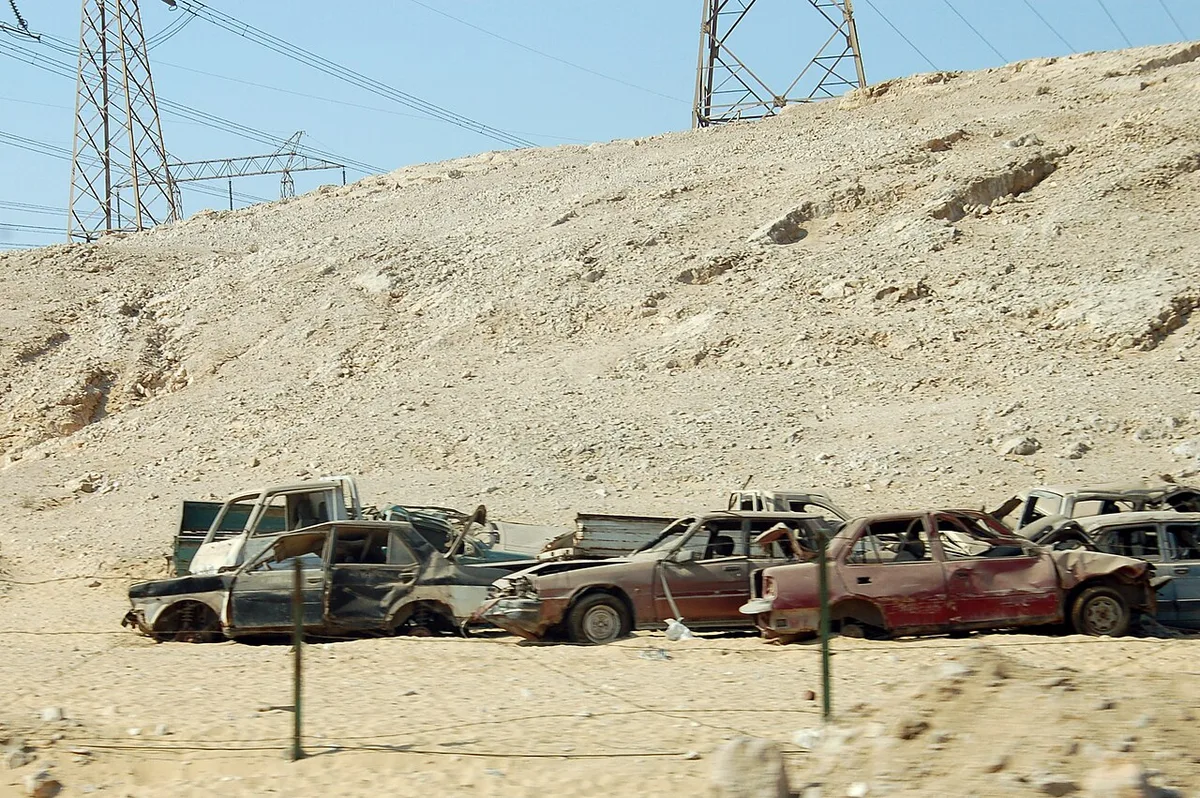
Image source: Wikimedia Commons / David Evers from Amsterdam, Netherlands (CC BY)
When to call 911 vs. when to move to a safe spot
Call 911 the moment any of these are true. Don't weigh it, don't ask permission, and don't let a polite "I'm fine" from the other driver talk you out of it.
- Anyone is unconscious, even for a second
- Chest pain, trouble breathing, or pain in the neck or back
- Numbness, tingling, or a limb that won't work
- Heavy bleeding, or a cut that won't stop
- A pedestrian, cyclist, or motorcyclist was involved
- Anyone is trapped, or a door won't open
- A driver appears impaired, aggressive, or confused
- A child was in the car and you can't fully assess them
- The other driver has no license, no insurance, or leaves
"Call 911" means you speak to a dispatcher, give the road, direction, nearest exit or landmark, number of vehicles, and the injuries you can see. Stay on the line if they ask you to. They'll walk you through first aid if needed.
If nobody is hurt, the cars are drivable, and you're off the travel lane, you don't need an ambulance. You still need a police report in many states, which is covered two sections down.

Image source: Openverse / GlacierNPS (PDM 1.0)
Why you shouldn't move someone with possible spinal injury
The spine is a column of bone protecting a bundle of nerve tissue. A fracture that stays put can heal. The same fracture that gets twisted can leave someone paralyzed for life.
That's the entire logic. Unless there's immediate danger, leave them where they are and keep them still. Support the head in the position you found it.
Don't straighten a neck that looks crooked, and don't sit someone up because they're more comfortable that way.
There are exceptions, and they're narrow. Move the person only if staying put is more dangerous than moving them:
- The car is on fire or smoking
- The vehicle is in a live traffic lane and can't be protected
- There's a fuel leak or hazardous spill
- The person is unconscious and not breathing, and you need to start CPR
If you must move them, pull in the direction of the body's long axis, keep the head and neck aligned with the spine, and get several people to help if you can. Then keep them still until EMS arrives.
If you're alone and unsure, call 911, put the phone on speaker, and follow the dispatcher. Every state's 911 system can coach you through this. Good Samaritan laws generally protect bystanders who act reasonably and in good faith, though the exact protection varies by state.
Would you know a concussion if you saw one?
Probably not, and that's normal. Concussion doesn't always mean unconsciousness. The common signs are headache that won't quit, nausea, dizziness, blurred vision, sensitivity to light or noise, and feeling "foggy" or slow.
The tell that catches people is repetition. Ask the same question twice, ten minutes apart, and see if the answer changes. If the person can't recall the last few minutes, or asks where they are more than once, treat it as a head injury and get them evaluated.
| Sign after a crash | What it likely points to | What to do |
|---|---|---|
| Neck stiffness, headache, foggy thinking | Whiplash or concussion | Same-day ER or urgent care |
| Numbness in arms or legs | Nerve or spinal involvement | Call 911, do not move the person |
| Bruising across the chest or shoulder | Seat belt loading | Get checked, even if pain is mild |
| Pain that appears 24 to 72 hours later | Delayed soft-tissue injury | See a doctor, document the visit |
Drivable, Blocking Traffic, or Dead in the Road: Deciding Whether to Move the Cars
Three conditions decide this. Can the car roll? Is it in a live lane?
Is anyone hurt? Run them in that order and the answer usually writes itself.
If the car drives and nobody is hurt, move it. That's the default in nearly every situation, and several states have formal programs with names like "Steer It, Clear It" that make it a legal expectation on busy roads.
If the car doesn't drive, or a wheel is jammed, or fluid is pouring out, leave it. Hazards on, warning triangle out if it's safe to place one, and everyone behind the barrier.
If someone is hurt, the car stays put until EMS says otherwise, unless there's fire or live traffic danger.
| Situation | Move the vehicles? | Where to put them |
|---|---|---|
| Both drive, no injuries, surface street | Yes | Nearest side street, lot, or shoulder |
| Both drive, no injuries, highway | Yes, quickly | Right shoulder or next exit |
| One car undrivable, no injuries | Only the drivable one | Shoulder, well past the wreck |
| Anyone injured | No, unless fire or traffic danger | Leave in place, protect the scene |
| Parking lot, no injuries | Yes, to a parking space | Out of the driving aisle |
| Fluid leak, smoke, or fire | Get everyone out first | 100 feet upwind if possible |
Highway vs. surface street vs. parking lot rules
Highways are the most dangerous place to stand and the most forgiving place to move a car. Get off the road, then figure out the paperwork. Move-over laws in all 50 states require passing drivers to shift lanes or slow down for stopped emergency and service vehicles, and many now cover any disabled vehicle with hazards on.
Surface streets are the opposite. Traffic is slower, turning cars are the real hazard, and there's usually a side street or lot within 50 feet. Move there.
On a multi-lane road, an intersection corner is a bad choice because you'll be blocking turns and sightlines.
Parking lots are legally odd. They're private property, so police often won't respond, and the lot owner has no duty to preserve camera footage. Move both cars into open spaces, then photograph the original positions from memory while they're fresh.
Say out loud where each car was and what direction it was heading.
When moving the vehicle is legally required, and when it hurts your claim
A handful of states require you to move a vehicle out of a travel lane when it's operable and no one is hurt. Ignoring that can earn you a citation on top of the crash.
The fear that moving the car "destroys the evidence" is mostly overblown in minor crashes. Modern claims run on photos and repair estimates, and both survive a 30-foot relocation. What doesn't survive is a second collision caused by a car parked in a live lane.
The exception is a serious crash with injury or a disputed version of events. There, position matters and the scene should stay frozen until police arrive. If you're unsure which side of that line you're on, take a dozen photos of where everything sits before you move anything.
Timestamped photos beat memory every time.
One more thing to check before a tow truck hooks up: where the car may be pulled from. Modern unibody cars and EVs have specific jacking and tie-down points, and a careless hook can bend a control arm or crack a battery tray. Knowing the right towing anchor on your vehicle prevents a repair bill that has nothing to do with the crash.
Impact damage also isn't always visible. A hard side hit can bend a tie rod or tweak a control arm while the car still tracks straight at low speed. Our breakdown of whether bent suspension parts justify the upgrade covers what alignment shops actually find after a hit like that.
When Police Show Up, When They Won't, and When the Law Requires a Report
There are three separate questions here, and people mix them up constantly. Do you want police there? Does the law require them there?
Will they actually come?
The answer to all three depends on where the crash happened and what the damage looks like.
Call police when there's an injury, a suspected impaired driver, a hit-and-run, a blocked lane, a commercial vehicle, or a disagreement about what happened. Also call when the other driver refuses to share insurance information or turns aggressive.
Police often won't respond to a two-car tap in a parking lot with no injuries and both cars drivable. That's a resourcing decision, not a legal ruling. You may still be required to file a report yourself.
Mandatory reporting thresholds by state
Most states set a dollar threshold for property damage plus a separate trigger for any injury or death. Cross either one and a report is required, whether or not an officer shows up.
| State | Report required when | Self-report form and clock |
|---|---|---|
| California | Injury, death, or $1,000+ in damage | SR-1, due within 10 days |
| Texas | Injury, death, or $1,000+ in damage | CR-3, generally within 10 days |
| Florida | Injury, death, or $500+ in damage | Self-report form, generally within 10 days |
| New York | Injury, death, or $1,000+ in damage | MV-104, within 10 days |
Treat that table as a starting point, not gospel. Thresholds and forms change, and a few states tie the requirement to a vehicle being towed rather than to a dollar figure. Confirm your state's current rule with its DMV or department of public safety before you assume you're clear.
The insurance side of the same crash is governed by state regulators, and the National Association of Insurance Commissioners publishes the consumer rules state by state.
Failing to file when you were required to can mean a suspended license, a fine, or a weakened claim. It's a cheap form to fill out and a costly one to skip.
Private property crashes and counter (self-filed) reports
Parking lots, drive-throughs, apartment complexes, and private roads are where police response rates fall off a cliff. Officers in many jurisdictions simply won't come out for a non-injury crash on private property.
That doesn't leave you empty-handed. Most states let you file a counter report, sometimes called a self-report or walk-in report, at a police station or through an online portal. You bring your photos, both drivers' information, and a written account of what happened.
Two habits make a counter report hold up:
- Write only what you saw, not what you concluded
- Attach photos and witness contacts to the filing
If an officer does respond, get three things before they leave: the report number, the officer's name and badge number, and the department's records request process. Report copies usually run $5 to $25 and take a few days to a couple of weeks. Some departments sell them online.
Giving a statement without handing over the case
You are required to identify yourself and provide your license, registration, and insurance details. You are not required to narrate fault or guess at what happened.
Stick to observable facts. "I was traveling east in the left lane. The other vehicle entered from the side street." That's a statement.
"I didn't see him, I guess I was going too fast" is a gift to the other insurer.
Body cameras and dash cams change the stakes here. Assume everything you say at the scene is recorded, because it probably is. Calm, factual, and brief is the right register.
As of 2026, most insurers also accept or request a first notice of loss online, often within minutes. That's fine and often smart. What you shouldn't rush is a recorded statement about fault, which is covered further down.
The Information Exchange and Scene Evidence: What to Collect Before Anyone Leaves
Everything you need gets collected in a ten-minute window, and then the window closes. The other driver leaves, the witness walks to their bus, the tow truck sweeps the glass.
Work through this list before anyone drives away.
From the other driver:
- Full name and phone number
- Driver's license number and state
- Insurance company, policy number, and the phone number on the card
- License plate and state
- Vehicle make, model, color, and VIN if visible through the windshield
From the scene:
- Wide shots showing both vehicles in the road, with lane markings and signage visible
- Four corner shots of each vehicle
- Close-ups of every damaged panel
- Both license plates
- Skid marks, debris fields, and fluid trails
- Traffic signals, stop signs, and yield signs at the intersection
- Weather and light conditions
- The other driver's insurance card, photographed flat
Shoot more than feels necessary. Digital photos cost nothing and the 40th frame is often the one an adjuster asks for.
Image source: Wikimedia Commons / Donald Trung Quoc Don (Chữ Hán: 徵國單), Wikimedia Commons.(Want to use this image?) (CC BY-SA)
Capture witnesses before they disappear
A neutral witness is worth more than any argument you can make later. Ask anyone standing nearby if they saw it happen, and get a name and a mobile number even if they say they'd rather not give a statement.
If they're willing, ask them to write two or three sentences in their own words and text it to you. A timestamped message from a bystander carries real weight with an adjuster.
Don't coach them. Don't ask what they think happened. Ask what they saw, write it down, and photograph their view of the intersection if they're standing somewhere useful.
The damage you can't see from the driver's seat
Broken glass, cracked lenses, and dangling mirrors are obvious. The expensive stuff usually isn't.
A shattered side mirror is a parts-and-labor job that varies wildly by model, and it's worth knowing what a shattered side mirror actually involves before you accept a quote. Same story with a cracked headlight housing, which can fog, fail inspection, and let water into the wiring, so pricing out a cracked headlight housing ahead of time keeps the estimate honest.
Modern cars also store crash data. Airbag modules log impact severity, and body shops pull diagnostic codes after a collision to see which sensors and systems need recalibration. If your dash lights up with warnings after a hit, that's expected, and it's also evidence that the impact was harder than it felt.
What not to post, sign, or agree to at the scene
Three things to avoid in the first hour.
First, don't post about the crash on social media. Insurers routinely review public posts, and a photo of you at brunch the day after you claimed a back injury gets used.
Second, don't sign anything handed to you at the scene beyond a police or tow authorization. Tow companies sometimes present "release" forms that include storage and lien language.
Third, don't agree to handle it privately without documenting it. Cash settlements for a bumper seem efficient until the other driver reports it as a hit-and-run two weeks later. If you do settle privately, write a short mutual release, photograph the damage, and keep the records.
The rest of the process, from the insurer call to the total loss decision, runs on what you captured in these ten minutes. Get it now, because you can't get it later.
What to Say, and What Never to Say, About Fault at the Scene
Two questions get mashed together at the roadside. What happened is a fact question. Who caused it is a legal one.
You're required to identify yourself and produce your license, registration, and proof of insurance in every state. You are not required to grade your own driving out loud. Fault gets assigned later by adjusters applying that state's negligence rules, and occasionally by a judge.
Your roadside opinion carries no legal authority. It does carry evidentiary weight, because police reports, body cameras, and dash cams all record it.
| Moment | Say this | Never say this |
|---|---|---|
| Officer asks what happened | "I was heading east on Elm. The other car pulled out from the side street." | "It was my fault, I wasn't paying attention." |
| Other driver apologizes | "Let's get the insurance info exchanged." | "Don't worry about it, these things happen." |
| Asked if you're hurt | "I'm not sure yet. I'm getting checked today." | "I'm fine." |
| Asked how fast you were going | "The posted limit." (Only if true.) | "Maybe 40? I don't really know." |
| Asked who was at fault | "I can describe what I saw." | "They came out of nowhere." |
The three phrases that cost the most
"I didn't see you" sounds honest. Adjusters read it as a failure to keep a proper lookout, which is a negligence element in every state.
"I'm sorry" is worse. It's an admission-shaped sentence, and the other carrier will quote it back in a settlement letter if they can.
"I'm fine" is the quiet killer. It goes into the police report and the other driver's notes, and then it sits there while you're still sore three days later.
Here's the nuance most people miss. Roughly three dozen states have some form of apology protection, either a statute or a rule excluding expressions of sympathy from evidence. California's Evidence Code section 1160, Florida's section 90.4026, and Texas Civil Practice and Remedies Code chapter 677 are three examples.
Those protections cover sympathy, not admissions of fault. "I hope you're okay" is protected. "I'm sorry, I ran the light" is not.
What to tell the other driver's adjuster
Nothing, at least not on day one. That carrier has no contract with you and no right to a recorded statement.
If they call, you can say: "I'll give a written statement through my insurer." Then hang up politely. Never sign a medical authorization, a release, or a "courtesy" check acceptance before you know the full extent of the damage and the injury.
A check with a release clause on the back is a settlement. Cashing it can end the claim.
Your own insurer is a different conversation
Your policy contains a cooperation clause. That's a contractual duty, and refusing to talk to your own adjuster can jeopardize coverage.
Cooperate, but stay factual. Report what you observed, where the cars were, and what damage you can see. Don't estimate repair costs, don't speculate about injury severity, and don't argue liability on the phone.
If your own adjuster asks whether you think you were partly at fault, answer with what you did, not with a percentage. "I was in my lane at the posted speed" is a complete answer.
Why 10% fault can still wipe out a claim
States use three different negligence systems, and the difference is not academic.
- Pure comparative fault (California, New York, Washington and about a dozen others): your recovery drops by your share of fault, but you can still collect at 90% fault.
- Modified comparative fault (most states): you recover nothing once you hit 50% or 51%, depending on the state.
- Contributory negligence (Alabama, Maryland, North Carolina, Virginia, and DC): any fault at all can bar recovery.
That's why the wording at the scene matters. A careless sentence that assigns yourself even a sliver of blame can move you across a threshold in a modified or contributory state.
The Other Driver Fled, Has No Insurance, or Won't Cooperate
Three bad outcomes, three different playbooks. The mistake is treating them the same and hoping your insurer sorts it out.
If the other driver left the scene
Do not chase. A pursuit turns you into the second crash in the report, and it can turn you into the at-fault party.
Pull over safely, hazards on, and call police. Report it as a hit-and-run, not as "a minor thing." That classification matters later when you file under uninsured motorist coverage.
Then write down everything before it fades:
- Plate number, even partial, plus the state
- Make, model, color, and body style
- Any distinguishing damage, stickers, or missing hubcaps
- Which direction they went and on what road
- A description of the driver if you saw one
- Time of the crash, to the minute
Start hunting for cameras within 24 hours. Fuel stations, convenience stores, bank branches, and apartment complexes often keep footage for 7 to 30 days before overwriting it. Ask the manager in person and ask what their retention window is.
If your car was parked and you came back to damage, check for a note first. Then ask the nearest business for footage and file a report anyway. Every state treats leaving the scene of a property-damage crash as an offense, and the penalties climb sharply once injury is involved.
How uninsured motorist coverage actually gets triggered
Uninsured motorist coverage (UM) and underinsured motorist coverage (UIM) are first-party coverages. You file them against your own policy, and your insurer then pursues the other driver.
That's the mental shift most people miss. You aren't asking your insurer for a favor. You're filing a claim you paid premiums for.
Key mechanics worth knowing:
- Hit-and-run counts as uninsured in most states, under a phantom vehicle provision. Several states require a prompt police report and some require physical contact with the fleeing vehicle.
- Property damage UM (UMPD) exists in roughly 20 states and is often capped low, sometimes at $3,500 or the state minimum.
- Deductibles are frequently waived on UM injury claims. UMPD deductibles vary.
- Limits are usually matched to your liability limits unless you signed a lower-limits waiver.
- Stacking rules vary. Some states let you combine UM limits across multiple vehicles on one policy.
- Proof matters. The adjuster will want the police report, the other driver's info if known, and a statement that the other party had no insurance.
Check your declarations page tonight. If UM shows a dash or a zero, call your agent tomorrow. It's usually one of the cheapest line items on the policy and the only thing standing between you and an uncollectable judgment.
When the other driver has coverage but stops answering
This is more common than a true hit-and-run. The other driver gives a bad phone number, dodges their adjuster, or disputes the version of events.
Your fastest route is usually your own collision coverage. You pay the deductible, your insurer pays the rest, and then it subrogates against the other carrier.
That subrogation process is how deductibles come back. It isn't guaranteed and it isn't quick, often 60 to 180 days, but insurers recover it more often than individuals do.
If you only carry liability coverage, your options narrow to the other carrier's claim process, a certified demand letter, and small claims court. Small claims limits run from about $2,500 to $25,000 depending on the state, and filing fees are typically under $100.
What a staged crash looks like
Staged collisions are a real industry, and the patterns repeat.
- The swoop and squat. Two cars work together. One cuts in front of you and brakes hard while the other blocks your escape lane.
- The panic stop at a merge. A driver waves you forward, then accelerates into you.
- Damage that predates the crash. Taped bumpers, mismatched paint, or dents that don't line up with the impact angle.
- Too many occupants. A two-door coupe that suddenly holds five injury claimants.
- A witness who appeared from nowhere and already has the other driver's backstory ready.
If the setup feels wrong, stay in the car, lock the doors, and drive to the nearest police station. Call 911 from the road. You can explain the whole thing from a parking lot with an officer standing next to you.
| What happened | Who pays first | First call |
|---|---|---|
| Other driver fled, you have UM/UMPD | Your own policy | Police, then your insurer |
| Other driver has no insurance | Your UM or collision coverage | Your insurer, then police report copy |
| Other driver insured but unresponsive | Your collision coverage, then subrogation | Your insurer |
| Other driver disputes fault | Both carriers, liability investigation | Your insurer |
| Suspected staged crash | Nobody moves until police arrive | 911 |
Same-Day Medical Checks: Why "I Feel Fine" Isn't a Diagnosis
You probably do feel fine. That's the problem. Adrenaline, cortisol, and endorphins blunt pain for 30 minutes to several hours after a collision, and the tissue damage doesn't announce itself on schedule.
Soft-tissue injuries follow a predictable curve. Most whiplash cases peak in stiffness and pain somewhere between 12 and 72 hours. Concussion symptoms can appear the same day or the next morning, often as a headache that won't lift or a foggy feeling that makes conversation hard.
There's also a claims reason to get seen early. A same-day or next-day visit creates a documented link between the crash and the injury. A visit three weeks later invites the adjuster to argue the injury came from something else.
The 24 to 72 hour window
| Symptom | Typical onset | Urgency |
|---|---|---|
| Neck stiffness and headache | 6 to 48 hours | Same-day urgent care |
| Low back pain, muscle spasm | 12 to 72 hours | Same-day or next-day |
| Dizziness, nausea, light sensitivity | Hours to 2 days | Same-day evaluation |
| Numbness, tingling, weakness in a limb | Any time | ER, immediately |
| Confusion, memory gaps, repeated questions | Immediate to hours | ER |
| Chest bruising from the belt | Immediate | Get checked even if mild |
| Headache that worsens over days | 2 to 5 days | ER, rule out bleed |
NHTSA's crash injury research has documented for years that occupants in low-speed collisions routinely report symptoms days after the event. That's not exaggeration. It's the normal timeline.
ER, urgent care, or your own doctor?
Match the setting to the symptom, not to your schedule.
| Setting | Best for | Reality check |
|---|---|---|
| Emergency department | Head injury, loss of consciousness, chest pain, suspected fracture, heavy bleeding | Highest cost, longest wait, only place with immediate imaging |
| Urgent care | Sprains, strains, minor cuts, same-day X-ray in many clinics | Usually $150 to $300 without insurance, fast |
| Primary care | Next-day evaluation, referrals, medication | Cheapest, but may lack imaging on site |
| Chiropractor or physical therapist | Ongoing soft-tissue care after fracture is ruled out | Get imaging first, not after ten visits |
One rule of thumb worth keeping: get cleared for fracture before you get adjusted. A chiropractor who treats a hairline vertebra fracture with manipulation is a serious risk, and it undercuts the claim too.
How the bills actually get paid
The order of payment depends on the state and your policy, not on who caused the crash.
- Personal injury protection (PIP). Required in no-fault states, covers medical costs, lost wages, and sometimes household services, regardless of fault. Limits commonly run $10,000 to $250,000 depending on the state.
- Medical payments coverage (MedPay). Optional in most at-fault states, covers medical bills for you and your passengers regardless of fault. Limits are usually $1,000 to $10,000.
- Health insurance. Usable in most situations and often the cheapest route to care. Your health plan will likely pursue reimbursement from any settlement.
- Attorney lien or letter of protection. A provider agrees to treat now and be paid from the eventual settlement. Useful when you have no coverage, expensive when the case drags.
Never sign a blanket medical authorization handed to you by the other driver's insurer. It lets them pull your entire medical history, including everything unrelated to the crash. If they need records, they can request them by date range and provider.
Document it so the claim survives
A crash injury claim lives or dies on records. Build the file from day one.
- Write a two-line symptom entry every evening, with date and severity from 1 to 10.
- Photograph bruising daily. Seat belt marks and shoulder bruising fade in about a week, and the photos are worth more than the memory.
- Tell every provider the visit is crash-related, and ask them to note it in the chart.
- Keep every bill, receipt, and explanation of benefits.
- Don't post gym selfies, hiking photos, or a 5K finish while a soft-tissue claim is open.
The biggest silent claim killer is a treatment gap. If you see a doctor once and then disappear for eight weeks, the adjuster will argue you healed in week one. Even a check-in visit keeps the record continuous.
Calling Your Insurer: Who to File With First in At-Fault vs. No-Fault States
The answer hinges on one variable, and it isn't where you live. It's the insurance system in the state where the crash happened.
Crash in a no-fault state and your own policy pays your medical bills first, no matter who caused it. Crash in an at-fault state and you'll usually be dealing with the other driver's carrier for the damage and your own for anything collision-related.
How fast do you actually need to call?
Faster than you think, and the deadline lives in your policy language, not in a statute.
Most policies say "promptly" or "as soon as practicable." In practice, insurers expect notice within 24 to 72 hours. Calling the same day is the safest default.
| State or system | Deadline to know | Notes |
|---|---|---|
| Most at-fault states | Policy language, "promptly" | 24 to 72 hours is the working standard |
| New York (no-fault) | 30 days for the no-fault application | Written proof of claim within 45 days |
| Florida (PIP) | 14 days from the crash for initial treatment | Miss it and PIP may not pay |
| Michigan (PIP) | 1 year for PIP benefits | Still call within days, not months |
| Injury lawsuits, most states | 2 to 3 years | Ranges from 1 year to 6 depending on state and claim type |
Late reporting usually doesn't void coverage on its own. Most states apply a prejudice standard, meaning the insurer has to show the delay actually harmed its investigation. Don't test that.
A crash where the other car was repaired before anyone photographed it is exactly the prejudice they'll point to.
In at-fault states, you have three routes
| Route | Speed | Out of pocket | Best for |
|---|---|---|---|
| Claim against their liability coverage | Slowest, liability must be accepted | Nothing if they accept fault | Clear liability, no injuries, you want to avoid your deductible |
| Your collision coverage, then subrogation | Fastest payout | Your deductible up front | Disputed fault, urgent repairs, or a rented car you need back |
| Both at once | Mixed | Deductible, later refunded | Serious damage or injury where you can't afford to wait |
Filing with your own insurer doesn't hand the other driver a win. It starts a process called subrogation, where your carrier pays you and then bills theirs.
That's also how deductibles get refunded. Aggregate claims data suggests recovery takes two to six months, so plan for the cash flow.
In no-fault states, your policy pays first
No-fault states currently include Florida, Hawaii, Kansas, Kentucky, Massachusetts, Michigan, Minnesota, New Jersey, New York, North Dakota, Pennsylvania, and Utah. Puerto Rico operates a similar system, and a few states offer a choice between systems.
Under pure no-fault, your PIP coverage pays your medical bills and lost wages regardless of who caused the crash. You generally can't sue for pain and suffering unless you cross an injury threshold, which is defined either by dollar amount or by injury type depending on the state.
Property damage usually still works the old way. In most no-fault states, you file the vehicle damage claim against the at-fault driver's carrier or your own collision coverage.
Recorded statements, releases, and the fifteen-minute call
Have these in front of you before you dial: the police report number, the other driver's insurance card, your photos, and your policy number.
Ask for four things on that first call:
- The claim number
- The adjuster's name, direct extension, and email
- Written confirmation of rental car authorization
- Confirmation that the tow and storage are covered
Two things to avoid on the first call. Don't accept a settlement number, and don't agree to a recorded statement on the spot. A recorded statement about fault, given while you're still shaken and without your photos in front of you, is how good claims go bad.
Will filing raise your premium?
Not-at-fault claims generally don't trigger a surcharge in most states, but a handful of states and insurers treat any claim as a rating factor. It's worth asking your agent directly: "Is this claim surchargeable under my policy?"
At-fault claims are a different story. Industry data puts the average increase around 30% to 45%, lasting three to five years. Accident forgiveness endorsements, where offered, usually apply to your first at-fault claim above a set dollar threshold.
Comprehensive claims, like hail, theft, or a deer strike, are usually not surcharged. That's a useful distinction if your damage didn't come from a collision at all.
The Adjuster, the Repair Estimate, and the Total Loss Decision
The claim stops being about what happened and starts being about numbers. This is where patience pays better than speed.
Who's actually on the other end of the phone
A staff adjuster works for the insurer. An independent adjuster is a contractor hired by the insurer, often for overflow or rural claims. Neither represents you.
A public adjuster works for you and typically takes 10% to 15% of the settlement. That math rarely works on a $3,000 car repair. It can work on a large diminished value or total loss dispute.
Your shop or their shop?
You have the legal right to choose the repair shop in all 50 states. Insurers can recommend a shop in their network, and many states have anti-steering rules limiting how hard they can push.
| Choice | Upside | Downside |
|---|---|---|
| Insurer's network shop | Often guarantees the work, handles supplements directly, faster cycle time | You have less control over parts and timeline |
| Your own shop | You know the work, direct communication | You may have to chase the insurer for supplements |
| Dealer collision center | OEM parts and manufacturer procedures, especially for newer cars | Highest labor rates, longer waits |
If you use a network shop, the insurer usually warrants the repair for as long as you own the car. That's a genuine benefit, not a marketing line.
OEM, aftermarket, or salvage parts
This is where estimates quietly diverge, sometimes by thousands.
| Part type | Cost | Fit and safety | Notes |
|---|---|---|---|
| OEM new | Highest | Exact factory fit, keeps warranty intact | Often required for leased cars and newer models |
| OEM surplus | Moderate | Same part, different box | Availability varies wildly |
| Aftermarket CAPA-certified | Low to moderate | Good when certified, variable when not | Ask for the certification number |
| Salvage or LKQ | Lowest | Fit depends on donor condition | Common on older vehicles, disclose it if you sell |
| Remanufactured | Moderate | Rebuilt to spec for some components | Common for alternators, compressors, calipers |
Many states require written disclosure when aftermarket crash parts are used. You can often pay the difference for OEM if you want it. Get that in writing before the work starts, not after.
Modern cars add a line item that used to not exist: recalibration. A bumper cover replacement can require camera and radar recalibration for lane keeping and automatic braking. If the estimate has no calibration line on a 2018-or-newer vehicle with driver assist features, ask why.
Reading the estimate and pushing back
A first estimate is based on what's visible. Hidden damage shows up at tear-down, and that's when a supplement gets filed.
Keep these habits:
- Ask the shop to photograph everything they find behind the panels
- Request the supplement in writing and confirm your adjuster received it
- Confirm rental coverage continues for the full repair, including supplement delays
- Ask whether paint materials, blend time, and clips are included
- Check the post-repair alignment if any wheel took the hit
If a wheel or hub took a direct impact, fasteners and studs often get replaced as a matter of course, and knowing the typical cost of replacing the fasteners keeps that line item honest. Same principle applies after a windshield replacement, where blades that clear the glass properly are a small add that prevents a much bigger annoyance.
Total loss: where the line actually sits
A car is declared a total loss when repairs exceed a set percentage of its actual cash value. That percentage comes from state law or the insurer's formula, and it ranges from about 70% to 100%.
Two formulas dominate. The total loss formula, used in states like California, compares repair cost plus salvage value against actual cash value. The percentage threshold approach sets a hard number, often 75% or 80%.
Actual cash value is not what you paid and not what a replacement costs. It's market value for your car, in its condition, with its mileage, in your area, on the day before the crash.
You can and should negotiate it. Pull three to five comparable listings within 100 miles with similar mileage and options, and send them to the adjuster with a short cover note. Aggregate claim data suggests this moves offers more often than people expect.
A few related items worth raising:
- Owner-retained salvage. You can sometimes keep the car and take a reduced payout. Check your state's rebuilt title process first.
- Gap insurance or loan payoff coverage. Covers the difference between the payout and your loan balance.
- Diminished value. In at-fault states, you may be able to claim the resale loss even after a perfect repair. Georgia has a formal formula, and deadlines are short.
- Sales tax and title fees. Many states require the payout to include them on a total loss.
If you and the insurer can't agree on value, most policies include an appraisal clause. You hire an appraiser, they hire one, and a third umpire settles the gap. It costs a few hundred dollars and is written into the contract you already have.
After the repair, before you sign off
Do a proper walkaround in daylight, and don't sign the satisfaction form until you're sure.
- Check panel gaps and paint match from three angles
- Confirm all warning lights are off after a 10-mile drive
- Test every driver assist feature: lane keeping, blind spot, adaptive cruise
- Check for wind noise and water leaks around replaced glass
- Get the alignment printout if suspension work was done
- Keep the repair invoice and warranty paperwork with the claim file
Then take photos of the finished car, including the odometer. If a problem surfaces six months later, that file is what gets the shop to honor its warranty instead of arguing about when the damage started.
Deadlines You Can't Miss: DMV Filings, Claim Windows, and Statutes of Limitation
Three clocks start ticking the moment metal meets metal. Most people only know about one of them, and it's usually the one with the softest deadline.
The DMV clock is shortest. The claim clock lives inside your policy language. The lawsuit clock is set by state statute, and it's the only one that permanently ends your rights.
| Clock | Typical window | Set by | If you miss it |
|---|---|---|---|
| State crash report | 5 to 10 days | State vehicle code | Fine, license suspension, weaker claim |
| Insurer notification | 24 to 72 hours | Your policy wording | Coverage dispute, delayed payout |
| No-fault or PIP filing | 14 to 30 days | State insurance code | Medical bills go unpaid |
| Property damage lawsuit | 2 to 6 years | State statute of limitations | Claim is gone |
| Injury lawsuit | 1 to 6 years | State statute of limitations | Claim is gone |
| Claim against a city or state agency | 60 days to 6 months | State tort claims act | Claim is gone |
Notice how the two shortest deadlines are the two you control. Those are the ones to handle first.
The DMV clock: usually 10 days, sometimes less
Most states impose a reporting duty on the driver, separate from whatever the police officer does. California's SR-1 is the best-known example at 10 days. Texas runs its CR-3 on a similar clock.
New York's MV-104 gives you 10 days as well.
A few states shorten that window when someone is injured. Others trigger the requirement based on a tow rather than a dollar figure. Some let you file online in ten minutes.
Two habits keep this clean. First, file even if you think the officer already did, because a driver report and a police report are separate documents. Second, keep a copy or a screenshot of the confirmation number, because "I filed it" without proof is a hard argument to win three months later.
If you crashed in a state you don't live in, you may owe a filing in the crash state and a report to your home DMV. Check both. Your home state can suspend your license over an out-of-state crash it never hears about properly.
Why "promptly" in your policy is a real deadline
Every auto policy has a notice clause. The wording is usually "promptly" or "as soon as practicable," which sounds soft and isn't.
Insurers read that as 24 to 72 hours. In practice, most states apply a prejudice standard, meaning the carrier has to show the delay actually damaged its ability to investigate before it can deny coverage. Don't build a strategy on that.
The failure mode is boring and expensive. You call on day nine, the other car is already repaired, the shop already scrapped the damaged parts, and now there's a genuine dispute about pre-existing damage. That's prejudice, and it's the kind an adjuster can document.
The statute of limitations is not the same for every claim
One crash can carry three different deadlines: injury, property damage, and, if you're unlucky, an uninsured motorist claim that follows its own contractual clock.
| State | Injury claim | Property damage claim | Notes |
|---|---|---|---|
| California | 2 years | 3 years | Government claims: 6 months |
| Texas | 2 years | 2 years | City claims often 6 months |
| Florida | 2 years | 4 years | Reduced from 4 years for injury in 2023 |
| New York | 3 years | 3 years | No-fault filing is 30 days |
| Kentucky | 1 year | 2 years | One of the shortest injury windows |
| Maine | 6 years | 6 years | One of the longest |
| Tennessee | 1 year | 3 years | Short injury clock |
| Illinois | 2 years | 5 years | Written contracts can extend |
Treat that as a rough map, not a legal opinion. Legislatures adjust these, and the details of a specific case can shift which clock applies. Confirm the current rule with your state's bar association or a local attorney before you assume you have time.
As of 2026, several states have active bills aimed at shortening or extending injury windows, mostly around rideshare and commercial vehicles.
When the clock starts somewhere you don't expect
The start date isn't always the crash date. A few doctrines move it.
- Discovery rule. In some states, the clock runs from when you knew or should have known about the injury. Latent spinal damage found six months later can extend the window.
- Minors. Children generally can't sue on their own until they turn 18, and most states toll the clock until then plus a period afterward.
- Mental incapacity. Similar tolling applies when the injured person can't manage their own affairs.
- Uninsured motorist claims. These are contractual, not tort claims. Your policy may impose a shorter window than the state statute, sometimes one to three years, and some policies require written notice of a UM claim within 30 days.
- Wrongful death. The clock starts at the date of death, not the date of the crash, which can matter if someone survives for weeks.
Crashes involving a government vehicle
This is the deadline that ends more valid claims than any other, and almost nobody knows about it.
If the other vehicle was a city bus, a school bus, a municipal truck, a police cruiser, or a state highway vehicle, you're dealing with a governmental entity. Most states require a formal notice of claim, filed with the agency itself, long before any lawsuit. Common windows run 60 days to six months.
The notice is a specific document with specific content requirements. Miss the window, or file it with the wrong office, and the claim can be barred no matter how clear the liability. If a government vehicle is involved in your crash, talk to an attorney inside the first week.
If a deadline has already passed
It's not always over. Options exist, and they depend on the state.
- A late claim may still be allowed if the delay was caused by a documented incapacity
- Some insurers will still negotiate a UM claim after a contractual window if they can't show prejudice
- Filing suit preserves a claim even if settlement talks are ongoing, and letting talks run past the statute is a classic mistake
- A court can sometimes grant relief from a missed government claim deadline if the agency had actual notice
None of those are reliable. The point is to call someone the week you realize, not the year.
Common Mistakes That Quietly Sink Otherwise Valid Claims
Most denied or underpaid claims don't get killed by fraud investigations. They get killed by small, ordinary decisions made in the first two weeks.
Here are the ones we see come up over and over, ranked roughly by damage done.
| Mistake | What it costs | The fix |
|---|---|---|
| Settling before injuries are known | Permanently closes the claim | Wait for a medical assessment, even a basic one |
| An eight-week gap in treatment | Adjuster argues you healed in week one | Book a check-in visit, even if you feel better |
| Recorded statement on day one | Locks in a version of events you can't change | Offer a written statement through your insurer |
| Signing a blanket medical release | Opens your entire medical history | Request records by provider and date range only |
| Skipping the police report | No neutral record of the scene | File a counter report yourself |
| Fixing the car before inspection | Destroys the evidence the estimate depends on | Photograph everything, get the adjuster's sign-off |
| Social media posts | Used as proof you're not injured | Stay off public posts until the claim closes |
| Leaving the car in storage | Fees of $30 to $75 per day, your bill | Move it to a shop or your driveway the same week |
| Never checking UM/UIM limits | An uninsured driver becomes your problem | Read the declarations page tonight |
| Accepting the first total loss offer | Thousands below market value | Send three to five comparable listings |
Settling before you know what the injury is
The other carrier's first offer is often fast, friendly, and framed as a favor. It's calculated against an injury they're hoping you won't discover until later.
Once you sign a release and cash the check, the claim is closed. That includes injuries that show up in two weeks, and it includes the disc that herniates in six months. There is no reopening it.
The rule is simple. Don't sign anything with release language on it until a doctor has actually examined you and given you a prognosis.
The treatment gap is the quietest claim killer
You go to urgent care on day one. You feel better by day four. You skip the follow-up because life gets busy, and then you're fine for two months.
Now imagine the adjuster's file. One visit, then nothing, then a demand letter. That file says you were hurt for a weekend.
Whatever you actually felt, the record tells a different story.
Continuity wins. A 15-minute check-in at week three costs a copay and keeps the timeline honest. If you truly healed, documenting that also helps your credibility.
The mistake that isn't about the claim at all
A crash with an occupied child seat has a replacement requirement most parents never hear about. NHTSA guidance says to replace a child restraint after a moderate or severe crash, and many manufacturers follow the same rule regardless of visible damage. That's a safety decision, not a claims decision, and it's worth checking child passenger safety guidance before you reuse the seat.
Things people say that become exhibits
A few sentences do disproportionate damage. All of them feel natural at the time.
- "I'm fine" on the police report, followed by a week of headaches
- "I barely tapped them" in a text to a friend
- A photo of a weekend hike, posted two days after a back injury
- A recorded statement estimating your own speed at "probably 40" on a 30 mph road
- An apology sent by text the next morning
Insurers don't need a private investigator for most of this. They need a public post and a signed statement.
What to do instead, in order
If you want the short version of every mistake above, it comes down to sequence.
- Get checked the same day or the next.
- Photograph everything before anything moves.
- Report to your insurer within 24 hours.
- Give facts, not conclusions.
- Keep every appointment, receipt, and record.
- Say nothing on social media.
- Sign nothing with release language until you understand what it gives up.
Rideshare, Rental, Borrowed, and Out-of-State Crashes: When the Normal Rules Don't Apply
The standard playbook assumes you were driving your own car, on your own policy, in your own state. Change any one of those and the coverage question changes with it.
Rideshare apps: which period were you in?
Uber and Lyft split app usage into periods, and the coverage attached to each one is wildly different. The same crash can produce a $1 million liability limit or almost nothing, depending on whether a passenger was in the car.
| Period | What's happening | Typical liability coverage |
|---|---|---|
| App off | Not working | Your personal policy only |
| Period 1 | App on, waiting for a request | Limited contingent liability, often $50,000 per person and $100,000 per crash, plus some UMPD |
| Period 2 | Request accepted, driving to pickup | Higher contingent limits, commonly $50,000 per person and $100,000 per crash |
| Period 3 | Passenger on board, trip in progress | $1 million third-party liability on the platform's commercial policy |
That's the structural picture, and the exact numbers shift, so verify against your app's current insurance page. The practical part is this: your personal policy usually excludes commercial use, so during periods 1 and 2 you may be relying on the thin contingent layer. Your own collision coverage often still applies to your own car, but check the exclusion language.
A collision during period 3 with a passenger on board is a completely different claim. Expect the platform's carrier to run the investigation, and expect your personal insurer to step aside.
Delivery apps are not the same as rideshare
Food and package delivery runs on different rules. Many delivery platforms provide occupational accident coverage for the driver, which is not the same as liability coverage for the other car. Some provide no third-party liability at all while you're on a delivery.
Worse, a growing number of personal auto policies now carry a specific delivery exclusion by name. That means a crash mid-delivery can fall into a genuine gap.
Check two things before your next shift: whether your personal policy excludes delivery work, and whether the app's coverage is liability or only injury-to-driver. If there's a gap, a commercial auto policy or a named non-owner policy closes it.
Rental cars: the waiver is not insurance
A loss damage waiver (LDW) is a product the rental company sells you. It waives your responsibility for damage to their car. It is not liability coverage, and it does nothing for the other driver's vehicle or for injuries.
Here's the decision tree.
- You have collision and comprehensive on your own policy. You're usually covered for the rental, subject to your deductible. Decline the LDW if you're comfortable with that deductible.
- You have liability only. Take the waiver, or take the rental company's liability supplement. Driving a rental with no damage coverage is an expensive gamble.
- You're renting abroad. Your US policy generally won't follow you to Mexico at all, and Mexico requires Mexican-issued liability coverage. Canada is usually covered, but confirm in writing.
- You paid with a credit card. Many cards offer secondary coverage that kicks in after your insurer pays. A few offer primary. Read the terms, not the sticker on the card.
Also check whether your rental agreement requires you to report the crash to them within 24 hours. Most do, and skipping it can void the waiver you paid for.
Borrowed cars and permissive use
Drive a friend's car with their permission and their policy is usually primary. That's called permissive use, and it's why you don't need to add yourself to their policy for a weekend.
Two limits exist. First, permission must be reasonable, so a friend who says "don't let anyone else drive it" cuts off coverage for the next person in the chain. Second, some policies limit permissive use to a specific class of driver, and household members are usually excluded unless listed.
Your own policy may then respond as secondary coverage. That's the piece people forget, and it's worth knowing whether your own carrier would step in.
Out-of-state crashes: whose law applies?
This trips up almost everyone. The short answer: the law of the state where the crash happened governs the claim, but your policy travels with you.
What that means in practice:
- Liability limits adapt. Most policies automatically meet the minimum financial responsibility limits of the state you're driving in, even if your home limits are lower.
- No-fault rules apply at the crash site. Crash in Florida and you're inside a PIP system for that claim, even if you live in a tort state.
- Reporting duties can double. You may owe a report to the crash state and to your home state.
- Statute of limitations follows the crash state, which can shorten your window considerably if you were traveling.
- Comparative fault rules follow the crash state, which matters if liability is disputed.
Keep the rental agreement, the crash report, and the other driver's information together in one folder. If you're home before the claim resolves, everything happens by phone and email, and disorganized files cost real money.
Quick Decision Guide: Match Your Situation to Your Next Move
Find your row. Do the first three things. Everything else can wait until you've done them.
| Your situation | Move 1 | Move 2 | Move 3 |
|---|---|---|---|
| No injuries, both cars drive | Get off the travel lane | Photograph everything, exchange info | Call your insurer today, file DMV report if required |
| Anyone hurt, even mildly | Call 911 | Don't move the injured person | Get evaluated the same day |
| Car undrivable or blocking a lane | Hazards on, everyone behind the barrier | Call police and a tow | Photograph before the hook attaches |
| Other driver fled | Do not chase | Call police, report a hit-and-run | Notify your insurer and start UM claim |
| Other driver has no insurance | Call police for a report | Exchange what info exists | File under your UM or collision coverage |
| Other driver is hostile or impaired | Stay in the car, lock the doors | Call 911 | Drive to a police station if you can do it safely |
| Parked car hit, no note | Photograph all damage | Ask nearby businesses for footage | File a police report anyway |
| Crash in a rental | Report to the rental company within 24 hours | Notify your insurer | Keep the rental agreement with the claim file |
| Crash while driving for an app | Screenshot the app status at the time | Report to the platform | Notify your personal insurer honestly |
| Crash in another state | Note the state, it governs the claim | File any required local report | Confirm your policy limits adapt |
| Someone else's car, with permission | Their policy is primary | Give your own policy info too | Don't let a third person drive it |
| Government vehicle involved | Get the agency name and unit number | Photograph everything | Call an attorney inside a week |
The two questions that resolve most of it
If you're standing there and can't remember any of the above, ask two things out loud.
First: is anyone hurt? If yes, everything stops and 911 gets called.
Second: is my car in a live lane? If yes, it moves or you move behind a barrier. There's no third option that involves standing next to it.
Everything else, the insurance calls, the report forms, the estimates, happens later and happens better with clear photos.
When to call a lawyer instead of handling it yourself
Most minor crashes don't need one. Some do, immediately.
- Any injury that keeps you out of work for more than a week
- A crash involving a commercial truck or a government vehicle
- A fatality or a crash with a pedestrian or cyclist
- A liability dispute where the other driver's story contradicts yours
- A total loss offer that's thousands below market
- A UM claim where your own insurer is slow-walking you
Personal injury attorneys work on contingency in most cases, typically a third of the recovery before a lawsuit is filed and more after. Consultations are usually free, and a twenty-minute call often tells you whether you have a claim worth pursuing.
Frequently Asked Questions
Do I have to call the police after a fender bender?
Not always, but usually yes if there's injury, a hit-and-run, or damage above your state's reporting threshold. Many states set that threshold at $1,000. On private property like a parking lot, police often won't respond, but you may still owe a self-filed report to the DMV.
How long do I have to file a car insurance claim?
Your policy controls this, not a statute. Most say "promptly," which insurers read as 24 to 72 hours. Lawsuit deadlines are much longer, running from one year in Kentucky to six in Maine, but waiting even a week can weaken your claim because evidence disappears fast.
Should I pay out of pocket instead of filing?
For small cosmetic damage under roughly your deductible, paying cash often makes sense. Above it, filing is usually better. Get a written estimate first, and if you do settle privately, put a short mutual release in writing and photograph everything so the other driver can't report a hit-and-run later.
Will my premium go up if I'm not at fault?
Usually not in most states, since not-at-fault claims typically don't trigger a surcharge. A few states and insurers treat any claim as a rating factor. Ask your agent directly whether the specific claim is surchargeable under your policy before you decide how to proceed.
How long does a car accident settlement take?
Property damage usually resolves in two to six weeks once the estimate is approved. Injury claims take longer, often three to twelve months, because treatment has to finish before a value can be placed on the case. Disputed liability or a lawsuit can push it past two years.
