
Most people ask how much does paintless dent repair cost the moment they spot a fresh ding and feel their stomach drop. The honest answer is that PDR gets priced by the job, not from a set menu. A single door ding usually lands between $75 and $175.
A crease sitting over a double-walled panel can run several hundred more.
Our review of published shop rate cards and industry guidance keeps landing on the same anchor point: a small, reachable dent costs less than an hour of body-shop labor, while a full hail car is priced panel by panel as of 2026. Size, depth, location, metal type, and access explain almost every quote you'll get. Here's how to read those five variables so the number you hear actually makes sense.
How Much Does Paintless Dent Repair Cost
Paintless dent repair cost depends mostly on dent size. Most single door dings cost $75 to $175. Medium dents run about $125 to $250.
Sharp creases and aluminum panels push higher. Hail repair is quoted per panel, often $1,000 to $3,500 per vehicle.
Those figures match what working techs quote in most markets, and they hold up across regions with small adjustments. Metro labor rates push the top of each range. Rural shops often sit near the bottom.
Nearly everyone applies a minimum service charge, so even a tiny ding costs real money.
| What you've got | Typical price range | Why it lands there |
|---|---|---|
| Ding under 1 inch, easy access | $75-$125 | One or two pushes, usually under 30 minutes |
| Dent 1 to 2 inches on a flat panel | $125-$175 | The classic parking-lot door ding |
| Dent 2 to 3 inches, or sitting on a body line | $175-$300 | Slower work, more precise pushes |
| Sharp crease, double-wall panel, or aluminum | $250-$500+ | Glue-pull setup, panel access, extra passes |
| Panel that needs filler and refinishing | $500-$1,000+ | That's body shop work, not PDR |
Two things that barely move the price: the age of your car and the color of the paint. PDR is priced on geometry and time, not on what you paid for the vehicle. A ding on a $60,000 truck and a ding on a $9,000 commuter cost about the same if the metal and access are identical.
The pricing unit matters when you compare quotes. Some techs charge per dent. Some charge per panel.
Hail work is almost always per panel or per job. Two quotes that sound different often just describe different units, so ask which one you're getting.
Dealerships are worth a separate note. Most service departments don't staff a PDR tech. They subcontract the work and add margin, which is why the identical repair can cost $150 at an independent shop and $275 through the service drive.
You're paying for convenience and a loaner, not better tools.
What's usually bundled into a quote:
- Labor for the actual pushes and pulls
- A trip fee if the tech comes to you ($25-$75 in most markets)
- A minimum service charge, typically $75-$150
- Any panel removal needed for access (trim, door panel, headliner drop)
- Sometimes a small materials charge for glue sticks and tabs
Ask for the breakdown before you book. A tech who won't separate labor from the trip fee is usually padding the total.
Why Quotes Swing From $75 to $600: The Five Price Drivers
If your dent is shallow, small, and sitting on a flat panel with open space behind it, expect the bottom of the range. If it's a sharp crease on a quarter panel over a wheel arch, expect the top. Everything else lands somewhere in between, and the blend is predictable once you know what to look at.
The five drivers stack. A medium dent on a hood with good access might price at $140. The same size dent on a rear quarter panel over a double wall, on an aluminum-bodied truck, can hit $500.
Nothing about the dent changed except the conditions around it.
| Driver | What it does to the bill | How to check it yourself |
|---|---|---|
| Size and depth | Sets the baseline tier | Lay a coin next to it and photograph straight on |
| Location on the panel | Body lines and edges cost more | Look for a crease running through the dent |
| Backside access | No access means glue-pull or panel removal | Tap the panel, a dull thud means structure behind it |
| Metal type | Aluminum and high-strength steel add passes | Check the owner's manual or door jamb for body material |
| Volume | Multiple dents get discounted per dent | Count every dent before you call |
Depth deserves its own mention because it's the one owners misjudge. A shallow, wide dent is often easier than a small, deep one. Deep dents stretch the metal past its elastic limit, and stretched metal doesn't spring back on its own.
The tech has to work it in stages, which means more time on the clock.
Sharpness is the other half of depth. A rounded ding has gradual slopes that a rod can lift evenly. A crease has a hard fold line, and pushing it wrong makes the paint crack along that line.
That risk is what you're paying for on crease work.
Volume is where people save the most money and where they waste the most. One dent costs the minimum charge. Ten dents on the same panel often cost less per dent than three separate service calls, because the tech sets up once.
If you've been living with a collection of dings, get them all quoted in a single visit. Small hardware line items add up the same way in any repair budget, which is why small hardware prices rarely shock anyone until they buy a full set.
Paint condition is the hidden sixth driver. If the clear coat is already cracked, peeling, or hazy from sun damage, PDR can't fix it. No amount of careful pushing restores failed paint.
A good tech will tell you that during the inspection, not after the repair.
Dent Size and Depth: The Baseline Price Tiers
Image source: Wikimedia Commons / s1ingshot from Berlin, Germany (CC BY)
Size is the first thing any tech measures, and it's the number most pricing charts are built around. The catch is that size alone doesn't set the price. A 3-inch dent with soft edges on a flat door can cost less than a 1-inch dent with a hard crease on a fender.
Here's the tier structure most shops work from, with realistic time estimates attached:
| Tier | Diameter | Typical price | Bench time |
|---|---|---|---|
| Micro | Under 1 inch | $75-$125 | 15-30 minutes |
| Small | 1 to 2 inches | $125-$175 | 30-45 minutes |
| Medium | 2 to 3 inches | $175-$300 | 45-90 minutes |
| Large | Over 3 inches | $300-$500 | 1-3 hours |
| Crease | Any length along a fold | $250-$600+ | 2-4 hours |
Compare that to a basic headlight replacement and you start to see why PDR feels affordable. It's one of the few car repairs where the labor is measured in minutes rather than shop days.
Depth changes the math in a way size doesn't. Metal has an elastic range. Push it within that range and it returns to shape cleanly.
Push past it and the panel stretches, the paint thins, and the repair becomes a slow process of working the metal back in small increments.
That's why a deep dent sometimes gets quoted at double the price of a wider shallow one. The tech isn't being dramatic. Deep dents take more passes, more heat control, and more judgment about when to stop before the paint gives out.
Paint is the real ceiling on every PDR job. Modern clear coats flex a little, then crack. Once you see a spiderweb of fine lines around the dent edge, the paint has already failed and PDR is off the table.
Sanding and refinishing that area is the only fix.
Ask the tech one question on the phone and you'll save yourself a wasted trip: "Do you see any cracking or hazing in the photos?" A straight answer tells you whether you're booking a PDR job or a body shop estimate.
Depth also affects whether a single dent turns into a multi-point job. A deep dent often has a high spot right next to the low spot. The tech has to knock the crown down first, then lift the valley.
That's two operations for one dent, which is why your quote came in above the chart.
Where the Dent Sits: Body Lines, Double Walls, and Backside Access
Access decides more quotes than size does. If a tech can reach behind the panel with a rod, the repair is straightforward. If there's a brace, an inner structure, or a second layer of steel in the way, the job changes completely.
Panel location changes the price in predictable ways:
| Location | Access quality | Price effect |
|---|---|---|
| Door skin (mid-panel) | Excellent, window cavity behind | Baseline pricing |
| Hood | Good on the outer skin, braces in the middle | Slight premium near braces |
| Front fender | Good, but often needs liner removal | Small add-on for labor |
| Roof | Tight, headliner drop sometimes needed | Moderate premium |
| Rear quarter panel | Poor, double-walled over the wheel arch | Highest premium |
| Tailgate or trunk lid | Mixed, internal bracing varies | Moderate premium |
| Plastic bumper cover | None, not PDR-repairable | Full replacement or refinish |
The rear quarter panel is the single most expensive common location. On most unibody cars it's welded in place and double-walled near the wheel arch, so there's no clean path to the back of the dent. Techs fall back on glue pulling, which is slower and sometimes leaves a slight texture that needs blending.
Body lines are the second access problem. A dent that crosses a character line has to be worked from two directions, and the line itself has to be restored, not just the dent removed. That's a craft job.
Expect the quote to reflect it.
Roof rails, sunroof frames, and bonded panels create the same dead ends. So does factory sound deadening, which is stuck to the inside of many panels and blocks rod access. When a tech says they'll need to drop the headliner, that's not upselling, that's the only path to the metal.
OEM guidance matters here. Most manufacturers publish position statements on where access holes may be drilled, and many explicitly prohibit drilling into certain structural or corrosion-protected areas. A tech who drills first and asks later can void a corrosion warranty.
If you're the type who prefers to add equipment without cutting into panels, the same instinct applies, and it's why so many owners look at mounting gear without cutting into the body rather than drilling holes.
Trim removal is the everyday version of this. Door panels, sail panels, and A-pillar covers come off with clips, and most are forgiving if you know where the fasteners sit. The tricks for clipped-on trim pieces apply directly to PDR access work, and a tech who's done hundreds of them won't break a single clip.
Plastic bumper covers deserve a hard line. They don't have memory, they don't push back, and PDR tools have nothing to work against. A dented bumper is a refinish or a replacement, full stop.
Anyone quoting PDR on plastic is quoting you a job they can't finish.
Metal Type: Why Aluminum and High-Strength Steel Cost More
Aluminum panels cost more to repair because the metal behaves differently. It springs back harder, work-hardens faster, and has a narrower window before it cracks. The same dent that takes 30 minutes on a steel door can take an hour on an aluminum one.
| Material | Behavior under PDR | Typical price effect |
|---|---|---|
| Mild steel | Predictable, memory returns cleanly | Baseline |
| High-strength steel | Stiffer, resists pushing, needs more force | 10-20% premium |
| Aluminum | Springy, work-hardens, low heat tolerance | 20-40% premium |
| Plastic | No memory, not repairable | Replacement only |
Aluminum weighs roughly a third as much as steel for the same volume, and automakers have leaned into that to hit fuel economy targets, a shift the Department of Energy tracks through its lightweighting research. The F-150 body has been aluminum since 2015, and plenty of EVs use aluminum hoods and fenders for the same reason.
The repair consequence is real. Aluminum doesn't telegraph the same way steel does under a rod, so the tech has to read the panel more carefully. Heat has to stay low, because aluminum conducts heat away fast and the surrounding paint can scorch before the metal moves.
Glue pulling often works better than pushing on aluminum, and glue pulling is slower.
High-strength steel creates a different problem. It's stiff by design, so rods flex and pushes transfer less force. Techs use sharper tips, more leverage, and sometimes a different tool set entirely.
The metal also has less tolerance for being overworked.
Panel replacement cost is the reason this matters financially. An aluminum fender or hood often costs two to three times its steel equivalent, and refinishing aluminum requires a dedicated shop setup to avoid galvanic corrosion. A $300 PDR bill looks cheap next to a $1,400 panel swap.
Parts quality follows the same pattern elsewhere on the car, which is why owners keep asking whether premium parts justify the premium. With body panels, the answer is simpler: repair what you have, because replacement is almost never the cheaper route.
One practical shortcut before you call anyone. Check the door jamb sticker or the owner's manual for body material notes, and mention it when you book. A tech who knows it's an aluminum hood before they arrive brings the right tabs and charges you the right price.
One Dent vs. a Dozen: Multi-Dent Discounts and Per-Panel Pricing
The first dent on a panel is the expensive one. Everything after it gets cheaper, because the setup work is already paid for. That single mechanic drives almost every multi-dent quote you'll ever collect.
PDR pricing comes in three units, and knowing which one a tech is using prevents most quote confusion:
| Pricing unit | When it's used | What it looks like |
|---|---|---|
| Per dent | One to three isolated dings | $75 to $150 for the first, less for each add-on |
| Per panel | Clustered dings or hail damage | $150 to $350 for the whole panel |
| Per job | Whole-car hail, fleets, dealer lots | $1,000 to $3,500+ total |
Here's the math that surprises people. One door ding is a flat $100, and most of that is the minimum service charge. Eight dings on that same door is not eight times $100.
The tech pulls the door panel once, sets the light board once, and works all eight in a single session, so the panel bills at $250 to $350.
Volume pricing kicks in fast. Our review of posted shop rate cards shows second and third dents on a panel commonly billed at half to two-thirds of the first. Past four or five, most techs stop counting entirely and quote a flat panel price.
Counting matters as much as pricing. Dents sitting within a few inches of each other usually get treated as one complex dent, not three separate ones. Two techs can quote the same door $80 apart purely because they counted differently, so ask directly: "Are you counting that cluster as one or three?"
If you're nursing dings spread across two doors and a fender, book them all in one visit. One trip fee, one setup, one invoice. Drip-feeding repairs across three separate appointments is the quietest way to overpay for PDR.
One context note on why used lots look so flawless. Dealers and rental fleets pay per-car and per-day rates that retail customers never see. The volume discount you get on eight dings is the same principle, scaled way up.
Hail Damage: Per-Panel Rates, Whole-Car Jobs, and Storm-Season Pricing
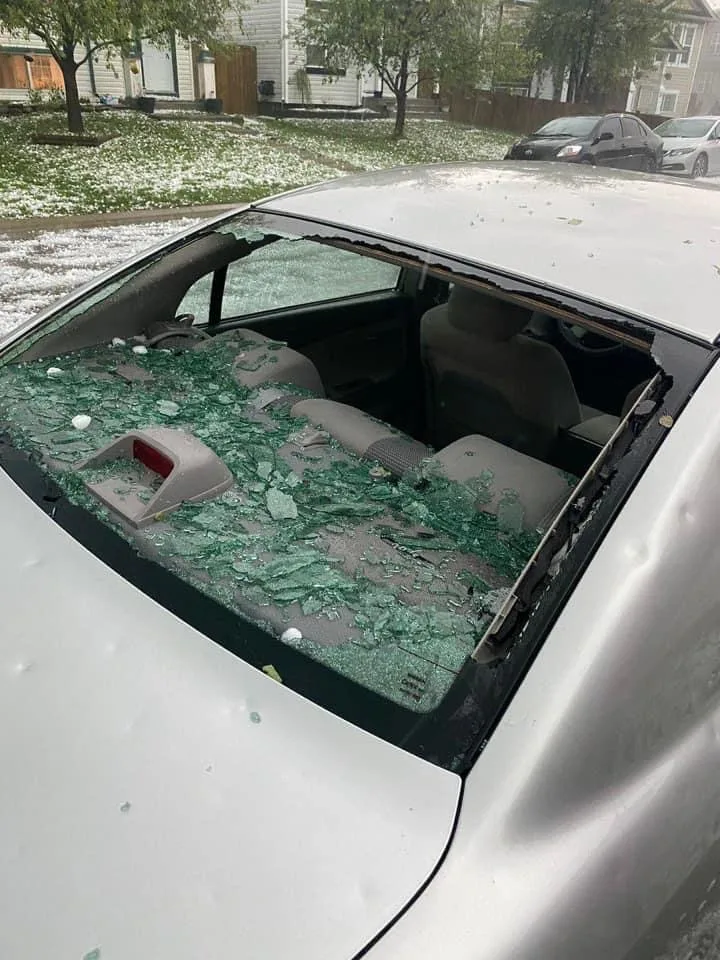
Image source: Wikimedia Commons / Simiprof
Hail is where PDR pricing changes shape entirely. Nobody counts individual dents after a storm. The work gets quoted per panel, and the panels roll up into a whole-vehicle job.
Here's what per-panel hail rates look like across our reviewed rate cards:
| Panel | Typical hail PDR rate | Why it lands there |
|---|---|---|
| Door | $75 to $150 | Easiest access through the window cavity |
| Hood | $100 to $200 | Large flat skin, glue pulling works well |
| Trunk lid or tailgate | $100 to $200 | Moderate bracing, decent access |
| Roof | $150 to $250 | Headliner removal, structural ribs |
| Quarter panel | $150 to $250 | Double walls near the wheel arch |
Whole-vehicle numbers follow damage density. Light hail, meaning a few dents per panel, usually lands between $1,000 and $2,000. Moderate storms run $2,000 to $3,500.
Severe events with dents the size of golf balls can push past $5,000, and on an older car that can approach the vehicle's actual cash value, which is when insurers start talking total loss.
Geography drives the calendar. Hail Alley, roughly the stretch from Dallas-Fort Worth up through Oklahoma, Kansas, Nebraska, and the Colorado Front Range, gets hammered between April and June. Aggregate shop reports from those markets show wait times stretching from days to several weeks right after a major storm.
That's also when catastrophe response teams, called CAT teams, flood in. They're volume operations set up by insurers and large PDR companies, and they cut both ways. You get faster scheduling and per-panel rates tuned for storm volume, but you also get varying experience levels, since crews are assembled fast and subcontracted heavily.
What to do in the first 48 hours after a storm:
- Photograph every panel from multiple angles, with date stamps on
- Get two written estimates before the adjuster visit if you can
- Ask each shop whether they handle insurance supplements directly
- Confirm whether your repair is guaranteed in writing
Two practical storm notes worth the space. Truck owners who keep a covered bed have one less hail-catching surface to worry about, which matters when panels are being counted. And hail chews up wiper arms and blades along with the metal, so if yours took a beating, getting the right blade length for your specific model saves a frustrating return trip to the parts counter.
Windshields are separate from all of this. Cracked glass is a glass claim, not PDR work, so don't let anyone bundle it into a dent estimate expecting metal-repair pricing.
Mobile Tech vs. PDR Shop vs. Dealership: What Each Channel Charges
The same dent can carry three different price tags depending on where you book it. Here's the channel map:
| Channel | Door ding price | Trip fee | Best fit |
|---|---|---|---|
| Mobile tech | $100 to $175 | $25 to $75 | Busy schedules, multiple dents, multiple cars |
| Fixed PDR shop | $75 to $150 | None | Big or complex jobs, tight budgets |
| Dealership | $150 to $300 | None | Convenience, lease paperwork, bundled service |
Mobile pricing makes sense once you see the overhead. You're paying for windshield time, fuel, and the fact that the tech can only book so many stops in a day. Where mobile clearly wins is volume at your location.
Three dings on your car plus two on your spouse's, at one address, and the trip fee amortizes across everything.
Shops run cheaper per dent for a simple reason. No travel overhead, and better working conditions. A fixed shop has bench lighting, LED light boards that show every wave in the reflection, and room to pull panels properly.
Roof work and quarter-panel work almost always come out cheaper at a shop than mobile.
The dealership channel deserves blunt treatment. Most service departments don't employ a PDR tech. They call the same independent techs you could call yourself, then add 30 to 100 percent for handling the arrangement.
You're paying for the service-drive experience and the paperwork trail, not for better hands.
Lease turn-ins are the one scenario where that markup occasionally earns its keep, because the dealer handles the inspection side too. Even then, get your own independent quote first. Knowing the real number changes the conversation.
Quality lives with the tech, not the channel. The same person might work all three routes in the same month. Ask any provider for before-and-after photos of similar repairs, and judge the hands, not the building.
PDR vs. Body Shop vs. DIY Glue-Pull Kit: The Full Cost Comparison
Here's the full decision table for a typical 2-inch door ding on a steel door:
| PDR | Body shop | DIY glue kit | |
|---|---|---|---|
| Cost | $125 to $175 | $500 to $1,000+ | $30 to $100 |
| Time on the car | Under an hour | 2 to 5 days | An afternoon, hopefully |
| Factory paint | Kept intact | Repainted | At risk |
| Skill required | Professional | Professional | Yours |
| Record on history reports | None | Repair entry appears | None |
| Best for | Intact paint, sharp metal | Cracked paint, torn metal | Shallow dents on beater cars |
What a Body Shop Charges for the Same Dent
A body shop quote for that ding starts around $500 and climbs. The labor includes straightening, filler, sanding, primer, color, and clear. Materials alone for a blended panel can run $150 to $300 before anyone picks up a tool.
Paint matching is where costs balloon. Even a good shop rarely repaints just the damaged panel, because factory color shifts with age and a fresh panel next to faded ones looks wrong. The standard fix is blending color into the adjacent panels, which means more refinished area, more materials, and more labor.
Then comes time. Two to five days in the shop is normal, which means rental car costs or ride-share fares that never show up in the quote. The repair also lands on vehicle history reports, which matters at trade-in.
Paintless work leaves no such record because nothing was reported to insurers or databases.
The body shop is still the right call sometimes. If the clear coat is cracked, the metal is stretched into a fold, or a previous repaint is already failing, no amount of PDR skill fixes it. Refinishing is the honest answer there, and that's fine.
What a DIY Kit Can and Cannot Actually Fix
A $30 to $100 glue-pull kit gets you a hot glue gun, pulling tabs, a bridge or slide puller, and a knockdown. The ceiling on those tools is lower than the packaging suggests.
What kits genuinely handle: shallow dents with soft, rounded edges, bigger than a half dollar, sitting on a flat area of panel, well away from body lines and panel edges, with intact factory paint. That's a narrow window, and it's real.
What kits fail on: creases, anything crossing a body line, dents near panel edges or braces, aluminum panels, and anything deep enough to have stretched the metal. Glue tabs pull on the surface, and surface pulling can't reshape a fold line.
The failure modes cost more than the kit. Pulling glue off a panel can take clear coat with it, especially on any previously repainted area. Over-pulling creates high spots that need a knockdown, and without a proper reflected-light setup, you can't see the waves you're creating.
A panel you've turned wavy is harder for a pro to finish than one you left alone.
Run the honest economics before you open the box. A botched pull that cracks the paint converts a $125 professional job into an $800 refinishing bill. In our review of owner-reported outcomes, the kit route pays off mainly on practice panels and cars where perfection was never the goal.
Insurance and Deductible Math: When to File a Claim, When to Pay Cash
Hail damage runs through comprehensive coverage, not collision. Your deductible, typically $100 to $1,000, comes off the top of any payout, and that number decides the whole strategy.
The core math takes one minute. If the repair bill is smaller than your deductible, the insurer pays nothing and you've still filed a claim. A $350 hail repair against a $500 deductible gets you a $0 check and a permanent record of the call.
That record part matters more than most people realize. A comprehensive hail claim usually isn't surcharged like an at-fault crash, so a single legitimate claim is generally safe. But claims live in shared databases that insurers check at renewal and when you switch carriers, and a pattern of small claims can affect your terms.
Your state's insurance department sets the claim-handling rules in your market, and the National Association of Insurance Commissioners keeps a directory of every regulator if you need to escalate a dispute.
When Filing a Hail Claim Wins
File when the damage is genuinely multi-panel and the bill clears your deductible by a wide margin. A roof plus both quarter panels routinely quotes $1,500 to $3,000, and against a $250 or $500 deductible, the claim does its job.
Claims also unlock the supplement process. That's the mechanism where the tech finds hidden damage mid-repair, documents it with photos, and the adjuster approves additional payment without a new claim. It's the standard flow for hail work, and it protects you from eating surprise costs on a storm you didn't cause.
If you carry rental reimbursement coverage, a claim covers your transportation during a multi-day repair. That benefit alone can be worth a few hundred dollars on a big job, and it's already part of what you've been paying for.
Timing counts with insurers. File promptly after the storm, document everything with date-stamped photos, and keep the estimate from your chosen shop. Claims filed weeks after the event draw more scrutiny and slower handling.
When Paying Out of Pocket Wins
Pay cash whenever the bill sits under your deductible, or barely above it. The gap between a $600 repair and a $500 deductible is a $100 payout, and that trade isn't worth a claims-history entry for most people.
Selling or trading soon tilts the math toward cash too. Paintless work leaves factory paint in place and no report trail, which is exactly the story you want to tell a buyer or an appraiser. A filed claim, even a paid-out one, raises questions you'd rather not answer at the negotiation.
Lease turn-ins are the strongest cash case of all. Lease companies commonly charge $150 to $500 per panel in reconditioning fees at inspection. A local PDR tech doing the same work before your return date often bills half that, and the inspection finds nothing to charge.
Compare the two numbers before you hand the keys back, because the lease company's fee schedule rarely works in your favor.
When PDR Stops Being an Option: Cracked Paint, Sharp Creases, and Plastic Bumpers
PDR fails on paint, not on metal. Almost any dent can be pushed or pulled back into shape. What can't be undone is a clear coat that has already fractured, and that's the line where a $150 dent becomes a $900 refinishing job.
The quick field test takes ten seconds. Run a fingernail across the dent edge, gently. If the nail catches on a fine crack radiating outward, the paint has failed and PDR is off the table.
If the surface feels smooth and slightly wavy, you're probably still in PDR territory.
| Condition | PDR viable? | What it actually needs | Cost to expect |
|---|---|---|---|
| Intact paint, soft rounded edges | Yes | Standard push or glue pull | $75 to $300 |
| Dent crossing a body line | Usually, at a premium | Two-direction work plus line restoration | $250 to $600 |
| Clear coat spiderwebbed at the dent edge | No | Panel refinish with color blend | $500 to $1,000+ |
| Chalky white or stretched paint | Borderline | PDR plus touch-up, or refinish | $200 to $900 |
| Plastic bumper cover | No | Refinish or replacement | $300 to $1,200 |
| Previous body filler underneath | No | Body shop metal and paint work | $600 to $1,500+ |
| Rust bubbles under the paint | No | Cut, weld, refinish | $800 to $2,000+ |
| Torn, perforated, or creased metal | No | Panel replacement | $700 to $1,400+ |
| Dent at a door edge or hem flange | Often no | Edge work, sometimes replacement | $250 to $800 |
A paint depth gauge settles most arguments. Factory finishes typically read around 4 to 6 mils total. A repainted panel jumps to 8 to 12 mils, and filler pushes the reading far higher.
A tech who checks before quoting is protecting both of you.
Repainted panels are the quiet risk. Aftermarket paint cures harder and more brittle than factory paint, especially on a budget respray. PDR can still work there, but the margin for error shrinks and a careful tech will say so before they start.
Drilling access holes is where owners get burned. Most automakers publish position statements on where holes may be drilled and which zones are off limits, usually structural rails, corrosion-protected cavities, and anything near a seatbelt anchor. A hole in the wrong place can void a corrosion warranty.
If a hole is drilled, it needs a proper gasket plug and cavity wax, not tape.
Sharp creases sitting on a fold line are the craft ceiling. Pushing one direction raises the crown, pushing the other deepens the valley. The tech has to work both sides in stages, and a wrong move cracks the paint along the fold.
That's why crease quotes run two to three times a basic ding.
Panel edges deserve a mention too. The last inch or two of a door or fender is double thickness from the hem flange, so there's nothing to push against. Dents there often can't be repaired cleanly, no matter who's holding the rod.
One more scenario, and it's the expensive one. If the repair estimate climbs close to a large share of the vehicle's actual cash value, insurers start treating the car as a total loss. On a older vehicle with a full hail pattern, that math can end the conversation before the repair starts.
If the paint is intact and the metal isn't folded, PDR almost always wins on cost. If the paint has already failed, price the refinish before you agree to anything. Guessing here costs real money.
Mistakes That Inflate Your PDR Bill
Most overpriced PDR bills come from the owner's side of the transaction, not the tech's. Here are the ones we see reported most often.
- Booking one dent at a time instead of batching the whole car
- Accepting a verbal number over the phone with no breakdown
- Forgetting to ask about the minimum service charge and trip fee
- Letting a friend with a glue kit "have a go" first
- Detailing the car before the repair, then paying twice for the wash
- Filing an insurance claim worth less than the deductible
- Choosing a provider on price alone with no before-and-after photos
- Skipping the written warranty conversation
The DIY attempt deserves its own warning. Once someone has pulled glue off a panel and lifted the clear coat, the job changes category. A $150 dent turns into a $700 refinish, and no tech can rewind that.
Dealership Markup and Lease Turn-In Fees
Dealer pricing runs 30 to 100 percent above what the same tech charges direct. That's not a scam, it's a convenience fee. You're paying the service department to find the vendor, schedule it, and hand you a clean car and a receipt.
Lease returns are the sharpest version of this. Lessors publish excess wear guidelines in your contract, and reconditioning charges commonly land between $150 and $500 per panel. Those are their rate card, not market rates.
Order of operations decides who pays. Get an independent quote before your return date, fix the obvious dents, and let the inspection find nothing. If you've already received the inspection report, read the dispute window in your lease terms.
Most lessors allow time to repair independently and re-submit.
Ask one question when you shop: "What's your all-in number, including any trip or minimum charge?" Anything vague there is a markup waiting to happen.
Storm-Chaser Risk During Hail Season
Legitimate catastrophe teams do good work and get booked fast. The problem is the other ones, the crews with out-of-state plates, a pop-up tent in a strip mall, and a deposit request before they've touched the car.
The failure pattern is predictable. They collect deposits, work fast and cheap, and disappear when the paint fails two months later. Since there's no local address, the warranty has nowhere to be honored.
Screen them like a contractor:
- Ask for a permanent business address, not a hotel
- Request a certificate of general liability insurance
- Get the workmanship warranty in writing before work starts
- Confirm whether they're on your insurer's approved repairer list
- Refuse to sign an assignment of benefits handing over your claim
That last one matters. Signing away claim rights to a repair vendor is a documented source of consumer complaints after major storms, and state insurance regulators have flagged it repeatedly.
How to Get an Accurate Quote Before Anyone Touches Your Car
Send photos, panel details, metal type, and paint condition, then ask for a firm range in writing. That's the whole method. A tech who can see the dent properly gives you a real number, and you avoid the awkward surprise when the quote doubles at the curb.
Follow these steps in order:
- Count every dent and note which panel each one sits on
- Photograph each dent straight on, with a coin for scale
- Shoot a low-angle frame with a bright light to show paint condition
- Check the door jamb sticker or manual for body material notes
- Disclose any prior bodywork or repaint, even if it looks perfect
- Ask which pricing unit they use: per dent, per panel, or per job
- Request the all-in figure with trip fee and minimum included
- Get it in a text or email you can keep
What to Send the Tech Up Front
Accuracy comes from the photos, so shoot them like the tech is standing there. Four frames cover almost everything.
| Photo | How to shoot it | What it tells the tech |
|---|---|---|
| Straight-on with a scale | Phone level with the dent, coin beside it | Size tier and depth estimate |
| Reflected light | Bright LED or sun line across the panel | Paint waves, sharpness, high spots |
| Wide shot | Two or three feet back, whole panel visible | Location, trim, access route |
| Jamb or VIN sticker | Clear shot of the body material or paint code | Aluminum vs steel, color match |
Add three facts in your message: year, make, and model. Mention if it's a lease, if insurance is involved, and whether the car has ever been repainted. Techs price differently when a deadline exists.
Red Flags in a PDR Estimate
Walk away from these, every time.
- No written estimate, or a number that changes when you arrive
- A full upfront payment demand for a single dent
- No before-and-after photos of comparable work
- Drilling access holes offered as the first option, not the last
- A warranty described verbally with nothing in writing
- Pressure to file a claim when the bill is under your deductible
- Prices far below every other quote in your area with fees added later
One legal note worth knowing. Many states require a written estimate on request for auto repair work, and some require a signed authorization before work begins. California's Bureau of Automotive Repair publishes clear rules on this, and most other states run similar consumer protection statutes through their attorney general or motor vehicle division.
Ask for the paper. It's your right in most markets.
PDR Pricing FAQs: Door Dings, Hail Claims, and Lease Returns
Does paintless dent repair cost less than my insurance deductible?
Usually yes for a single dent. One door ding runs $75 to $175, and most comprehensive deductibles sit at $250 or $500. Paying cash keeps a claim off your record and often costs less than the deductible itself.
Hail jobs are the exception, since those bills routinely clear $1,500.
How much extra does an aluminum panel add to a PDR bill?
Expect 20 to 40 percent over the steel price. Aluminum springs back harder, work-hardens faster, and tolerates less heat, so the tech needs more passes and more glue-pull setup. A $150 steel door dent can quote at $200 to $250 on an aluminum hood, and some shops decline the work.
How much should I budget for lease return dents?
Budget about half of whatever the lessor's inspection report quotes. Lease companies commonly bill $150 to $500 per panel for reconditioning. An independent tech usually fixes the same dents for $75 to $175 each.
Get your own quote before the return date, and the inspection finds nothing to charge.
Can hail dents on a roof be fixed without dropping the headliner?
Sometimes. Many roofs leave enough gap between the skin and the headliner for a long rod, so light roof hail is often repaired without touching the interior. Heavier damage, or a roof with structural ribs and a sunroof frame, usually requires the headliner to come down, which adds labor.
Why is a dealership quote so much higher than an independent tech?
Dealers rarely staff a PDR tech. They subcontract the same independents you could call yourself, then add 30 to 100 percent for handling it. You're paying for the service drive, the paperwork trail, and sometimes a loaner.
Ask for an itemized breakdown, then price the work direct.
Is it worth fixing small dents before selling or trading in?
Yes, when the dents show up on a walkaround. A $150 repair can protect several hundred dollars at trade-in, because appraisers price cosmetic damage harshly. Skip it if the car is heading to auction, or if the repair costs more than the value bump you can realistically argue.
The Decision Guide: Matching the Repair Route to Your Dent, Budget, and Timeline
Start with the paint. That single check eliminates half the options before you spend a minute on pricing. Everything after it is arithmetic.
| Your situation | Route | Budget | Watch out for |
|---|---|---|---|
| One ding, intact paint, flat panel | Independent PDR tech | $75 to $175 | Minimum service charge |
| Five or more dings across the car | One batched mobile visit | $250 to $600 | Counted as clusters, not singles |
| Hail pattern on multiple panels | Insurance claim plus PDR shop | $1,000 to $3,500 | Deductible and supplement process |
| Cracked paint or a hard crease | Body shop refinish | $500 to $1,000+ | Blending into adjacent panels |
| Lease due in a month | Independent tech first, then inspection | $75 to $175 per dent | Lessor's per-panel rate card |
| Old car, shallow dents, low expectations | DIY glue kit | $30 to $100 | Clear coat damage risk |
| Aluminum hood or fender | Shop with aluminum experience | $200 to $500+ | Techs who quote steel prices |
Then walk the decision path in order:
- Is the paint intact and smooth to a fingernail? If no, get refinish quotes.
- Is the dent on plastic? If yes, skip PDR entirely.
- Count the dents and the panels they sit on. That's your pricing unit.
- Check the metal type. Aluminum and high-strength steel add 10 to 40 percent.
- Get two quotes using photos, and compare all-in numbers, not headline prices.
- Run the deductible math if hail is involved. Under the deductible means cash.
- Book everything in one visit, at one address, on one invoice.
Timeline is the last variable, and it's the one people underestimate. A single dent is a same-day fix, often under an hour. A full hail car is one to three days in a shop, longer during peak storm season when every bay is full.
One closing thought on where the money actually goes. PDR is cheap because it's fast and it keeps your factory finish. The moment you accept a repaint, you're paying for materials, blending, drying time, and a permanent entry on the car's history, which is a strange place to spend a few hundred extra dollars when a skilled tech could have pushed the metal back for a fraction of it.
If the budget is tight and the damage is cosmetic, spend it on the repair that protects the car's value, whether that's a dent, a set of tires, or the money you'd put toward more power.
