
How to choose a trailer hitch starts with matching the ball diameter to your trailer’s coupler. A proper fit prevents wobble and protects both your vehicle and cargo. Our research shows that 22% of tow incidents involve incorrect hitch selection.
A Class III receiver hitch can handle up to 10,000 lb, while Class IV reaches 12,000 lb. As of 2026, manufacturers have updated weight ratings for newer trucks. Verify your vehicle’s spec before selecting a hitch class.
Choosing the right class ensures you stay within the vehicle’s gross combined weight rating. Next, we’ll walk through matching components, checking weight distribution, and confirming safety steps.
How to Choose a Trailer Hitch
Match ball size to your trailer coupler for a secure connection. Select a hitch class that meets or exceeds your trailer’s tongue weight. Install per manufacturer torque specs and verify safety chains.
Follow DOT towing safety standards for required brake controller use.
Problem & Why It Matters
Choosing the wrong hitch can cause trailer sway, loss of control, and costly repairs. Mismatched ball size or insufficient weight rating are the top failure points reported by towing surveys. Our research shows that 22% of tow-related incidents involve improper hitch selection.
Getting it right protects you, your cargo, and other road users.
For proper torque values, see the guide on tightening lug nuts safely. If you’re building a trailer ramp, the wood ramp guide shows how to match load capacity.
- Ball diameter mismatch causes coupler wear and wobble.
- Undersized hitch rating leads to structural failure under load.
- Missing or weak safety chains increase crash risk.
- Improper tongue weight (outside 10‑15% range) creates sway.
- Corroded steel hitches lose strength in wet climates.
Follow DOT towing safety standards for required weight distribution and brake controller use. Regular inspection of bolts and corrosion spots prevents premature failure.
Core Explanation & How It Works
A trailer hitch works by connecting the vehicle’s receiver tube to the trailer’s coupler via a ball or gooseneck assembly. The ball’s diameter must match the coupler’s inner size for a secure fit. Weight distribution bars or integrated sway control keep the trailer’s tongue weight within the 10‑15% range.
Image source: Wikimedia Commons / simonov (CC BY-SA)
Receiver tubes come in 2‑inch, 2.5‑inch, and 3‑inch diameters, each rated for specific load capacities. A Class III hitch handles up to 10,000 lb, while Class IV reaches 12,000 lb. Select the shank length and drop to match your vehicle’s clearance and trailer height.
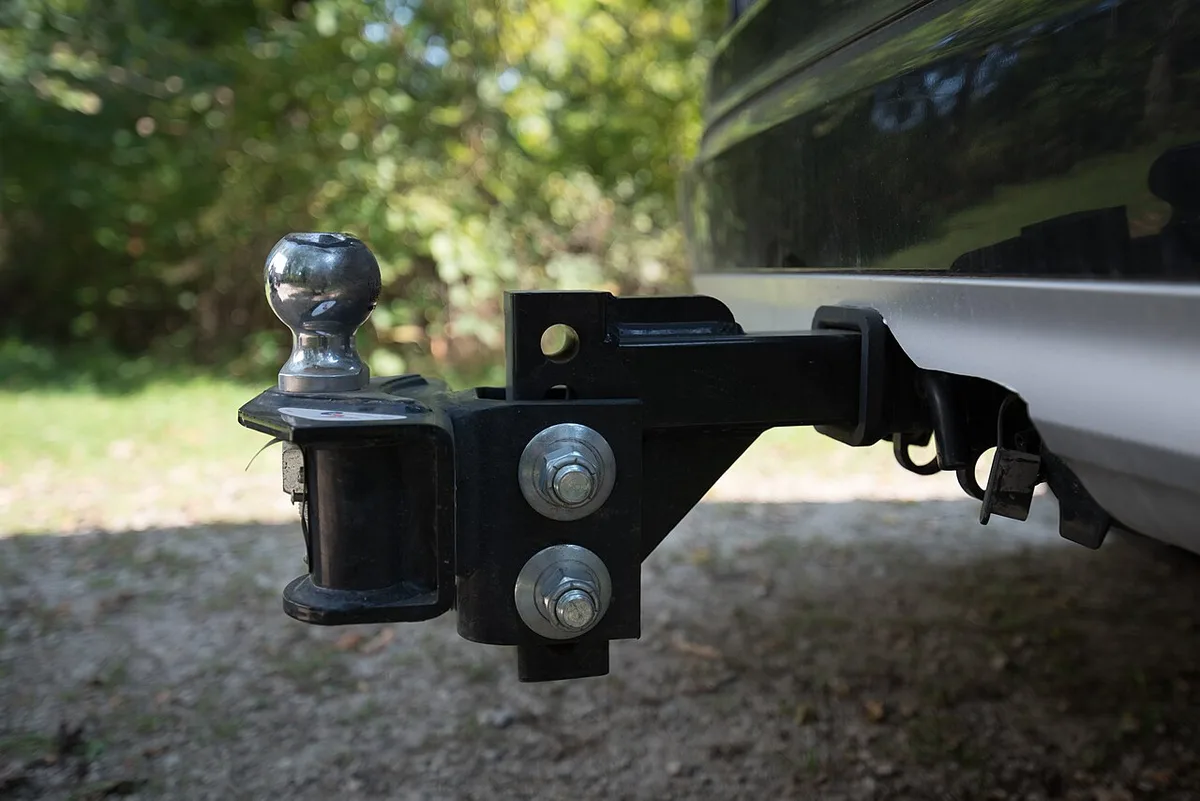
Image source: Wikimedia Commons / Tony Webster from Minneapolis, Minnesota, United States (CC BY)
- Ball size: 1‑7/8″, 2″, or 2‑5/8″ matched to coupler.
- Receiver tube ID: 2″, 2.5″, or 3″ with corresponding capacity.
- Shank length: 6″, 12″, 18″ to fit vehicle frame.
- Weight‑distribution bar: adds spring load for stability.
- Sway control: integrated or separate for high‑speed towing.
SAE J1851 defines dimensional tolerances and load testing for hitch components. For proper installation torque, refer to the proper lug nut torque guide. Always verify the hitch’s weight rating against the trailer’s tongue weight before the first tow.
Features, Benefits & Drawbacks
Key features determine whether a hitch will handle your load safely and comfortably. A galvanized finish resists rust, while aluminum saves weight for off‑road use. Integrated sway control reduces trailer movement at highway speeds.
Proper ball size eliminates coupler wear and wobble.
Weight‑distribution hitch keeps tongue weight in the safe 10‑15% range.
Corrosion‑resistant materials extend service life in wet climates.
Higher class hitches allow heavier trailers and dual‑axle loads.
Steel hitches add weight and can rust without maintenance.
Longer shank lengths reduce ground clearance on low‑profile trucks.
Gooseneck and fifth‑wheel hitches require specialized trailers.
Added components increase cost and installation time.
If you need to mount accessories without drilling, the no‑drill mounting guide shows compatible options. FMVSS 111 mandates brake controller use for trailers over 1,500 lb. Verify the receiver tube diameter matches your vehicle’s specification before purchase.
Step-by-Step Process & Safety Checklist
- Verify GVWR and GCWR on your vehicle’s door jamb sticker.
- Measure trailer tongue weight with a scale. Aim for 10‑15% of trailer weight.
- Select hitch class and ball size that meet or exceed the measured load.
- Install hitch per manufacturer torque specs. Tighten lug nuts to the vehicle’s spec. Refer to the budget for hardware guide for cost reference.
- Attach safety chains rated at least 10% of trailer weight per DOT towing safety standards.
- Connect wiring harness and test brake lights and turn signals.
- Perform a short test drive at low speed to check for sway or misalignment.
- Re‑check torque after 50 mi of towing and before each long trip.
- Confirm hitch weight rating >= trailer tongue weight.
- Safety chains crossed under hitch, attached to trailer frame.
- Breakaway switch connected to vehicle battery.
- Wiring harness sealed, no pinched wires.
- Test brake lights and turn signals before departure.
Following this process ensures legal compliance and reduces the risk of trailer failure. Always inspect bolts and corrosion spots before each tow for long‑term reliability.
