
A start-stop car is a different animal when the battery finally quits. If you want to know how to replace the battery in a car with start stop, the short version goes like this. You're fitting an AGM or EFB unit, not the cheap flooded battery from an older hatchback.
There's also a small sensor clamped to the negative post, and the car's computer expects to hear about the new battery. Get any of that wrong and you've spent $250 on a part that dies inside a year.
The wrench work is familiar. Negative cable off first, positive second, and reverse that on the way back in. What changed is the chemistry and the battery management system, which tracks charge and aging.
Manufacturer specs put terminal torque at 5 to 7 Nm, so a torque wrench earns its keep. Start with the money, because the wrong part is the expensive mistake.
How to Replace the Battery in a Car With Start Stop
Disconnect the negative cable first, then the positive. Lift the old battery out and note its group size. Fit an AGM or EFB battery of the same size.
Reconnect positive first, then negative. Register the new battery with a scan tool so charging stays correct.
Why the Wrong Battery (or the Wrong Install) Costs You Real Money
Start with the sticker shock. An AGM battery for a start-stop car runs about $150 to $350 as of 2026. An EFB sits closer to $120 to $220.
A plain flooded battery costs $90 to $150, and that gap tempts people into the wrong part.
Here's the catch. Start-stop cars live in a partial state of charge. The alternator backs off at every red light, then pushes current back in when you pull away.
Flooded batteries handle that cycle badly. They sulfate early and quit in 12 to 18 months, while a proper AGM goes 4 to 6 years.
Then there's battery registration. The battery management system counts amp-hours in and out. Drop in a fresh battery without telling it, and it keeps charging on the old battery's aging profile.
You end up with chronic undercharging and a part that never reaches full health.
Our research across owner forums and shop write-ups keeps circling the same two failures: wrong chemistry and skipped registration. Both look perfect on day one. Both show up as a dead car on a cold morning two winters later.
The DIY math is still good. You skip $100 to $250 in labor and get a $10 to $30 core credit back. That only works if the part and the procedure are right.
AGM, EFB, or Flooded: What a Start-Stop Car Actually Needs
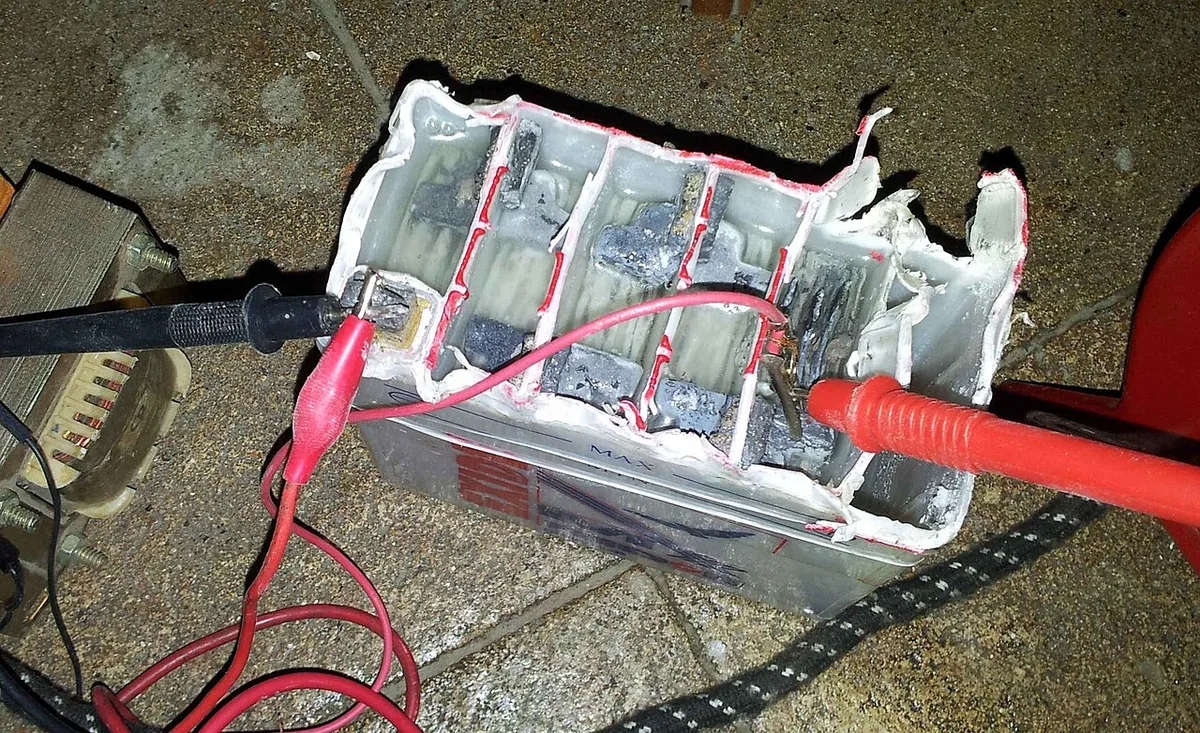
Image source: Wikimedia Commons / Sakar.solanki (CC BY-SA)
Three chemistries show up in this conversation. Only two of them belong under the hood of a start-stop car.
| Chemistry | Cycle tolerance | Typical price | Realistic life |
|---|---|---|---|
| AGM | High | $150 to $350 | 4 to 6 years |
| EFB | Moderate | $120 to $220 | 3 to 5 years |
| Flooded | Low | $90 to $150 | 12 to 18 months |
EFB is the budget middle ground. It's the factory fit on plenty of smaller European cars, and swapping to AGM is fine as long as the price doesn't scare you.
Reading the label and group size before you buy anything
Your old battery tells you almost everything you need. Check the group size (H6/LN3, H7/LN4, 94R), the cold cranking amp figure, and the amp-hour rating. Group sizes follow Battery Council International definitions, so an H6 case fits any H6 tray.
If the label is faded, measure the case and the tray with a tape before you order.
Match or beat the original cold cranking amps. Never go below. Extra CCA buys cranking margin in a cold snap and nothing else.
Why a plain flooded battery dies in 12 to 18 months
A flooded battery is happiest sitting at full charge. The start-stop cycle parks it around 70 to 80 percent instead, and that's where lead sulfate hardens onto the plates. AGM survives it because the glass mat presses acid against the plates and accepts charge faster.
The Parts You'll Touch and the Ones People Miss
Four things come off or go back on beyond the two cables. Miss one and the job isn't done.
- Hold-down clamp and tray bolt. The battery weighs 40 to 60 pounds, and a loose clamp lets it slide toward the fan or the hood.
- Vent tube. Sealed batteries still vent. Route the tube through the factory grommet, or gas and acid mist end up in the cabin.
- IBS sensor on the negative post. That small shunt reads current, voltage, and temperature. It goes back on the post it came from.
- Terminal clamps. Torque them to 5 to 7 Nm. Tight enough to hold, loose enough not to crack a post.
If your car uses push-button start systems, keep the fob well away from the cabin while you work. You don't want the car waking up mid-job. Extra grounds from added electrical accessories can also skew what that sensor reads.
Cars where the battery hides under the seat or in the trunk
Plenty of European models put the battery under the rear seat, in the trunk floor, or behind a trim panel. Under-seat jobs put airbag connectors within inches of your wrench. Disconnect power and wait before you unbolt a seat rail.
Trunk-mounted batteries still need the vent tube routed out through a floor grommet.
Step-by-Step: Swapping the Battery Without Waking Up the Wrong Module
Image source: Wikimedia Commons / User:trnsz (CC BY-SA)
Before you touch a terminal: sleep mode, memory saver, and the negative-first rule
Park on level ground and shut everything off. Move the key fob out of range and give the modules 2 to 10 minutes to sleep. Plug a memory saver into the OBD-II port or the 12V socket to keep radio codes, the clock, and window positions alive.
Removal, tray cleanup, and neutralizing corrosion
Loosen the negative clamp first, then the positive. Tuck the negative cable away so it can't swing back onto the post. Remove the hold-down, the vent tube, and the IBS lead, then lift the battery with a strap.
Scrub the tray with baking soda and water, rinse, and let it dry.
Install, reconnect, and torque to 5 to 7 Nm
Set the new battery in the same orientation as the old one. Positive cable first, then negative, then the hold-down, then the vent tube, then the IBS lead. Torque both clamps to 5 to 7 Nm and give each one a firm tug.
Registering the new battery to the BMS (and what happens if you skip it)
This is the step people skip. Registration tells the charging system the battery is new and resets the aging counters. Without it, the car keeps charging to the old profile.
A capable scan tool handles it in a minute or two. Some brands also want the BEM code printed on the battery case.
Mistakes That Fry Modules, Batteries, and Warranty Claims
Reverse polarity, over-tightened posts, and jump-starting a start-stop car
Hooking the cables up backward sends current through the main fuse and, on bad days, into the ECU.
Over-tightening cracks a post or strips a clamp bolt, and that terminal never sits flat again.
Jump-starting is the quieter risk. A flat start-stop battery can pull a big surge, and a cheap jump pack without an AGM-safe boost mode stresses the sensor. Use a proper boost mode, and follow the sulfuric acid and lead handling guidance that applies to any lead-acid work.
Why start-stop still won't engage after a fresh battery
Nine times out of ten it's registration or a state-of-charge relearn. The system wants the battery above roughly 70 percent, the engine warm, and the cabin at a sane temperature before idle-stop arms. A weak IBS reading or a parasitic draw keeps it off too.
Don't blame the battery for everything. If the engine cranks but won't catch, look at an engine that isn't getting spark. If the plugs come out wet, you've found other faults that mimic a weak battery.
Skipping registration can also complicate a warranty claim, since some brands ask for proof it was done.
Costs, Lifespan, and What You Actually Save Doing It Yourself
The numbers line up fast. A shop charges $100 to $250 in labor on top of the part, and dealer rates sit at the top of that range. Do the swap yourself and the same money buys a better battery instead of paying someone to turn a wrench.
| Route | Typical out the door |
|---|---|
| Dealer, AGM fitted | $350 to $500 |
| Independent shop | $250 to $400 |
| DIY with a good AGM | $150 to $350 |
| Core credit back | $10 to $30 |
Lifespan depends far more on chemistry and climate than on brand name. AGM units typically deliver 4 to 6 years in mild conditions. In Arizona or Texas heat, expect 2 to 3 years instead, because heat kills a battery faster than cold ever does.
Your driving pattern matters just as much. Short stop-and-go trips never let the alternator finish the job, so the battery spends most of its life below full charge. Rideshare and delivery drivers can halve normal service life that way without realizing it.
The savings only hold if you keep the car a while. A registered AGM that lasts five years costs roughly $50 a year. A flooded battery replaced every 18 months at $120 runs higher than that, and it strands you twice as often.
Even the small hardware adds up less than people expect, similar to the way lug nut prices stay modest next to the parts they hold on.
Safety, Recycling, and When to Hand It to a Shop
Hydrogen, sulfuric acid, and airbag precautions
A lead-acid battery vents hydrogen while it charges, and hydrogen plus a spark is a bad afternoon. No smoking, no grinding nearby, and keep the area aired out while you work.
Sulfuric acid burns skin and eyes. Wear glasses and nitrile gloves, and keep baking soda within reach to neutralize a spill before it reaches paint or concrete.
The jobs that genuinely aren't worth DIYing
Under-seat batteries on cars with side airbags are the big one. You're working inches from SRS connectors and seat bolts with torque values that matter in a crash. Hand that job to a shop unless you're comfortable with the procedure.
Registration on some European models needs factory software, not a generic tool. If your scanner can't reach the BMS module, that's a dealer visit, and it's cheaper than a bricked module.
Recycling isn't optional, either. Lead-acid batteries carry a core charge in nearly every state, and the national recycling rate sits above 98 percent. Give the old one back where you bought it.
You don't need to lift the car for any of this, so skip the homemade ramp project entirely. Level ground is all the access you need.
Frequently Asked Questions
Can I put a regular battery in a start-stop car?
Technically it fits, and that's the trap. A flooded battery can't handle the constant partial charging a start-stop system creates. Expect sulfation and failure within 12 to 18 months.
The $100 you save up front disappears the first morning it leaves you stranded.
Do I have to register a new battery?
On most start-stop cars, yes. Registration resets the battery management system so it charges on a fresh profile instead of the old battery's aging curve. Skip it and you risk chronic undercharging, a short life, and a warranty argument.
Some brands also want the BEM code.
How long does the swap take?
Plan on 30 to 45 minutes for a battery under the hood. Add 15 to 30 minutes if it lives under a seat or in the trunk. Registration takes a couple of minutes with the right scan tool.
Give the modules 2 to 10 minutes to sleep before you disconnect anything.
Will start-stop work right after a new battery?
Not always, and that's normal. The system wants the battery above roughly 70 percent charge, the engine warm, and the cabin near its set temperature. Drive it for a day or two first.
If idle-stop still won't arm, check registration and hunt for a parasitic draw.
Can I jump-start a car with start-stop?
Yes, but do it properly. Use a jump pack with an AGM-safe boost mode, or follow the terminal order printed in your owner's manual. Don't boost with the dead car's engine running.
Then drive 20 to 30 minutes so the alternator can put a real charge back in.
