
Your car starts fine, but the clock is wrong, the radio reads SAFE, and one window is frozen halfway down. Learning how to reset a car after replacing the battery is really about figuring out which systems lost their memory, not hunting for one magic button. A battery swap cuts power to dozens of modules, and each one wakes up with a different kind of amnesia.
Manufacturer specs confirm the mechanical part is easy. Terminal torque is usually 8 to 10 Nm (70 to 90 in-lb), and a healthy battery should rest around 12.6 volts. The trouble starts after the reconnect, when the car quietly decides what to forget and what to relearn.
How to Reset a Car After Replacing the Battery
First, find out whether your car registers its battery. Cars with smart charging need scan-tool registration. Then run the relearns your vehicle actually uses.
That covers idle, windows, steering, and radio codes. Drive 20 to 30 minutes, then rescan.
Why Your Car Acts Weird After a Battery Swap, and Why Reset Means Five Different Things
What Actually Lost Power
Every module holds keep-alive memory (KAM), a small store of learned values that survives key-off but not a cable pull. The engine computer forgets its idle trim. The transmission forgets shift adaptives.
The steering angle sensor forgets where straight ahead was.
Then there's the battery itself. Cars with an Intelligent Battery Sensor (IBS) on the negative cable track state of charge, age, and charging profile. Fit a fresh battery and the car keeps charging it like the old, tired one.
That's how a brand-new AGM dies years early.
The 30-Second Rule: Reset, Relearn, or Nothing
Before you touch a thing, ask one question. What kind of car is this? A 2004 Corolla with crank windows and a knob radio has nothing to relearn.
A 2019 BMW has a battery to register and a dozen modules to settle.
| What you're resetting | What it holds | Symptom when lost |
|---|---|---|
| Battery registration | Charging profile, age, Ah rating | Overcharging, short battery life |
| Idle and throttle adaptives | Learned airflow at idle | Rough or hunting idle |
| Steering angle zero | Straight-ahead reference | Traction and ABS lights |
| Anti-theft pairing | Radio and key handshakes | SAFE display, no-crank |
| Window and sunroof limits | Pinch-protection travel stops | Window stuck or refusing auto-up |
One caveat: persistent rough running after a swap is usually a relearn, but not always. Stubborn roughness can trace back to oil-fouled plugs that were there before the battery died.
Before You Disconnect: The 10-Minute Setup That Prevents Most Headaches

Image source: Wikimedia Commons / Unknown authorUnknown author
Do this while the old battery still has enough juice to keep modules awake.
Memory Saver Goes On Before, Not After
A memory saver is a 12V feed that plugs into the OBD-II port and holds KAM alive during the swap. Plug it in first. Plug it in after you've pulled the negative cable and it does absolutely nothing.
No memory saver? A jump box clipped to the cables works on most cars.
Scan, Photograph, Write It Down
Read every stored and pending code before you start, then photograph the screen. Note the radio anti-theft code if your car uses one, because immobilizer pairing basics get awkward fast once a head unit locks itself. Jot down any aftermarket accessories on constant power too.
Chemistry, Group Size, and CCA Decide Whether Registration Is Mandatory
Check the label: AGM, EFB, or flooded lead-acid, plus BCI group size and cold cranking amps (CCA). Matching like for like keeps most cars happy. Upgrading from flooded to AGM usually makes registration non-negotiable.
Safety first, always. Rings off, glasses on, area ventilated. Lead-acid batteries vent hydrogen while charging, and federal battery handling guidance exists because people get hurt skipping this.
First Branch: Figure Out Which Kind of Car You're Standing In Front Of
Three groups. Pick yours and the rest of the job shrinks fast.
If It's Pre-CAN and Simple, There's Nothing to Do
Think mid-1990s and older, cable throttle, no body computer. Connect the cables, torque the terminals, set the clock, drive away. Genuinely that simple.
If It Has an IBS or a BMS, Register the Battery
Smart-charging cars include BMW, Mini, Audi, VW, Mercedes-Benz, Ford, Volvo, and Stellantis models. Quick tell: a small module clamped onto the negative cable means you have an IBS. Register with a scan tool, or use the maker's own key sequence if one exists.
Skip it and the charging strategy stays calibrated to a battery that's no longer there. Overcharge, heat, and an early failure follow.
If It Has Start-Stop, or It's a Hybrid or EV, Expect a Waiting Game
Auto start-stop only engages once a long list of conditions line up, so a dormant system right after a swap is normal. On hybrids and EVs, the small 12V auxiliary battery is completely separate from the traction pack. Its DC-DC converter charges it, and the car may need a full key cycle before everything settles.
The Reset Playbook, Branch by Branch
Run only what applies to your car. Registration comes first on anything with smart charging.
Battery Registration and BMS Reset: Scan Tool vs the Ford High-Beam Dance
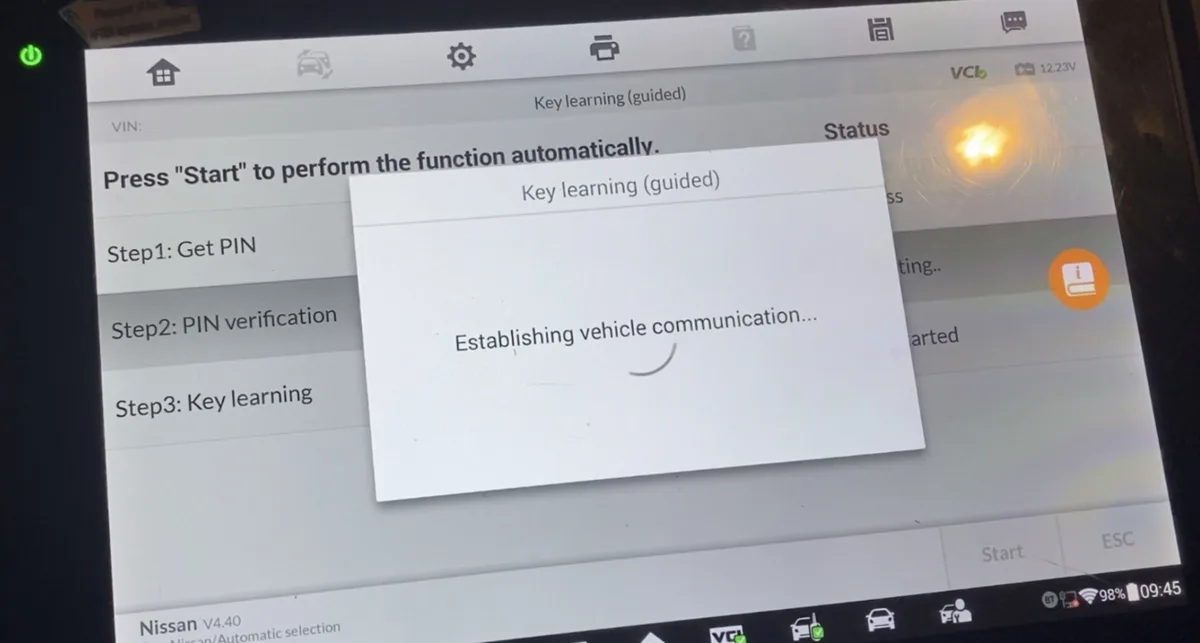
Image source: Wikimedia Commons / KennyMGarcia
Most European makes want a bidirectional scan tool that can write the battery's Ah rating, chemistry, and age back to the BMS. Ford and Lincoln have a free alternative on many models: ignition on, flash the high beams five times, press the brake three times, then watch for the battery light to blink. If it never blinks, check whether you simply have a dead high-beam bulb.
Idle and Throttle Relearn: The Park-and-Idle Routine
Key on, every accessory off. Start the engine and let it idle in park for 5 to 15 minutes. Then run another few minutes with the A/C on high.
Cable-throttle cars can skip this entirely.
Transmission Adaptives and the Drive Cycle
Give it 20 to 30 minutes of mixed speeds and gentle stops. Don't hammer the throttle. If shifts stay harsh after a week, wiped adaptives may not be the culprit, and fluid that's overdue is the better suspect.
Steering Angle, Windows, Sunroof, and TPMS
- Steering angle sensor: full lock left, full lock right, then a straight drive. Pay attention to centering the wheel on a quiet road.
- One-touch windows: hold the switch up through full close, keep holding 3 to 5 seconds, then repeat downward.
- Sunroof and liftgate: same principle, hold the button at the travel limit until it clicks or stops.
- TPMS: use a scan tool, or the car's own reset menu or button.
When a Key Dance Won't Cut It: Tools, Shops, and What It Really Costs
Code Reader vs Bidirectional Scan Tool vs Dealer Software
| Tool | Typical cost | What it can actually do |
|---|---|---|
| Basic code reader | $20 to $60 | Read and clear codes. No registration. |
| Phone app plus OBD-II dongle | $10 to $100 plus subscriptions | Live data, some resets, make-specific limits |
| Bidirectional scan tool | $150 to $500+ | Battery registration, SAS calibration, TPMS |
| Dealer or OEM software | Shop labor rates | Everything, including module programming |
Buying once beats paying twice if you own the car long term. Our breakdown of the tool tiers that matter covers which features justify the price jump.
DIY Registration vs Paying a Shop
Dealer registration commonly runs $150 to $250 as of 2026, and independent shops often charge about half that. Plenty of retailers install a battery free and quietly skip registration, which is exactly how people end up back at the counter a year later.
When the Symptom Isn't a Relearn at All
Sometimes the reset is fine and something else is wrong. A parasitic draw above roughly 50 mA, a corroded ground strap, or a broken IBS signal wire all mimic a failed relearn. Test those before you chase procedures.
Mistakes That Kill New Batteries and Trigger Phantom Codes
Registering the Wrong Chemistry Is Worse Than Not Registering
If you tell the car it has a flooded battery when you actually fitted an AGM, the charging strategy runs too hot for the chemistry. AGM plates don't tolerate that voltage profile. Not registering at all is a slow problem.
Registering the wrong type is a fast one.
Clearing Codes Instead of Fixing Them
Clearing a code wipes the evidence, not the fault. If a misfire or lean-condition code returns after a swap, the low-voltage event may have simply unmasked something that was already failing. Read the freeze-frame data before you clear anything.
Terminal Torque, Cable Order, and the Wrench Across the Posts
Negative off first, negative on last. Torque to roughly 8 to 10 Nm and check the hold-down clamp, because a loose battery rattles its internals to death. And never let a wrench bridge both posts.
That arc can cost you a module, not just a fuse.
Does Driving Really Reset Everything?
No. A 20 to 30 minute drive handles idle trim and transmission adaptives on many cars. It does nothing for battery registration, window limits, steering zero, or TPMS.
Treat driving as one step, not the whole fix.
What Done Looks Like: Verification, Timing, and Long-Term Care
The Three Voltage Checks Worth Doing
Measure at the battery with the engine off after a 30 minute drive. A healthy resting figure sits near 12.6V, and anything below 12.4V points to a charging or draw issue. Then check running voltage, usually 13.5 to 14.7V, and watch cranking voltage stay above roughly 9.6V.
Recheck the Hardware After a Week
Terminal clamps settle. A week of heat cycling loosens what felt solid on install day. Give both clamps a quick wiggle, confirm the hold-down is snug, and glance at the IBS connector on the negative cable if your car has one.
Confirming the Small Stuff Came Back
Start-stop should re-engage once coolant, cabin temperature, and state of charge all line up. Windows should complete a full auto-up cycle without reversing. If steering still pulls or feels vague after a lock-to-lock calibration, worn suspension and steering parts may be the honest answer.
Heat Kills Batteries Faster Than Cold
Cold reduces capacity and exposes a weak battery. Heat quietly destroys it. A battery that lasts five years in the UK may struggle past two in Arizona, and no amount of correct registration changes that.
Follow EPA guidance on lead-acid recycling when you retire one.
Frequently Asked Questions
Do I really need to reset my car after replacing the battery?
Only if your car has something to lose. Pre-CAN vehicles with cable throttles usually need nothing. Cars with smart charging, start-stop, one-touch windows, or a steering angle sensor do need registration and relearns.
Check for an IBS module on the negative cable as your first clue.
Can I drive with an unregistered battery, and for how long?
Yes, the car will start and run. The damage is slow. The BMS keeps applying the old battery's charging profile, so the new one gets overcharged, runs hot, and ages early.
Weeks won't strand you. Months could cost you the battery's service life.
Why is my radio locked and my window stuck half-open?
Both lost their stored memory. The radio is waiting for its anti-theft code, which is often in the owner's manual or a card in the glovebox. The window needs pinch-protection re-initialization: hold the switch up through full close, keep holding for 3 to 5 seconds, then repeat downward.
My start-stop stopped working after the swap. Is the battery bad?
Probably not. Auto start-stop needs a charged battery, a warm engine, a settled cabin temperature, and the right brake pressure. It often stays dormant for several drive cycles after a power loss.
Give it a week of normal driving before you suspect the battery.
Will skipping registration void my battery warranty?
It can, depending on the make. Some manufacturers specify battery registration as part of the replacement procedure, and a warranty claim may be questioned if the BMS was never updated. Keep your receipt, note the install date, and register within the first few drives.
