
Your dash lights flicker, the radio cuts out, and suddenly the steering goes heavy. If you've ever wondered what happens when a car battery dies while driving, here's the short version: the engine stops, and every assist system that makes the car feel normal stops with it. The good news is that it rarely happens without warning.
Most failures announce themselves a minute or two ahead.
The part most drivers get wrong is the cause. A battery that dies while the engine is running is almost always the victim, not the culprit. Per SAE J537 rating conventions, a healthy 12V battery sits near 12.6 volts at rest, and once charging stops you're living on reserve capacity alone.
What you do in the first ten seconds matters more than anything you do after you stop.
What Happens When a Car Battery Dies While Driving
When a car battery dies while driving, the engine stalls and assist systems fade. Your steering turns heavy and the brake pedal goes firm. Dash lights dim first, then warning icons stack up.
Coast to the shoulder and switch on your hazards. The battery is usually the victim, not the cause.
What Actually Dies First: Battery vs. Alternator When Your Car Quits at Speed
A battery that dies while the engine is running is usually the victim. The alternator, the belt-driven generator that charges the battery and powers the electronics, has either stopped charging or is charging weakly. The battery itself was fine.
It simply ran out of stored energy because nothing was putting energy back in.
That distinction matters because it changes what you hand over money for. Bolting a new battery onto a car with a dead alternator gets you a few miles and a second stall.
Battery vs. Charging System: How to Tell Them Apart
| Clue | Battery failed while parked | Charging failed while driving |
|---|---|---|
| When it quits | Won't crank, engine off | Quits at speed, engine running |
| Warning light | Often none before failure | Battery icon appears first |
| Restart after cooldown | Usually still dead | Often restarts, then dies again |
| Real fix | Battery replacement | Alternator, belt, or regulator |
If the engine cut out while you were moving and the battery light showed up first, suspect the charging system. If the car simply refused to crank one morning, the battery is the better bet. If it restarts after fifteen minutes of sitting and dies again a mile later, that's a charging failure in nearly every case our research turns up.
The Dashboard Warning Timeline: What Dimming Lights and Stacked Warning Icons Are Telling You
Voltage doesn't drop in a straight line. It sags in steps, and each step takes something on the dash with it.
A healthy car runs about 13.5 to 14.7 volts with the engine on. As the alternator fades, you'll see the headlights yellow and the blower motor slow. Around 12 volts, the radio may reboot on its own.
Below 10 volts, control modules start dropping offline.
That's when the dash lights up. ABS, airbag, traction control, and tire pressure warnings all fire together. Drivers often assume four separate failures.
In reality it's one low-voltage event tripping every module that needs a stable supply.
The order of the warnings is your diagnostic clue. A battery icon that shows a minute or two before the stall points at the charging system. Warning lights that appear only after the car has already quit point at a battery that couldn't hold a charge.
Dimming lights that brighten when you rev the engine are another charging-system signature. That's a belt or alternator problem, not a bulb on its way out, so the cost of a new bulb won't buy you anything here.
How Long You Have Once Charging Stops: Reserve Capacity, Load, and the Real Clock
Reserve capacity answers the question everyone asks after a stall. How far can I go?
It measures how many minutes a battery can supply 25 amps at 80°F before falling to 10.5 volts. Passenger-car batteries typically rate 90 to 130 minutes. That sounds generous.
Real-world runtime is shorter.
Your car is rarely pulling just 25 amps. Headlights, the rear defroster, and a set of wiper blades can add 40 to 60 amps between them. A wet night in January stacks all three at once.
Here's the practical translation, using as of 2026 manufacturer figures:
- Daylight, lights and wipers off: possibly 20 to 40 minutes of running
- Night driving with headlights: often 10 to 20 minutes
- Lights, defroster, and rain together: sometimes under 10 minutes
Treat those as rough bands, not promises. A battery already weak enough to be part of the problem has less to give than its label suggests. Assume minutes, not miles.
SAE International sets the rating conventions manufacturers work from, so the number on the case is a controlled test figure rather than a guess.
Losing Power Steering and Brake Assist Mid-Drive: The Safe Sequence for the First Ten Seconds
The first ten seconds are a steering and braking problem, not an engine problem.
When the engine stops, a belt-driven power steering pump stops with it. Electric power steering behaves differently, but the result feels similar: the wheel goes heavy. The brake booster loses its vacuum supply too, so the pedal goes hard and stopping distance grows.
Do this, in order:
- Keep both hands on the rim and accept the extra effort. Steering still works, just not easily.
- Press the brake early and firmly. A hard pedal needs more leg than you're used to.
- Signal, check the mirror, and aim for the shoulder or the next exit.
- Switch on your hazards before you stop, not after.
- Shift to neutral if you need to roll further, then park once you're clear.
Two things to avoid. Don't pump a firm brake pedal, because you're fighting a booster with nothing left to give. Don't kill the ignition and yank the key while rolling, since that can lock the column and disable the airbags.
How you hold the wheel matters more than usual here. A firm grip at nine and three gives you far more leverage with the assist gone than a lazy palm at twelve.
Coasting to a Stop and Getting Help: Shoulder Positioning, Hazard Lights, Move Over Laws, and When to Call a Tow
Getting off the road is half the job. Being seen while you're there is the other half.
Aim for the right shoulder, as far from the travel lane as the surface allows. If an exit ramp or parking lot is within coasting distance, take it. A car stopped on a ramp is dramatically safer than one stopped on a shoulder at 70 mph.
Turn the wheels away from traffic before you set the parking brake. If the car does get clipped or rolls, it moves away from the lane instead of into it.
Then work through this checklist:
- Hazards on, engine off
- Parking brake set
- Reflective triangle or flares behind the car if you carry them
- Everyone out through the door facing away from traffic
- Stand behind the barrier, never between the car and the lane
Move Over laws in most US states, summarized in NHTSA's roadside safety guidance, require approaching drivers to slow down or change lanes for a stopped vehicle showing hazards or warning devices. That protection only works if you're visible and positioned sensibly.
Call for help before you start diagnosing. If the car restarted after a cooldown, drive to the nearest shop rather than to your destination. If a tow is coming, tell the dispatcher whether the car rolls and steers, because a locked wheel or seized driveline changes how it gets loaded.
Point out the right tow point rather than letting the driver guess.
Restart Clues That Reveal the Culprit: Clicks, Slow Crank, Cooldown Restarts, and What a Jump Start Proves
The starter motor is the best diagnostic tool you own, and using it costs nothing.
Turn the key or push the button and listen. A brisk, normal-sounding crank that won't catch points away from the charging system and toward fuel or spark. In that case, a cautious shot of starter fluid can confirm whether the engine still has ignition at all.
| What you hear | What it usually means |
|---|---|
| Fast, healthy crank, no start | Fuel or ignition fault |
| One loud click | Low voltage, bad ground, or failed solenoid |
| Rapid chatter of clicks | Battery too flat to pull the solenoid in |
| Slow crank that perks up after a jump | Battery was deeply discharged |
Two clues carry more weight than the rest. A car that restarts after ten to fifteen minutes of cooling and dies again a mile later is showing the heat-soak failure signature of an alternator. The second clue is what a jump start does next.
If it fires, runs, and keeps running once the cables come off, the alternator is probably charging and the battery was the weak link. If it quits a few minutes after cable removal, you're running on borrowed electrons and shouldn't leave the lot.
One correction to a common assumption: jumping a car does not meaningfully recharge a flat battery. It borrows enough to crank. The battery still needs a proper charger, or a replacement if it's already old.
Testing It Yourself: Voltage, Load, and Ripple Checks That Confirm the Failure Before You Buy Parts
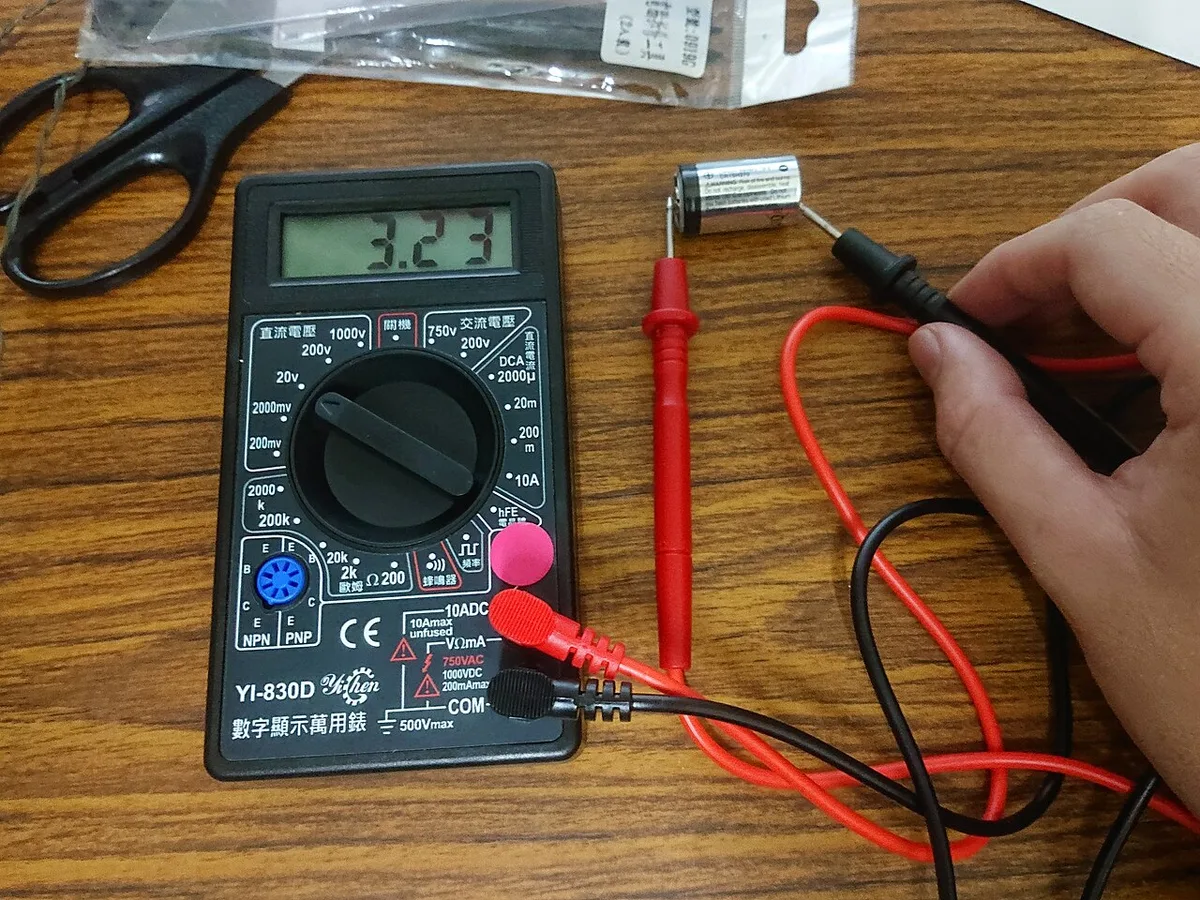
Image source: Wikimedia Commons / Jiazheng0609 (CC BY-SA)
Four readings settle almost every case, and a basic multimeter covers three of them.
- Resting voltage: engine off, lights off, an hour after the last drive. Expect about 12.6V. Near 12.0V means roughly a quarter charged.
- Cranking voltage: watch the meter while a helper cranks. It should stay above roughly 9.6V. A dip to 8V says the battery can't carry load.
- Running voltage: idle with accessories on, look for 13.5 to 14.7V. Smart-charging systems sit lower in short stretches, so blip the throttle and watch for the rise.
- AC ripple: switch the meter to AC volts across the terminals with the engine running. Above about 0.5V AC points at a failing diode.
A conductance tester reaches the same verdict as a load test without cooking the battery. Load testing means half the rated cold cranking amps for 15 seconds, holding above 9.6V at 70°F.
If charging codes such as P0562 or P0620 are stored, a scan tool that fits your budget pulls them in seconds. Codes confirm the circuit. They won't tell you whether the culprit is the alternator, the belt, or a corroded cable, so the meter still earns its keep.
Terminal Cleaning and the Cheap Fixes People Skip
Loose or corroded terminals imitate a dying battery better than most drivers expect. Look for white-green crust, swollen insulation, or a clamp you can twist by hand.
Disconnect the negative first, scrub posts and clamps with a battery brush, then apply a corrosion inhibitor and tighten to spec. Retest afterwards. Plenty of "dead battery" reports end right there, fixed for the price of a brush.
Parts, Prices, and Registration: What a Real Repair Costs and Why a New Battery Sometimes Won't Fix It
Prices move by region and vehicle, but the shape of the bill is predictable.
| Item | Typical US range (2026) |
|---|---|
| Battery, Group 35 or 24F, 500-700 CCA | $120-$300 |
| Alternator, installed | $300-$900+ |
| Serpentine belt and tensioner | $80-$250 |
| Charging-system diagnostic | $75-$150 |
| Tow | $75-$200 |
Two line items catch people out. The first is battery registration. On many BMW, VW/Audi, Ford, and GM vehicles, the battery management system tracks the age and capacity of the battery it was paired with.
Fit a new one without registering it and the charging strategy stays calibrated for the old unit, overcharging the replacement and shortening its life.
The second is parts matching. The wrong group size, too few cold cranking amps, or a flooded battery dropped into a vehicle that specifies AGM all lead to repeat failures. Match the label on the old battery rather than the price tag.
Then there's accessory load. If you've added auxiliary lighting or a winch, the alternator has to cover that draw at idle, not just at highway RPM. And if the car does get towed, point the driver at a proper recovery point instead of the first piece of metal they spot.
The rule stays simple: prove the charging system first, then decide whether the battery has earned retirement.
Frequently Asked Questions
Can you jump-start a car with a bad alternator?
Yes, but it only gets you moving. The donor battery supplies the crank, then your alternator has to carry the entire electrical load. If it has failed, the engine quits again within minutes.
Jump it to clear a live lane, not to drive home.
How far can you drive once the battery light comes on?
Usually a few miles, sometimes much less. You're on reserve capacity alone, and that shrinks fast under headlights, wipers, and the rear defroster. At night in the rain, think minutes rather than miles.
Aim for the nearest safe exit, not the nearest shop.
Does the engine really shut off completely?
Yes. The engine needs electricity for fuel delivery, ignition, and the modules running both. Once voltage collapses, it stalls.
It can also cut out with no stutter at all, which is why the change in steering and braking feels so abrupt.
Can you still steer and brake with the engine off?
Yes, both still work, just with more effort. Steering goes heavy without hydraulic or electric assist. The pedal firms up because the booster lost vacuum.
Steady hand placement on the rim gives you real leverage, so press early and firmly.
Is a battery that died while driving covered by warranty?
Often, partly. Most batteries carry a free-replacement window of 18 to 36 months, then prorate after that. Alternators usually fall under a separate parts warranty.
Keep the diagnostic receipt, since a claim may need proof the charging system was tested rather than guessed at.
