
A slipping gear, a shudder at 40 mph, a clunk when you drop it into drive. Most drivers wait until something feels catastrophic before they ask how to tell if your transmission is going bad. That wait gets expensive fast.
The gap between a $200 solenoid and a $4,000 rebuild is usually measured in months of ignored symptoms.
Manufacturer service tables generally put severe-service fluid changes somewhere between 30,000 and 60,000 miles, even when the same owner's manual brags about "lifetime fluid." In our research, heat does most of the damage. Normal automatic transmission fluid runs around 175 to 200°F, and sustained temperatures past 250°F cook it quickly. So let's start where it matters most: the symptoms that mean you shouldn't be driving at all.
How to Tell If Your Transmission Is Going Bad
Watch for slipping, delayed engagement, shuddering, or burnt-smelling fluid. A transmission that flares between gears or bangs into drive is worn. Dark fluid with grit in the pan confirms internal wear.
Any grinding or complete loss of drive means stop driving now. Otherwise, check fluid and codes before assuming the worst.
Stop Driving Now: The Symptoms That Mean Park It Today
Some failures give you warning. Others don't. These are the ones that mean the car sits until a shop looks at it.
- Grinding or metallic scraping that rises and falls with road speed. Hard parts are chewing themselves up, and every mile adds money to the bill.
- No engagement in any gear. The engine revs, the car doesn't move. That's a tow, not a test drive.
- Heavy slipping paired with a burnt smell. Slip makes heat, heat glazes the clutch packs, and glazed clutches slip harder.
- Fluid pouring out underneath. A rusted cooler line can empty the pan in seconds and leave you stranded.
- An overheat message or limp mode at highway speed. Sudden torque loss in traffic is a real crash risk.
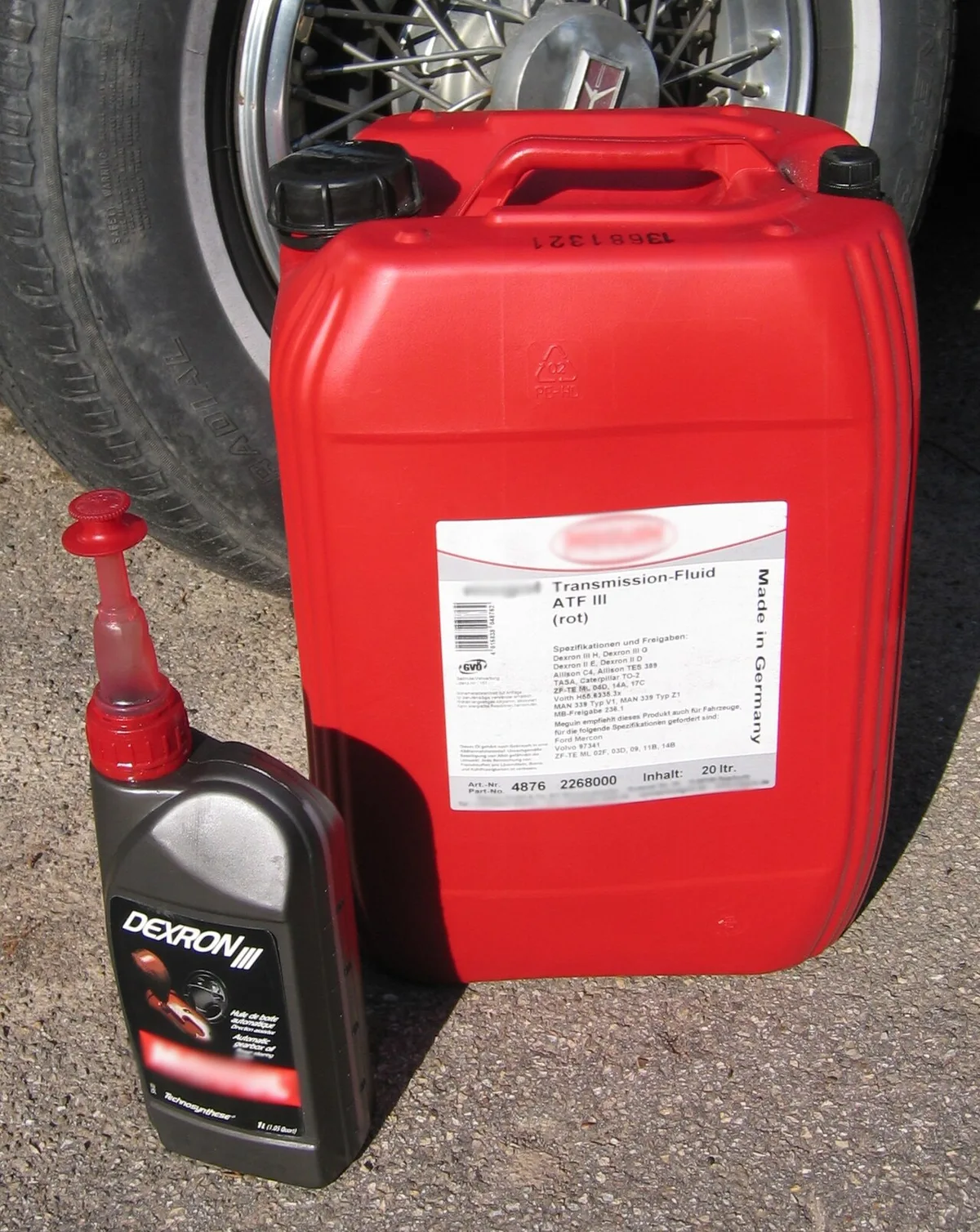
Image source: Wikimedia Commons / Hans Haase (CC BY-SA)
If you spot anything on that list, stop. If your only complaint is a slow, lazy engagement when cold that clears once warm, you can book a diagnostic and keep the driving local and gentle.
Here's the trap. Limp mode is a protection strategy, not a random glitch. The TCM (transmission control module) catches a fault, raises line pressure, and locks you into one gear so you can limp off the road.
Disconnecting the battery clears the warning light and the stored code with it. You've just erased the evidence your mechanic needed.
Check the Cheap Stuff First: Fluid, Level, and Pan Debris
What does transmission fluid color actually tell you?
Color is dye, not a health report. Red, amber, green, and blue fluids all exist because each spec uses a different dye package, so a red fluid in a unit that calls for amber is a wrong-fluid red flag, not proof of health. What matters is condition.
Bright and translucent is good. Dark brown or black with a burnt varnish smell means the fluid has been cooked. Milky pink means coolant has crossed over through the radiator cooler, which is the classic "strawberry milkshake" failure.
What's normal on the pan magnet?
Fine grey paste is normal break-in and clutch dust. Glitter, brass-colored flakes, or actual chunks are not. If you find friction material in the pan, the clutch packs are already shedding, and a fluid change won't fix that.
Why do sealed units get the level check wrong?
Because there's no dipstick. On a sealed unit you run the engine, verify fluid temperature with a scan tool (typically around 104 to 122°F), and crack the check plug on the pan with the engine idling in Park. Fluid should trickle, not gush.
Too many DIY services get botched here, and an overfilled unit foams and slips just like an underfilled one. If you're doing this at home, our walkthrough on topping off a sealed unit covers the temperature window step by step.
While you're under there, look at the pan and cooler lines for seepage and rust. If you're dropping the pan for a filter change, get the car on stands or ramps first. Our guide to getting the front end up safely is worth ten minutes of your time before you crawl under anything.
Match Your Symptom to the Likely Cause
This is where most diagnoses go sideways. The same shudder can come from a lockup clutch, a misfire, or a collapsed engine mount. Use the pattern, not a single symptom.
| Symptom | What it usually means | Urgency |
|---|---|---|
| RPM flare between shifts under load | Worn clutch packs or low line pressure | Weeks, not months |
| Shudder at 30 to 45 mph, light throttle | Torque converter clutch or engine misfire | Diagnose now |
| Delayed P to D or P to R when cold | Low fluid, hardened seals, restricted filter | Check fluid first |
| Hard bang into gear | High line pressure, worn mount, failing solenoid | Diagnose soon |
| Whine that tracks road speed | Pump or bearing wear | Shop visit |
A torque converter clutch (TCC) shudder feels like driving over rumble strips for two seconds, usually as the converter locks in top gear. A misfire feels almost identical from the driver's seat, so pull misfire counters before you blame the gearbox. If you find oil-fouled plugs causing a misfire, fix that first.
Plenty of "transmission problems" disappear with a tune-up.
CVTs have their own signatures. A steady whine under acceleration is often normal pulley and belt noise. Juddering, hesitation off the line, and a rubber-band feel that gets worse hot are not.
Dual-clutch units jerk at low speed by design, but a flashing warning, clutch slip codes, or a shove on every downshift point at the mechatronic unit.
Codes, Live Data, and the Road Test That Confirms It
A code is a starting point, never a verdict. P0700 just means "the transmission module has something to say," so you need the TCM codes behind it. Ratio codes in the P0730 to P0736 range mean commanded gear and actual gear disagree, which points at slip.
The P0740 family covers the torque converter clutch circuit. P0711 to P0715 cover sensors and fluid temperature. U0100 means the modules stopped talking, which is often wiring or a weak battery rather than a dead gearbox.
Then comes live data, and this is where cheap scanners fall short. You want commanded versus actual gear ratio, TCC slip (under roughly 50 to 100 rpm when locked), line pressure, and fluid temperature during a real road test. Our guide on picking a scan tool explains which specs actually read transmission data.
Before you authorize anything, rule out the impostors. Check for recalls and technical service bulletins covering your transmission family, then test the engine mounts, CV axles, wheel bearings, brake pedal switch, and battery grounds. Diagnostic standards like SAE J1979 define how that scan data is delivered, which is why a capable tool matters more than a long list of code definitions.
Service It, Fix It, or Cut Your Losses
A dark fluid with lazy shifts calls for a drain and fill plus a filter. A pan full of friction material on a slipping unit calls for something much bigger. The expensive mistake is paying for the second before you've confirmed the first.
Drain-and-Fill, Exchange, or Power Flush?
A drain-and-fill swaps 4 to 7 quarts out of an 8 to 12 quart total. It's gentle, cheap, and safe on a high-mileage gearbox. A fluid exchange pushes nearly all of it through the cooler lines, which is fine when the transmission is healthy and the fluid is merely old.
A pressurized power flush is the one to refuse on a worn unit. In our research, that's the service most often followed by a failure within a thousand miles. Old fluid isn't the problem at that point.
Debris is, and a flush stirs it into the valve body.
What Should Each Repair Actually Cost?
| Repair | Typical cost, 2026 | When it fits |
|---|---|---|
| Fluid and filter | $200 to $450 | Dark fluid, no slip |
| Shift solenoid | $400 to $900 installed | One circuit code, one missing gear |
| Valve body | $800 to $2,000 installed | Several pressure codes |
| DCT mechatronic unit | $2,000 to $3,500 | Clutch slip codes, harsh shifts |
| Rebuild or reman unit | $3,000 to $6,000 installed | Metal debris, no engagement |
If the diagnosis points at one solenoid circuit, replace the solenoid, not the gearbox. If line pressure is wrong across several gears, you're into valve body territory. If the pan holds glitter or chunks, the unit comes out.
Ask for your old parts back and get the warranty in writing. Twelve months or 12,000 miles is the common benchmark for a rebuild. A used unit at $1,200 to $3,000 sounds tempting, but you're buying someone else's maintenance history.
Mistakes That Turn a $250 Fix Into a $4,000 Rebuild
Does "Lifetime Fluid" Mean You Never Change It?
No. Lifetime means the warranty period, not the life of the car. Manufacturer severe-service tables still list intervals in the 30,000 to 60,000 mile range for towing, heat, and stop-and-go use.
Ignoring that is how a $250 service becomes a rebuild.
Can You Diagnose a Transmission From a Code Alone?
No, and shops that try will sell you the wrong repair. P0700 only says the module has a complaint stored. You need live data from a road test to see whether commanded ratio and actual ratio agree.
Why Are Additives and Cleared Codes a Bad Idea?
Slip-stop products thicken the fluid and mask the symptom for a few weeks. Meanwhile the clutch packs keep wearing. Disconnecting the battery to kill the light does the same damage to your diagnosis by wiping the stored codes and freeze frame.
What Should You Check on a Used Car Test Drive?
Drive it 15 minutes before you judge it. Get it fully hot, include a hill and a highway merge, and feel for flare between shifts. Look at the rest of the car too.
Sellers who fit the cheapest chassis parts they can find rarely spring for fluid services either.
Frequently Asked Questions
How long can I drive with a slipping transmission?
Weeks at most, and only if it slips lightly when cold and the fluid is full. Slipping makes heat, and heat accelerates wear fast. If the flare gets worse within a few days, stop driving.
Know where the factory tow point is before you need it.
Does dark fluid always mean the transmission is failing?
No. Dark fluid means it's old, not necessarily that the gearbox is dead. Burnt smell plus grit in the pan is the combination that points at real clutch wear.
Fluid that's dark but clean, in a car that shifts well, usually just needs a service.
Can a transmission problem fix itself or be reset?
Not really. A relearn can smooth harsh shifts after a battery swap or a repair. It won't repair worn clutches, a sticking valve, or a failing solenoid.
If a reset makes the symptom vanish for a week and it returns, the cause is still there.
Is it worth rebuilding a transmission on a high-mileage car?
Only when the rest of the vehicle justifies it. Compare the rebuild quote against the car's value. If the transmission costs more than half of what the car is worth, and the body, brakes, and suspension are tired too, trading in is often the smarter money.
What does a transmission shop check that a general mechanic doesn't?
Live transmission data under load. That means commanded versus actual gear, converter slip, line pressure, and fluid temperature on a road test. A general shop can pull codes, but reading them properly takes the right scan tool and the experience to interpret it.
