
You turn the wheel to pull out of a spot and it fights back. That resistance is what people mean when they ask what causes hard steering, and the answers split into three clear groups: lost power assist, a mechanical bind in the linkage, or geometry and tires that demand more effort. The repair can cost twenty dollars or two thousand.
Which of those three you're actually in decides everything.
Manufacturer specifications put typical front tire pressure at 32 to 36 psi, and a tire sitting ten pounds under that adds real weight to the wheel at parking speeds. We've watched that single number get overlooked while people price out steering racks. So let's walk the same path a good shop uses, starting with the hardware under your hood.
What Causes Hard Steering
Hard steering usually means the power assist has dropped. Common causes include low tire pressure, a slipping belt, low fluid, or a failing pump. Electric systems fail at the motor, module, or torque sensor.
A binding u-joint or a worn rack causes one-direction stiffness. Sudden stiffness with a red warning means stop driving. Check the cheapest items first.
How Your Steering Assist Actually Works: Hydraulic, Electric, and Electro-Hydraulic
Steering effort comes down to a simple split. You supply the muscle, and the car supplies the rest. When the assist side of that equation drops, the wheel suddenly feels like it belongs to a heavier vehicle.
Knowing which system you have isn't trivia. It decides which checks even apply to you.
Hydraulic power steering (HPS): pump, fluid, pressure, and the rack's control valve
An engine-driven vane pump pushes fluid at roughly 1,000 to 1,500 psi on most passenger cars. Flow runs about 1.5 to 3 gallons per minute at spec. A small torsion bar inside the rack reads how hard you're turning and sends pressure where it's needed.
That design explains a familiar pattern. When the pump can't keep up at idle, effort climbs. The same car feels perfectly normal once you're rolling.
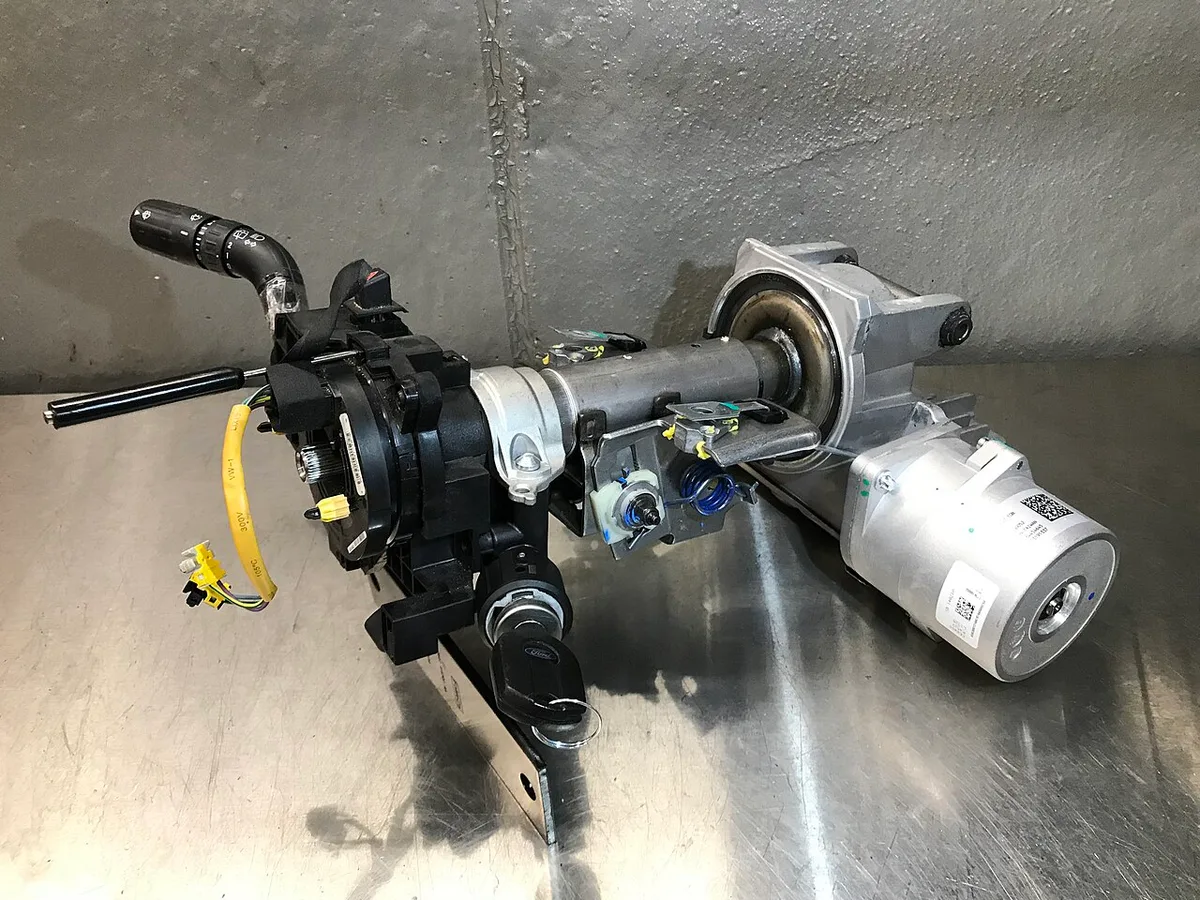
Image source: Wikimedia Commons / Samf4u (CC BY-SA)
Electric power steering (EPS): motor, torque sensor, module, and fail-safe mode
Electric power steering removes the hydraulics completely. A torque sensor in the column measures your input, and a motor on the column or the rack supplies the push. A control module decides how much assist you get.
As of 2026, EPS is standard on nearly every new passenger car sold in the US and UK. That matters for diagnosis. There is no reservoir, no belt, and no fluid to top up.
When the module detects a fault, it drops into a fail-safe mode. Sometimes assist is reduced. Sometimes it disappears entirely.
The wheel goes heavy and a warning lamp comes on.
Electro-hydraulic (EHPS): the hybrid setup on older hybrids and Euro cars
Electro-hydraulic steering sits between the two. An electric pump drives a hydraulic rack, so the car keeps fluid but loses the belt. You'll find it on older hybrids and a number of European models.
The tell is simple. If the car has a power steering reservoir but the pump isn't driven by the accessory belt, you're looking at EHPS. Diagnosis borrows from both worlds.
Image source: Wikimedia Commons / Elliott Brown from Birmingham, United Kingdom (CC BY-SA)
Why your system type decides which diagnostic branch even applies
Here's the if/then that saves the most money:
- If you have a belt-driven pump, check fluid level and belt condition before anything else. Those two items account for a large share of sudden heavy steering.
- If you have EPS, check the warning lamp and stored codes first. Adding fluid is not an option because there's nothing to add.
- If you have EHPS, check the pump's electrical supply as well as the fluid. Either side can fail.
| System | What supplies the assist | First thing to check when it goes heavy |
|---|---|---|
| Hydraulic (HPS) | Belt-driven pump and fluid | Fluid level, then belt condition |
| Electric (EPS) | Motor plus control module | Warning lamp, then stored codes |
| Electro-hydraulic (EHPS) | Electric pump plus hydraulic rack | Pump supply, fluid level, codes |
One thing crosses all three systems. Hand position changes how much leverage you get on a heavy wheel, and our notes on grip and hand placement explain the mechanics of that. It won't rescue a failed pump.
It does make a marginal system easier to live with.
Find Your Branch First: Five Questions That Rule Out Half the Causes
Don't start with parts. Start with the pattern. Five questions narrow the field before you spend a dollar, and most drivers can answer all five from memory.
Does it happen in both directions or just one?
Both directions points at assist or at something affecting the whole front end. One direction points at a bind. That single answer cuts the list roughly in half.
Is it stiff from the first start, or does it ease off after a few miles?
Cold-only stiffness that frees up after a few miles has a name in the trade: morning sickness. It usually means worn seals inside the rack, not a dying pump. Stiffness that never eases points somewhere else.
Is it worst at idle and low speed, or does it stay heavy at speed?
Assist problems show up hardest when pump output is lowest, which is idle. Geometry and tire problems stay heavy everywhere. This question separates the two camps fast.
Did it come on suddenly, or has it been creeping in for months?
Sudden onset suggests a belt, a blown fuse, a failed sensor, or an impact. Gradual onset suggests wear, fluid degradation, or a change in tires and alignment.
Any noise, warning light, or recent work?
A whine that rises with engine speed belongs to the pump. A groan at full lock is usually aerated fluid. A red steering icon on an EPS car is a stop-driving signal, not a maintenance reminder.
| What you notice | Most likely branch | Cheapest first check |
|---|---|---|
| Hard in both directions at idle | Lost assist | Fluid level, belt, warning lamp |
| Hard in one direction or one spot | Mechanical bind | U-joint, ball joint, strut bearing |
| Hard only on the first drive of the day | Rack seals or fluid viscosity | Fluid condition and service history |
| Hard at all speeds, both directions | Tires, alignment, caster | Pressures against the door placard |
| Sudden, heavy, with a warning light | Assist failure, stop driving | Scan for codes, check recalls |
If you own a scan tool or you're about to buy one, a model that reads chassis codes is worth the extra money. Our guide to choosing a reader that handles C and U codes covers what to look for. Many cheap units only read engine codes and will miss an EPS fault entirely.
Branch 1: Hard in Both Directions, Worst at Idle: You've Lost Assist
This is the most common branch, and it's also the one where people overspend. The symptom is symmetrical. The wheel is heavy in both directions, and it's heaviest when the engine is idling or the car is barely moving.
Assist loss almost always traces to one of four things. Fluid, belt, pump, or electronics. Work them in that order.
On a hydraulic car: glazed belt, low or foamy fluid, weak pump
Start with the reservoir. A cold engine, level ground, and a clean rag tell you most of what you need.
- Level: below the cold mark means you have a leak, not a consumption issue. Hydraulic systems don't burn fluid.
- Color: fresh fluid is translucent red or amber, depending on spec. Dark grey or black fluid has been cooked.
- Smell: a burnt smell means heat damage. The fluid is done.
- Foam: bubbles mean air is getting in. Aerated fluid compresses, and a pump can't build pressure through it.
Then look at the belt. A glazed belt looks shiny on the ribs and slips under load, which is exactly when you're parked and turning. Wet weather makes it worse, which is why some drivers notice heavy steering only on rainy mornings.
The wet-weather belt test
Spray a small amount of water on the belt with the engine idling. If the steering gets noticeably heavier, the belt is slipping. That's a cheap test with a clear answer.
A whine that tracks engine RPM is the other classic clue. If the noise rises and falls with revs while the car is stationary, the pump is complaining. A pump that whines and delivers weak assist at idle is on its way out.
When a pressure and flow gauge actually settles it
Sometimes the pump sounds fine and the assist is still weak. That's when a gauge earns its keep. A shop will tee into the pressure line and compare against the manufacturer's relief specification, typically in that 1,000 to 1,500 psi band for passenger cars.
Low pressure with good fluid and a good belt means the pump's internal clearances are worn. Flow testing catches the opposite problem, where pressure looks fine but volume falls off under demand.
On an electric car: EPS motor, module, or torque sensor failure
EPS diagnosis starts with a scan, not a wrench. Pull the codes before you touch hardware. Chassis codes point at the steering system itself.
U-codes point at communication between modules, which can be a wiring or voltage problem rather than a dead motor.
Check the basics that mimic electronics failures:
- Battery voltage and charging. A weak battery or a failing alternator can throw phantom EPS faults. Modules that don't get clean voltage behave unpredictably.
- Ground straps and connectors. Corrosion at the column or rack connector is common in salt-belt states.
- Known bulletins. A technical service bulletin or open recall may describe your exact symptom with a documented fix. The NHTSA recall lookup takes your VIN and tells you whether your car is covered, and it's free.
A skipped steering angle sensor relearn is another quiet culprit. If the battery was replaced, the rack was swapped, or the column was disturbed, the sensor may need a zero-point calibration. Without it, assist can be uneven or reduced.
Why a weak battery or a skipped sensor relearn mimics a dead EPS unit
Both faults produce the same complaint: the wheel feels heavy and the warning lamp is on. Only one of them costs four figures to fix.
That's why the diagnostic order matters more than the parts list. Voltage first, codes second, relearn third, hardware last. Shops that jump straight to a motor replacement sometimes create a return visit they can't explain.
Branch 2: Hard in One Direction or One Spot: Something Is Binding
Asymmetry is the giveaway here. If the wheel is heavy turning left but normal turning right, or if there's a notchy spot at one point in the rotation, assist isn't your problem. Something mechanical is fighting you.
Binding rack internals and shifted rack mounts
A worn rack can develop tight spots as the pinion and the rack bar wear against each other. You'll feel it as a stiffness that comes and goes through the travel rather than staying constant.
Rack mounts matter too. After a hard curb strike or a collision repair, the subframe can shift just enough to preload the rack. The steering then binds in a way that no amount of fluid will fix.
Dry or rusted intermediate-shaft u-joint: the classic notchy spot
The intermediate shaft connects the column to the rack through one or two universal joints. Those joints have tiny needle bearings that dry out and rust, especially on cars that see road salt.
The symptom is distinctive. The wheel turns freely, then catches at a specific angle, then frees up again. Owners often describe it as a click or a notch rather than heavy steering overall.
Seized ball joint, tie rod end, or strut mount bearing
Any joint in the steering chain can seize. A dry ball joint adds resistance that shows up as heavy steering in one direction. A binding strut mount bearing often comes with a pop or creak over bumps.
Tie rod ends wear in a way that produces play more often than bind, but a neglected one can seize solid. Replacement parts vary a lot in quality, so it's worth knowing whether pricier tie rod ends justify the extra cost before you buy. Feedback on brand-name units like these suggests the sealing quality is where the money goes.
Steering column bearing and lock-cylinder drag
Less common, but real. A dry column bearing or a sticking lock cylinder adds drag that you feel through the wheel at all times. It's often mistaken for a rack problem because the resistance feels constant.
The quickest way to separate column drag from rack drag is to disconnect the intermediate shaft and turn each side by hand. If the column is stiff on its own, you've found it.
The "recent pothole or curb strike" clue
Ask yourself what changed. A hard hit can bend a tie rod, knock the alignment out, damage a wheel bearing, or shift the subframe. Any of those can produce one-direction stiffness.
If the stiffness started the same week as an impact, treat it as damage until proven otherwise. That reframes the diagnosis from wear to inspection.
Splitting rack resistance from knuckle resistance
Get the front end off the ground on proper stands before you judge anything. Ramps are for fluid changes, not for turning the wheels by hand. If you'd rather build than buy, our walkthrough on raising the front end safely at home is a reasonable starting point for the support side of the job.
With the wheels in the air and the engine off, turn lock to lock. Resistance here means mechanical, not assist. Then disconnect one outer tie rod and turn each side independently.
The rack should move freely on its own. If it doesn't, the bind is inside the rack or the column.
That one test has probably saved more racks from the scrap pile than any other. It costs nothing and takes ten minutes.
Branch 3: Hard Only When Cold: Rack "Morning Sickness" and Thick Fluid
If the wheel is heavy for the first minute and then loosens up, you're in a different branch. This pattern is so common in the trade that it has its own name: morning sickness.
The symptom is repeatable. Park overnight, start the car, and the wheel feels stiff or notchy. Drive a couple of miles and the effort drops back to normal.
It doesn't come back until the car sits cold again.
Morning sickness usually lives inside the rack. As the rack's internal seals and bore wear, fluid slips past where it shouldn't. Cold, thick fluid makes that bypass worse.
Once the fluid warms and thins, the seals behave again.
Why worn rack seals stiffen at cold start
A rack depends on internal pressure to help you turn. Worn seals let pressure escape, so assist drops when the fluid is thickest. The pump is often fine and gets replaced anyway.
That's the expensive mistake in this branch. Owners feel heavy steering in January and buy a pump in February. The real fault was the rack all along, and the new pump didn't fix it.
There's a second variant worth knowing. A sticking spool valve inside the rack's control assembly can feel notchy when cold and free up with heat. It's the same complaint with a different internal cause, and it still points at the rack.
How to tell morning sickness from a tired pump
Run the cold-start test properly and you'll get a clear answer:
- Let the car sit overnight on level ground.
- Start it and note the effort at a standstill before touching the throttle.
- Hold a steady idle for 60 seconds and recheck. A pump problem will still be there.
- Drive two to three miles and recheck. If the effort has eased noticeably, you're looking at the rack or the fluid.
A tired pump behaves differently. Its assist is weakest at idle and never fully recovers, hot or cold. It also tends to whine with engine RPM.
Rack morning sickness is quiet.
| Cold-start behavior | More likely cause | First move |
|---|---|---|
| Stiff for a minute, then normal | Rack seals or fluid viscosity | Check level and fluid condition |
| Stiff at idle always, whines with revs | Worn pump | Pressure and flow test |
| Stiff only on damp mornings | Glazed belt slipping | Belt and tensioner inspection |
| Stiff, then a warning lamp appears | EPS fault or low voltage | Scan codes, test battery |
Fluid viscosity, winter climates, and heat damage
Cold weather doesn't create the problem, it exposes it. A rack that's marginal in July will be obvious in January. Fluid that's years old and contaminated makes the effect stronger.
Hot climates attack from the other side. Sustained heat oxidizes the fluid and hardens the seals. A car that spent five summers in Arizona and now lives somewhere cold can show morning sickness at surprisingly low mileage.
The cheap test comes before the expensive one. Suck a sample of fluid with a turkey baster and look at it against a white paper towel. Dark, gritty, or burnt-smelling fluid gets replaced first.
Sometimes that alone softens the cold-start stiffness enough to buy you time.
What electric steering does in cold weather
EPS cars can feel heavy on a freezing morning too, but the cause is different. Battery capacity drops in cold weather, and an EPS motor pulls serious current when you turn at a standstill. Low voltage can push the module into reduced assist.
If a jump start or a new battery makes the stiffness disappear, you never had a steering problem. You had a power problem wearing a steering costume.
The if/then for this branch
- If the stiffness clears within a few minutes of driving and the fluid is dark or the level is low, service the fluid first.
- If fresh fluid at the right spec changes nothing, plan for rack work.
- If the noise tracks engine speed instead of temperature, move to the pump branch.
- If there's a warning lamp and the car is electric-assisted, stop and scan before anything else.
One honest note on cost. A fluid service runs a small fraction of a rack replacement. Do the cheap step first, even when you're fairly sure it won't be enough.
Branch 4: Hard All the Time: Tires, Alignment, and Caster
Some cars aren't broken. They're just heavy by design, or heavy because of a setup choice. If the wheel is stiff in both directions, at every speed, hot or cold, you're likely in this branch.
The tell is consistency. Assist faults fluctuate with RPM and temperature. Geometry problems don't.
They're there from the first turn of the wheel to the last.
Check tire pressure against the door-jamb placard before anything else
This is the cheapest diagnosis in the entire article and it gets skipped constantly. Manufacturer placards typically call for 32 to 36 psi on passenger cars. A tire ten pounds under spec flattens its contact patch and adds real drag to the steering.
Use the sticker in the driver's door jamb, not the number molded into the tire sidewall. The sidewall figure is a maximum load pressure, not a recommendation for your car. Tire industry guidance from the Rubber Manufacturers Association makes the same point.
Check all four tires cold, before you've driven. Then check them again in a month. A tire losing a few pounds a month has a slow leak, and that leak is a safety issue of its own.
Wide tires, lifted trucks, and high positive caster: heavy by design
Some setups legitimately increase steering effort. If the car was modified, that's often the whole answer.
- Wide, high-grip tires put more rubber on the road and more resistance through the rack.
- Low-profile sidewalls transmit effort instead of absorbing it.
- Aggressive all-terrain or mud tread adds rolling drag that you feel at parking speeds.
- Heavy load-range tires on trucks and vans stiffen the whole front end.
- Lifted suspensions often add positive caster, which improves straight-line stability at the cost of heavier low-speed steering.
Caster is the angle most drivers have never heard of and most alignment techs check first. Typical passenger car settings sit in the 3 to 6 degree range. Push it higher and the wheel self-centers harder, which feels great on the highway and heavy in a parking lot.
If you lifted the truck and the steering got heavy the same week, that's not a fault. That's the trade you bought. The fix is a caster correction, not a new pump.
Uneven wear, a shifted belt, and wheel-bearing drag
Not every tire problem is a pressure problem. A belt that has shifted inside the tire creates a constant pull or drag. Cupped or feathered wear from worn suspension does the same.
A failing wheel bearing adds rotational drag that can read as steering resistance. The usual giveaway is noise that changes when you load one side in a turn. If the growl follows the steering direction, suspect a bearing before you suspect the rack.
Dragging brakes belong on this list too. A caliper that won't release makes the car pull and can make the front end feel loaded. Touch each wheel hub after a short drive.
One that's noticeably hotter than the rest is telling you something.
The alignment rule: never condemn parts before the caster sweep
Get the alignment checked before you authorize any steering repair. A shop can print you a full before-and-after sheet in about 30 minutes.
Look at three numbers: caster, camber, and toe. Toe that's way out scrubs the tires and adds drag. Uneven caster from a bent component makes the car pull and can change effort from side to side.
| Reading | What it means for steering effort | Likely fix |
|---|---|---|
| Caster above spec on both sides | Heavy but stable, worst at low speed | Reset to spec, check for a lift kit |
| Caster uneven side to side | Pull plus asymmetric effort | Inspect for bent strut or control arm |
| Toe badly out | Tire scrub, vague and draggy feel | Alignment correction |
| Camber out with uneven wear | Wander plus heavier turn-in | Alignment plus wear inspection |
If the alignment is in spec, the tires are correct, and the wheel is still heavy, you've earned the right to look at assist and mechanical bind. Not before.
The Hydraulic Checklist: Fluid Level, Belt Tension, Leaks, and Pump Flow
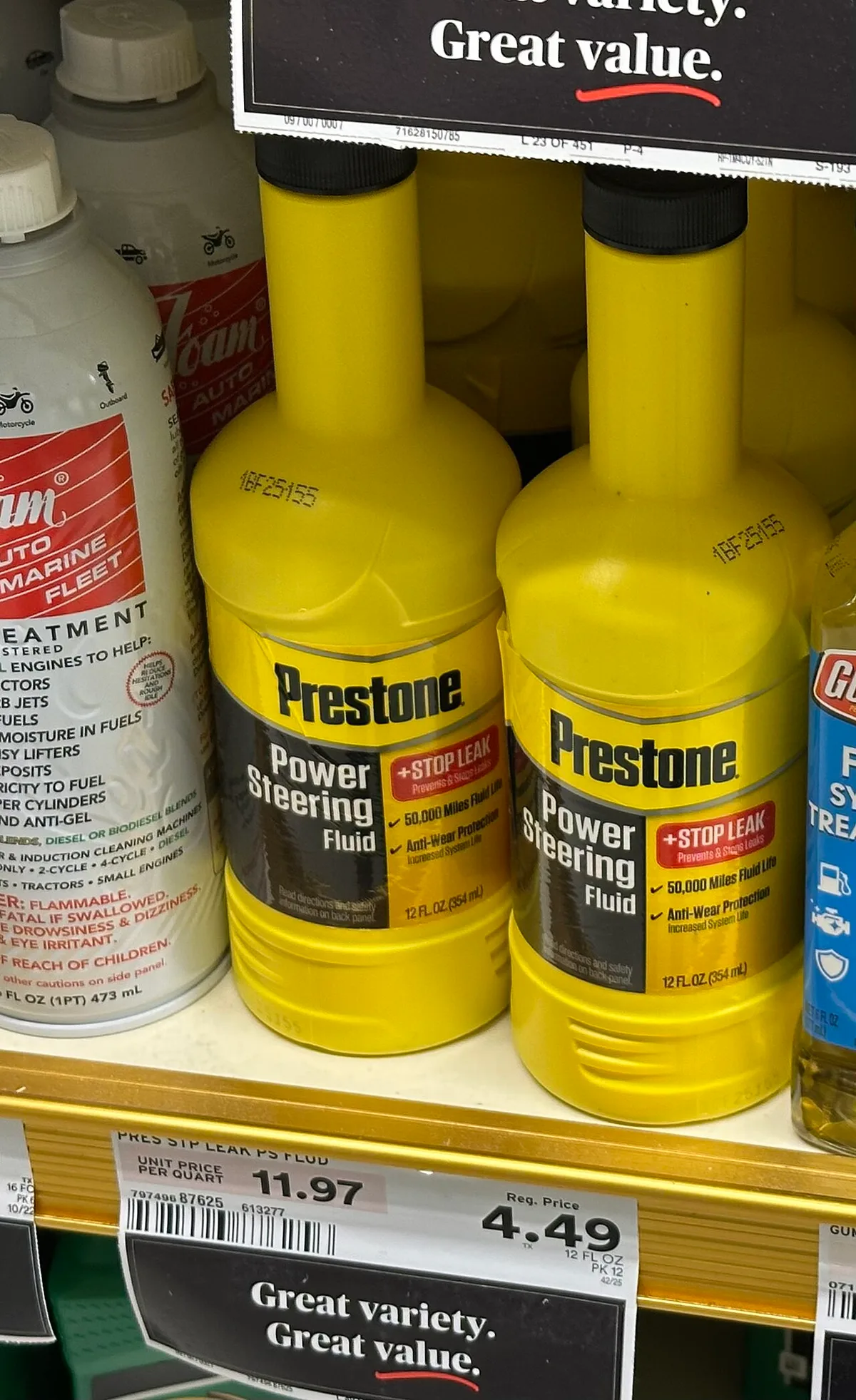
Image source: Wikimedia Commons / Jonathan Schilling (CC BY-SA)
Hydraulic systems fail in a predictable order. Fluid goes first, then the belt, then the pump, then the rack. Work down that list and you'll rarely replace something that was still good.
Our research across service bulletins and owner reports keeps landing on the same point. Most "failed pumps" arrive at the shop with a low reservoir and a glazed belt.
Fluid: level, color, smell, foam, and the spec that matters
Check the level with the engine off and the car on level ground. The reservoir has cold and hot marks, and both mean something. Below the cold mark points at a leak, because hydraulic systems don't consume fluid.
Then judge the fluid itself. Fresh fluid is translucent red or amber. Dark grey fluid has been cooked.
A burnt smell means heat damage. Bubbles or foam mean air is entering somewhere.
Aerated fluid is the one people misdiagnose. Air compresses, so the pump can't build pressure through it. The wheel goes heavy and the pump groans.
The fix is finding the air source, not adding more fluid.
The spec matters more than the color. Power steering fluid is not universal, and guessing can swell seals and create a new leak.
| Vehicle family | Common spec | What not to do |
|---|---|---|
| Most GM, Ford, and Asian models | Dexron-type automatic transmission fluid or a dedicated PSF | Assume any red fluid works |
| Many European models (VW, Audi, BMW, Volvo) | Pentosin CHF 11S or CHF 202 | Top up with ATF |
| Honda and some others | Manufacturer-specific PSF only | Substitute a generic fluid |
| Electric and electro-hydraulic systems | Check the manual, some share one fluid circuit | Add fluid to a system with no reservoir |
If you're servicing the system yourself, a slow drain and refill follows the same logic as a proper fluid and filter routine. Move the old fluid out, get the level right, and don't overfill.
Overfilling is a real mistake with real consequences. Too much fluid aerates, the reservoir cap vents it out, and you end up with a mess under the hood plus weak assist.
Belt and tensioner: glazing, cracks, contamination, and travel
With the engine off, look at the ribbed side of the belt. Glazing shows up as a shiny, hard surface where the ribs should be matte. Cracks across the ribs mean it's due regardless of mileage.
Check the tensioner too. It should hold steady with the engine running, with no bouncing or chirping. A weak tensioner lets the belt slip exactly when the pump needs the most torque, which is at idle with the wheel at full lock.
Oil or coolant on the belt is its own problem. It softens the rubber and causes slip. Fix the leak before you fit a new belt, or you'll be back in a month.
Leak hunt: rack boots, lines, fittings, pump seal
Follow the fluid. The usual suspects, in rough order of frequency:
- Rack boots. A wet boot means the rack's inner seal is weeping. Pinch the boot and check for fluid pooling.
- High-pressure line and fittings. Look for damp fittings and cracked rubber near the pump.
- Return line and cooler. These corrode in salt-belt regions and kink where they're routed tight.
- Pump shaft seal. Fluid thrown around the pulley area points here.
A slow leak is worth catching early. A pump that runs dry destroys itself, and the debris it makes travels straight into the rack.
Pump: the whine test and when a pressure gauge settles it
A pump that whines with engine RPM and delivers weak assist at idle is on its way out. That's usually enough to justify a replacement on an older car.
On a newer or more expensive vehicle, get a pressure and flow test before you commit. A shop tees a gauge into the pressure line and compares against the manufacturer's relief specification. Low pressure with good fluid and a healthy belt points at internal wear.
Flow matters as much as pressure. A pump can hit relief pressure in a static test and still fall short when it has to move volume during a fast turn.
Fluid service intervals that prevent this entire branch
Most manufacturers don't publish an aggressive power steering interval, which is why the fluid gets ignored for a decade. Practical guidance from independent shops lands around 30,000 to 60,000 miles, or sooner if the fluid is already dark.
System capacity is usually under a quart, so this isn't a costly service. It's also the single best thing you can do to keep a pump and rack alive past 150,000 miles.
The Electric Steering Checklist: Codes, TSBs, and Sensor Relearns
Electric steering rewards a different order of work. Scan first, then check power, then check for known fixes, then touch hardware. Doing it backwards is how people end up with a motor they didn't need.
Scan for EPS codes before touching anything
Chassis codes start with C and point at the steering system itself. A torque sensor fault, a motor circuit fault, or an internal module fault will usually set one.
Communication codes start with U. Those point at how modules talk to each other. A U-code often traces back to wiring, a ground, or low voltage rather than a dead steering unit.
Read the codes, note them, then clear and recheck. A code that returns immediately is real. A code that never comes back after a battery service was probably a voltage event.
Check for a TSB or recall by VIN before buying parts
This step has saved more money than any diagnostic tool. Stiff steering, reduced assist, and sensor faults are covered by technical service bulletins on a long list of models. A bulletin tells you the documented fix, and often the labor time, before you spend a cent.
Recall coverage is free to check by VIN through the NHTSA database. Run it once a year even when nothing feels wrong. Steering assist defects have triggered real recalls, and owners often learn about them years late.
Battery voltage and charging checks that clear phantom faults
An EPS motor can draw a large current spike during a parking maneuver. A battery that's weak or a charging system that's marginal can't support that spike. The module responds by reducing assist and lighting the lamp.
Test the battery at rest and again with the engine running. A healthy battery sits around 12.6 volts static. Charging voltage typically lands between 13.8 and 14.4.
Then inspect the grounds. Corroded straps at the column, the rack, or the frame are common in regions that salt their roads. A ground that reads fine with a meter can still fail under load, so a voltage drop test beats a visual check every time.
Steering angle sensor zero-point and torque sensor calibration
Both need attention after certain repairs. Steering angle sensor calibration tells the car where straight ahead actually is. Skip it after a rack swap or an alignment, and stability control and assist can both behave oddly.
Torque sensor calibration is less commonly needed, but some platforms require it after column or module work. The procedure usually needs a capable scan tool, not a basic code reader.
That's the point where a cheap reader runs out of usefulness. A tool that can run relearns and read chassis codes costs more, and our breakdown of what separates a capable scan tool from a basic one explains where that line sits. If you plan to keep the car past 100,000 miles, it pays for itself the first time you avoid a dealer diagnostic fee.
When an electric steering fault means stop driving
Some EPS faults degrade gracefully. Others don't. Treat these as park-it signals:
- A red steering warning icon on the dash.
- A message reading "Service Power Steering" or "Power Steering Fault."
- Assist that cuts in and out while you're moving.
- A wheel that suddenly goes heavy at speed.
Electric assist can drop to zero without warning. On a hydraulic car you usually get noise and a gradual fade first. On EPS, the transition can be instant.
If that happens at highway speed, you need both hands and a lot of road.
Don't clear the code and keep driving to see if it comes back. Get it scanned, and check the recall list before anything else.
The 15-Minute Driveway Test: Mechanical Bind vs. Lost Assist
Before you price parts, run one test that splits the two main branches. It takes about fifteen minutes and needs nothing more than a jack, stands, and a helper.
The test answers a single question. Does the resistance come from the assist system, or from something mechanical fighting the wheel?
Step one: get the front end safely in the air
Level ground, parking brake on, rear wheels chocked. Lift the front, set jack stands under the manufacturer's lift points, and lower the jack so the stands carry the weight. Never work under a car held by a jack alone.
Then disconnect the negative battery terminal if you'll be anywhere near the column or clock spring. Wait the dwell time in your manual before touching airbag wiring. That wait matters.
Step two: lock to lock, engine off
With the engine off and the front wheels off the ground, turn the wheel from lock to lock. Feel for consistency.
Smooth, even resistance throughout is normal. It should feel light enough to turn with one hand. Anything notchy, gritty, or heavy points at a mechanical bind.
Step three: disconnect a tie rod to isolate the rack
Remove one outer tie rod nut and pop the joint free. Now turn the wheel again. The rack and column should move freely with no load on them.
Then turn the disconnected knuckle by hand. It should swing smoothly through its arc. If it's stiff, the bind is in the ball joint, strut bearing, or wheel bearing on that side.
Step four: read the result
Here's how to interpret what your hands just told you.
| What you felt | What it points to | Rough next step |
|---|---|---|
| Heavy with the wheels in the air, both directions | Rack internals or column drag | Disconnect the shaft, retest each side |
| Free with wheels in the air, heavy on the ground | Assist loss or tire drag | Check fluid, belt, codes, pressures |
| Notchy at one spot in the rotation | Intermediate shaft u-joint | Inspect and replace the joint |
| Stiff knuckle with the tie rod off | Ball joint or strut bearing | Replace the offending joint |
| Free everywhere, still heavy on the road | Alignment, caster, or tire size | Caster sweep and pressure check |
That last row is the one people argue with. A car can pass every mechanical test and still steer heavily because the geometry is wrong. If everything is free and the wheel is still heavy, the answer is in the alignment sheet.
One more practical note on reassembly. Rack and subframe fasteners on many modern cars are torque-to-yield, which means new bolts and a torque wrench. An impact gun is fine for removal and wrong for installation.
If you don't own a torque wrench, this is the point where a shop visit is cheaper than a mistake.
What the Fixes Actually Cost: From a $20 Belt to a $2,200 Rack
Two cars can roll in with the same complaint and leave with bills four figures apart. Same symptom, different branch. That's why pricing the repair before you diagnose it wastes everyone's time.
Here are the ranges that show up again and again in US shop data and owner-reported invoices. Treat them as bands, not quotes.
| Cause | Parts | Installed cost (US, 2026) |
|---|---|---|
| Low tire pressure | $0 | Free |
| Fluid drain and refill | $10 to $25 | $80 to $150 |
| Serpentine belt | $25 to $70 | $120 to $250 |
| Belt tensioner | $50 to $120 | $200 to $400 |
| Intermediate shaft u-joint | $80 to $250 | $250 to $600 |
| Outer tie rod ends, pair | $60 to $200 | $250 to $500 plus alignment |
| Ball joint, one side | $60 to $200 | $300 to $700 |
| Strut mount bearing | $60 to $150 | $300 to $600 |
| Power steering pump | $200 to $500 | $450 to $900 |
| High-pressure line | $60 to $200 | $250 to $600 |
| Remanufactured rack | $400 to $900 | $1,200 to $2,200 |
| New OEM rack | $900 to $2,000 | $1,600 to $3,000 |
| EPS motor or module | $400 to $1,000 | $900 to $2,000 |
| Four-wheel alignment | None | $100 to $200 |
| Diagnostic scan | None | $100 to $175 |
The labor rate sets the floor. Independent shops across the US commonly bill $100 to $200 an hour, and UK garages sit around £60 to £120. Dealer rates run at the top of those bands, and the diagnostic fee is usually charged on top.
Rack replacement is where the clock really runs. Book time lands at three to six hours on most cars, and it climbs on all-wheel-drive models where the subframe has to drop. That single design detail can double a quote between two otherwise similar vehicles.
New, remanufactured, or salvage rack: where the risk actually sits
The part choice matters as much as the labor. Each option suits a different owner.
- New OEM costs the most and carries known quality plus a real warranty. Best for a car you plan to keep past 200,000 miles.
- Remanufactured sits in the middle and is what most shops fit by default. Quality tracks the rebuilder, so warranty length is your best signal. One to three years is normal.
- Salvage is cheapest and the riskiest. A used rack arrives with unknown wear, and it may already have the cold-start stiffness you just paid to get rid of.
- Rebuild kits exist for a few older platforms. They only make sense if the rack bore is still healthy.
What actually drives the spread between two quotes
Ask what's included before you compare numbers. The cheap quote is usually cheap for a reason.
- Alignment. A rack swap needs one. Some quotes bury it, others leave it out entirely.
- Consumables. New rack boots, new tie rod ends, new torque-to-yield bolts and fluid all add up.
- Coding. EPS work on many cars needs a module configuration or a sensor relearn. Not every independent shop has the tool.
- Corrosion. A salt-belt car with seized fasteners can add an hour of labor before work even starts.
- Access. Vans, trucks, and transverse V6 engines test a technician's patience and your budget.
Where cheap parts cost you twice
Some savings come straight back as a second repair.
- Generic EPS sensors and modules often need coding that the cheap part can't accept. They also fail early.
- Bargain rubber boots split within a season and let grit into a freshly sealed rack.
- Unverified fluid at the wrong spec swells seals. You trade a $15 bottle for a $1,500 rack.
- No-name pumps on a high-mileage car can deliver weak pressure from day one.
One useful bit of perspective. Most of the cheap checks in this whole diagnosis need nothing more than a pressure gauge and a wrench. Even fresh hardware for every wheel costs less than a single diagnostic fee at a dealership.
The Expensive Mistakes: Condemning a Good Rack for a $30 Part
Every experienced technician has a story about a rack that didn't need replacing. The pattern behind those stories is almost always the same. Someone skipped a cheap check and jumped to the worst-case part.
Here are the ones that show up most often, and what each one actually costs.
Replacing the rack when the real fault was tire pressure
A front tire at 22 psi when the placard calls for 35 flattens its contact patch and drags. The wheel gets heavy, especially at parking speed, and the driver assumes the worst.
Twenty minutes with a gauge costs nothing. A rack replacement that fixes nothing costs four figures and doesn't solve the complaint.
Adding fluid to a car that has no reservoir
Electric steering has no pump and no fluid. Owners who top up the wrong cap usually hit the brake fluid or the coolant reservoir.
Brake fluid in the wrong place attacks paint and rubber. Coolant in the power steering system is worse. If you can't find a reservoir cap labeled for steering, your car doesn't have one.
Using the wrong fluid because "it's red"
Power steering fluid is not interchangeable by color. European cars that call for Pentosin CHF 11S or CHF 202 do not want Dexron-type ATF.
The failure takes weeks to show. Seals swell, a new leak appears at the rack, and the fluid foams under load. By then the system has been running on the wrong chemistry for a month.
Overfilling the reservoir
Too much fluid aerates as the pump churns it. Foam doesn't build pressure, so assist drops and the cap vents the excess over the engine bay.
Fill to the cold mark with the engine off and the car level. Then recheck hot. The two marks exist for a reason.
Replacing the pump when the rack has morning sickness
This is the classic misdiagnosis. Cold-only stiffness that fades after a couple of miles points at rack seals, not the pump. A new pump changes nothing and the driver is back in a week.
Check whether the stiffness follows temperature or engine speed. Temperature means the rack. Engine speed means the pump.
Chasing codes while skipping the mechanical basics
A binding u-joint, a seized ball joint, and a soft tire don't set diagnostic trouble codes. They just make the wheel heavy.
If the scan comes back clean and the wheel is stiff, stop looking at the computer. Get under the car and check the linkage by hand.
Skipping the bleed or the sensor relearn
Trapped air in a hydraulic system groans and delivers weak assist. A steering angle sensor left uncalibrated can leave assist uneven and upset the stability control.
Either one turns a successful repair into a comeback. Both take minutes with the right procedure.
Running a pump dry after ignoring a leak
A seeping rack boot is easy to ignore until the reservoir runs low. A pump that pulls air destroys its internals in short order.
The debris it makes travels into the rack and the cooler. One cheap seal becomes a pump, a rack, and a line flush.
Ignoring a technical service bulletin
Manufacturers document common faults in bulletins that name the symptom and the fix. Many stiff-steering complaints on specific models have a published answer.
Checking by VIN takes two minutes. Sometimes it saves you from buying a part that was never going to help.
Reusing torque-to-yield bolts and reaching for the impact gun
Rack and subframe fasteners on modern cars are often single-use. Reusing them risks a fastener that won't hold torque.
An impact wrench is a removal tool. Installation calls for a calibrated torque wrench and the spec, or the rack sits preloaded and binds.
| Mistake | Typical cost of the error | What the fault actually was |
|---|---|---|
| Rack replaced for a pressure problem | $1,200 to $2,200 | Tire pressure or a glazed belt |
| Fluid added to an EPS car | $100 to $400 in cleanup | A sensor, module, or voltage fault |
| Wrong fluid spec used | $400 to $1,500 | A $15 bottle of the right fluid |
| Pump replaced for cold stiffness | $450 to $900 | Worn rack seals |
| Relearn skipped | One return visit | A five-minute calibration |
| Dry pump run to failure | $1,500 to $3,000 | A leaking rack boot |
The pattern under all of these is the same. Money got spent before the branch was confirmed. Free checks first, cheap checks second, parts last.
When Hard Steering Means Stop Driving: Safety Triggers and Recalls
Some stiffness is annoying. Some of it is a warning to pull over. Knowing which one you're looking at matters more than knowing the part number.
Why electric assist fails differently from hydraulic
A hydraulic system usually gives you warning. The pump whines, assist fades, and effort creeps up over days. You get time to book a repair.
Electric assist can drop from full to nothing between one turn and the next. There's no fluid to lose pressure slowly and no belt to squeal first. The module decides it can't trust a sensor and pulls assist.
At parking speed that's an inconvenience. At 60 mph with one hand on the wheel, it's a genuine emergency.
The warning signs that mean park it now
Treat the following as stop-driving conditions, not maintenance reminders.
| Signal | What it likely means | What to do |
|---|---|---|
| Red steering icon or a "Service Power Steering" message | EPS fault, assist reduced or gone | Pull over safely, arrange recovery |
| Assist cutting in and out while moving | Intermittent sensor, motor, or voltage fault | Park it, scan, check battery and grounds |
| Wheel suddenly heavy at highway speed | Assist loss under load | Both hands, slow gradually, exit the road |
| Groan plus heavy wheel plus a burnt smell | Pump or fluid failure | Stop, let it cool, check level |
| Fluid spraying or a wet pinhole on a line | High-pressure line failure | Engine off, do not touch, get help |
High-pressure fluid injection is a medical emergency
Power steering lines run at roughly 1,000 to 1,500 psi. A pinhole leak in a pressurized line can inject fluid straight through skin.
The wound looks tiny and feels like a sting. The damage underneath is severe and can become necrotizing within hours. Never run a finger along a pressurized line to check for leaks.
Use a piece of cardboard, and if fluid breaches skin, go to an emergency department immediately and tell them it was hydraulic fluid.
Airbags, clock springs, and the dwell time
Any work near the column puts you next to the airbag circuit. Disconnect the negative battery terminal first and wait the interval your manual specifies, which is often several minutes.
Don't spin the steering wheel with the column apart. The clock spring has a limited number of turns before it tears, and a torn one takes the horn and the airbag with it.
Jacks, stands, and the rule that never bends
Level ground, parking brake set, rear wheels chocked, stands under the manufacturer's lift points. Then lower the jack so the stands carry the load.
Never put any part of your body under a car held by a jack alone. This is the single most common way home mechanics get seriously hurt, and it happens in seconds.
Recalls and bulletins are free to check
Steering assist defects have triggered real recalls, and many owners learn about them years after the fact. Run your VIN through the official recall database once a year, whether anything feels wrong or not.
In the UK, the DVSA runs an equivalent recall checker, and steering and suspension components are MOT inspection items. A leaking rack or excessive play can produce a fail or an advisory even when you've noticed nothing.
Steering angle accuracy is a stability control issue
Federal rules require electronic stability control on new passenger vehicles. That system relies on an accurate steering angle reading to know where you intend to go.
A sensor left uncalibrated after a rack swap or an alignment can degrade stability control without ever lighting the steering lamp. It's one more reason the relearn isn't optional.
Old fluid is hazardous waste
Used power steering fluid doesn't go down a drain or into the trash. Collect it and drop it at a recycling center or a parts store that accepts automotive fluids.
Most areas treat a quarter of used fluid the same as they treat used oil. One quart is enough to cause a real problem in a storm drain.
Frequently Asked Questions
Can I keep driving with hard steering?
Only if the wheel still turns and no warning lamp is on. Heavy-but-functional steering on a hydraulic car is usually safe to drive to a shop. A red steering icon, a "Service Power Steering" message, or assist that cuts in and out means stop and arrange recovery.
Electric systems can lose assist instantly.
Can low tire pressure really make the wheel this heavy?
Yes, and it's the most common cheap cause. A tire ten pounds under the placard pressure flattens its contact patch and adds real drag at parking speeds. Check all four cold against the door-jamb sticker, not the sidewall maximum.
If the wheel lightens after inflating, you've found it.
My car has electric steering, so where do I add fluid?
Nowhere. Electric power steering has no pump, no reservoir, and no fluid. The assist comes from a motor on the column or the rack, driven by a control module.
If you're hunting for a cap to top up, the fault is electrical or mechanical. Get the codes scanned instead.
Can I use automatic transmission fluid instead of power steering fluid?
Only if the manufacturer specifies it. Many GM, Ford, and Asian models do accept Dexron-type ATF. Plenty of European cars require Pentosin CHF 11S or CHF 202, and ATF will swell the seals and cause leaks.
Check the cap, the manual, or a fluid data sheet before pouring.
Is it the pump or the rack, and how do I tell them apart?
Listen to when it happens. A failing pump is weakest at idle, whines with engine speed, and never fully recovers. A worn rack is stiff when cold and frees up after a few miles of driving.
A pressure and flow test settles the pump question in about twenty minutes.
Why is my steering stiff only in winter?
Cold fluid is thick fluid, and worn rack seals leak more pressure when it's thick. That combination produces stiffness on the first start that fades as everything warms. Old, contaminated fluid makes it worse.
A fluid service often softens it, but persistent cases usually point at the rack.
Decision Guide: Match Your Symptoms to Your Next Move
By now you've got a symptom pattern. This is where it turns into a plan.
Start at the top of the table and work down. Each row costs more than the one above it, so the order matters as much as the diagnosis.
| What you're experiencing | First move | Typical cost |
|---|---|---|
| Heavy in both directions, any speed, any temperature | Check all four tire pressures cold | Free |
| Heavy at idle, eases when revs rise, whines | Check fluid level, color, and belt | Free to $25 |
| Heavy in one direction or notchy at one spot | Lift the front end and turn lock to lock | Free |
| Heavy only on the first drive of the day | Sample the fluid, note cold versus hot | $10 to $25 |
| Heavy plus a warning lamp on an electric car | Scan for chassis and communication codes | $100 to $175 |
| Heavy after a curb strike or pothole | Alignment check with a caster sweep | $100 to $200 |
| Heavy after a lift kit or bigger tires | Caster correction and alignment | $100 to $300 |
| Heavy with a red warning and no assist | Stop driving, check recalls by VIN | Free |
What you can reasonably handle yourself
Four jobs sit comfortably in the DIY column for most owners. Checking and setting tire pressures. Topping up or sampling hydraulic fluid.
Inspecting a belt for glazing and cracks. Running the wheels-in-the-air bind test with a helper.
Everything else needs a lift, a torque wrench, a scan tool with relearn capability, or all three. A rack swap on a car with a dropped subframe is not a driveway job, and the fasteners alone will tell you so.
When a shop visit is cheaper than the guess
Book the diagnostic before you book the repair if any of these apply:
- You've already replaced one part and the symptom hasn't changed.
- The car has electric assist and you don't own a tool that reads chassis codes.
- The stiffness came on suddenly after an impact.
- There's a warning lamp on the dash.
- You're looking at a rack, a pump, or a steering column.
A $150 diagnostic that stops a $1,500 wrong guess is the best money in this entire article.
The order of spend that saves the most
Think in four tiers and never skip one. Free first: pressures, belt visual, wheels-in-the-air test, recall check by VIN. Cheap second: fluid service, alignment, a diagnostic scan.
Mid-range third: belt, tensioner, u-joint, tie rod ends, ball joints. Expensive last: pump, rack, EPS module.
Most hard steering complaints get solved in the first two tiers. That's not wishful thinking. It's what the symptom pattern keeps pointing back to.
Keeping assist healthy past 150,000 miles
None of this is exotic. It's just a short list that most owners never touch.
- Service the power steering fluid every 30,000 to 60,000 miles, or sooner if it turns dark.
- Look at the belt at every oil change, and replace the tensioner with it if it's bouncing.
- Check tire pressures monthly and before long trips, cold.
- Get an alignment after any suspension work, lift kit, or hard curb strike.
- Run your VIN through the recall database once a year.
- Fix weeping rack boots early, before the pump starts pulling air.
Do those six things and the wheel stays light. Skip them and the branch you land in eventually gets expensive.
