
A slipping transmission doesn't fail all at once. It whispers first, usually a small flare on the 2-3 shift or a tach that climbs faster than the speedometer. If you're wondering what causes transmission slipping, the honest answer is that a dozen different faults produce the exact same symptom.
Sorting out which one you're facing, before you spend money, is the whole game.
The stakes are higher than most owners realize. Friction material that slips burns, and that burnt debris then clogs the filter and valve body. Manufacturer service data puts normal automatic transmission fluid at roughly 175 to 200°F, and sustained runs past 220°F speed up the breakdown fast.
So the order you check things in matters, and it starts with five quick questions.
What Causes Transmission Slipping
Transmission slipping means the gearbox can't hold its grip under load. Most cases trace back to low fluid, burnt fluid, or worn clutch packs. Failing solenoids, sensors, and wiring can mimic a mechanical fault.
A weak pump or a leaking valve body drops line pressure in every gear.
Why a Slipping Transmission Is a Countdown, Not a Nuisance
A slipping transmission is friction in the wrong place. Instead of holding a gear firmly, the clutch packs or the belt slide against each other. Sliding surfaces make heat quickly, and heat is what turns a cheap repair into a rebuild.
The damage compounds in a predictable loop. Friction plates burn and glaze, then shed material into the fluid. That debris clogs the filter and packs into valve body passages, line pressure falls, and the unit slips even harder.
Across the shop write-ups and owner reports we reviewed, the gap between "slight flare" and "won't move" was measured in days to a few weeks of daily driving.
So the goal isn't a perfect diagnosis on day one. It's stopping the loop early, while a fluid service or a solenoid still fixes it.
Park it and get a tow if:
- Slipping gets worse under load or uphill
- You smell burnt friction material
- The dash shows limp or failsafe mode
- It won't engage Drive or Reverse at all
The 60-Second Triage: Five Questions That Narrow the Cause
Answer these before you open the hood. They cost nothing and they cut the suspect list in half.
- When does it slip? Cold, hot, or both.
- Which gears? One gear, all gears, or only under light throttle.
- What's the load? Gentle cruise, hard acceleration, uphill, or towing.
- Which direction? Forward, reverse, or both.
- What does the fluid look and smell like?
Cold vs. hot, one gear vs. all gears, load vs. cruise
If it slips only when cold and clears within five minutes, suspect low fluid, a torque converter draining back, or a sticky valve body. If it slips only when hot, look at fluid condition and line pressure, because thin hot fluid leaks past worn clearances.
If one gear slips, that points at a specific clutch pack or band. If every gear slips, the fault sits upstream of the geartrain: pump, filter, valve body, or pressure control.
Image source: Wikimedia Commons / Anslaton (CC BY)
Forward only, reverse only, or both
Reverse-only slip usually means the low/reverse clutch or band is worn, and that's a hard internal job. Forward-only slip often points to the forward clutch or a related seal. Slip in both directions is the least specific pattern, and it usually sends you back to pressure and fluid.
Cheap Causes First: Fluid Level, Condition, and Spec
Fluid is where you always start. It's the cheapest thing to check and the most common cause of a slipping complaint.
Reading the Fluid the Right Way on a Sealed "Lifetime" Unit
Level matters, but so does method. Park on level ground, get the transmission to operating temperature, cycle through the gears, then check with the engine running. Sealed units use a check plug instead of a dipstick, and the engine still has to be running.
That "lifetime fluid" label really means the life of the warranty. Severe-duty schedules from most manufacturers still call for a service well before 100,000 miles. If you're working out how to top up a sealed unit, follow your own model's procedure rather than a generic video, and get the car safely in the air first.
Burnt Smell, Dark Color, and Clutch Material in the Pan
Wipe the dipstick on white paper and look at it in daylight. Then smell it.
| What you find | What it usually means |
|---|---|
| Bright red or pink, no smell | Fluid is healthy, look elsewhere |
| Dark brown with varnish | Fluid is oxidized, service it now |
| Sharp burnt smell | Clutch material has been cooking |
| Grit or grey paste on the magnet | Friction and steel debris, internal wear |
| Milky pink froth | Coolant contamination or a serious overfill |
Why the Wrong ATF (or an Overfill) Mimics a Worn Transmission
Fluid spec is not a suggestion. Dexron, Mercon, ATF+4, Toyota WS, Honda DW-1, and CVT-specific fluids are different chemistries with different friction behavior. A "universal" fluid in a spec-sensitive unit can make shifts slip or grab.
Overfilling does damage too. Too much fluid gets whipped into foam by the rotating parts, aerated fluid compresses, and pressure drops. That's why the filter change itself matters as much as the fluid.
When It's Electronic: Solenoids, Sensors, Wiring, and the TCM
Electronic faults are the great impersonators here. A shift solenoid that can't hold pressure feels exactly like a worn clutch pack from the driver's seat.
What the Codes Actually Tell You
Scan before you clear anything. Stored and pending codes plus freeze-frame data tell you the conditions when the fault set.
- P0730 means an incorrect gear ratio, which is the computer confirming slip
- P0731 to P0735 pin the ratio error to a specific gear
- P0740 and P0741 point at the torque converter clutch circuit or a clutch that won't lock
- P0841 flags a transmission fluid pressure switch
- P0700 just says the transmission module has a fault stored, so read the TCM codes too
Ratio codes are the useful ones. The module compares input speed to output speed and works out that the ratio doesn't match the commanded gear. That's slip, measured.
Why a $150 Speed Sensor Can Look Like a Dead Gearbox
A failing input or output speed sensor feeds the module bad data, so shifts arrive late or flare. Chafed wiring and corroded connectors do the same thing. Before you authorize internal work, it's worth picking a scan tool that reads live transmission data, not just engine codes.
Manufacturer service bulletins are worth checking too. The NHTSA recall and complaint database often shows whether your exact model and year has a known pattern.
When It's Mechanical: Clutch Packs, Bands, Valve Body, and the Pump
If fluid and electronics check out, you're into the hard parts. This is where the diagnosis gets physical: pressure gauges, a pan drop, and a look at what's sitting on the magnet.
AT vs. CVT vs. DCT: Three Different Slip Signatures
- Conventional automatic: revs flare between shifts, delayed engagement, and a burnt smell. Clutch packs, bands, and the valve body are the usual suspects.
- CVT: engine speed rises without matching acceleration, plus whine or judder. Belt and pulley clamping pressure is the issue, and stepper motor or valve body faults are common.
- Dual-clutch: judder and hesitation at low speed in crawl traffic. Dry clutches overheat, wet clutches suffer from degraded fluid and adaption drift.
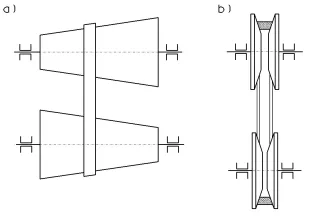
Image source: Wikimedia Commons / Original uploader was Jonasz at pl.wikipedia (CC BY-SA)
Low Line Pressure Across Every Gear Points Here
Slipping in every gear, hot or cold, usually means the pump isn't making pressure or the valve body is dumping it. Worn pump gears, a stuck pressure regulator, a leaking separator plate, or a torn accumulator piston all do it. A line pressure test at the case port confirms it before anyone pulls the unit.
Matching the Fix to the Verdict: Service, Solenoid, Valve Body, or Rebuild
By now you should be on a branch. Each one carries a very different price tag, so match the fix to the finding rather than to the first quote you're handed.
- Dark fluid, low level, no debris: service it. Drain-and-fill, fresh filter, recheck after 500 miles.
- Ratio codes plus a failed solenoid or sensor circuit: replace the electronic part first. Cheapest item on the board.
- Low line pressure in every gear with clean fluid: valve body before pump, every time.
- Clutch material on the magnet plus a burnt smell: the friction packs are done. Rebuild or replace.
Drain-and-fill and a full fluid exchange are not the same job. A drain-and-fill swaps roughly a third of the fluid and leaves debris where the filter can trap it. A full exchange on a high-mileage slipping unit can push loosened material straight into the valve body.
If it's already slipping badly, skip the flush.
Doing the service yourself is realistic for most owners, especially if you're comfortable dropping the pan. Sealed units with no dipstick need a model-specific procedure for topping up a sealed gearbox. Guessing that fill level causes as many slips as worn clutches do.
You'll also need height to reach the filter, and a pair of solid wooden ramps beats a flimsy jack, though the level check itself still happens on flat ground.
| Repair path | Typical cost |
|---|---|
| Scan and road test | $100 to $200 |
| Fluid and filter service | $100 to $350 |
| Solenoid or speed sensor | $200 to $800 |
| Valve body replacement | $800 to $1,800 |
| Full rebuild | $2,500 to $5,000+ |
| Reman unit, installed | $4,000 to $8,000+ |
Prices as of 2026 sit in these bands. Regional labor rates shift them, and CVT or luxury-brand units land at the top end.
Mistakes That Turn a $200 Repair Into a $4,000 Rebuild
The most expensive mistake is waiting. The second is trusting a bottle.
- Slip-fix additives. They swell seals and thicken fluid. That masks the symptom while the clutch packs keep burning.
- "Just drive it gently." Gentle driving still slips under partial throttle, and partial throttle is where the damage happens.
- Clearing codes before you scan. You erase the freeze-frame data that recorded when and why the fault set. Use a tool that reads transmission modules, and choosing a capable scanner is worth the homework.
- Universal fluid. A spec mismatch changes friction behavior and can finish off a CVT.
- Topping off instead of chasing the leak. A pan gasket is cheap. A pump starved of fluid is not.
Know when to stop. Slip that worsens under load, a burning smell, or a limp-mode warning means park it. Towing rules matter too, since most AWD and full-time 4WD units need a flatbed, so sort out where to hook a strap before the truck arrives.
Keep every receipt. Under the Magnuson-Moss Warranty Act, a warranty can't be voided simply because you did the service yourself, and paperwork is your proof. Check the NHTSA recall database for your model year as well.
Some slipping complaints turn out to be known defects covered by a campaign, which means the repair may cost you nothing.
Frequently Asked Questions
Does a fluid change fix transmission slipping?
Sometimes. If the fluid is dark and the slip is mild, a drain-and-fill with a new filter can restore pressure and shift quality. If the pan magnet is packed with clutch material, fresh fluid won't rebuild a worn friction surface.
Service buys time, not a cure.
Can a slip-fix additive make things worse?
Yes. Additives swell seals and alter friction behavior. That can quiet the symptom for a few thousand miles while the clutch packs keep wearing.
Most transmission manufacturers don't approve them, and the debris they loosen can block valve body passages.
How long can you drive with a slipping transmission?
Not long. Mild slip caught early can last weeks if you stop towing and keep fluid temperatures down. Slip that worsens under load, combined with a burning smell, usually ends in a tow within days.
The longer you drive, the smaller the cheap-fix window gets.
Why does my transmission only slip when it's cold?
Cold fluid is thick, so pressure control problems show up first. A torque converter that drains back overnight, a low fluid level, or a sticky valve body all cause a cold-only flare that fades in a few minutes. Hot-only slip points the other way, toward thin fluid and low pressure.
Is a slipping transmission always a rebuild?
No. Low fluid, a clogged filter, a failing solenoid, a chafed harness, or a bad speed sensor all mimic internal wear. A pressure test plus a code scan separates the hundred-dollar fixes from the four-thousand-dollar ones before anyone drops the unit.
