
If your car bangs into gear at a red light, you're probably asking why does my automatic transmission shift hard, and whether the gearbox is already toast. Here's the good news. Harsh shifting is usually a pressure problem, not a mechanical death sentence.
In most cases the transmission is still healthy and just being told to clamp its clutches too fast.
Manufacturer service data puts a normal shift at roughly 0.3 to 0.6 seconds, and anything beyond 0.8 seconds gets flagged as a fault. Fluid level is checked in a narrow window too, usually around 40 to 50 degrees Celsius with the engine running and the lever in a set position. Those two numbers matter far more than any internet symptom list.
Before you price a rebuild, you need to work out which pattern you're in.
Why Does My Automatic Transmission Shift Hard
Harsh shifting usually means line pressure is too high or applied too fast. Low or wrong-spec ATF is the most common cause. A sticking solenoid or dirty valve body can do it too.
Cleared adaptive memory also makes shifts feel firm. Note exactly when the bang happens. That timing narrows the fault quickly.
Why an Automatic Transmission Shifts Hard, and Why When It Happens Is the Real Clue
Every shift you feel is a hydraulic event. The Transmission Control Module (TCM) tells the electronic pressure control solenoid how much line pressure to send, and that pressure drives a piston that clamps a clutch pack. A smooth shift is just pressure ramping on gradually over a few tenths of a second.
Too much pressure, or pressure that arrives too fast, and the clutch slams home. That's the bang. Notice what it usually isn't: a broken gear.
Harshness is a message about conditions. The TCM learns shift pressure to suit your driving, and it keeps a separate learned value for each shift, such as 1-2 and 2-3. When something skews its inputs, whether fluid viscosity, throttle signal, or solenoid response, that learned value drifts until the correction runs out of room.
Here's the if/then logic worth memorizing. If the bang only shows up when the fluid is cold, suspect viscosity and stiff seals. If it appears in one gear only, suspect that clutch circuit or its solenoid.
If it started right after someone worked on the car, suspect the work first.
Same symptom, three different fixes. That's why the timing question comes before the parts cannon.
The Branching Diagnosis: Five Harsh-Shift Patterns and What Each One Points To
Match your complaint to one of these five patterns. Each one sends you somewhere different, and that saves you money.
Image source: Wikimedia Commons / Hymn62 (CC BY-SA)
It Only Slams on the First Few Shifts of the Morning
Cold ATF is thicker, and seals are stiff until they warm. Most units soften within a minute or two of driving. If the harshness fades once warm, you're likely looking at fluid condition, a restricted filter, or a tired pump, not a dying clutch.
It Bites Hard Only on the 1-2 Shift, Then Smooths Out
A single-gear complaint narrows the field fast. The 1-2 shift carries the most load and wears first. Worn valve body bores, a lazy shift solenoid, or an apply piston leaking past its seal all live here.
Read the 1-2 adaptive value before you buy anything.
It Shifted Fine Until the Battery Died or the Fluid Got Serviced
Cleared adaptive memory means the TCM starts from scratch. The first few drives feel firm or clumsy, and a battery disconnect does the same thing. Give it 20 to 30 minutes of varied driving with several full warm-up cycles.
If it hasn't settled by then, look deeper.
It Hangs, Flares, Then Engages With a Bang Under Light Throttle
Flare means the clutch slips before it grabs, which points to a pressure or volume problem. A leaking seal or worn pump is the usual suspect. Light-throttle flare followed by a bang is the pattern most likely to turn into a real repair bill.
Don't keep hammering it.
Every Gear Bangs and the D Light Is Flashing
That's limp mode, also called failsafe. The TCM has logged a fault and pinned line pressure high to protect the hardware. Every shift feels brutal because it genuinely is.
Read the codes before you drive another mile.
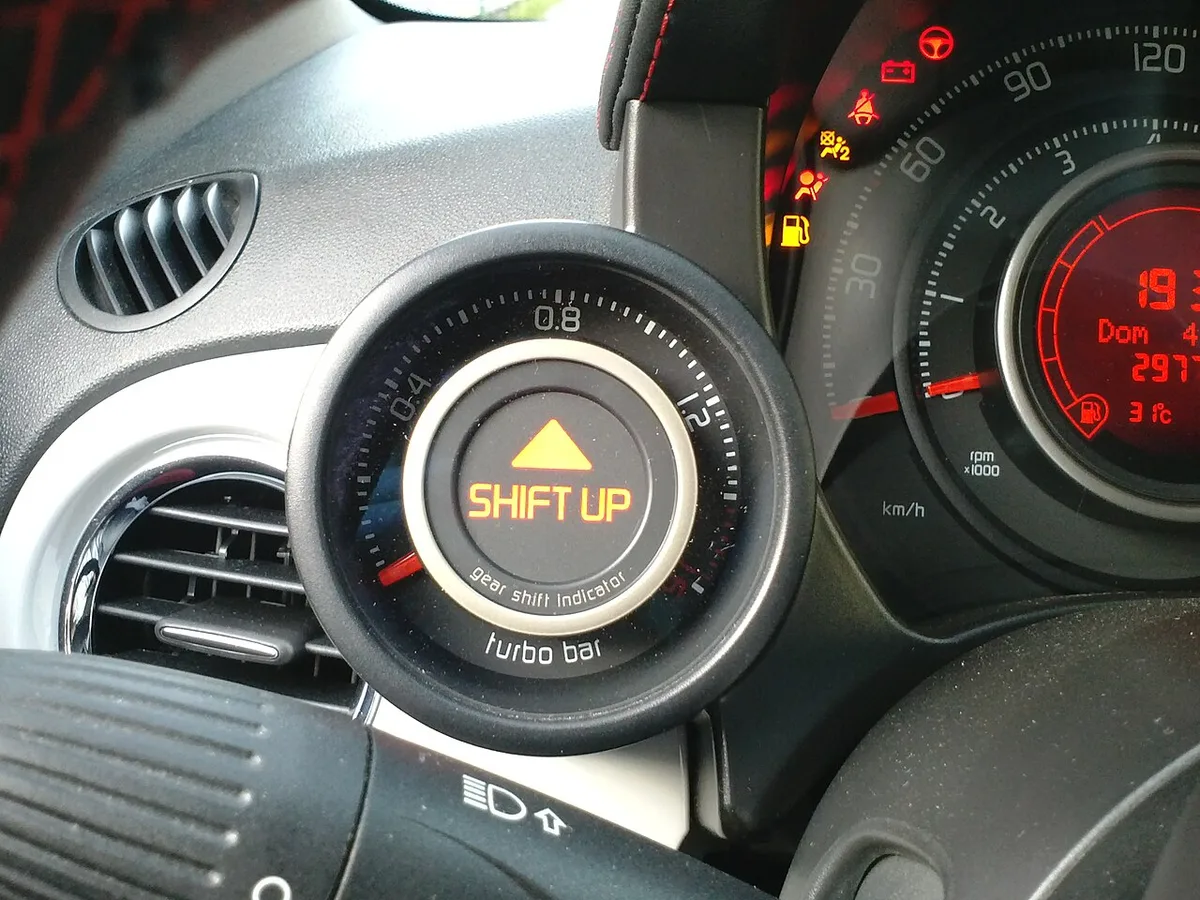
Image source: Wikimedia Commons / Jacapa090
Cheap Checks First: Fluid Level, Stored Codes, and Adaptive Learning
Most hard-shift complaints get solved here, before anyone drops a pan. Work through these in order.
- Scan every module, not just the engine. A basic engine-only code reader can miss TCM codes entirely, so it pays to know what separates a real diagnostic tool from a toy before you start guessing.
- Check the fluid the way the manual says. Engine running, correct temperature, correct lever position. Get this wrong and you'll chase a level that was never off.
- Wipe the dipstick on a white rag. Burnt smell, grit, or a milky look all tell you something. On a sealed unit with no dipstick, the fill-and-check procedure still exists, and here's how that job actually goes on a sealed gearbox.
- Pull the freeze-frame data. Record which gear, what throttle, what temperature. That single snapshot usually confirms the pattern you found above.
- Check for technical service bulletins by VIN. NHTSA keeps a public bulletin and recall database that often lists a known harsh-shift calibration fix for your exact model year.
- Rule out everything bolted to the transmission. Worn engine mounts, worn CV joints, and even oil-fouled plugs causing a load misfire can feel exactly like a transmission slam from the driver's seat.
If all six come back clean and the fluid is fresh, the next step is a line pressure test at the case tap with a shop gauge. That's the point where DIY diagnosis usually hands over. You'll also want the car safely in the air for anything involving the pan, and a proper set of ramps beats a wobbly jack every time.
What the Fixes Actually Cost
Costs are where harsh-shift panic gets expensive. Most of the cheap fixes sit under $250 in parts, and they solve a large share of cases. Pricing below reflects typical US independent shop and parts figures as of 2026.
| Repair | Typical cost | What it fixes |
|---|---|---|
| Fluid and filter service | $100 to $250 | Low, burnt, or wrong-spec ATF, restricted filter |
| Professional diagnostic scan | $100 to $200 | Identifies the actual fault before parts get thrown |
| Solenoid set | $150 to $400 parts | Sticking shift or pressure solenoid, one-gear harshness |
| Rebuilt valve body | $400 to $1,200 | Worn bores, cross leaks, chronic pressure control drift |
| TCM reflash or update | $100 to $250 | Known calibration faults covered by a bulletin |
| Remanufactured unit | $2,500 to $6,000 plus install | Internally worn transmission beyond economic repair |
| Full shop rebuild | $3,000 to $8,000 | Clutch and hard-part failure, limp mode with debris |
A fluid and filter service is the cheapest real diagnostic you can buy. If the pan comes down, look at the magnet. Fuzz is normal.
Chunks, brass glitter, or clutch material in the fluid mean the decision has already been made for you. While the pan is off, replacing the filter and gasket costs very little extra and removes one variable from the equation entirely.
Never authorize a rebuild on a verbal description alone. Ask for codes, adaptive values, and a pressure reading in writing. A shop that can't produce those numbers is guessing with your money.
Mistakes That Turn a $150 Fix Into a Full Rebuild
These are the moves that convert a cheap repair into a five-figure headache.
- Flushing a high-mileage, neglected unit. A power flush stirs up debris that was sitting harmlessly in the pan and pushes it into the valve body and solenoids. Drain and fill, or a pan drop, is the safer route on an unknown service history.
- Using the wrong ATF because it's "universal." Modern specs are not interchangeable. Dexron, Mercon LV and ULV, ATF+4, Toyota WS, and ZF LifeguardFluid all behave differently, and the wrong viscosity changes shift feel within a few hundred miles.
- Diagnosing before the adaptive relearn finishes. If the battery was disconnected or the codes cleared, you're judging a transmission that hasn't finished learning. Drive it properly first.
- Ignoring limp mode and driving on. Failsafe pressure is brutal by design. Continuing to drive with a flashing D light grinds clutch packs that might have survived a tow.
- Skipping the mount and driveline check. Plenty of "transmission clunks" get fixed with a $60 mount, and plenty of good transmissions get replaced because nobody looked.
- Overfilling to be safe. Too much fluid aerates and foams, and foamy fluid doesn't hold pressure. Follow the temperature procedure exactly.
One more: don't let a shop talk you into a rebuild before you've seen a line pressure reading. Numbers first, parts second. That rule alone has saved readers thousands.
Keep Driving, Park It, or Tow It: A Hard-Shift Decision Guide
If the D light is flashing, park the car. Limp mode means the TCM has already found a fault it can't correct, and every harsh shift from that point is clutch material going away. Towing costs a couple hundred dollars.
A rebuild costs thousands.
If the light is off and the car otherwise behaves, you can usually drive it gently to a shop or home. Use the branches below to sort the safe cases from the expensive ones.
- Harshness only when cold, gone in two minutes: drive it, book a service, and check the fluid level by the book. This is the most forgiving pattern.
- Harsh but no slip, clean fluid, no codes: short trips at light throttle are fine. Skip the highway pull and skip towing the trailer.
- Rough shift plus a flare (revs climb before it grabs): stop driving. Flare is slip, and slip burns clutch packs in a few hundred miles.
- Burnt smell, dark fluid, or grit on the rag: park it. Fresh fluid won't fix burnt friction material.
- Metal chunks or brass glitter in the pan: park it. That transmission is finished, and driving it just adds a torque converter to the bill.
- Harsh shift after a battery disconnect: drive it normally for 20 to 30 minutes. The relearn needs varied driving, not a parking lot.
One rule covers most of it. Harshness without slip is annoying. Harshness with slip is expensive.
If you can't tell which one you've got, treat it as slip until a technician says otherwise.
Two safety notes before you crawl under anything. Hot ATF will burn you, so let the unit cool first. And used fluid goes to a household hazardous waste site, per EPA guidance on used oil, never down a drain.
Frequently Asked Questions
Is a hard shift always a sign the transmission is failing?
No. Most harsh-shift cases trace back to fluid level, fluid spec, a sticking solenoid, or cleared adaptive memory, and those are cheap fixes. A failing transmission usually brings friends along: slipping, flaring, a burnt smell, or a flashing gear indicator.
Harshness on its own is a pressure complaint, not a death sentence.
Can I just reset the adaptive learning myself?
You can, and on many models it's a scan-tool function rather than a secret handshake. But resetting without fixing the underlying cause just restarts the clock. The TCM relearns the same bad correction and you're back where you started in a few hundred miles.
Diagnose first, then reset.
Does a transmission flush fix harsh shifting or cause it?
It can do either. A gentle fluid exchange on a maintained unit often smooths shifts noticeably. A high-pressure flush on a neglected, high-mileage gearbox can lift debris out of the pan and push it into the valve body and solenoids.
On unknown service history, a drain and fill or a pan drop with a new filter is the safer call.
Will the wrong ATF really make it shift hard?
Yes, and faster than most people expect. Shift feel depends on viscosity and friction modifiers, and the specs genuinely differ between Dexron, Mercon ULV, ATF+4, Toyota WS, and ZF LifeguardFluid. A "universal" fluid that claims to cover everything is a gamble.
Use the spec printed in your owner's manual, not the one on the shelf.
How long can I drive with a transmission stuck in limp mode?
Minutes, not miles, and only to get off the road. Failsafe mode pins line pressure high to protect the hardware, so every shift is genuinely brutal. Clutch packs that would have survived a tow can be scored beyond reuse in a short drive.
Call for recovery and read the codes where you stop.
