
Every automatic on the road shows you a handful of letters, and most drivers only ever touch two of them. If you've ever wondered what do the gear letters on an automatic mean beyond Park and Drive, you're in good company. The letters look simple enough.
The trouble is that the same letter can do completely different jobs in different cars.
In the US, Federal Motor Vehicle Safety Standard 102 locks in the P-R-N-D-L order, so those first five positions stay predictable across brands. Everything after D is up to the manufacturer. Toyota and Lexus hybrids use B for engine braking, Ford trucks add Tow/Haul, and plenty of modern CVTs label a ratio hold as L.
Here's what each position actually does, and when it's the right call.
What Do the Gear Letters on an Automatic Mean
Gear letters on an automatic tell the transmission which range of gears to use. P locks the output shaft. R reverses the direction of travel.
N disconnects the engine from the wheels. D gives you every forward gear automatically. Letters past D change how and when the car shifts.
Why the Gear Letters Confuse Almost Everyone
Two or three forward gears became eight, nine, even ten. The letters never changed to match.
That's the short version. Early automatics had so few ratios that a single D covered the whole range. A modern 10-speed in a pickup has more forward gears than the alphabet on the console can describe.
So manufacturers stacked extra positions on top of the old lineup to fill the gap.
Then the branding took over. Federal rules fix the first five positions for cars sold in the US, which means P, R, N, D, and L land in the same order in almost everything you rent or borrow. Everything past D is manufacturer territory.
A B position on a Toyota hybrid means engine braking. On another car, a B might mean a low range. Same letter, different job.
Physical layouts changed too, and that made reading the lever harder. Column shifters gave way to console gates, rotary dials, push buttons, and monostable levers that spring back to center after every move. Push-button start and modern keyless entry and start systems removed one more cue, because there's no ignition cylinder to tell you what state the car is in.
That mix caused a genuine safety problem. In 2016, Fiat Chrysler recalled more than a million vehicles because the monostable shifter snapped back to center after each selection. Drivers couldn't feel which gear they'd picked, and some walked away believing the car was in Park.
The National Highway Traffic Safety Administration documented rollaway injuries before the fix, which added stronger warnings and a slow-speed auto-park feature. You can read the agency's recall records directly at NHTSA.
Here's what actually varies from brand to brand:
- What sits past D. Some cars have S, some have L, some have both, some have M with paddles.
- What the letter does. L holds a low gear on a Ford, locks out overdrive on an older Chevy, and does something else again on a Subaru.
- Where the lever lives. Column, console, dash, or a dial on the center stack.
- Whether the lever even moves. Monostable and push-button setups never stay where you put them.
- What the cluster shows. The gear indicator on the dash is the real answer, not the lever position.
That last point is the one worth taping to your sun visor. Trust the indicator in the instrument cluster. The lever is just a switch.
What P, R, N, D, S, L, B, and M Actually Do
Here's the full lineup, plus where you'll typically run into each one.
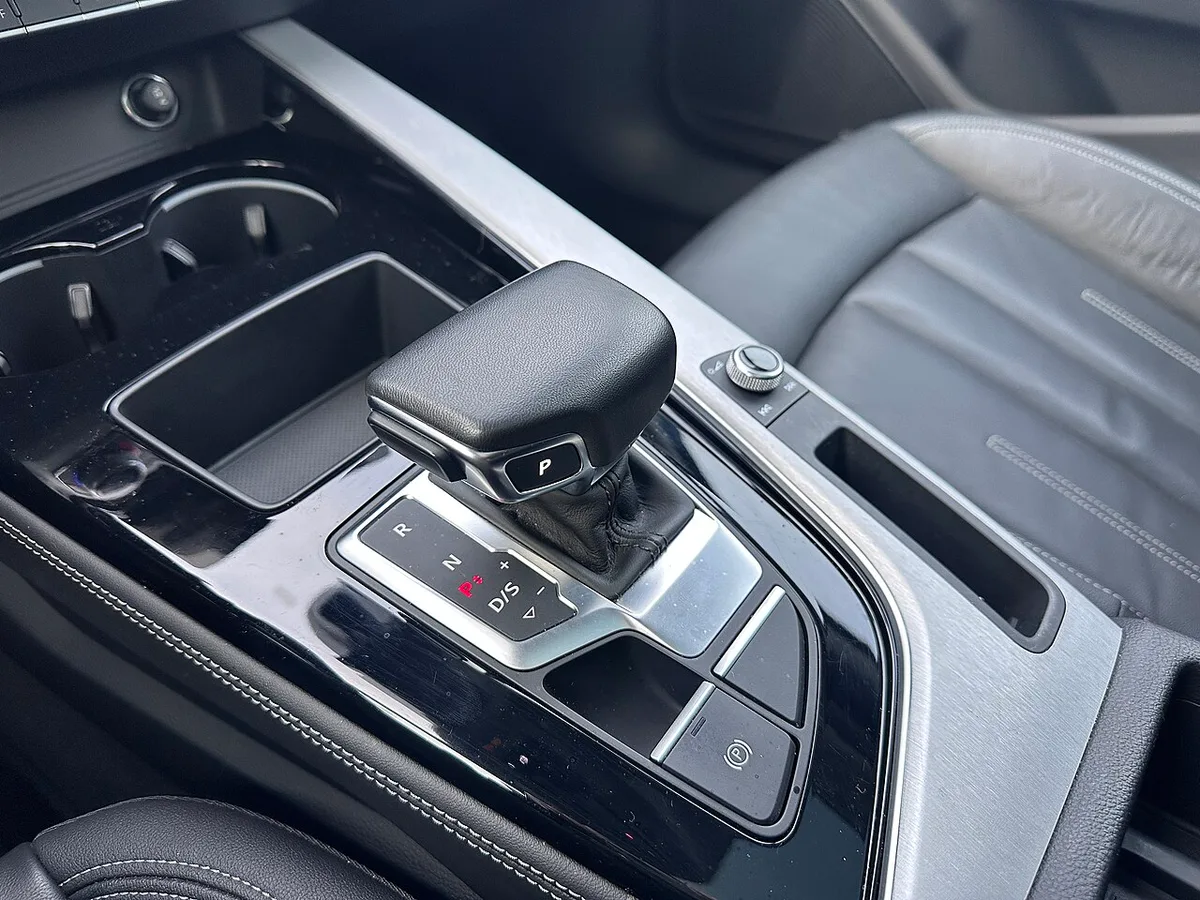
Image source: Wikimedia Commons / Acgskup (CC BY)
| Letter | What it actually does | Where you'll usually see it |
|---|---|---|
| P | Drops a parking pawl into a toothed wheel to lock the output shaft | Every automatic |
| R | Reverses the direction the wheels turn | Every automatic |
| N | Disconnects the engine from the wheels, with no lock | Every automatic, plus car washes and flat towing |
| D | Uses all forward gears automatically | Every automatic |
| L | Holds lower gears or locks out the top ratio | Trucks, CVTs, older domestic cars |
| S | Raises shift points and holds gears longer | Sport trims across most brands |
| B | Adds engine braking and stronger regenerative drag | Toyota and Lexus hybrids |
| M | Hands shift control to you, within programmed limits | Cars with paddles or a manual gate |
What Does P Actually Hold?
P engages a parking pawl, a metal pin about the size of your finger that drops into a notched wheel on the transmission output shaft. It's built to hold a stationary car on a normal slope, not to stop a rolling one. Never shift into P while the car is still moving.
On a steep hill, set the parking brake first and let it take the load. That keeps the pawl from binding, which is why some cars are hard to shift out of Park after sitting on an incline. The pawl is a parking aid.
The brake is the brake.
What Do R and N Actually Do?
R sends the transmission through a reverse gearset, and most modern cars won't engage it above roughly 3 to 5 mph. N simply opens the connection between engine and wheels. Nothing locks, so the car can roll.
N gets misused more than any other position. Coasting downhill in neutral is illegal in many US states and removes the engine braking that keeps your speed in check. Sitting at a red light in N saves nothing measurable and cuts fluid flow through the cooler on some units.
Leave it in D and hold the brake.
Why Does L Mean Different Things on Different Cars?
L is the least standardized letter on the console. On a conventional automatic, it holds the transmission in the lowest gear or gears so the engine can brake the car. On a CVT, it commands a low ratio range for climbing or descending.
On older domestic cars, the same idea showed up as D3, D2, 3, 2, 1, or an OD OFF button that locked out the top cog.
The practical test is simple. Select L at low speed and watch the tachometer. If rpm climbs and stays up as you accelerate, the transmission is holding a lower range.
If nothing changes, that car's L does something else, and the owner's manual is the only reliable answer.
What Is S For, and What About B?
S stands for Sport, and it isn't a gear at all. It's a different shift schedule. The transmission waits longer before upshifting, downshifts more eagerly, and often holds a gear when you lift off the throttle.
You get sharper response and worse fuel economy. That's the whole trade.
B shows up almost exclusively on Toyota and Lexus hybrids. It increases regenerative braking and engine braking on a descent, which recovers energy instead of burning it off in the brake pads. B is not Reverse, and it's not a brake pedal substitute.
It's a drag mode for long downhill runs.
Does M Do Anything on Its Own?
Usually not. On most cars, moving the lever to M arms manual mode but changes nothing until you touch a paddle or nudge the lever. Some vehicles will hold the current gear, others will drop one to signal you're in control.
Two behaviors surprise new owners. First, the computer still protects itself, so it will upshift near redline and refuse a downshift that would over-rev the engine. Second, most cars return to full automatic if you stop touching the paddles for a while.
Manual mode is a request, not a command.
The letters past D don't add power. They change when and how the transmission shifts, and that's it.
How Your Car Turns a Letter Into a Shift, and Why the Letters Aren't Universal
The lever sends a signal. A computer makes the actual decision.
That computer is the Transmission Control Module, or TCM. It reads throttle position, vehicle speed, engine load, brake status, and traction control input many times per second, then picks a gear from a shift map. Adaptive learning layers on top, so the transmission gradually adjusts to how you drive.
That's why a rental car feels different after a week with you in it.
Three mechanisms explain most of what you feel from the driver's seat:
- Torque converter lockup. A clutch inside the converter closes at steady cruise, tying the engine to the driveline. Highway rpm drops a few hundred and fuel economy improves.
- Kickdown. Push the pedal past its detent and the transmission drops one or two gears at once for passing power.
- Gear hunting. On a grade, the box upshifts, loses speed, downshifts, and repeats. Tow/Haul and L exist mainly to stop this.
Modern "gearboxes" aren't all the same animal, which is why the letters behave differently.
| Type | How it shifts | What the letters feel like |
|---|---|---|
| Torque-converter automatic | Planetary gearsets and clutch packs | Smooth steps, creeps at idle |
| CVT | Steel belt on variable pulleys | Stepless, drones, fakes "gears" |
| Dual-clutch (DCT/DSG) | Two clutches preselect the next gear | Fast, occasionally jerky, little creep |
| eCVT (hybrid) | Power-split planetary with motor assist | Seamless, engine rpm floats free of speed |
On a CVT, L and S don't select a gear because there are no gears to select. They change the ratio the computer targets. The letters survived because drivers expect them, not because the hardware still matches.
When something feels wrong, the TCM usually knows before you do. It stores diagnostic trouble codes for shift solenoid faults, slipping clutches, and sensor failures, and pulling the stored fault codes with a scan tool takes ten minutes and costs far less than a rebuild. Fluid condition matters just as much.
A unit that's been cooked will act up long before it fails, and a full fluid and filter service at 30,000 to 60,000 miles on a severe schedule is cheap insurance. For owners doing it at home, keeping the fluid at the right level on a sealed unit is the step most people get wrong.
The Four Conditions That Decide Which Letter You Actually Need
Forget the alphabet for a second. Four variables decide which position you want: load, grade, grip, and speed.
Load is what you're carrying or towing. Grade is whether the road climbs or falls. Grip is how much traction the surface offers.
Speed is whether you're crawling or cruising. Change any one of them and the right answer can flip.
| Condition | What you'll notice | What to select |
|---|---|---|
| Heavy trailer on a climb | Constant shifting, rising transmission temperature | Tow/Haul, or L/4 to lock a gear |
| Long descent | Speed creeping up with your foot off the gas | L, S, M in a low gear, or B on a hybrid |
| Snow or ice on takeoff | Wheelspin, tail stepping out | Snow or Winter mode, or a second-gear start |
| Crawling traffic in a DCT | Shudder at low speed | Leave it in D, let the clutches manage |
| Steep driveway or ramp | Car lurching, hard to modulate | L or a low manual gear, feather the throttle |
| Off-road in soft ground | Wheels spinning, no momentum | 4L or a low range plus a taller gear |
Now the if/then version, which is how you'll actually use it:
- If the transmission keeps hunting between two gears on a climb, then select Tow/Haul or drop to a numbered low range and let the engine pull.
- If you're descending and the car gains speed with your foot off the pedal, then pick a lower range before the brakes get hot, not after.
- If the tires spin on a cold start in snow, then engage a winter mode or start in second gear to soften the torque hit.
- If you're in stop-and-go traffic with a dual-clutch, then leave it in D. Manual mode in a crawl just adds clutch heat.
- If you're towing on rolling terrain, then turn Tow/Haul on before the grade begins. Engaging it mid-slide is too late.
- If you're on a hybrid and the battery is full at the top of a long descent, then B is your friend. The engine braking picks up where regeneration runs out.
One warning about branching on feel alone. The lever position tells you nothing about what the transmission is doing right now. Glance at the cluster indicator, especially in rentals and unfamiliar cars.
Long Mountain Descents: Engine Braking Without Cooking Your Brakes
Brakes turn motion into heat. On a long descent, they can't shed that heat fast enough.
A 4,000-pound car at highway speed carries a lot of energy, and every brake application converts some of it into temperature at the rotors. Drag the brakes for a few miles and pad temperatures climb past the point where the friction material fades. The pedal then feels soft or long, and stopping distance grows fast.
Brake fluid is the next weak link. DOT 3 fluid boils around 401°F when fresh but closer to 284°F once it absorbs moisture, and DOT 4 sits near 446°F dry. Boil the fluid and the pedal goes to the floor no matter how hard you push.
Engine braking solves the problem by letting the engine absorb the load. The transmission holds a low gear, the engine spins faster, and the car slows without touching the pads. The old rule from commercial driving still holds: descend a grade in the same gear you'd need to climb it.
Here's the sequence that works:
- Slow down before the grade starts. Pick your target speed while the road is still flat.
- Select your range early. L, S, M in a low gear, or B on a hybrid. Do it at the top, not halfway down.
- Confirm the engine is holding. Watch the tach. Rpm should climb and stay elevated as the car descends.
- Brake in short, firm applications. A few hard, brief presses shed speed and let the brakes cool between them.
- Step up a gear if rpm gets close to redline. Most transmissions will upshift on their own, and you can help with the paddle.
- Pull over if you smell hot brakes or feel the pedal soften. Let everything cool before continuing.
What not to do on a descent:
- Don't coast in N. Many state vehicle codes, including California's, make coasting downhill in neutral illegal, and it removes your engine braking entirely.
- Don't ride the brakes for miles. Light continuous pressure is the fastest route to fade.
- Don't downshift two gears at once on a wet or icy surface. Engine braking can break traction on a rear-drive car, so ease into it.
- Don't trust engine braking over black ice. Use gentle, early braking and let ABS and stability control do their jobs.
- Don't forget the basics of control. Your hand position on the wheel matters more on a descent than anywhere else, because a sudden curve at speed needs both hands and your eyes up the road.
One more number worth knowing. Transmission fluid runs at roughly 175°F to 200°F in normal use, and sustained heat above about 250°F accelerates oxidation sharply. A long grade in the wrong gear pushes fluid temperature up and holds it there.
That's the quiet cost of riding the brakes instead of using the letters.
Towing and Hauling: When Tow/Haul, OD Off, or L Earns Its Keep
A trailer changes the math. It adds weight, drag, and a pendulum behind your rear axle.
Tow/Haul mode is the manufacturer's answer. Press the button and the transmission raises its shift points, holds gears longer, and keeps the torque converter locked on deceleration so the trailer doesn't push the truck around. Many trucks also tie it to a changed grade logic and an integrated trailer brake controller.
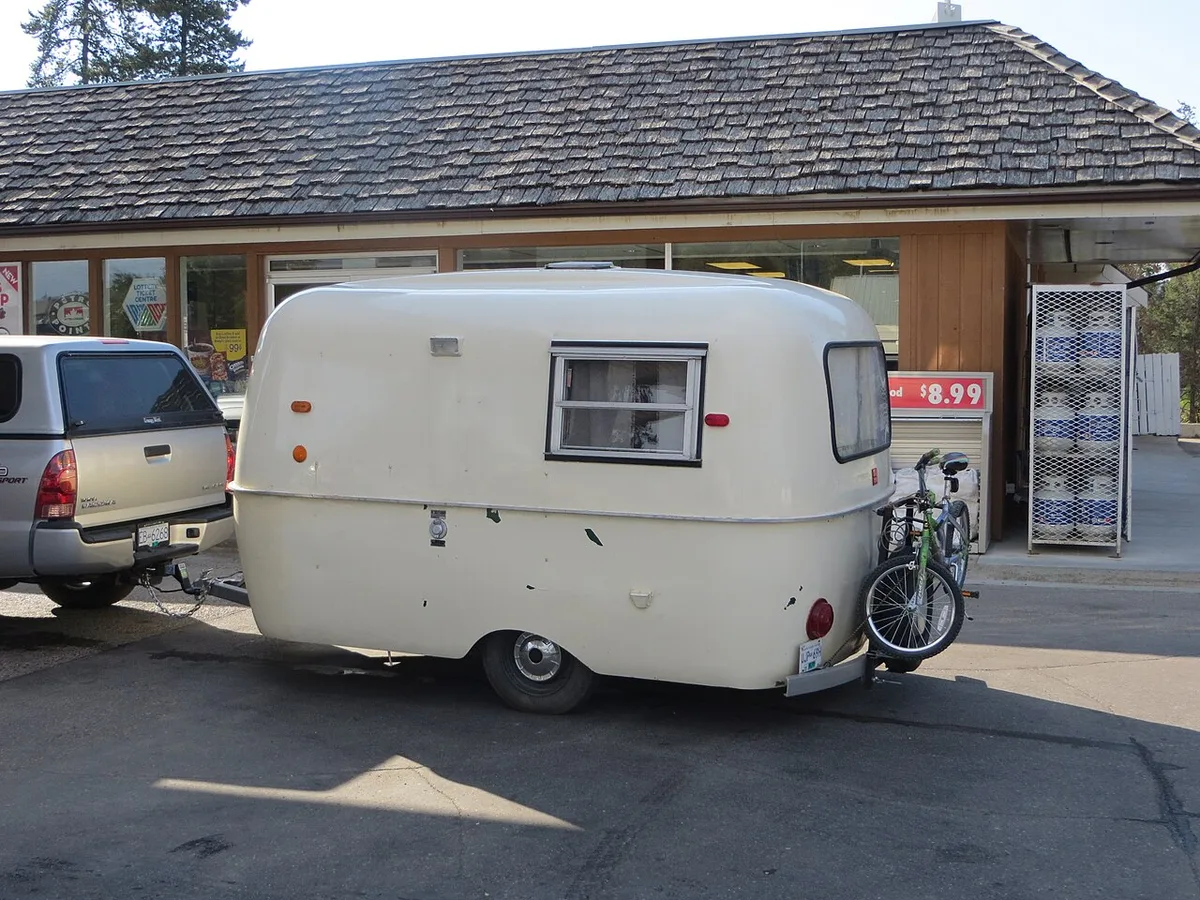
Image source: Wikimedia Commons / David Wilson from Oak Park, Illinois, USA (CC BY)
Here's what the mode actually changes, per manufacturer specs:
- Shift timing. Upshifts happen later, so the engine stays in its torque band.
- Downshift behavior. The box drops a gear sooner on a grade instead of lugging.
- Converter lockup. It stays locked more often, which cuts heat and slip.
- Grade logic. Some trucks will hold a gear all the way down a descent without you asking.
- Brake integration. Tow/Haul can trigger trailer brakes and exhaust brake on diesel models.
What About OD OFF and the Numbered Ranges?
OD OFF is the older version of the same idea. On a 4-speed automatic from the 1990s or 2000s, that button locked out the top overdrive gear so the transmission wouldn't hunt between third and fourth on a grade. Pressing it at highway speed dropped the revs up a few hundred and stopped the shuffle.
Numbered positions do it more precisely. D3 caps the transmission at third gear, D2 at second, and 1 or L at first. Modern 8- and 10-speeds replaced the numbers with a manual gate, so you tap down to the gear you want and the box holds it.
The logic is identical across all three eras. You're telling the transmission "do not go above this gear."
How Do You Pick the Right Range for a Load?
Match the choice to the load and the terrain.
| Situation | Select | Why it works |
|---|---|---|
| 6,000 lb trailer on flat highway | D with Tow/Haul on | Holds lockup, cuts hunting, keeps temps down |
| Long climb with a camper | Tow/Haul, or L/4 to lock a gear | Stops the upshift-downshift cycle that builds heat |
| Steep descent with trailer brakes | Tow/Haul plus a low manual gear | Engine and trailer brakes share the load |
| Boat ramp or steep gravel | 4L plus first gear | Maximum torque multiplication at walking speed |
| Empty truck on rolling hills | D, Tow/Haul off | The mode just burns fuel when there's no load |
| Older 4-speed towing in summer | OD OFF | Removes the weakest gear from the rotation |
Two numbers explain most towing failures. Gross combined weight rating, or GCWR, is the total the truck and trailer can weigh together. Exceed it and no gear selection saves the transmission.
The other is fluid temperature, which climbs fast under load and starts breaking down above roughly 250°F.
Watch the gauge if you have one. If you don't, add an aftermarket monitor before your next long haul. A $200 gauge is cheaper than a $6,000 rebuild.
What Are the Common Towing Mistakes?
- Leaving Tow/Haul off until the transmission starts hunting. Turn it on before the grade.
- Towing in overdrive on an old 4-speed. The weakest clutch pack takes the load.
- Using L for highway towing. It pins rpm high and cooks fluid for no benefit.
- Ignoring payload while chasing tow rating. A lockable bed cover adds a little weight and a lot of aero help, but gear in the bed still counts against your limit.
- Assuming the truck's ratio is enough. A 3.21 final drive tows differently from a 3.73 or 4.10, and the door sticker tells you which you have.
- Skipping the cool-down. Let the truck idle a couple of minutes after a hard pull so fluid circulates and temperatures settle.
One habit worth building: before you hook up, read the trailer's weight and your truck's ratings. Then decide the gear. Not the other way around.
Snow, Ice, and Steep Driveways: The Low-Grip Branch
Low grip flips the usual advice. Normally you want more torque. On ice, you want less.
That's why Snow and Winter modes exist. They soften throttle response, start the car in second gear, and sometimes alter traction control thresholds so the system allows a little slip instead of cutting power dead. The goal is a gentle launch.
Wheelspin on a cold tire gets you nowhere fast.
Subaru's X-MODE, Toyota's Multi-Terrain Select, and similar systems go further. They manage throttle, brakes, and torque split together. Aggregated owner reports suggest they help most on loose snow and gravel, and help least on polished ice where only studs or chains make a real difference.
Should You Use a Low Gear on Snow?
Yes on a climb, no on a descent. That's the short answer.
A low gear on a snowy incline keeps the engine in its power band and stops the transmission from upshifting mid-slope, which is when you lose momentum. On the way down, aggressive engine braking can lock the driven wheels and break traction, especially in a rear-drive car with an open differential.
Use gentle, early braking instead. Let ABS and stability control work. If the car starts to slide, ease off and steer where you want to go.
| Situation | Select | Reason |
|---|---|---|
| Flat takeoff on packed snow | Snow mode, or manual second gear | Cuts the torque hit at the tires |
| Climbing a snowy hill | D or S, steady throttle | Keeps momentum without a shift mid-slope |
| Descending a snowy hill | Low gear plus light braking | Splits the work, avoids wheel lock |
| Deep snow, need to push through | D, traction control off if it's cutting power | Momentum matters more than grip management |
| Icy driveway apron | Second gear, feather throttle | Lowest risk of spin |
How Do You Handle a Steep Driveway or Loading Ramp?
Slow, deliberate, one input at a time.
Line the car up straight before you commit. Then select L or first gear in manual mode so the car creeps at a controlled speed. Keep your foot on the brake and let idle creep do the work.
If you have Hill Start Assist or Auto Hold, it'll hold the brake for a second or two while you transition from brake to throttle.
Don't ride the clutch in a DCT on a steep ramp. Don't stab the throttle to "get it over with." And don't forget the parking brake when you stop, because a pawl alone on a 15% grade is doing more work than it wants to.
What About Ice and Engine Braking Together?
This is the one place where the letters can hurt you.
Engine braking sends torque backward through the driveline. On a low-grip surface, that torque can exceed what the tires can transmit, and the driven wheels stop turning while the car keeps sliding. Front-drive cars plow.
Rear-drive cars step out.
So on ice, downshift one gear at most. Apply the brakes progressively. And keep your steering inputs smooth so the front tires keep rolling and steering.
A quick rule: if you can see your breath, don't let the transmission do your braking.
Stop-and-Go Traffic, Hybrids, and What B Is Really For
Traffic is where most gear-letter myths live. Let's clear the big one first.
Putting the car in N at every red light saves no measurable fuel and adds wear. In a conventional automatic, N drops line pressure and reduces fluid flow through the cooler. In a dual-clutch, it makes the clutches do more work on the next engagement.
Leave it in D and hold the brake. That's what the hardware is designed for.
Auto Hold and brake hold features make this easier. Tap the brake at a stop, and the car holds pressure for you until you touch the throttle. No foot fatigue, no gear shuffle.
What Does B Mean on a Hybrid Shifter?
B means engine braking on Toyota and Lexus hybrids. Selecting it increases regenerative drag and, when the battery is full, adds real engine braking through the power-split system.
That last part is the key. Regenerative braking only works while the high-voltage battery has room to accept charge. On a long descent from a mountain pass, the battery fills in a few miles.
Once it's full, regen stops and the car freewheels faster. B picks up where regen runs out.
Use B for long descents and steep grades. Don't leave it on for normal driving. It holds the engine at higher rpm, which hurts fuel economy and makes the cabin louder.
How Does an EV Compare to B?
An EV does the same job with different labels. One-pedal driving modes, regen paddles, and "L" or "B" positions on some models all increase the amount of energy recovered per lift of the throttle. Hyundai and Kia use paddle levels.
Nissan calls it e-Pedal. Tesla ties it to a regen strength setting.
The trade-off is the same everywhere. More regen means more drag and less coasting. The U.S.
Department of Energy's fuel economy resources lay out how regenerative capture changes consumption in city versus highway cycles, and the city advantage is the whole reason hybrids exist.
Is S Mode Bad for the Car?
No. S just changes the shift schedule.
It holds gears longer, downshifts earlier, and often keeps the converter unlocked for quicker response. You'll see worse fuel economy and more engine noise. You won't hurt anything.
On some sportier models, S also tightens the throttle map and changes stability control thresholds.
What does add wear is leaving a car in a low manual gear at highway speed. Sustained high rpm raises fluid temperature and puts constant load on the clutch packs. If the tach sits above 4,000 at cruise, you're in the wrong position.
Does Eco Mode Really Save Fuel?
Usually a little. Our reading of EPA test methodology and manufacturer documentation suggests ECO modes typically return 1 to 3 mpg in mixed driving.
The gains come from earlier upshifts, a softer throttle map, and reduced accessory load. On a flat commute with steady speeds, you'll see the benefit. On hills with a load, ECO can cause more shifting and less benefit.
If the transmission starts hunting, turn it off.
Manual Mode and Paddles: What M Does (and Doesn't Do)
Manual mode gives you the gear choice. It doesn't give you a clutch.
That distinction matters. In M, you're telling the TCM which gear you want. The computer still decides whether to honor it.
Most units will refuse a downshift that would push the engine past roughly 6,000 to 6,500 rpm, and many will upshift on their own near redline to protect themselves.
So M is a strong suggestion, not a mechanical linkage.
What Do the Different Brands Call It?
Almost every maker has its own name for the same feature.
| Brand | Label |
|---|---|
| Toyota and Lexus | S mode with a +/- gate, or M on some models |
| Ford | SelectShift |
| GM | Tap Up / Tap Down, or M |
| Chrysler, Dodge, Jeep | AutoStick |
| BMW | Steptronic |
| Mercedes-Benz | Manual mode on 7G- and 9G-Tronic |
| Volkswagen and Audi | Tiptronic |
| Honda | Sport mode with paddle shifters |
| Nissan | Manual gate on Xtronic CVTs |
| Subaru | Manual mode with paddles |
The behavior underneath is similar. Move the lever to the manual gate, then use paddles or the lever itself to change gears. Some cars require a second press to confirm.
How Do You Actually Use M Well?
Three situations where it genuinely helps.
- Before a pass. Downshift one or two gears early so the car is already pulling when you commit. Waiting for kickdown costs a beat you may not have.
- Long descents. Pick a gear that holds your speed without brakes. Adjust as the grade changes.
- Towing and steep ramps. Lock a gear so the transmission can't upshift mid-climb.
And three situations where it hurts. Stop-and-go traffic in a DCT adds clutch heat. Snowy descents risk wheel lock.
Highway cruising in a low gear just burns fuel.
What Surprises New Owners?
Two things, mostly.
The auto-upshift is the first. You hold second to redline expecting a shift, and the car shifts for you anyway. That's protection, not a fault.
The second is the time-out. Most systems quietly return to full automatic after 10 to 30 seconds of no paddle input, or when you come to a stop. If the car "keeps shifting by itself" in manual mode, you've probably timed out.
There's also rev matching on downshifts in many modern units. The engine blips to match road speed, which smooths the shift and reduces driveline shock. It's a nice piece of engineering.
It's not you being talented.
Does Manual Mode Make a Car Faster?
Not usually. Modern automatics shift faster than human hands, which is why most performance cars quote quicker 0-60 times in automatic mode.
Where M wins is predictability. You know which gear you're in and what happens next. On a track, that's worth more than raw shift speed.
On a mountain road, it's worth more than a tenth of a second.
Off-Road Ranges: Keeping 4H, 4L, and the Gear Lever Straight
Two different gear systems live in a 4WD truck, and people mix them up constantly.
The transmission is the gearbox you've been reading about. The transfer case is a second box behind it that sends power to the front axle and offers a low range. The gear lever picks a ratio.
The transfer case picks which wheels get power and how much multiplication they get.
| Mode | What it does | When to use it |
|---|---|---|
| 2H | Rear wheels only | Dry pavement, normal driving |
| 4A or Auto | Clutch sends power forward as needed | Wet roads, patchy snow, mixed surfaces |
| 4H | Locks front and rear together | Snow, gravel, mud, dirt at speed |
| 4L | Same lock plus roughly 2.7:1 reduction | Crawling, steep climbs, deep mud, heavy pulling |
That reduction ratio is the headline. A typical 4L is around 2.7:1, which multiplies whatever first gear gives you. Combine a 4.7:1 first gear with a 2.7:1 low range and you get crawling torque that no automatic mode can match.
Can You Shift Into 4L While Moving?
Usually not. Most manufacturers require a stop, shift to N, then engage 4L. Some electronic systems allow engagement below 3 mph.
Check your manual before you try it on a trail.
The bigger risk is driving a part-time 4WD system on dry pavement. With the transfer case locked, the front and rear axles fight each other in turns because they need to travel different distances. That's driveline wind-up, and it can damage the transfer case.
Save 4H for surfaces that can slip.
Where Do Crawl Control and Hill Descent Control Fit?
They're automation layered on top of the letters.
Hill Descent Control sets a target crawl speed, usually somewhere between 1 and 5 mph, and modulates the brakes to hold it. You steer. The truck does the rest.
Crawl Control does the same on loose surfaces, managing throttle and brakes together so you don't dig in.
Terrain modes (Sand, Mud, Rock) change throttle mapping, shift points, and traction control thresholds all at once. Per manufacturer documentation, Rock mode typically holds first gear and delays upshifts to keep torque steady.
What you should still do yourself: pick the range, know your recovery points before you need them, and walk the obstacle before driving it. Electronics help. They don't scout for you.
What Are the Off-Road Gear Mistakes?
- Running 4H on dry asphalt. Wind-up and premature transfer case wear.
- Using 4L on the highway. Engine screaming, fluid hot, no benefit.
- Leaving the transmission in D on a steep descent. It upshifts, and you lose engine braking.
- Downshifting mid-obstacle. Pick your gear before the tires hit the rock.
- Forgetting the rear differential lock. On loose climbs, an unlocked diff sends power to the spinning wheel.
- Ignoring transmission temperature. Low range and slow going means little airflow through the cooler.
One last distinction. 4L multiplies torque. It does not increase traction. Traction comes from tires, weight, and how gently you use the pedal.
Mistakes That Quietly Wear Out a Transmission
Transmissions rarely fail all at once. They wear out in small increments, one habit at a time.
Our review of shop data and owner forums points to the same handful of culprits again and again. None of them feel dramatic in the moment. All of them show up as a rebuild bill years later.
Which Habits Do the Most Damage?
| Habit | What it does inside the box | Better move |
|---|---|---|
| Holding on a hill with throttle, not brakes | Torque converter slips and fluid temp spikes | Use the brake or Auto Hold |
| Shifting D to R while still rolling | Shock loads the clutch packs and band | Come to a full stop |
| Skipping fluid service on a "lifetime" fill | Contaminants and varnish build until valves stick | Service at 60,000 to 100,000 miles |
| Using the wrong fluid spec | Wrong friction modifiers cause slip or harsh shifts | Match the exact number in the manual |
| Brake-torqueing a dual-clutch at a light | Clutches slip and cook | Hold with the brake, leave it in D |
| Resting your hand on the lever | Constant pressure on the manual gate | Hands on the wheel |
| Adding power without a TCM tune | Stock shift pressures meet more torque | Tune the shift strategy with the engine |
| Ignoring a shudder at light throttle | Worn converter clutch lining spreads debris | Diagnose in the first few hundred miles |
What Does Shift Flare or Shudder Tell You?
Shift flare is rpm rising without the car accelerating, usually right as a gear engages. Shudder is a rapid vibration at light throttle, often between 30 and 50 mph when the converter clutch locks. Both are early warnings, and both are cheap to diagnose and expensive to ignore.
Shudder that clears when you lift off the throttle points at the torque converter clutch. Flare on one specific shift points at a clutch pack or a worn valve body bore. Either one deserves a scan tool and a fluid inspection before it becomes a rebuild.
Why Is "Lifetime Fluid" Misleading?
"Lifetime" in a service manual usually means the warranty period, not the life of the car. ZF, a major transmission supplier, has publicly recommended fluid changes around 60,000 to 80,000 miles on units it originally called sealed for life.
Our reading of manufacturer schedules shows the same pattern. Severe-service columns list 30,000 to 60,000 miles for towing, heavy traffic, and hot climates. Most drivers fall into at least one severe category without realizing it.
How Long Should a Transmission Last?
Aggregate shop and fleet data puts the realistic range at 150,000 to 200,000 miles with regular fluid service. Failures cluster earlier, often between 100,000 and 150,000 miles, on units that never had a fluid change.
The exception is the eCVT in hybrids, which has fewer wear parts and routinely runs past 200,000 miles on basic maintenance. Different animal, different lifespan.
Parking, Rollaway Risk, and the Rules Behind the Letters
Park is the letter with the highest stakes. Get it wrong on a slope and the car becomes a runaway object.
Why Does the Car Make You Press the Brake to Leave Park?
That's the brake-shift interlock, and it's a regulated safety feature, not a convenience. Federal Motor Vehicle Safety Standard 114 requires cars to resist accidental movement out of Park. The interlock sits under that umbrella.
It also explains why you can't pull the key or shut down a push-button car easily while it's in gear. As of 2026, most keyless systems add a chime and an automatic shift to Park when the driver's door opens with the fob gone.
What Actually Holds the Car in Park?
A parking pawl, roughly finger-sized, drops into a notched wheel on the transmission output shaft. It's engineered to hold a stationary car on a normal grade with a safety margin, not to arrest a moving one.
Two limits matter. First, the pawl can bind under load on a steep hill, which is why the lever fights you the next morning. Second, if the pawl or its spring fails, nothing else in the transmission is holding the car.
That's the entire argument for the parking brake.
How Do You Park on a Hill the Right Way?
Follow the same order every time, uphill or down:
- Stop completely. Hold the brake pedal with steady pressure.
- Set the parking brake or electronic parking brake. Let it take the load.
- Release the foot brake briefly. The car should settle onto the brake, not the pawl.
- Shift into Park. Now the pawl is a backup, not the primary holder.
- Curb the wheels. Turn them away from the curb facing downhill, toward it facing uphill.
- On a steep grade, add chocks. Fleets and anyone towing should keep a set in the trunk.
In the UK and much of Europe, the standard habit is handbrake first, then first gear or Park, with wheels turned. Same physics, different vocabulary.
What If the Battery Dies While the Car Is in Park?
There's an override for that. Look for a small slot or button near the shifter, sometimes labeled shift lock release. Pop the cover, press the tab with a key or screwdriver, and the lever will move with the brake applied.
On a monostable or rotary shifter, check the owner's manual first. Some units have a cable release under the console trim, and forcing the lever can break the detent.
How Do Keyless Cars Roll Away?
The 2016 Fiat Chrysler recall was the headline case, covering roughly 1.1 million US vehicles. The monostable lever sprang back to center, so there was no physical cue telling the driver which gear they'd chosen. NHTSA documented injuries from rollaways before the fix.
Modern systems attack the problem from several angles. Auto Park engages if the door opens while in gear. Warning chimes escalate.
Some cars refuse to shut down unless they're in Park. None of that replaces a parking brake habit.
Is Park Enough at a Car Wash or on a Ferry?
No. Most tunnel car washes want Neutral with the engine running, per the operator's instructions. Follow the signage for the specific wash.
On a ferry or a steep loading ramp, set the parking brake and consider chocks. Deck motion plus a wet steel surface is not the place to trust a pawl alone.
Transmission Care: Heat, Fluid, and Habits That Add Miles
Heat is the number one killer. Fluid is the number two. Everything else is a distant third.
How Hot Is Too Hot?
Normal operating temperature sits around 175°F to 200°F. Oxidation accelerates sharply above 250°F, and the industry rule of thumb is that fluid life drops by roughly half for every 20°F above that baseline.
A long climb with a trailer can push a unit well past 250°F in minutes. That's why trucks with tow packages get auxiliary coolers, and why an aftermarket gauge is one of the best cheap upgrades for anyone who tows regularly.
How Often Should You Change the Fluid?
| Transmission type | Typical interval | Notes |
|---|---|---|
| Conventional torque-converter automatic | 30,000 to 60,000 severe / 60,000 to 100,000 normal | Severe covers towing, short trips, heavy traffic |
| CVT | 30,000 to 60,000 | Spec-specific fluid only, no substitutes |
| Dual-clutch (DCT/DSG) | Around 40,000 | Often includes a filter and sometimes a mechatronic service |
| eCVT hybrid | 60,000 to 100,000 | Simple, durable, frequently neglected anyway |
Pan Drop, Flush, or Drain and Fill?
A drain and fill replaces roughly a third to half of the fluid. It's safe, cheap, and easy to repeat every 20,000 to 30,000 miles. A pan drop adds a filter change, which matters on units with a serviceable filter.
A full flush exchanges nearly all the fluid at once. It's useful on a well-maintained unit and risky on a neglected high-mileage one, where dislodged debris can plug a valve body. If a shop pushes a flush on a 140,000-mile transmission that's never been serviced, ask questions.
How Do You Check the Level on a Sealed Unit?
Many modern units deleted the dipstick. Checking one usually means bringing the fluid to a specific temperature, then opening a check plug on the pan and confirming a thin stream. It's fussy, and it needs the car level.
If you're getting underneath, a sturdy set of wooden ramps is safer than trusting a jack alone. Get the level right before you chase a shift complaint, because a half-quart low will mimic a failing solenoid.
What Else Keeps a Transmission Alive?
- Keep the cooler clean. Debris and road grime on the cooler fins raise temperatures fast.
- Watch live data, not just the warning light. A scan tool showing transmission fluid temp tells you more than a dash icon ever will.
- Let the adaptive learning relearn after a service. Expect a few hundred miles of slightly different shift feel.
- Fix small leaks early. A weeping pan gasket becomes a low-fluid slip in a few months.
- Check the fluid after any coolant work. Cross-contamination between coolant and ATF destroys clutch material quickly.
Frequently Asked Questions About Gear Letters
What Does L Mean on an Automatic Shifter?
L means Low, and it holds the transmission in a lower gear range instead of letting it upshift through all of them. On a conventional automatic it's for descents, towing, and steep climbs. On a CVT, it commands a low ratio rather than a specific gear.
What Does S Mean on a Gear Shift?
S stands for Sport, and it changes the shift schedule rather than selecting a gear. The transmission holds gears longer, downshifts sooner, and responds faster to the throttle. Fuel economy drops slightly.
Nothing wears out faster, as long as you're not cruising at high rpm on the highway.
What Does B Mean on a Toyota or Lexus Hybrid?
B means engine braking. It increases regenerative drag and adds real engine braking once the hybrid battery fills up. Use it on long descents where regen alone stops doing the job.
It isn't Reverse, and it isn't a substitute for the brake pedal around town.
Can You Shift Into Neutral While the Car Is Moving?
Yes, and it does no mechanical harm in most cars, but there's rarely a good reason. Coasting in Neutral removes engine braking and is illegal in many US states on downgrades. Leave it in Drive unless a car wash attendant asks otherwise.
What Happens If You Shift Into Reverse While Rolling?
Most modern cars simply refuse the command above roughly 3 to 5 mph, and some chime or flash a warning. Older units without that protection can suffer serious internal damage. Either way, come to a full stop before you select R or P.
Does Manual Mode Hurt the Transmission?
No, within limits. The computer blocks downshifts that would over-rev the engine and upshifts near redline to protect itself. The real risks are holding a low gear at highway speed for long stretches and using manual mode in stop-and-go traffic with a dual-clutch.
The Ten-Second Decision Guide: Matching the Letter to the Situation
Here's the whole topic on one screen. Find your situation, read across, and go.
| Situation | Select | Why |
|---|---|---|
| Normal driving, any weather | D | The computer has more data than you do |
| Highway cruise, flat road | D, overdrive on | Lowest rpm, best economy |
| Long mountain descent | L, S, low M gear, or B on a hybrid | Engine braking keeps the brakes cool |
| Towing on rolling hills | D with Tow/Haul on | Holds gears, stops hunting, cuts heat |
| Heavy trailer on a long climb | Tow/Haul plus a locked lower gear | Keeps the engine in its torque band |
| Snow or ice takeoff | Winter/Snow mode, or second gear in M | Softens the torque hit at the tires |
| Icy descent | One gear down at most, light braking | Avoids locking the driven wheels |
| Stop-and-go traffic | D, foot or Auto Hold on the brake | Designed for it, generates least heat |
| Steep driveway or ramp | L or first gear, idle creep | Controlled speed, no clutch slip |
| Car wash tunnel | N, engine per the signage | Wheels must roll freely |
| Flat tow behind an RV | Per the owner's manual, often N with a specific procedure | Pump and lube requirements vary |
| Off-road crawl | 4L plus first gear, or Crawl Control | Torque multiplication at walking pace |
| Deep snow, need momentum | D with traction control off if it cuts power | Momentum beats grip management here |
| Parked on a hill | Park plus parking brake, wheels curbed | Pawl is a backup, not the brake |
| Rental car, unfamiliar layout | Find the cluster indicator first | The lever lies, the dash doesn't |
Three habits cover almost everything on that table.
Read the cluster, not the lever. Select your range before the grade or the obstacle, never halfway through it. And treat Park as a parking aid that works alongside the parking brake, not instead of it.
Do those three things and the letters stop being a mystery. They become what they always were: a short set of instructions for a very complicated machine, written by engineers who expected you to know the difference between holding a car and stopping one.
