
Your temperature gauge just swung past normal, or steam is rolling out from under the hood. You need to know what to do if a car overheats, and you need it in the next thirty seconds. Short version: get off the road, shut the engine down, and keep your hands off the radiator cap.
Most engines die because the driver kept rolling toward the next exit.
Manufacturer specifications put normal coolant temperature around 195 to 220°F, already hotter than water's 212°F boiling point at sea level. A 15 psi pressure cap lifts a 50/50 coolant mix to roughly 265°F before it boils. That headroom is the whole game.
Lose pressure, and the liquid inside your engine flashes to steam in seconds.
What to Do If a Car Overheats
Pull over safely, then shut the engine off. Turn on your hazard lights before anything else. Never open the radiator cap on a hot engine.
Let everything cool for at least 30 minutes. Call a tow if the needle climbs again after a restart.
Your Gauge Just Moved: What's Actually Happening Under the Hood
The temperature gauge is not a precision instrument. It reads coolant temperature at one sensor, usually near the thermostat housing, and it flatters you on purpose. Most manufacturers buffer the signal so the needle parks dead center across a wide band of normal temperatures.
That's why an engine sitting at 215°F can still look perfectly content.
Here's the part that actually matters. Coolant only does its job while it stays liquid. Once it boils, steam pockets form at the hottest spots, typically around the exhaust valves and between the cylinders.
Steam carries almost no heat away, so those pockets get hotter while the gauge is still climbing. That's how a ten-minute overheat becomes a warped aluminum head.
Two failures usually happen together. Pressure escapes, which drops the boiling point, which makes more steam, which pushes more coolant out of the overflow. The system cooks itself in a loop.
Your job is to break that loop early.
| Needle position | What it usually means | What to do |
|---|---|---|
| Sitting mid-range, creeping slightly in traffic | Normal heat soak, fans cycling on and off | Keep driving, watch it |
| Past three-quarters but below the red | Cooling system is losing ground | Take the next exit, not the next town |
| Touching the red or a warning light is on | Coolant is boiling or about to | Stop at the first safe spot |
| Pinned, with steam or a sweet smell | Pressure is gone, coolant is venting | Stop now, engine off |
Why "It's Only Halfway" Isn't Reassurance
Halfway is normal. That's the design point, not a warning. The useful question isn't where the needle sits, it's whether it's moving and how fast.
A needle that climbs a full mark in two minutes is a different emergency than one that drifts up on a long grade and settles.
Watch the trend, not the snapshot. If you can't stop yet, that trend is the only data you have.
What the Heat Is Actually Damaging
Aluminum cylinder heads start losing their shape well before anything visibly melts. They warp, the head gasket loses its seal, and combustion pressure starts pushing into the cooling system. You'll see bubbles in the overflow tank and coolant disappearing with no puddle underneath.
That's the turning point on cost. Industry repair data puts a hose or thermostat in the low hundreds. A head gasket job with resurfacing runs $1,500 to $3,500 and up.
A cracked block or a hydrolocked cylinder pushes past $3,000 to $7,000.
One more thing worth knowing. As of 2026, industry tracking puts the average US light vehicle at more than 12 years old. Original hoses, plastic-tank radiators and never-changed coolant are the norm on the road, not the exception.
Age is why these failures cluster in summer traffic.
When the Dash Gives You More Than a Gauge
Newer cars throw a message instead of a needle: engine hot, AC off, or reduced power. That last one is limp mode, and it's the computer protecting itself by cutting output. Don't treat it as a glitch to clear.
If a check engine light comes with it, a P0217 code is the powertrain module's own overheat record. Reading it with a basic scan tool tells you how hot it got and whether a sensor is lying to you.
Image source: Wikimedia Commons / Terry Whalebone from Bolton, UK (CC BY)
The 60-Second Triage: Reading the Gauge, the Steam, and Where You're Standing
This is the decision point. Before you touch a thing, answer three questions honestly.
- What is the gauge doing? Climbing steadily, sitting high, or pinned with steam?
- Where are you? Open shoulder, live lane, tunnel, bridge, desert two-lane with no cell signal?
- What's in the trunk? A jug of premixed coolant, or nothing but a jack and an old umbrella?
Those three answers route you into one of three branches. Every other detail is secondary.
The If/Then Version
- If steam is pouring out, or the needle is pinned, and you can reach a shoulder or exit: Branch One. Stop and shut it down.
- If the gauge is climbing but there's no steam, and stopping right now would put you in a live lane: Branch Two. Buy time and get somewhere safe.
- If the car has already cooled and you're parked somewhere protected: Branch Three. Diagnose before you restart.
There's no fourth branch. "Push on and hope" is how people turn a $150 hose into a $3,000 head gasket.
Shoulder Safety Comes Before Diagnostics
A breakdown on the highway shoulder is a genuinely dangerous place. NHTSA tracks roadside and pedestrian-strike crashes every year, and most of them happen on the traffic side of a stopped vehicle. Get everyone out through the doors facing away from traffic.
Stand behind the barrier, up the embankment, well past the rear bumper.
Keep your hands steady and your attention outside the car while you're rolling to a stop. Knowing where to place hands on the steering wheel matters more than usual when you're steering with one hand and hunting for the hazard button with the other.
Don't stand between your car and the guardrail either. If someone drifts, that gap is where the car goes.
Branch One: Steam Pouring Out or the Needle Pinned, Stop Now, Stop Right
This branch is not negotiable. Steam means pressure has already escaped, and a pinned needle means the metal is cooking. Every minute you keep the engine running adds damage you can't undo.
- Signal, then get off the travel lane. Exit ramp, shoulder, parking lot, anything better than a live lane.
- Hazard lights on immediately. Before you open the door.
- Shut the engine off. Don't idle it to "let the fan cool it." The engine is the heat source.
- Pop the hood release from inside if you can reach it, then leave the hood closed. Opening it fully invites a face full of steam.
- Get people out and behind the barrier on the side away from traffic.
- Wait at least 30 to 45 minutes before you touch anything under that hood. Longer if it's a hot day.
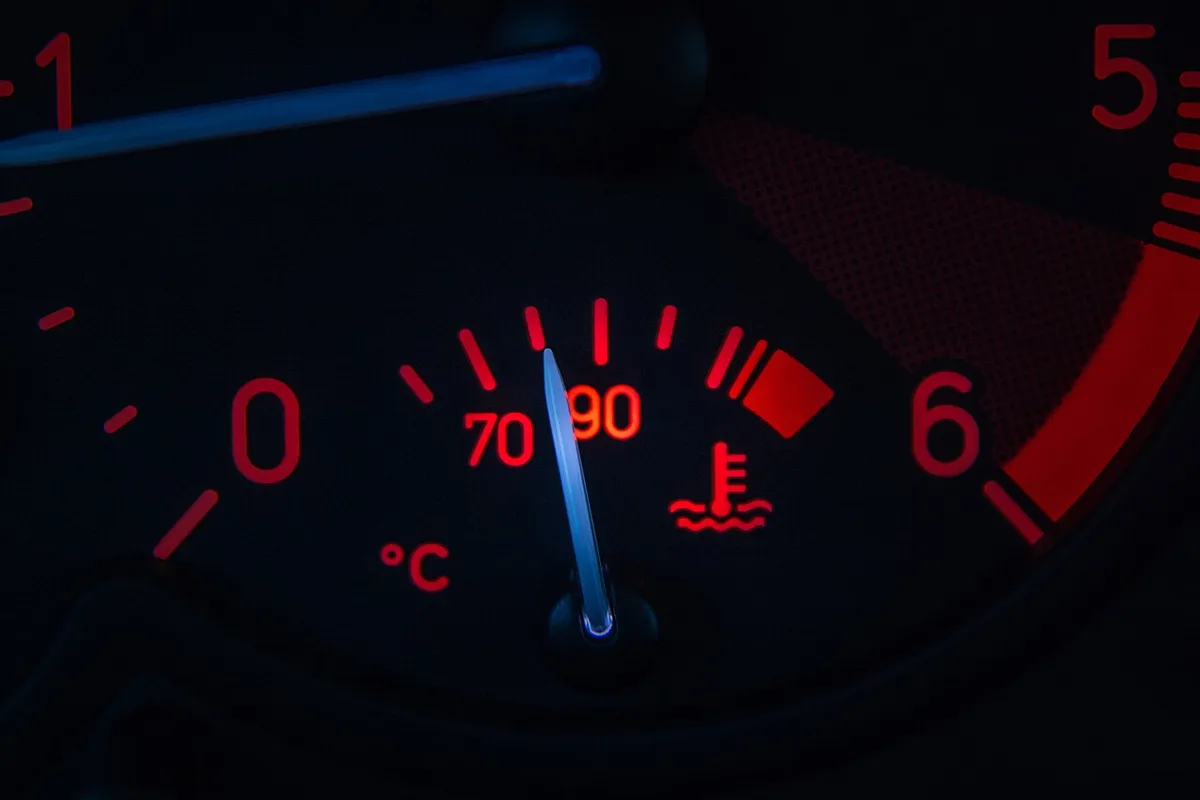
Image source: Wikimedia Commons / Ivan Radic (CC BY)
What Not to Do While It's Cooling
- Don't open the radiator cap. Pressurized coolant above 250°F will flash to steam the instant pressure drops, and it sprays upward at your hands and face. This is the single most common serious injury in this whole scenario.
- Don't pour cold water on the engine or into the radiator. Thermal shock can crack a head or a block.
- Don't restart it to "see if it's fine now." Wait until the gauge is cold and you've checked the coolant.
- Don't crawl under the car on a shoulder. Ever.
- Don't stand at the open hood with your back to traffic.
The Tow Call: What to Say and What It Costs
Tell dispatch the make, model, and whether the car is all-wheel drive. An AWD vehicle needs a flatbed or a dolly, not a wheel-lift. Low-clearance cars and anything with a body kit also want a flatbed.
Typical US hook fees run $75 to $150, plus $3 to $7 per mile. Many insurance policies and membership plans already cover towing, so check the app before you pay cash.
While you wait, figure out where the front and rear recovery points are on your car. Knowing which loop the driver should hook saves ten minutes in a live lane.
The Honest Triage: Is It Really That Bad?
Sometimes it is genuinely minor. A failed fan relay in slow traffic will overheat a car every time and cost $20 to fix. A sticking thermostat does the same thing.
Neither one destroyed anything if you shut down early.
The tell is what happens after it cools. If it starts, holds temperature at idle, and the heater blows hot, you may have caught it in time. If the gauge climbs again within five minutes, or the heater blows cold while the engine is hot, stop guessing and get it diagnosed.
Branch Two: The Gauge Is Climbing but You Can't Stop Yet
This branch exists because reality is messy. Maybe you're in the middle lane of a bridge, in a tunnel, or towing a trailer on a two-lane with no shoulder. You need minutes, not a lecture.
Step 1: Kill the AC, Crank the Heat
Turn the air conditioning off. The condenser sits right in front of the radiator and dumps its heat straight into it. Switching it off removes a real load.
Now turn the cabin heater to full hot, fan on high, and crack the windows. The heater core is a second, smaller radiator. Running hot coolant through it pulls genuine heat out of the engine and pushes it into the cabin.
Yes, it's miserable in August. It also works. A heater core can shed several kilowatts of heat, which is enough to buy you a few minutes at reduced load.
Step 2: Cut the Engine Load
- Slow down. Air resistance and engine speed both make heat.
- Drop a gear on a climb if you're in an automatic with a manual mode. Lower rpm under load, less heat.
- Kill the accessories you don't need.
- Turn off tow/haul mode if you're empty.
- Take the next exit even if it's not yours.
Step 3: Pick a Real Destination
Aim for a gas station, a fast-food lot, a side street, a park-and-ride. Anywhere you can park with the hood facing away from traffic. Do not aim for home if home is 20 minutes out.
If the needle keeps climbing while you're doing all of this, the decision is made for you. Pull off at the first possible spot and go to Branch One.
The Heat Sources People Forget
Cooling systems don't fail in isolation. A slipping automatic transmission generates serious heat under load, and a unit that's low on fluid slips more. Checking the transmission's fluid level on a neglected car is worth the two minutes, because both systems share the same airflow through the front of the vehicle.
Other quiet contributors: a packed radiator core full of bugs and road debris, a missing undertray that changes airflow, a roof box or loaded trailer adding drag, and low tire pressure adding rolling resistance. None of them cause an overheat by themselves. Stack three on a 105°F day and the system runs out of margin.
