
Knowing what to do if the accelerator sticks comes down to two moves you can make in about three seconds: stand on the brake and shift to neutral. Everything after that is detail, and the detail matters. Most drivers freeze instead, or grab for the ignition first, which is the one response that can cost you your steering.
Since model year 2011, US-market vehicles have been required to include brake override logic under Federal Motor Vehicle Safety Standard 126, so pressing both pedals together automatically cuts engine power. Older cars, cable-throttle trucks, and plenty of imports never got that safety net. Here's how the sequence really works, why the popular advice gets the order wrong, and where it falls apart on specific cars.
What to Do If the Accelerator Sticks
Press the brake pedal hard and keep it pressed. Shift the transmission to neutral. Steer to the shoulder and stop.
Then shut the engine off and set the parking brake. Brake plus neutral works on almost every car ever built.
Why a Stuck Accelerator Is a Split-Second Decision, Not a Maintenance Problem
A stuck accelerator isn't a slow problem. At 60 mph you cover 88 feet every second, so two seconds of unintended full throttle adds well over 100 feet before your foot even moves. The first ten seconds decide almost everything, and what you do with your hands and feet matters far more than what you eventually find under the hood.
Panic freeze is the real enemy here. AAA Foundation for Traffic Safety work on perception-response times puts a typical driver at roughly 1 to 1.5 seconds just to recognize an unexpected event, before any physical reaction starts. Add a second of disbelief and you've burned the entire margin.
Then there's the diagnosis problem. A large share of "my car accelerated on its own" reports turn out to be pedal misapplication, where the driver pressed the accelerator thinking it was the brake. The joint NHTSA and NASA investigation into unintended acceleration, published in 2011, found no electronic defect in the vehicles it studied and pointed to pedal misapplication and floor mat entrapment as the main causes.
That matters because the two scenarios need different follow-up even though they feel identical from the driver's seat.
Here's where the common flat list of advice breaks down. "Brake, shift, pull over, turn off the engine" reads fine until you apply it to a 2008 truck with a column lock, or a push-button hybrid that won't shut down the way you expect. Order matters more than the list itself.
| First instinct | Why people do it | What usually happens |
|---|---|---|
| Reach down and pull the pedal up | It feels like the obvious physical fix | Your eyes leave the road at the worst possible moment |
| Pump the brakes | Old habit from fading drum brakes | You bleed off the vacuum assist you actually need |
| Shift into Park | Pure panic | The interlock usually refuses, and if it doesn't, the parking pawl can shear |
| Turn the key off at speed | It's the only "off" switch you know | Steering lock engages on some cars and assist disappears |
| Brake hard, shift to neutral | Training rather than instinct | The car slows under full control with the engine still running |
The scale of this problem is not small. The 2009 to 2011 unintended acceleration recalls covered roughly 10 million vehicles in the US alone, and the resulting rulemaking changed throttle software across the entire industry. You can check any vehicle against open recalls in about two minutes using the NHTSA recall lookup, which is free and VIN-based.
One more thing worth saying plainly. This is not a maintenance topic you can defer. A lazy return spring or a mat that's crept forward is a warning, and warnings are cheap to fix.
Ignoring one until it becomes an event is how people end up in a guardrail.
What's Actually Happening Under the Hood When the Pedal Sticks
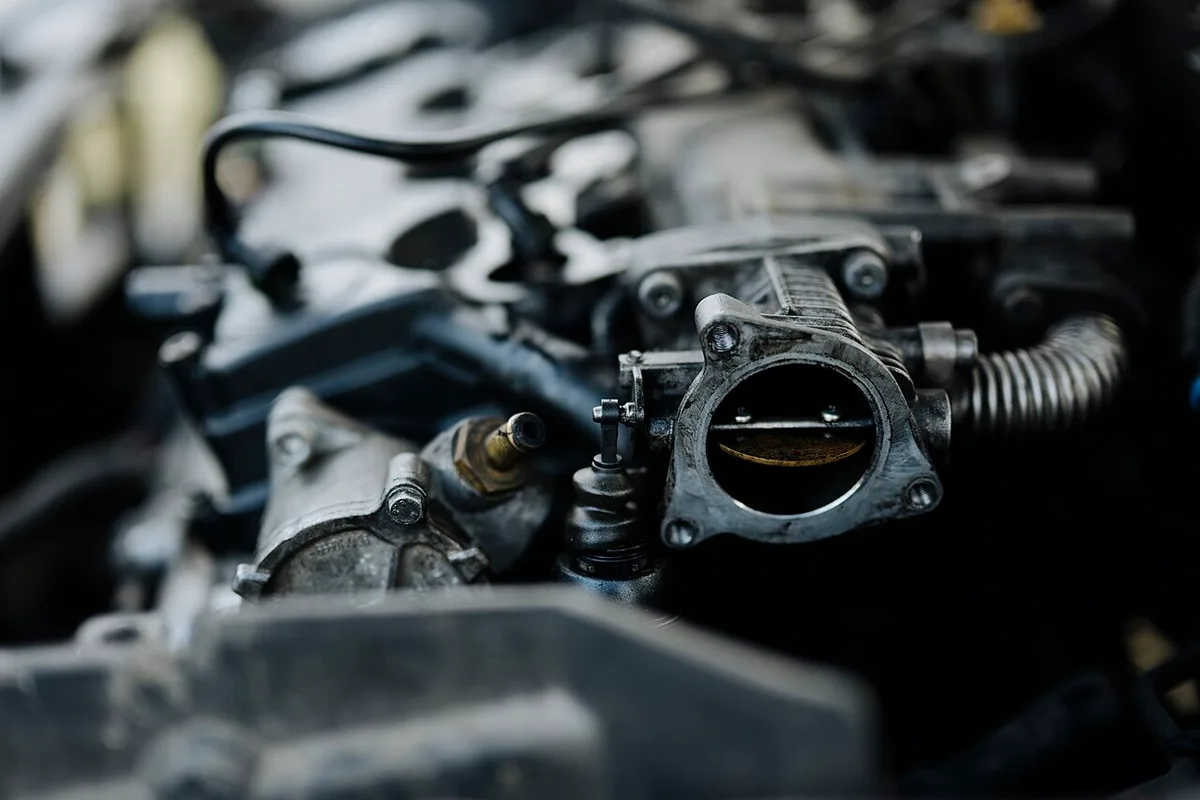
Image source: Wikimedia Commons / Shixart1985 (CC BY)
There are two completely different systems hiding behind the same symptom, and knowing which one you have changes the diagnosis, the cost, and sometimes the emergency procedure. Older and simpler cars use a mechanical link between your right foot and the engine. Newer cars use a sensor and a motor.
Start with the parts. Your foot pushes an accelerator pedal assembly, which pivots on a bushing and gets pushed back by one or two return springs. On a cable car, that pedal pulls a steel cable through a sheath, and the cable opens a throttle plate inside the throttle body.
On a drive-by-wire car, the pedal contains accelerator pedal position sensors that report to the powertrain control module, which then commands a motor to open that same plate.
The throttle plate itself is a brass or steel disc, often called a butterfly, sitting in a bore. When it's clean, it snaps shut the instant you lift. When it's coated in crankcase vapor and carbon, it can hang up on the bore, usually right at the closed position.
That's the classic "high idle after cleaning" or "idle flares when I stop" complaint.
The Pedal, the Cable, and the Throttle Plate
Cable systems fail in slow, physical ways. The cable frays and drags inside its sheath. The linkage at the throttle body gums up because nobody has lubricated it in 120,000 miles.
A return spring loses tension, so the pedal comes back lazily or not all the way. None of that happens instantly, which is why a creeping idle is worth taking seriously.
The other classic mechanical cause isn't mechanical at all. It's a floor mat that has slid forward and pinned the pedal down, or a stack of mats, or an all-weather mat laid on top of the carpeted one. Mat entrapment is why modern mats have retention clips and why the clip check belongs in your oil change routine.
Drive-by-Wire: When the Signal, Not the Metal, Is the Problem
Electronic throttle control, usually shortened to ETC, has no cable at all. The pedal sends voltage, and the PCM decides how much to open the plate. That sounds fragile, so engineers built in redundancy.
Most systems use two pedal sensors with different voltage curves that must agree, plus a plausibility check against mass airflow and engine speed.
When the signals disagree, the PCM doesn't guess. It drops into limp mode, limits engine speed, and lights the wrench or check engine lamp. That's why a failing sensor usually shows up as a car that won't rev past 2,000 rpm rather than one that runs away.
It's also why pulling live sensor data is the fastest way to confirm a throttle complaint, and a basic scan tool that reads live data will show you pedal and throttle percentages side by side.
| Trait | Cable throttle | Electronic throttle (ETC) |
|---|---|---|
| How the pedal talks to the engine | Steel cable and linkage | Two pedal sensors feeding the PCM |
| Typical sticking cause | Frayed cable, gummy linkage, tired return spring | Carboned plate, sensor drift, chafed wiring |
| Built-in redundancy | None | Dual sensors plus limp mode |
| Usual fix | Lubricate or replace cable, replace spring | Clean or replace the throttle body, relearn, reflash |
Design rules for these systems sit under ISO 26262, the functional safety standard that governs how much a single fault is allowed to affect vehicle behavior. If you want the framework itself, ISO's own standards portal is the place to read it rather than a summary.
One overlooked path deserves its own mention. Cruise control, especially adaptive cruise, can hold speed without your foot anywhere near the pedal. If the car accelerates on its own while cruise is engaged, that's a cruise fault, not a stuck pedal, and the first move is to cancel cruise with the stalk button or a brake tap.
The Immediate Response: Brake, Neutral, Steer, Shut Down
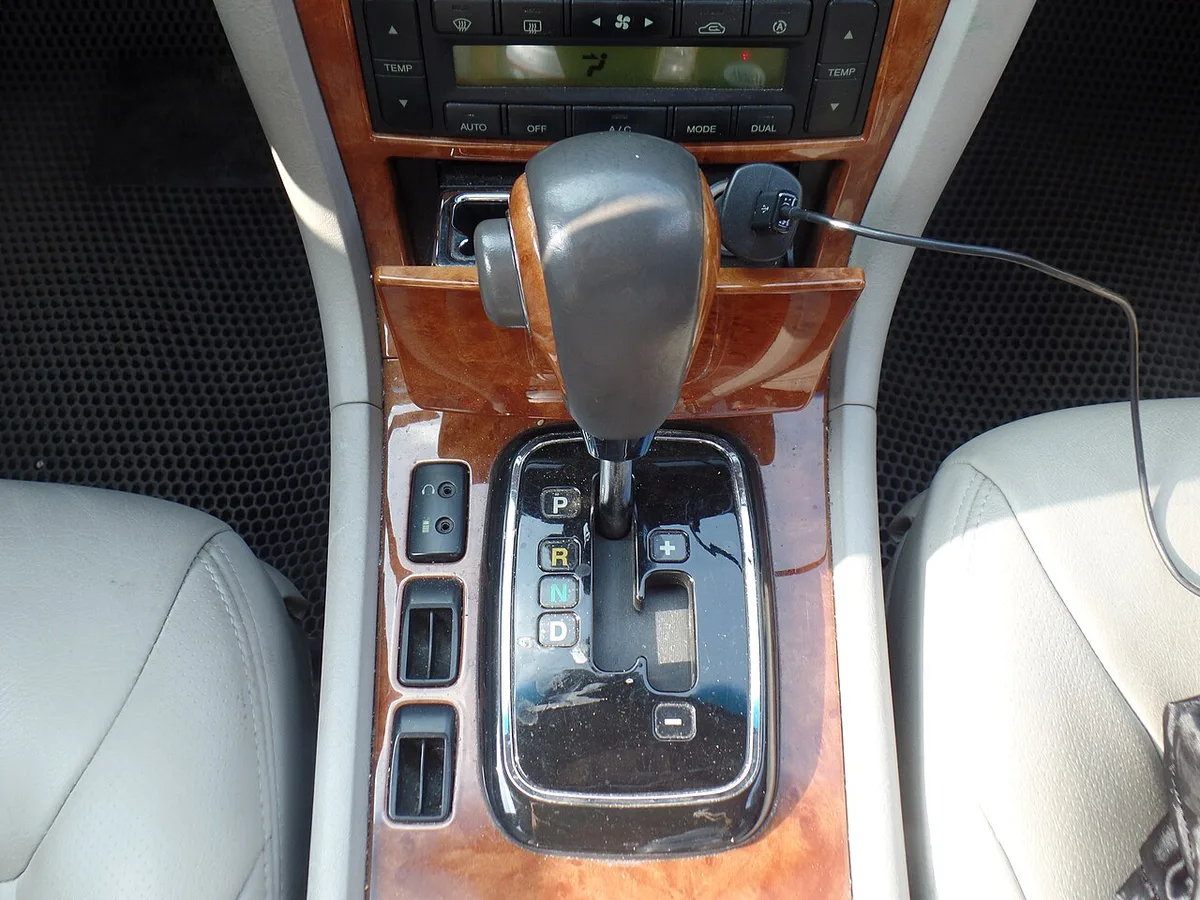
Image source: Wikimedia Commons / Jhcbs1019 (CC BY-SA)
This is the part worth memorizing, because you won't have time to reason it out. The sequence below works on automatics, manuals, hybrids, cable throttles, and drive-by-wire alike.
- Brake firmly and continuously. Both feet if you need them. Don't pump, don't stab, don't lift to see if the pedal freed itself.
- Shift to neutral. Firmly, past any gate, without pressing the release if it's not needed. In a manual, press the clutch and hold it.
- Steer to the shoulder or an exit ramp. Signal if you have a free hand. Keep a proper grip on the wheel rather than one palm at the top, since hand position affects how much steering authority you have when assist drops.
- Shut the engine off once you're stopped. If you must kill it while still moving, follow the procedure for your ignition type in the section below.
- Park, brake, hazards. Select Park, set the parking brake, switch on the flashers, and get out on the traffic side away from the lane.
Notice what's not on that list. No reaching under the dash. No shifting to Park at 60 mph.
No key yanking. Those three moves cause more damage than the stuck throttle itself.
If you end up stopped in a live lane, and you will want to be towed rather than limping on a jammed throttle, know where your factory tow point sits before anyone hooks a strap to something that isn't rated for it.
Why Neutral Comes Before the Ignition
Neutral disconnects the engine from the wheels without switching anything off. The engine keeps running, so you keep power steering and vacuum brake boost, and you keep the option to drive away if the situation resolves. Shifting back into Drive is equally reversible.
Killing the ignition is the opposite trade. You lose assist, you may lose the steering column lock on older cars, and you can't undo it quickly. On top of that, an engine held at full throttle with no load will bounce off the rev limiter, which is unpleasant but harmless on a modern car.
That fuel cut exists precisely to protect the engine when the throttle is stuck.
What to Do Once You're Stopped
Once the car is stationary and in Park, shut the engine off normally. Don't restart it to see if the problem repeated. That's how people end up doing it a second time in traffic.
Get out and look at the pedal area. If a mat is on top of the pedal or bunched under it, you've found your cause, and it's a two minute fix. Pull the mat out, stow it in the trunk, and drive on with extra care.
If the pedal springs back cleanly and the mat is clear, treat it as a real fault. Have the vehicle towed. Then photograph the pedal and mat position, note the time and speed, and report it to NHTSA if the car behaved unexpectedly.
Documentation is what turns a scary story into a paper trail that supports a warranty claim or a recall investigation.
Warm weather and cold weather change this slightly. In freezing conditions, moisture in a cable sheath or around a throttle plate can freeze overnight and free itself as the engine bay heats up. That intermittent behavior is worth mentioning to a technician, because it's nearly impossible to reproduce on a warm afternoon.
Brake Override: What Your Car Will and Won't Do for You
Brake override is the system that decides which pedal wins when you press both. On a car that has it, sustained brake application with the throttle open cuts engine power to idle within a fraction of a second. The brake wins, the car slows, and the engine stops fighting you.
That last part is the whole point. Without override, you're asking your brakes to fight an engine making peak torque, and brakes lose that fight over distance because they fade as they heat. With override, the engine exits the argument entirely.
The physics is worth understanding even if you never need it. Brakes convert motion into heat, and they can only shed so much heat per second. A single hard stop from 60 mph is nothing.
A mile of dragging brakes against a wide-open throttle will cook fluid, glaze pads, and eventually give you a long pedal.
Coverage isn't universal, so verify your own car rather than assuming. The owner's manual usually states it, and a five minute test in an empty lot at low speed tells you the truth: hold light brake pressure, add throttle, and feel whether the engine drops to idle. Do it at walking pace with nobody behind you.
The MY2011 Rule in the US and UN R13-H in Europe
The US requirement arrived through the back door of stability control. FMVSS 126 mandated electronic stability control on new light vehicles, and the rule that phased in from 2008 and completed for model year 2011 included brake override as part of the package. Europe took a similar route through UN Regulation No. 13-H, which sets braking approval requirements for passenger cars sold there.
| Standard | Region | What it covers |
|---|---|---|
| FMVSS 124 | US | Accelerator control systems must return to idle when released |
| FMVSS 126 | US | Stability control, and with it brake override, on vehicles from model year 2011 |
| UN R13-H | Europe | Braking approval rules, including brake override logic |
| ISO 26262 | Global | Functional safety process for throttle and pedal sensor design |
Worth knowing: FMVSS 124 is the older, narrower rule, and it's about the accelerator returning to idle when you release it. It has existed for decades and it's the reason a broken return spring is a defect rather than a quirk.
Cars That Predate the Requirement
This is where the fatality risk spikes. A 2004 sedan, a work truck with a cable throttle, an older van with a floor-mounted pedal and no override, and most motorcycles have no software to save you. On those vehicles, brake plus neutral isn't the preferred answer.
It's the only answer.
There's a second group worth flagging. Vehicles sold in markets with looser requirements, small-engine equipment, and modified cars with aftermarket throttle bodies or tunes may not behave the way the regulation assumes. A reflash can change idle behavior in ways the factory calibration never intended.
One practical check for anyone buying used: look up the VIN, confirm the recall status, and physically inspect the pedal and mat area before you drive it home. Two minutes of diligence beats discovering the problem on a slip road.
Key vs Push-Button Ignition: Shutting Down Without Locking the Column
With a traditional key, the danger is the column lock. Turning the key all the way to OFF while moving can engage a mechanical steering lock and leave you with a wheel that won't turn. The engine stops, the assist drops, and now the steering is both heavy and, on some cars, physically locked.
The safer move on a key car, if you truly must shut down while rolling, is to turn to the ACC or ON position rather than fully off. That kills the engine without letting the lock engage. Even then, do it only after you've already shifted to neutral and are slowing under brakes.
Push-button cars work differently. As of 2026, most of them use a hold-to-stop protocol: press and hold the start button for about three seconds while the car is moving, and the engine shuts down. Many also accept three quick presses in a row.
A single press while rolling is usually ignored or triggers a warning chime, which is deliberate.
Keyless systems carry their own confusion. Drivers hunt for a key that's in their pocket, or press the button repeatedly in a panic without realizing that rapid presses are exactly the shutdown command. It's also easy to assume a fob does more than it does, so it helps to know how push-button starting differs from plain remote unlocking before you're testing it in an emergency.
A few specifics that trip people up:
- Electronic column locks generally only engage when the vehicle is in Park or the driver's door opens, which is safer than the old mechanical setup but varies by brand.
- Hybrids and EVs may have no traditional engine sound, so the "is it still running" check is the instrument cluster, not your ears.
- Some cars require brake pedal pressure to authorize shutdown, which is awkward if the brake is already at the floor. In practice the hold still works.
- Fob batteries dying can produce a "key not detected" message that confuses people mid-panic. Hold the fob against the start button, which most systems read through a passive backup.
The single best preparation here costs nothing. Sit in your own car, stationary, in Park, and read the owner's manual section on emergency engine stop. Then rehearse the hold once.
You're building a reflex, and reflexes are what show up when your thinking brain is busy.
Steering feel after a shutdown is worth a warning too. Without assist, effort roughly doubles or triples, and worn front-end steering components make that worse because you feel every bit of play through the wheel. If your car already wanders or clunks, don't count on deft steering with the engine off.
Automatic vs Manual, Cable vs Drive-by-Wire: How the Branches Change
The core sequence holds on anything with wheels, but the controls you grab are not the same. A manual gearbox gives you a direct mechanical disconnect. An automatic makes you go through the selector, and the selector is where most panics happen.
If you drive a manual, press the clutch and the brake together. The engine free-revs, forward pull stops instantly, and you are already in the safest state you can reach. Coast to a stop, then select neutral and shut down.
If you drive an automatic, find neutral by feel rather than by sight. Practice it once in a parked car so your hand knows the travel. Column levers and console shifters are easy.
Rotary dials and push-button selector banks are not, especially at night with your eyes glued to the road.
| Selector type | How you reach neutral | What catches people out |
|---|---|---|
| Column shifter | Pull the lever up and forward past Drive | Detents are soft, easy to overshoot into Reverse |
| Console lever | Push forward from Drive without the release button | Some gates need the button, some refuse it above a set speed |
| Rotary dial | Twist two clicks from Drive | Detent feel is vague, requires a firm continuous turn |
| Push-button bank | Press and hold N | Some cars need a second press or brake pressure to confirm |
Two interlocks matter here. Most automatics need the brake pressed to move out of Park, which you're already doing. Some also refuse Reverse above a walking pace, which is a gift, not a fault.
What about damage? A short coast in neutral is harmless. The transmission's internal pump still turns with the engine running, so lubrication continues.
Coasting a mile downhill in neutral to save fuel is a different argument, and it's a bad one for control reasons, not mechanical ones.
Manual drivers get one extra trap. Don't plan on engine braking or a deliberate stall as your emergency answer. Stalling kills power assist and gives you a dead weight to steer.
Clutch, brake, neutral, done.
Cable Versus Electronic: The Symptom Tells You Which Branch You're On
If the pedal feels stiff, gritty, or slow to return, you're probably in cable territory. That's a mechanical bind somewhere between your foot and the throttle plate. The engine note usually follows your foot closely, just with lag and friction.
If the pedal feels completely normal but the engine holds revs anyway, you're looking at electronic throttle control. The pedal is reporting fine while the plate stays open, or the module is commanding it open. That's a software or sensor branch, and no amount of stomping will free it.
Here's the if/then version:
- Pedal heavy and lazy, engine follows it: cable or linkage bind. Neutral and brakes still work. Fix is mechanical.
- Pedal normal, engine won't drop: electronic fault. Brake override may save you if the car has it.
- Pedal pinned to the floor, mat visible underneath: entrapment. Neutral first, then deal with the mat once stopped.
- Both pedals feel wrong at once: suspect the mat or a foreign object in the footwell before you suspect the car.
One more branch worth knowing. Older trucks with a mechanical injection pump and a cable linkage can hang the throttle open on a worn shaft seal. Those engines rev slowly and drop slowly, so a driver often notices the idle creeping days before anything dramatic happens.
Creeping idle is a warning, not a personality quirk. If your car is due for a fluid service anyway, keeping the transmission fluid at the right level is worth doing, but it won't fix a throttle problem and it's a distraction from the real fault.
Cruise Control Runaway: When the Car Holds Speed on Its Own
A car that accelerates with your foot nowhere near the pedal isn't a stuck accelerator, and the response differs. Cruise control is the likeliest culprit, and it has its own cancel path built into the controls you already touch.
Cancel first, diagnose second. Tap the brake. Press the CANCEL button on the stalk.
Press the clutch on a manual. Any of those should disengage cruise within a fraction of a second on a functioning system.
If the car keeps pulling after a brake tap, stop trusting cruise as the explanation. Treat it as a genuine throttle fault and go to neutral.
How you tell the two apart comes down to behavior. Cruise holds a set speed and adjusts gently to hills. A stuck throttle climbs, usually hard, and keeps climbing until the rev limiter catches it.
Cruise also tends to disengage the moment you touch the brakes, and it illuminates a light on the dash when it's active.
Adaptive cruise control adds a wrinkle. Radar-based systems will accelerate to return to your set speed when the lane ahead clears, and that can feel like a surge after a lane change. It's normal, it's documented in the owner's manual, and it startles people constantly.
Older vehicles had more failure paths. Vacuum-operated cruise servos used a diaphragm and a cable to the throttle linkage, and a binding cable could hold the throttle partly open with cruise switched off. Aftermarket cruise kits, popular on older pickups and vans, are the worst offenders because the linkage geometry is often improvised.
A few practical rules that head off most of this:
- Turn cruise off in heavy rain, snow, or standing water. Wheel slip confuses the system and it can apply power at exactly the wrong time.
- Don't use cruise on winding roads or in dense traffic where you need constant throttle control.
- If your car surges or hunts for a speed setting, get the system checked rather than living with it.
- On a long descent, cruise can keep feeding throttle while you brake. Use a lower gear instead.
Three Root Causes, Three Fixes: Floor Mat, Throttle Body, Software
Nearly every stuck-throttle complaint lands in one of three buckets. Each one has a distinct signature, a distinct fix, and a very different price tag.
| Root cause | The tell | The fix | Typical difficulty |
|---|---|---|---|
| Floor mat entrapment | Pedal sits low, mat bunched or overlapping, happens after cleaning or new mats | Remove the mat, fit retention clips, run one mat only | Minutes, free |
| Throttle body carbon | Idle hangs around 1,200 to 1,500 rpm and drops after a throttle blip | Clean the bore and plate, then run a relearn | An hour, low cost |
| Sensor, wiring, or calibration | Wrench light, limp mode, codes stored, no mechanical bind | Diagnose with a scan tool, then reflash or replace | Shop visit |
Floor Mat Entrapment: The Ten Second Fix
Mat entrapment is the most common and the most easily prevented. A mat slides forward, the pedal lands on top of it, and the return spring can't fight the mat's friction against the carpet. Stacked mats make it worse because the top layer walks.
The tell is physical. Look at the pedal with the engine off. Does it sit lower than the brake pedal by more than a small margin?
Is the mat edge visible above the pedal pad? Both point to entrapment.
The fix is to pull the mat out entirely, check the retention clips on both sides, and never run a carpeted mat and an all-weather mat together. If the clips are broken, replace the mat. They're cheap, and they exist for exactly this reason.
Throttle Body Carbon: The Slow Creep
Carbon buildup inside the throttle bore is normal. Crankcase vapor carries oil mist, the oil bakes onto the bore and the plate edge, and eventually the plate has to push through a sticky ring to close. That's when the idle starts hanging.
The signature is a cold-start idle that sits high and takes a long time to settle, or a car that flares to 1,500 rpm when you push in the clutch. Warm it up, blip the throttle, and watch whether the idle drops cleanly.
Cleaning is straightforward if you're careful. Remove the intake duct, hold the plate open with a soft tool rather than your fingers, and wipe the bore with throttle-body cleaner on a lint-free cloth. Don't flood the bore, and don't spray cleaner into a mass airflow sensor upstream.
Most cars then need an idle relearn, which is either a scan tool function or a prescribed drive cycle.
Sensor, Wiring, and Calibration: The Expensive Bucket
This is where the fault codes appear. P2135 covers pedal and throttle position correlation, and P0121 and P0222 point at throttle position sensor range and circuit problems. Limp mode, a wrench light, and a 2,000 rpm ceiling are the usual presentation.
Wiring damage is underrated. Rodent chews, chafed harness sections near the pedal bracket, and corrosion at the connector all produce intermittent faults that come and go with bumps and temperature. A technician who only swaps parts without checking the harness will chase this forever.
Manufacturer technical service bulletins often cover recalibration for a specific model and year. Those are worth checking before anyone replaces a throttle body on your dime.
Mistakes That Turn a Scare Into a Crash
The stuck throttle itself is rarely what hurts people. The recovery attempt is. These are the moves that convert a controllable event into a crash, and every one of them is common.
- Pumping the brakes. This is a habit from the era of drum brake fade. Modern brakes want one firm, continuous application. Pumping wastes the vacuum assist you'll need.
- Shifting into Park at speed. The interlock will usually refuse the command. If it doesn't, you're asking a small metal pawl to stop a two-ton car, and it can shear or destroy the transmission case.
- Reaching down to free the pedal. Your eyes leave the road for a second or two. At highway speed that's a hundred feet of blindness.
- Killing the ignition before neutral. You lose power assist and, on older cars, risk an engaged steering lock. Now you have two problems.
- Yanking the key out completely. Same risk, plus the column lock on a wider range of vehicles.
- Opening the door to bail out. This is a real reported behavior, and it's fatal at speed. Stay belted and stay in control.
- Steering with one hand while you fight the shifter. You need grip. Both hands on the wheel the moment you're in neutral.
- Restarting to see if it happens again. People do this on the shoulder and then rejoin traffic. Don't. Diagnose on a scan tool, not on a live road.
- Driving home after a mat fix. Fine for a mat. Not fine for anything else. If the pedal didn't spring back cleanly, it's a tow.
Passengers have a role too. If the driver is frozen, a passenger can reach the selector on many cars from the passenger seat, or hit the hazards. It's worth a thirty second conversation before a long road trip, especially with a new driver at the wheel.
One psychological point that matters more than any bullet above. Human beings under sudden stress do what they've rehearsed, not what they've read. If you have never once moved that lever to neutral with intent, your hands may not find it.
One dry run in a parking space changes that permanently.
After You've Stopped: The Diagnosis Workflow
Once the car is stationary, in Park, with the parking brake set and the hazards on, the panic is over and the detective work starts. Work through this in order, and don't skip the cheap checks.
- Photograph everything before you touch it. Pedal position, mat position, and the footwell floor. This is your evidence if the fault turns out to be a defect.
- Check the mat and the pedal. Pull the mat clear. Press the pedal by hand and release it. It should snap back crisply and land on its stop.
- Look for foreign objects. Water bottles, floor mats from the rear, kids' toys, a loose floor anchor. Don't laugh, it happens.
- Read the codes. A scan tool that shows live data and freeze-frame information is the difference between guessing and knowing. If you don't own one, this is the moment to learn what separates a useful scanner from a toy.
- Compare the pedal and throttle signals. Watch accelerator pedal position and throttle position percentages as someone presses the pedal slowly. They should rise and fall together, smoothly, with no dropouts or disagreement.
- Inspect the throttle body. Pull the intake duct and look at the bore. A dark ring at the plate edge means cleaning is due.
- Check the return spring and linkage. On cable cars, work the linkage by hand and feel for grit or binding. Look for a frayed cable at the sheath entry.
- Run the VIN against open recalls. Free, takes two minutes, and sometimes ends the investigation on the spot.
- Test drive with the scanner connected. Re-scan afterwards and compare freeze-frame data from the event with the data you captured on the road.
What the Numbers Should Look Like
Pedal and throttle values track each other, but not one to one. Pressing the pedal to 40 percent doesn't necessarily open the plate to 40 percent, because the calibration is not linear. What you're checking is correlation, not equality.
Two pedal sensors should read in agreement, and their voltages usually move in opposite directions by design. That's deliberate redundancy. If one sensor drifts or flatlines while the other behaves, the module flags a correlation code and drops into limp mode.
Rough idle counts are useful too. A healthy throttle body closes the plate to a small commanded opening at idle, often under 20 percent on a scan tool display. A carboned one needs a wider opening to hold the same idle speed, and you can watch that number creep up over months.
When the Scan Tool Says Nothing
A clean code scan doesn't mean a clean bill of health. Intermittent wiring faults often leave no stored code until they've happened several times. Water ingress, a chafed harness, or a failing pedal sensor can log a pending code that clears itself.
That's when you write down everything instead. Outside temperature, engine temperature, speed, what you were doing, and whether it repeated. Patterns beat parts cannon every time, and a technician with a good description will find in an hour what a vague complaint hides for weeks.
The Repair Path: Cleaning, Replacing, Relearning, Reflashing
Fixing a stuck throttle is mostly about picking the cheapest correct step and stopping there. Our analysis of parts pricing and service bulletins puts most successful repairs well under $300 in parts. The expensive version is usually the one where somebody guessed.
| Job | Typical parts cost | Typical labor | When it's the right call |
|---|---|---|---|
| Throttle body cleaning | $10 to $25 in cleaner and cloths | 30 to 60 minutes | Visible carbon ring, hanging idle |
| Throttle body replacement | $150 to $450 | 1 to 2 hours | Worn bore, failed actuator motor, cracked housing |
| Pedal assembly replacement | $80 to $300 | 30 to 90 minutes | Sensor drift, cracked pedal arm, broken spring mount |
| PCM reflash | $0 to $200 | About 1 hour | A bulletin applies to your VIN |
| Floor mat set with clips | $30 to $120 | Minutes | Mat won't stay anchored |
Prices swing with make and model, and dealer labor rates run higher than independent shops. Treat the table as a sanity check rather than a quote.
Step One: Clean Before You Replace
Cleaning is the right first move when the symptom is a hanging idle rather than a runaway. A throttle plate that sticks at closed needs to push through a ring of baked-on varnish every time it shuts. Cleaning removes that ring.
You need throttle-body cleaner, a lint-free cloth, and a soft brush. Nothing abrasive goes anywhere near the bore. Don't use carb cleaner on a drive-by-wire body, because it can attack the internal seals and the electronics.
Remove the intake duct and look inside. Hold the plate open with a plastic wedge or a soft-handled tool, never your fingers if the ignition is on. Wipe the bore and the plate edge until the metal is clean, then reassemble and run the relearn.
Relearn After Cleaning
Here's the part that generates most of the frustration. A cleaned throttle body has a different closed position than a carboned one, and the powertrain control module has learned the old values. Without a relearn, the engine idles high, hunts, or throws a code.
Two ways to do it. The proper way is a scan tool with a throttle or idle relearn function, which takes about two minutes. The old way is a prescribed drive cycle: warm the engine, idle in gear with accessories off, then drive a set pattern of stops and steady speeds.
Manufacturer procedures vary, so check the book for your car.
When Replacement Beats Cleaning
Replace the throttle body when the bore is worn or scored, when the actuator motor is noisy or dead, or when the plate binds even after a thorough clean. A plastic gear inside the actuator can strip, and no amount of solvent fixes that.
Pedal assemblies are usually replaced rather than repaired. The sensors are sealed, the springs are calibrated, and a rebuilt pedal is rarely worth the risk. If the pedal doesn't return crisply after you've ruled out the mat, a new assembly is the honest answer.
Reflashing and Module Replacement
Sometimes the fault lives in software. A calibration update can change how aggressively the module commands the plate, and manufacturers issue those updates for a reason. The reflash requires a dealer-level tool and a stable power supply, which is why it's a shop job rather than a driveway job.
Module replacement is rare and expensive. It's the last stop, not the first. Anyone who recommends a new PCM before checking harness continuity and live sensor data is skipping steps with your money.
Cruise Cable and Linkage Repairs
On older vehicles with a mechanical cruise servo, the cruise cable runs parallel to the throttle cable and attaches at the same linkage. A binding cable or a servo that won't release will hold the throttle partly open even with cruise off.
Test it by disconnecting the cruise cable at the throttle body and working the linkage by hand. If the bind disappears, you've found it. Replace the cable rather than lubricating a frayed one, and check that the servo releases fully when you tap the brake.
The Parts Canon Trap
The most expensive repair path is the one where every component gets swapped in turn. A correlation code plus a chafed harness looks identical to a failed throttle body on the scan tool. One costs $400, the other costs $40 in wire and heat shrink.
Ask for the diagnostic steps in writing. A shop that can tell you what it measured, and what the values should have been, is a shop worth keeping.
Prevention That Actually Works
Prevention here is boring, cheap, and effective. None of it takes more than a few minutes, and all of it addresses a real failure mode rather than a hypothetical one.
The Two-Minute Mat Check
Do this at every oil change and after every interior cleaning. Grab the mat at the front edge and pull. It shouldn't move more than a fraction of an inch.
If it slides, the clips are broken or missing.
Check both sides, because one intact clip lets the mat pivot. Then look at the pedal with the engine off. If the mat sits above the pedal pad or bunches under it, fix it before you drive.
Never stack mats. One mat, anchored, is the rule. All-weather mats go in place of the carpeted set, not on top of it.
Throttle Body Cleaning as Mileage Climbs
Carbon buildup is a function of mileage, oil vapor quality, and short-trip driving. Our research suggests a cleaning interval somewhere between 30,000 and 60,000 miles for many engines, with more frequent cleaning on direct-injection engines and cars that do a lot of stop-start work.
Watch the idle rather than the odometer. A cold idle that hangs high and takes ages to settle is your cue. If you're already raising the front end safely for other service work, the throttle body is easy to reach on most transverse four-cylinders.
Cable Lubrication on Older Vehicles
Cable throttles need attention that nobody gives them. Once a year, work a few drops of cable lubricant down the sheath at the firewall end. Don't use heavy grease, which attracts grit and makes things worse.
While you're there, look at the linkage at the throttle body. Clean it with brake cleaner and apply a dry lubricant. Inspect the return spring for corrosion and stretch, and replace it if the pedal feels lazy on release.
Rehearse the Neutral Shift Once a Year
This is the highest-value habit on the list and it costs nothing. In an empty lot, at walking pace, shift from Drive to Neutral and back. Feel the detent, learn the travel, hear what the engine does.
Then find the emergency engine stop procedure in your owner's manual and read it. As of 2026, most push-button cars want a three-second hold, and most people have never tried it. Thirty seconds of practice is the difference between a reflex and a panic.
Used Car Checks
Before buying, run the VIN against open recalls and look at the footwell. Worn or missing mat clips, a pedal that sits lower than the brake, and any signs of an aftermarket mat stack are all reasons to look closer.
Ask whether the throttle body has ever been cleaned and whether any calibration updates were applied. A seller who doesn't know isn't lying. They just never thought about it.
When to Escalate: Dealer, TSB, and the NHTSA VIN Lookup
Some problems don't belong in your driveway. A throttle fault with stored codes, a car that's under warranty, and anything that repeated after a clean all belong with a professional who has the diagnostic tools and the calibration files.
Is It a Recall or a TSB?
These are two very different things, and drivers confuse them constantly.
| Term | What it means | Who pays | How you find it |
|---|---|---|---|
| Safety recall | A defect that affects safety, ordered by the regulator | Manufacturer, free, any mileage | VIN lookup on the NHTSA site |
| Technical service bulletin | A known fix pattern the manufacturer shares with technicians | You, unless the warranty applies | Dealer service department, by VIN |
| Customer service campaign | An extended warranty or goodwill repair program | Manufacturer, within limits | VIN lookup or dealer records |
A bulletin is not a recall. It's the manufacturer saying "we've seen this before, here's the procedure." That's still useful, because it saves diagnostic time and can point to a calibration update rather than a part.
Warranty Coverage and What It Doesn't Cover
A safety recall repair is free regardless of mileage or ownership, and manufacturers must remedy it. That's federal law, and it doesn't expire the way a bumper-to-bumper warranty does.
Emissions warranties are the other lever. Throttle bodies and pedal sensors fall under emissions control on many vehicles, and the federal emissions warranty runs longer than the basic coverage, often eight years or 80,000 miles on specified components. Check the booklet that came with the car rather than assuming.
Wear items are the exception. A floor mat is yours. A tired return spring on a 12-year-old car is likely yours too, unless a recall covers the assembly.
Filing a Complaint with NHTSA
If your car did something it shouldn't have, report it. The NHTSA defect reporting process is free, takes about ten minutes, and feeds the data set that triggers investigations. A single complaint rarely moves anything.
A pattern does.
Include the speed, the road conditions, the temperature, whether the mat was involved, and what you did. Vague complaints get filed and forgotten. Specific ones get matched to others.
What to Bring to the Service Writer
Skip "it accelerated on its own." That phrase makes technicians think pedal misapplication, and sometimes they're right. Describe the event instead.
Tell them the speed, the gear, whether cruise was on, what the pedal felt like, and whether the mat was in place. Bring your photos. Mention any codes you scanned and the freeze-frame data if you captured it.
Precise complaints get diagnosed. Vague ones get a test drive and a shrug.
Real Scenarios: Parking Lot Misapplication, Highway Runaway, Cold-Start Throttle Hang
Three patterns account for most of what drivers describe as unintended acceleration. They look similar from behind the wheel and completely different once you dig in.
The Parking Lot Wrong-Pedal Event
This is the most common by far, and it usually happens at low speed in a tight space. A driver means to brake, hits the accelerator instead, the car lurches, and the surprise makes the foot press harder. Reported speeds in these events are often under 15 mph, but the damage happens fast because there's a wall or a shopfront nearby.
The signature is a short pedal travel and an engine that responds instantly. A genuine stuck throttle usually produces a complaint at road speed, not while parking. The joint NHTSA and NASA engineering analysis published in 2011 found no electronic defect in the vehicles studied and pointed at pedal misapplication and mat entrapment instead.
The fix here isn't mechanical. It's seating position and pedal familiarity. Drivers who sit too far back lose the reference that tells their foot which pedal is which.
The Highway Runaway
The high-speed version is far rarer and far more dangerous. A driver at 65 to 75 mph feels the car pulling, the engine note climbs, and the first instinct is often to lift off the pedal. When lifting changes nothing, panic sets in.
The sequence that works is the one covered earlier: brake hard, shift to neutral, steer to the shoulder. Recovery is usually successful when the driver gets to neutral within a few seconds. Brake fade is the enemy, and it's why dragging brakes against a wide-open throttle for a mile is a losing strategy.
Mechanical causes dominate here. A mat that shifted, a binding cruise cable, a throttle plate stuck open on carbon. Those are all inspectable after the fact, and all of them leave physical evidence.
The Cold-Start Throttle Hang
This one is subtler and gets misdiagnosed constantly. The car starts fine on a mild morning. On a freezing night, the idle hangs at 2,000 rpm and takes forever to drop, or the pedal feels stiff for the first mile.
Two mechanisms fit. Moisture in a cable sheath freezes and drags until the engine bay warms up. Or a carboned throttle plate sticks harder when cold because clearances tighten.
In both cases the symptom fades as the car warms, which is exactly why it never gets reproduced at the shop.
If you live somewhere with hard winters, mention the temperature when you describe the fault. A technician who knows it's cold-specific will look at the cable and the bore first instead of chasing a ghost.
What All Three Have in Common
In every case, the first two seconds matter more than the diagnosis that follows. The driver who brakes and shifts to neutral keeps control regardless of the root cause. The driver who reaches for the ignition or the mat loses it.
That's the practical takeaway. You don't need to know why the car is doing it while it's doing it. You need to know the two moves that stop it, and you need them loaded before you ever need them.
Frequently Asked Questions
What is the first thing to do if the accelerator sticks?
Press the brake pedal hard and keep it pressed. Then shift the transmission to neutral. Brake plus neutral cuts forward drive on nearly every vehicle built, and it keeps the engine running so you retain power steering and brake assist.
Should I turn the engine off if the accelerator sticks?
Not first. Shift to neutral and brake first, then shut down once you're stopped. Killing the ignition at speed can drop power assist and, on older key cars, engage the steering column lock.
Push-button cars usually need a three-second hold to shut down while moving.
Do all cars have brake override?
No. In the US, brake override arrived with the stability control requirement that completed for model year 2011 under FMVSS 126. Europe followed a similar path through UN Regulation No. 13-H.
Older vehicles, cable-throttle trucks, motorcycles, and some imports may have no override at all.
Can a floor mat really cause a stuck accelerator?
Yes, and it's one of the most common causes. A mat that slides forward pins the pedal down, and stacked mats make it worse. Check that both retention clips are intact, run one mat only, and look at the pedal with the engine off to spot entrapment.
How much does it cost to fix a stuck accelerator?
A mat fix is free. A throttle body cleaning typically runs $10 to $25 in materials if you do it yourself, or an hour of shop labor. Throttle body replacement usually lands between $150 and $450 in parts.
A safety recall repair costs you nothing.
Is a stuck accelerator covered by warranty?
Sometimes. Safety recalls are free regardless of mileage, and throttle components often fall under the longer federal emissions warranty. Wear items like floor mats and tired return springs usually aren't covered.
Check your booklet and run the VIN against open recalls before paying for anything.
