
Running dry on a highway shoulder is one of those moments where the wrong move can genuinely hurt you. If you've ever wondered what to do if you run out of gas, here's the short version: get off the travel lane, make yourself visible, and do not walk the shoulder looking for a station. Your car is shelter and your best safety device.
It is not a thing to abandon.
Most owner's manuals put the reserve at roughly 1 to 2 gallons once the low fuel warning light comes on, which works out to somewhere between 25 and 50 miles of range. That margin burns away fast at highway speed with a headwind. So before you think about fuel, deal with where you are and who can see you.
What to Do If You Run Out of Gas
If you run out of gas, pull as far right as you can. Turn on your hazard lights right away. Stay inside with your seatbelt on.
Call roadside assistance or 911 from your phone. Never walk the highway shoulder to find gas.
Stranded Right Now? Do These Things First
The first sixty seconds set the tone for everything that follows. Get the car off the travel lane if it will roll at all. Even a few feet onto the shoulder changes the risk picture completely.
Your engine just quit, so treat the controls as heavy. Power steering assist is gone and the brake pedal needs a firm, early push. Keep both hands on the wheel and aim for the widest, flattest piece of shoulder you can reach.
Don't coast past a good spot hunting for a better one.
Then work down this list in order.
| Step | Do this | Why it matters |
|---|---|---|
| Steer off the lane | Aim for the widest paved shoulder in sight | Every foot away from traffic buys reaction time |
| Wheels turned | Point the front wheels away from the road | If the car gets nudged, it rolls off the road, not into a lane |
| Parking brake | Set it once you stop | A stationary car can still creep on a grade |
| Hazard lights | Hit the triangle switch immediately | Drivers read flashing lights as trouble before they read anything else |
| Hood up | Release the latch and prop it | A raised hood is the universal sign of a broken-down car |
| Seatbelt | Buckle up even while parked | A stopped car on a shoulder still gets hit |
| Phone | Call for help from inside the car | You stay protected while you sort out options |
| Location | Note the mile marker, exit number, or drop a GPS pin | Dispatch needs a pin, not a description |
How to tell a dispatcher exactly where you are
Start with the interstate number and your direction of travel. Then add the last mile marker you passed and the nearest exit. If you didn't catch either, describe the last sign you saw and any landmark nearby.
A dropped pin from your maps app is the fastest thing you can give a dispatcher. Send it to whoever you're talking to, and stay on the line. Most states also run a 511 travel line that can tell you about road conditions and connect you to a courtesy patrol.
What to do when a stranger pulls over
Plenty of people stop with good intentions. That doesn't mean you should open the door. Crack the window an inch and ask them to call roadside assistance or the state patrol for you.
Don't accept a ride and don't get into their vehicle. Don't hand over your keys. A polite "thanks, help is already on the way" is enough.
If the person won't leave and you feel unsafe, call 911 and say so plainly.
When the car won't roll at all
Some cars die in the worst possible place: dead center of a live lane, with traffic closing in. That is no longer a fuel problem. Get everyone out on the side away from traffic and get behind a barrier, then call 911.
The next section covers that call in detail, because it's the one decision people get wrong most often.
When It's a 911 Call, Not a Roadside Assistance Call
Call 911 when the car cannot be moved out of a live traffic lane. That single condition outweighs almost everything else. Only law enforcement can legally and safely shut down a lane, and that is exactly what needs to happen.
Image source: Wikimedia Commons / Highway Patrol Images (CC BY)
Beyond that, the list of emergency conditions is short and specific.
- The car is stopped just past a blind curve, on a bridge, or inside a tunnel.
- You're on a narrow two-lane with no shoulder and traffic passing at speed.
- You see smoke, fire, or a strong smell of fuel.
- Anyone in the car is injured, unconscious, or having a medical emergency.
- A child, an elderly passenger, or a pet is at risk from heat or cold.
- Someone approaching you is behaving in a way that scares you.
- You're in a blizzard, a whiteout, or a deep freeze with no working heat.
Roadside assistance handles the ordinary version of this event. You're safely off the road, everyone is fine, the weather is survivable, and you need a gallon of gas. That's a commercial transaction, not an emergency.
| Your situation | Who to call | Why |
|---|---|---|
| Stalled in a live lane, traffic moving | 911 | Only police can block a lane safely |
| Broke down at night on an unlit highway | 911 or state patrol non-emergency | A dark car is nearly invisible at speed |
| Safely on the shoulder, mild weather | Your insurer's roadside line | Fuel delivery is often already in your policy |
| Deep cold, no heat, no shelter | 911 | Exposure turns a wait into a medical emergency |
| Someone won't leave you alone | 911 | Trust the instinct and say it plainly |
| Road conditions or a courtesy patrol | 511 | State travel lines route to motorist assist programs |
What the dispatcher will ask you
Expect the same handful of questions every time. Your exact location, your direction of travel, how many people are in the car, whether anyone is hurt, and whether the vehicle is blocking a lane.
Answer in that order and you'll get through it fast. If you're unsure about the location, say so and give your best guess plus the last exit you remember.
Give responders room to work
When the tow truck or patrol car arrives, stay put and stay visible. Don't stand behind your vehicle waving your arms. That puts you in the exact spot where a distracted driver is most likely to end up.
Move over laws in all 50 states require drivers to shift lanes or slow down for stopped emergency vehicles, per NHTSA roadside safety guidance. Those laws protect responders and tow operators. They also protect you if you're standing in the wrong place, which is why you shouldn't be.
How Much Fuel You Really Have Left When the Light Comes On
The warning light is a warning, not a verdict. Almost every car has a buffer built in, and knowing roughly how big yours is keeps you from panicking into a bad decision.
Image source: Wikimedia Commons / Stephane Gaudry (CC BY)
What the reserve tank actually holds
There's usually no separate reserve tank. The light simply triggers when the fuel level sender, a float on an arm inside the tank, hits a set resistance point. What's left below that point is your reserve.
As of 2026, most passenger vehicles light up with roughly 1 to 2 gallons still in the tank. Larger SUVs and pickups often sit closer to 2.5 gallons. The range you get from that varies wildly with how you drive.
| Vehicle type | Typical reserve after the light | Rough distance at highway pace |
|---|---|---|
| Compact sedan | 1.5 to 2 gallons | 30 to 45 miles |
| Midsize SUV | 2 to 2.5 gallons | 35 to 55 miles |
| Full-size pickup | 2.5 to 4 gallons | 40 to 70 miles |
| Hybrid | 1.5 to 2.5 gallons | 55 to 95 miles |
Treat those as planning numbers, not promises. Your own manual is the only figure that actually applies to your car, and it's usually buried in the fuel section.
Why your gauge and "miles to empty" lie near empty
Tanks aren't shaped like bricks. They're saddle-shaped, stepped, or wrapped around a driveshaft. That means the top half of the gauge often falls faster than the bottom, or the other way around.
The distance-to-empty figure is worse. It divides remaining fuel by your recent average economy, so the number swings based on the last few miles you drove. Crawl through traffic and it climbs.
Climb a grade at 75 mph and it drops like a stone.
Some cars display a blank dash or a zero at a point where you still have half a gallon moving around. Park on a slope and the sender reads wrong in either direction. This is why drivers who "ran out" sometimes restart after a few minutes on level ground.
What kills your remaining range fastest
- Highway speed above 65 mph, where drag rises steeply.
- A strong headwind, roof cargo, or a bike rack.
- Towing anything at all, which can cut range by a third or more.
- Sub-freezing temperatures, plus the heater pulling load.
- Stop-and-go traffic with the air conditioning running.
If two or three of those stack up, cut your reserve estimate in half and act accordingly. That's the honest math.
One thing worth knowing about the fuel pump
The in-tank electric fuel pump sits submerged in gasoline, which cools and lubricates it. Run the tank dry and that pump spins in air. It gets hot, and repeated dry running shortens its life.
That's the real reason mechanics tell you not to habitually drive to zero. It isn't superstition. Replacement runs roughly $400 to $1,000 or more in parts and labor, which is a steep price for skipping one fuel stop.
Pulling Over the Right Way: Where to Stop, and Whether to Stay in the Car
Where you stop matters as much as the fact that you stopped. A car parked badly on a shoulder is a hazard. A car parked well is a waiting room.
Choosing your spot on the shoulder
Look for the widest stretch of pavement you can coast to, then commit to it.
- A straight section beats a curve every time. Get past the curve, not into it.
- Right shoulder beats the left every time. On a divided highway, the median shoulder leaves you a few feet from the fastest lane.
- Skip bridges, underpasses, and tunnels. There's nowhere to stand and nowhere to go.
- Avoid soft grass, mud, and gravel. A car sunk to the frame turns a fuel drop into a tow.
- Check what's underneath. A hot catalytic converter parked over tall dry grass starts fires, and that's a real summer risk in the West.
Once stopped, set the parking brake and turn the wheels so the car would roll away from traffic. Small habit, real payoff.
Staying inside vs. getting out behind the guardrail
This is the decision people second-guess, so use plain if-then logic.
If the car is fully off the travel lane, the shoulder is wide, and the weather won't hurt you, stay inside with your seatbelt on. Lock the doors and keep the hazards running. Your car is a steel shell with crumple zones.
Your body isn't.
If the car is in or near a live lane, or you stopped in a curve with poor sight lines, get out. Exit on the side away from traffic, which usually means the passenger door on a right shoulder. Then put a guardrail, a concrete barrier, or a ditch between you and the road.
Never stand between your car and passing traffic. Never sit on the hood, lean on the trunk, or stand behind the bumper. Those are the spots where struck-by-vehicle crashes happen.
If you're coasting with the engine dead, remember the steering is heavy and the brakes need a hard push. Keeping both hands on the wheel through the whole maneuver gives you far more control than a one-handed grab.
If you plan to run the engine for heat or air conditioning, know how your fob behaves. Cars with a push-button start can be locked and left running, and some shut themselves off after a set timer. You don't want to find that out at 2 a.m. in a snowstorm.
Triangles, flares, and making the car visible
Visibility is the whole game on a shoulder. A car with no lights on at dusk reads as a shadow until it's far too late.
For commercial vehicles, FMCSA rules require warning triangles placed roughly 10 feet, 100 feet, and 200 feet behind the vehicle. That spacing is a sensible model for anyone. If you carry a kit, set the triangles out on the shoulder behind you, walking away from traffic as you go.
Flares still work, but LED road flares are the safer choice around dry grass and spilled fuel. Hazard lights will drain your battery over a few hours. A flat battery is a cheap problem compared to being invisible, so leave them on.
Other quick wins: pop the hood, lift the cargo cover so the interior light shows, and keep a reflective vest within arm's reach of the driver's seat. Fix a dim or dead bulb before a long trip rather than after, and make sure your blades actually clear the glass so you can see the shoulder you're aiming for in rain.
Why Walking the Highway Shoulder for Gas Is the Deadliest Move
Walking for fuel feels productive. It's the single most dangerous thing you can do in this situation, and it's illegal in most places besides.
The shoulder of an interstate is not a sidewalk. It's a narrow strip of pavement directly beside vehicles closing at 70 mph or more. Drivers there aren't scanning for pedestrians.
They're watching lanes, mirrors, and the car ahead.
The numbers back that up. More than 7,500 pedestrians die on US roads each year, according to GHSA pedestrian safety data, and a heavy share of those deaths happen on high-speed roads at night. A stranded driver in dark clothing on an unlit shoulder is close to invisible until roughly the last second.
Then there's the legal side. Pedestrians are prohibited on interstate highways in nearly every state, with narrow exceptions for emergencies. A trooper who spots you walking the shoulder will stop you, and you'll have traded a wait for a citation.
When walking to a station is genuinely fine
There is a version of this where walking makes sense. It requires all of the following.
- You're on a surface street, not a limited-access highway.
- It's daylight and visibility is good.
- There's a sidewalk or a wide verge the whole way.
- The station is visible and genuinely close, a few hundred yards at most.
- You never cross a travel lane or a ramp to get there.
If even one of those fails, stay with the car. A wait of an hour beats a walk you don't come back from.
What not to do while you wait
- Don't cross the interstate on foot, ever. Not to reach the median, not to reach the other side.
- Don't hitchhike or accept a ride from someone who stops.
- Don't leave the car unlocked with your phone, wallet, or bags inside.
- Don't walk to "see what's up ahead" out of boredom.
- Don't send a passenger off alone while you stay behind.
If a tow is the only answer, know where the truck will attach. Every car has specific factory tie-down and recovery points designed to take that load, and pointing them out saves time and bodywork.
Idling for Heat in Snow: The Carbon Monoxide Trap
Running the engine for heat is a sound move in a storm, but only with a clear exhaust pipe. That single detail separates warmth from poison. Snow rebuilds around a parked car fast, and a buried tailpipe pushes exhaust back into the cabin through the trunk seals and the vents.
Carbon monoxide has no smell, and it doesn't wake you up. The CDC logs more than 400 accidental CO poisoning deaths a year in the US, and stranded vehicles with snow-packed exhausts appear in that count every winter. The sequence is always similar.
Engine running, pipe buried, someone drowsy in the back seat.
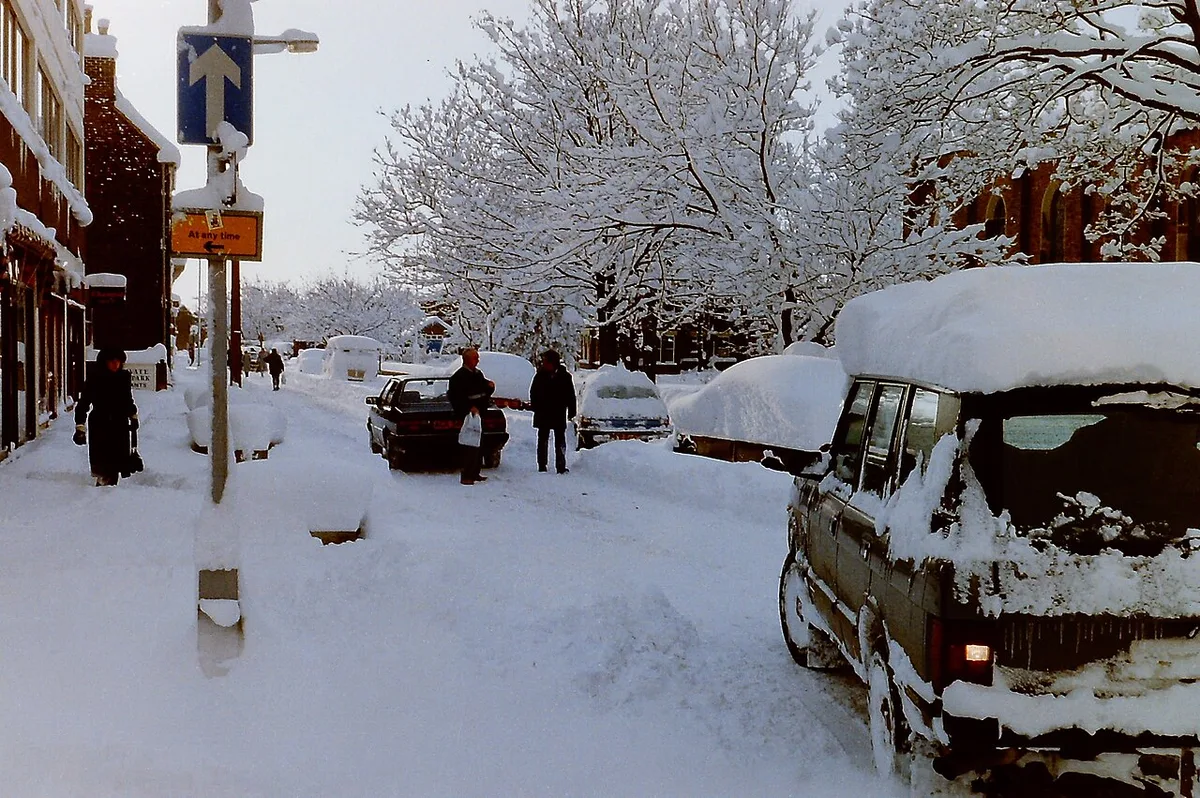
Image source: Wikimedia Commons / pjlcsmith2 (CC BY)
The winter idle routine that keeps you safe
| Step | Why it matters |
|---|---|
| Dig out the tailpipe before every restart | Drifts rebuild in minutes, not hours |
| Crack a downwind window about an inch | Gives any leaking vapor a path out |
| Idle 10 to 15 minutes per hour | The cabin holds heat between runs |
| Recheck the pipe between runs | Blowing snow fills it back in |
| Clear the base of the windshield | That's where the cabin draws fresh air |
Run the engine in intervals, not continuously. Ten to fifteen minutes per hour keeps the cabin habitable while limiting your exposure window and saving fuel. Between runs, get out and look at the pipe again if snow is still falling or drifting.
Never idle against a snowbank or a wall. The physics are the same as a buried pipe, because the exhaust swirls straight back at the car. A garage goes without saying.
It's never an option.
Symptoms that mean shut it down now
- Headache that builds while the engine runs
- Dizziness or lightheadedness
- Nausea or vomiting
- Confusion, or someone drifting off unusually hard
- Feeling flu-like without any fever
If anyone shows these signs, kill the engine and get everyone into fresh air. Call 911 rather than toughing it out. CO binds to red blood cells and clears slowly, so crews treat exposure seriously even after you feel better outside.
One more winter habit worth adopting: a compact CO alarm made for travel and camping runs $25 to $50. For anyone who drives rural routes through snow country, one in the glovebox is cheap insurance.
Your Three Ways Out: Roadside Assistance, Fuel Delivery, or a Gas Can
Once you're safely parked, the fuel problem usually has three fixes: a roadside plan, a delivery service, or a can someone brings you. Pick based on your situation, not on impatience. In a bad spot, waiting cleanly beats improvising badly.
Roadside assistance you may already be paying for
Start with your auto insurance. A large share of full-coverage policies carry a roadside rider, often just a few dollars a year, and fuel delivery is almost always on the covered list. The number lives in your insurer's app or on the back of your insurance card.
Newer vehicles often have automaker roadside plans too. Coverage runs anywhere from two years to a decade depending on the brand, and it stays with the vehicle, not the owner. The owner's manual spells out what's included and for how long.
Motor clubs like AAA run roughly $60 to $100 a year for a basic tier. Some credit cards and even cell phone plans bundle roadside perks as well. Check what you already have before you pay twice.
One thing to expect: most plans deliver 1 to 2 gallons of regular unleaded. That's enough to reach a station, not a fill-up.
Fuel delivery services and apps
Bigger metros have on-demand fuel delivery apps that bring a top-up to your exact spot. Coverage thins out in the suburbs and disappears in rural counties, and some services only carry regular gasoline. If your insurer has an app, its roadside button usually transmits your location, which beats reading a mile marker over the phone.
In rural areas, calling the nearest station directly sometimes works. Small-town stations have been known to run a can out for a fee. Asking costs nothing.
Having someone bring you a gas can
This is often the fastest fix in a metro area. Send your rescuer clear instructions rather than good intentions. They need an approved can, at least 2 gallons, and the correct fuel type for your car.
Stations sell cans at a markup, but price stops mattering at this point. Have them fill the can on the ground, cap it tight, and stand it upright for the drive back.
Side-by-side: speed, cost, and best-fit situations
| Option | Typical wait | Typical cost | Best fit |
|---|---|---|---|
| Insurance roadside rider | 45 to 90 minutes | Usually $0 | Highway shoulders, night, weather |
| Automaker plan | 45 to 90 minutes | Included with the vehicle | Cars still inside the coverage window |
| Motor club | 45 to 90 minutes | Membership fee | Drivers without an insurance rider |
| Fuel delivery app | 20 to 60 minutes | $5 to $20 over pump price | Metro areas in mild conditions |
| Friend with a can | Depends on distance | Fuel plus the can | Daylight, safe spot, close to home |
| Tow to a station | Under an hour | $75 to $150 hook fee plus mileage | Only if you suspect pump damage |
If you're on a high-speed shoulder, wait for the service that comes to you. If you're on a quiet surface street in daylight, a friend with a can wins on speed. A tow almost never makes sense for an empty tank, since every option above costs less than the hook fee.
Bringing Gas Back Yourself: Approved Cans, Static Electricity, and Transport Rules
Maybe you walked a safe surface street to the station, or maybe someone is bringing the can back to you. Either way, the same rules apply from pump to fuel door. Get them right and this whole detour ends in twenty minutes.
Image source: Wikimedia Commons / Robotanks (CC BY-SA)
What counts as an approved container
Buy a proper portable fuel container. That means a plastic or metal can with a flame arrestor, a spill-resistant spout, and a child-resistant cap. The Children's Gasoline Burn Prevention Act has required those child-resistant caps on new cans sold in the US since 2009.
Never use a glass jug, a milk jug, or a bucket. They fail on spill control and static grounding immediately, and station attendants can and will shut the pump off.
Skip the 1 gallon can and get at least 2 gallons. Fuel sloshes to one side on any grade, and the pump pickup can sit above a single gallon.
Static electricity: the part people skip
Gasoline vapors ignite at everyday temperatures. The flash point sits around minus 45 degrees Fahrenheit, which means the vapor above the liquid is always ready to light. A static discharge at the fill point is how it happens.
- Set the can on the pavement before filling, never inside the truck bed.
- A plastic bed liner insulates the can, so any charge it carries can't bleed off. Ground it on actual ground.
- Keep the nozzle in contact with the can while filling.
- Don't slide back into your vehicle mid-fill. Re-entering builds a fresh static charge on your clothes, and it discharges the moment you touch the nozzle.
Transport rules for the drive back
- Cap tight, can upright, wedged or strapped so it can't tip over.
- Trunk or truck bed only. Never the passenger cabin, especially with kids aboard.
- If the bed is shut under a latched bed cover, leave it cracked open so vapors don't pool.
- No smoking, no open flames, nothing hot near the can.
- Wash your hands when you're done. Soap, not a wipe on your jeans.
Fuel quality, fuel type, and siphoning
Check the age of whatever fuel you're pouring. Untreated gasoline keeps for 3 to 6 months, and a can that wintered in a shed may carry water or varnish. Fuel stabilizer extends that toward a year, but it goes in when you store the can, not when you pour it.
Octane hardly matters in an emergency. Regular 87 runs fine in most cars, and a premium-only engine will burn a gallon of regular for a few miles without complaint. The knock sensors pull timing and the computer compensates.
Don't make a habit of it, but don't panic over it either.
The mistake that actually costs money is a fuel mix-up. Gasoline in a diesel tank is far worse than diesel in a gasoline tank. A modern diesel runs a high-pressure common-rail injection pump lubricated by the fuel itself.
Gasoline strips that lubrication and can destroy the pump in minutes of running.
If you own a diesel, say the word "diesel" out loud when you hand someone a can. Better still, write it on a strip of tape and stick it to the can. Borrowed cans cause more misfuels than pumps do.
Don't siphon by mouth, ever
Some people still suggest sucking fuel out of a lawn mower or a second car with a hose. Skip it entirely. Gasoline contains benzene, a known carcinogen, and a mouthful pulled into the lungs causes chemical pneumonitis, which is a hospital visit with imaging and observation.
There's also no need. Approved cans cost less than a copay, and a hand pump siphon runs about $15. If you must move fuel between containers, use a pump and keep your mouth out of the loop.
Pouring it in without making a mess
Set the can on the ground next to the car, not on the trunk lid. Use the spout's built-in vent or a wide funnel so the flow stays steady. Stop when the nozzle clicks or when you hit your 2 gallon mark.
Spilled gas on paint is a real problem. Wipe it off immediately with a damp cloth and rinse the panel with water. Gasoline softens clear coat fast, and a splash left sitting in the sun can leave a permanent stain.
Cap the can tight, stow it outside the cabin, and get back in the car. Then wash your hands before you touch your phone or your face.
Restarting the Car After the Tank Ran Dry
Pouring fuel in is half the job. The other half is getting the fuel from the tank to the engine, and that takes a specific sequence on most modern cars.
The key-on prime cycle
Your fuel system is sealed and pressurized. When the tank went dry, the pump pulled air instead of liquid, and the line lost its prime. Refilling the tank doesn't fix that on its own.
Here's the routine that works on the vast majority of fuel-injected cars.
- Add at least 2 gallons. One gallon may not be enough to submerge the pump pickup.
- Turn the key to ON, or press the start button without your foot on the brake. Don't crank.
- Listen for the fuel pump. That two second hum from the rear of the car is the pump priming the line.
- Turn the key back to OFF and wait a few seconds.
- Repeat the ON and OFF cycle three or four times.
- Now crank the engine normally. Give it 5 to 10 seconds of steady cranking before you pause.
On some cars, the pump only runs while the starter is turning. If the cycle above does nothing, go straight to cranking in 10 second bursts with a 30 second cool-down between attempts. Starter motors get hot fast.
Why it cranks longer than usual
Air in the fuel rail and the lines has to be pushed out before the injectors see liquid. That takes a few revolutions, sometimes more. Five to twenty seconds of cranking after a dry tank is normal.
A few things make it worse. A nearly dead battery after sitting with the hazards on. A clogged fuel filter that was already marginal.
Cold weather, which thickens the fuel and slows cranking speed.
If the car sputters, catches, and dies, you're close. Cycle the key once more and try again. Those little catches mean fuel is arriving.
When to stop cranking and call for a tow
Stop after about four or five attempts. Continuing past that point risks cooking the starter and draining the battery, and you'll be in a worse spot than when you started.
Call for a tow if the car cranks hard but never fires, if you hear no pump hum at all, or if the car started fine before this and something else feels wrong. A fuel pump that was already weak often picks this moment to quit for good.
Diesel vehicles need more than a splash
Diesel is a different animal. Running a diesel dry pulls air into the high-pressure side, and the system won't self-bleed the way a gasoline system does. Many modern diesels need a manual priming sequence, and some need a scan tool to command the lift pump.
Your owner's manual will spell out the bleed procedure for your exact engine. If it involves cracking injector lines, that's a job for someone with tools and gloves. Don't guess at it on a shoulder in the dark.
For a diesel, the smarter call is usually a tow to a shop. The fuel cost is the same either way. The difference is whether you add a wrecked injection pump to the bill.
Did Running Out of Gas Damage Your Fuel Pump?
Sometimes, yes. Usually no. The honest answer depends on how dry it ran, how often, and how healthy the pump was before.
One empty tank on a 40,000 mile car rarely kills anything.
What dry running does inside the tank
The in-tank electric pump is cooled and lubricated by the fuel around it. Gasoline carries heat away from the motor windings. With the tank empty, the pump spins in vapor, and internal temperatures climb.
That heat degrades the brushes and the plastic impeller over time. It also accelerates wear on the pump bushing. None of this fails instantly.
It shows up months later as a pump that whines, stutters, or quits on a hot day.
There's a second issue that gets missed. Sediment and water settle at the bottom of a tank. Running to empty stirs that layer up and sends it through the filter and the pump strainer.
That's why some cars run rough for a few miles after a dry-out.
Signs the pump is on its way out
- A high-pitched whine or hum from the rear of the car that changes with throttle.
- Long crank times before the engine catches, especially when cold.
- Power loss or surging under hard acceleration.
- The engine dying at speed, then restarting after a cool-down.
- Intermittent no-starts that seem to fix themselves.
If you notice two or more of those, get the fuel pressure tested. An OBD2 scanner can pull fuel trim and misfire codes that point in the same direction, though it won't read pressure directly. A shop gauge on the fuel rail is the real test.
What a replacement actually costs
| Vehicle type | Typical parts cost | Typical out-of-pocket total |
|---|---|---|
| Compact sedan | $150 to $400 | $450 to $800 |
| Midsize SUV | $200 to $500 | $600 to $1,000 |
| Full-size truck | $250 to $600 | $700 to $1,200 |
| Diesel pickup | $400 to $900 | $1,000 to $1,800 |
The labor is the expensive half, because the tank usually has to come down. Some vehicles have an access panel under the rear seat. Most don't.
Weigh that against the cost of running to empty on purpose to save time. It's a bad trade. Filling at a quarter tank costs you nothing and keeps the pump submerged, cool, and quiet.
One related habit worth knowing: a hard-starting car after a refuel isn't always a fuel problem. If the engine cranks fine but won't catch, and you've already primed the system, a spark or fuel delivery fault is the next thing to check. Starting fluid down the intake is a diagnostic tool people misuse badly, and it should never be sprayed into a modern engine while cranking if you don't know what you're doing.
Mistakes That Turn an Empty Tank Into an Emergency
An empty tank is an inconvenience. What follows is the short list of moves that turn it into a crash, a citation, or a hospital bill. We pulled these from crash reporting patterns and roadside safety guidance rather than guesswork.
| Mistake | What actually happens | Do this instead |
|---|---|---|
| Staying in a live lane to "think" | Traffic closes at 70 mph with no warning | Get out on the far side and call 911 |
| Standing at the rear bumper to wave help down | That's the impact zone in a rear-end hit | Stand behind a barrier, well off the pavement |
| Piling everyone out on the traffic side | Kids and pets step into the lane | Exit the passenger side, away from traffic |
| Coasting in neutral to stretch the roll | You lose engine braking and steering feel | Coast in gear, brake early and firmly |
| Leaving hazards off to save the battery | A dark car on a shoulder is invisible at dusk | Hazards on, hood up, triangles out |
| Pouring fuel with the engine hot | Vapor near a hot exhaust is a fire risk | Let it cool, pour slowly, no smoking |
| Using the crusty can from the shed | Water and varnish foul the injectors | Buy fresh fuel in an approved can |
| Handing your keys to a helpful stranger | You lose control of your own vehicle | Keep the keys, call your own service |
Leaving the car in a live lane while you decide
Every second you sit in a travel lane is a second someone behind you is closing fast. If the car will roll even a few feet, roll it. If it won't, that's the 911 call we covered earlier.
Don't start diagnosing the problem in the lane. Don't open the hood in the lane. Don't stand at the driver's door with traffic passing your hip.
Standing at the back bumper to flag people down
This is the single most lethal habit on the list. A driver focused on the lane ahead sees your car late. They swerve, and the space they swerve into is exactly where you're standing.
Put steel or concrete between you and moving traffic. A guardrail works. A ditch works.
Distance works.
Letting everyone out on the traffic side
The instinct is to open the nearest door. On a right shoulder, that door faces the lane. Get everyone out the passenger side, and carry small kids rather than letting them walk the shoulder.
Leash the dog before you open anything. A frightened animal on a highway shoulder is a second emergency.
Killing the battery while you wait
Hazards, cabin lights, a phone charger, and the radio can flatten a marginal battery in two to three hours. Then you're stuck for a jump as well as fuel.
Run the engine briefly if you can do it safely, charge your phone in short bursts, and keep the interior lights off. A portable jump pack in the trunk solves this permanently for about $60 to $120.
Pouring fuel with the engine hot or running
Let the engine cool before you pour. Vapor around a hot exhaust manifold or a hot catalytic converter is the ignition source nobody plans for, and a splash on a hot pipe can flash.
Engine off, no smoking, no phone in your hand at the fill point. Nothing hot anywhere near the can.
Assuming the can in your garage is still good
Untreated gasoline degrades in 3 to 6 months. Ethanol blends pull moisture out of humid air, which is why old fuel sometimes looks cloudy or smells flat. That stuff will start a lawn mower badly and a fuel-injected car worse.
Rotate your emergency can. Pour it into the car once or twice a year and refill it fresh.
Refusing a tow when the evidence says you need one
If the car cranks hard and never fires, or you hear no pump hum at all, a fuel top-off won't save you. Every extra hour on the shoulder adds risk without adding a fix.
Take the tow. A $120 hook fee is the cheapest possible version of that day.
Rough Scenarios: Blizzard, Night, No Signal, Kids in the Car
The core playbook holds in every scenario. What changes is the order of operations and how fast the risk climbs. Here's how each condition reshapes the decision.
Winter storms and whiteouts
Cold turns a wait into a survival problem, and visibility turns your car into a target. Both push you toward calling 911 early rather than late.
Run the engine in intervals only, and clear the tailpipe before each run. Keep a window cracked on the downwind side. Insulate with what's in the car: floor mats, jackets, a blanket, even cardboard.
Move into the passenger footwell if the cold wins. It's the smallest volume of air to keep warm. Signal for help with a bright cloth tied to the door handle or antenna, and keep the dome light on at night while you're awake.
Don't wander off to find a farmhouse. Whiteout disorientation is real, and people die within a few hundred yards of their own vehicle.
Nighttime breakdowns
Darkness doubles the danger because drivers judge distance by headlights, not by shape. Your car reads as a shadow until it's far too late.
Get the hazards on before anything else. Set triangles or an LED flare out behind you, walking away from traffic the whole time. A reflective vest within reach of the driver's seat is worth more at 2 a.m. than any other item in your kit.
If you're on an unlit rural two-lane, call 911 rather than a roadside line. Dispatchers can send a patrol car to sit with you, and its light bar is the most visible thing on the road.
Dead zones: stranded with no cell signal
No bars doesn't mean no options. It means you work through them in order.
- Send a text anyway. Texts sometimes squeeze through on a weak signal when calls fail.
- Walk 50 to 100 feet to higher ground, still staying off the pavement.
- Use offline maps. Downloading your region before a trip means the app still shows your position without data.
- Note your mile marker or exit number on paper so a passing motorist or trooper can relay it.
- Wait for a state courtesy patrol or motorist assist vehicle, which run on many urban interstates.
If someone stops and offers to call for you, give them the highway number, direction, mile marker, and your plate color. Don't get in their car.
Desert and extreme heat
Heat is the killer here, and the clock runs faster than people expect. A parked car in full sun can hit 130 degrees Fahrenheit inside within an hour, per CDC heat safety guidance.
Get shade if any exists. Otherwise crack the windows, drink water steadily, and wet a cloth for your neck and wrists. Never leave a child or pet in the car, even briefly, even with the windows down.
If you're low on water and it's midday, stay put and stay quiet. Walking in desert heat with no water is a fatal decision more often than a delayed one.
Driving with children or pets aboard
Kids change the math on every decision. Their heat tolerance is lower, their impulse control is worse, and a shoulder is not a place for them to stretch their legs.
Buckle them in, keep them calm, and give them a job so they feel useful instead of scared. Keep pets leashed or crated. Never let a child walk to the guardrail alone, and never send one to flag down help.
If a child shows signs of heat illness, confusion, or extreme lethargy, skip roadside assistance entirely and call 911. That's a medical call now.
Making Sure It Never Happens Again: Kit, Coverage, and Fuel Habits
Most stranded drivers had a warning light and a plan to stop "at the next one." Closing that gap takes one afternoon of setup and a habit change that costs nothing.
The kit that earns its trunk space
You don't need a full overlanding setup. You need the handful of items that change the outcome of this specific event.
| Item | Why it's on the list | Typical cost |
|---|---|---|
| Approved 2 gallon fuel can | Turns a tow into a twenty minute fix | $15 to $35 |
| LED road flares or triangles | Makes the car visible without fire risk | $15 to $30 |
| Reflective vest | The cheapest life insurance you'll ever buy | $8 to $15 |
| Jumper pack | Solves the dead battery that follows | $60 to $120 |
| Folding shovel | Digs out a snow-packed tailpipe | $20 to $40 |
| Blanket and warm layers | Buys hours in cold weather | $20 to $50 |
| Water and shelf-stable snacks | Essential in heat, useful always | $10 to $20 |
| Paper and marker | Writes your mile marker for a passerby | Under $5 |
| Portable CO alarm | Catches a buried exhaust before you do | $25 to $50 |
Store the vest and the flares where you can reach them from the driver's seat. A kit buried under luggage is a kit you won't use.
Audit the coverage you already have
Before you buy anything, find out what's already bundled. A surprising number of drivers pay for roadside twice.
- Check your auto policy declarations page for a roadside rider.
- Check your owner's manual or the automaker app for included assistance.
- Check your credit card benefits for roadside perks.
- Check whether a motor club membership is already in the household.
Write the roadside number on a card and keep it in the glovebox. When you're rattled on a shoulder, digging through an app store is the last thing you want to do.
Fuel habits that end the problem
The fix is boring and it works. Fill at a quarter tank, not at the light. That keeps the in-tank pump submerged and cool and leaves you a real buffer for the day a station is closed or a detour eats 30 miles.
Before long rural stretches, top off even at half a tank. On mountain grades and in headwinds, plan fuel stops around the terrain, not around your usual routine. If you tow, expect a third less range and plan accordingly.
If you regularly drive unlit rural roads, better auxiliary lighting is a genuine safety upgrade rather than a cosmetic one. Being seen early matters more than seeing early.
Two phone settings worth turning on today
Set up your emergency contacts and medical ID so they're reachable from the lock screen. Then download offline maps for the regions you drive through most. Both take under five minutes and both pay off on the day the signal drops.
Frequently Asked Questions
Can roadside assistance bring me gas for free?
Often, yes. Many full-coverage auto policies and motor club memberships include fuel delivery at no extra charge beyond the fuel itself. Automaker programs frequently cover it during the warranty window.
You'll usually get 1 to 2 gallons of regular unleaded, enough to reach a station. Check your policy declarations page and owner's manual before paying out of pocket.
How far can I really drive once the fuel light comes on?
Most cars have 1 to 2 gallons left, which is roughly 25 to 50 miles at highway pace. Larger SUVs and pickups often hold closer to 2.5 gallons. Cut that estimate in half if you're towing, climbing, driving into a headwind, or running the heater in freezing weather.
Your owner's manual gives the exact figure for your model.
Is it actually bad for your car to run out of gas?
One empty tank rarely causes damage. The problem is the in-tank electric fuel pump, which is cooled and lubricated by the fuel around it. Running dry lets it spin hot, and repeated dry running shortens its life.
It also stirs up settled sediment. Replacements run roughly $400 to $1,000 with labor, so habitually driving to zero is an expensive shortcut.
Can I legally walk on the interstate to get gas?
In nearly every US state, no. Pedestrians are prohibited on interstate highways, with narrow exceptions for genuine emergencies. A trooper who spots you will stop you, and you'll trade a wait for a citation.
Walking a surface street with a sidewalk in daylight is a different matter. Walking a highway shoulder never is.
Why won't my car start after I just put gas in?
Air in the fuel lines and rail has to be pushed out before the injectors see liquid. Cycle the key to ON and back to OFF three or four times, listening for the pump's two second hum, then crank in 10 second bursts. Five to twenty seconds of cranking is normal after a dry tank.
Stop after four or five attempts.
Do diesel vehicles need more than fuel after running dry?
Yes, and it's a bigger job. A diesel that runs dry pulls air into the high-pressure side, and the system won't self-bleed the way a gasoline system does. Many modern diesels need a manual priming sequence, and some need a scan tool.
Check your owner's manual. If the procedure involves cracking injector lines, that's a tow to a shop.
The Bottom Line: Stay Put, Be Visible, Call for Help
The whole playbook fits on an index card. Steer off the pavement. Wheels turned away from traffic.
Hazards on, hood up. Seatbelt on, doors locked, phone in hand.
Call 911 if the car is blocking a lane, if anyone is hurt, or if the weather is genuinely dangerous. Call your insurer or motor club for the ordinary version. Stay near the vehicle and stay behind a barrier if you get out.
Never walk the shoulder of a highway. Never accept a ride from a stranger. Never idle with a buried exhaust.
Then get fuel in it, prime the system with a few key cycles, and drive to the nearest station. Fill it properly this time. The twenty minutes you save by skipping a stop is the most expensive twenty minutes on the road.
